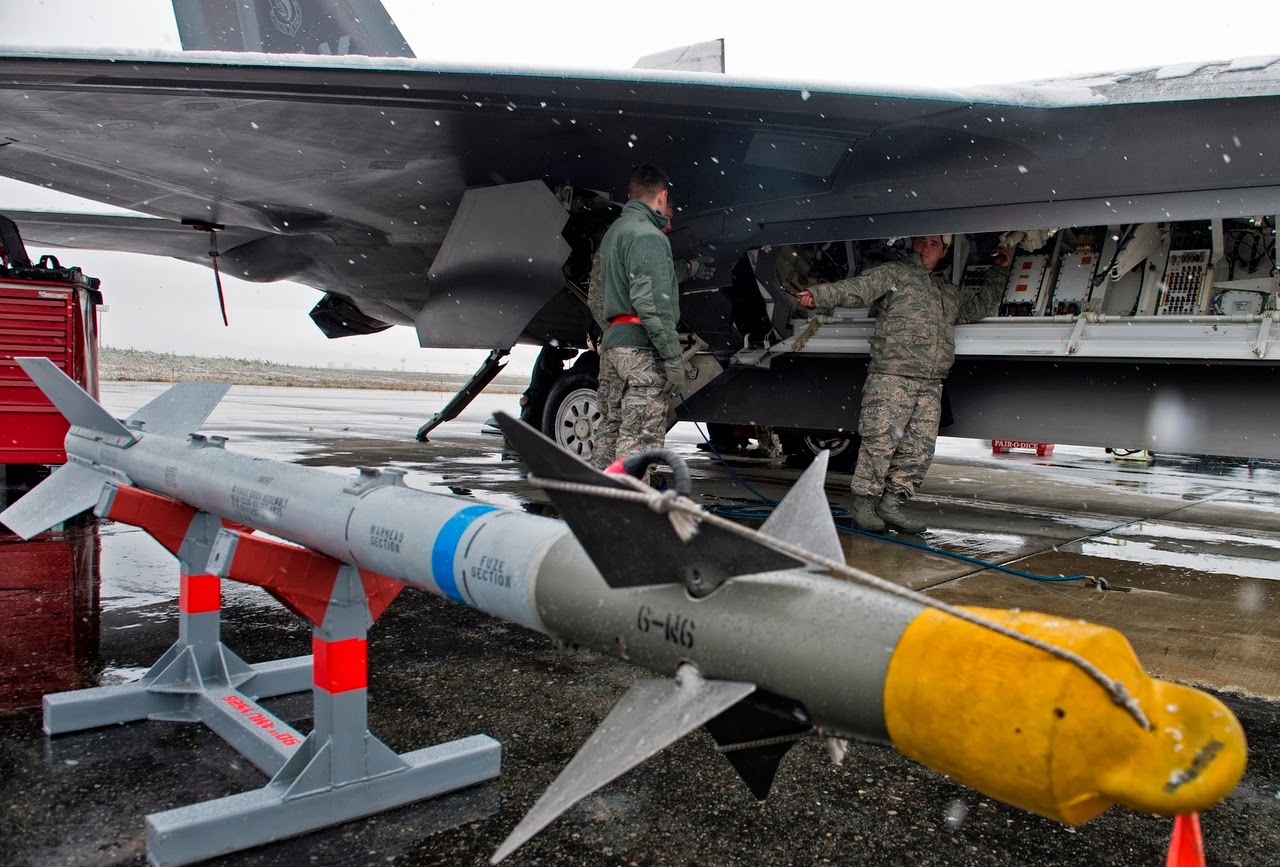
Comprehensive Overview of F-22 Raptor Missile Systems and Armament Integration
The F-22 Raptor utilizes a sophisticated suite of air-to-air missiles, primarily the AIM-120D AMRAAM for beyond-visual-range engagements and the AIM-9X Sidewinder for close-quarters dogfighting. These weapons are housed in internal bay...
The F-22 Raptor utilizes a sophisticated suite of air-to-air missiles, primarily the AIM-120D AMRAAM for beyond-visual-range engagements and the AIM-9X Sidewinder for close-quarters dogfighting. These weapons are housed in internal bays to preserve the aircraft's stealth profile, utilizing high-speed hydraulic launchers to eject ordnance into the airstream.
Contents
The Architecture of Stealth: Internal Weapon Bays
The Lockheed Martin F-22 Raptor is defined by its ability to engage the enemy before being detected. Unlike 4th-generation fighters that carry missiles on external wing pylons, the F-22 carries its primary armament internally. This design is critical for maintaining a low Radar Cross Section (RCS). When missiles are hung externally, their metallic skins and complex shapes reflect radar waves, making the aircraft visible to enemy sensors from hundreds of miles away.
The Raptor features four internal bays: two lateral (side) bays and one large ventral (main) bay. The side bays are designed specifically for short-range heat-seeking missiles, while the main bay is configured for long-range radar-guided missiles or air-to-ground munitions. The mechanical complexity of these bays is immense; they must open, eject the missile, and close within seconds to minimize the time the aircraft’s RCS is compromised.
In 2026, as peer-adversary radar technology continues to evolve, the F-22’s internal carriage remains its most significant tactical advantage. The aircraft can cruise at supersonic speeds (supercruise) without the aerodynamic drag associated with external munitions, allowing it to reach the "launch envelope"—the optimal position for a high-probability kill—faster and more efficiently than its predecessors.
Beyond-Visual-Range Dominance: The AIM-120 AMRAAM
The backbone of the F-22’s air-superiority mission is the AIM-120 Advanced Medium-Range Air-to-Air Missile (AMRAAM). Specifically, the F-22 utilizes the AIM-120C and the more advanced AIM-120D variants. The main weapon bay can accommodate up to six of these missiles, arranged in a staggered configuration to maximize space.
AIM-120D Capabilities and Integration
The AIM-120D represents a significant leap in lethality over earlier iterations. It features a two-way data link, allowing the F-22 to provide mid-course updates to the missile while it is in flight. This is crucial for engaging maneuvering targets at long distances. Furthermore, the AIM-120D incorporates GPS-aided navigation and an improved "no-escape zone," which refers to the area where a target cannot outmaneuver the missile regardless of its defensive actions.
One of the F-22's unique strengths is its ability to "loft" the AMRAAM. By launching from high altitudes and high speeds, the Raptor imparts additional kinetic energy to the missile, extending its effective range significantly beyond what a non-stealth fighter could achieve. In the 2026 operational environment, this capability allows the F-22 to strike enemy "high-value airborne assets," such as AWACS or tankers, while remaining outside the range of enemy defensive fire.
The LAU-142/A AME Ejector
To deploy the AMRAAM from the main bay, the F-22 uses the LAU-142/A Abbreviated Munitions Ejector (AME). This is not a simple gravity drop; the AME is a highly sophisticated hydraulic-pneumatic system that forcibly punches the missile away from the aircraft. This ensures that the missile clears the aircraft's boundary layer—the turbulent air hugging the fuselage—even at supersonic speeds, preventing the missile from tumbling or colliding with the airframe upon release.
Within-Visual-Range Lethality: The AIM-9X Sidewinder
For close-in engagements, the F-22 relies on the AIM-9X Sidewinder. Two of these missiles are carried in the side bays, one on each side of the intake ducts. The AIM-9X is an imaging infrared (IIR) missile, meaning it "sees" the thermal signature of the target rather than just tracking a heat point.
Side Bay Mechanics
The side bays of the F-22 are engineering marvels. When a pilot selects a Sidewinder, the bay door hinges open, and a trapeze mechanism extends the missile’s seeker head into the airstream. This allows the missile to "lock-on" to a target's heat signature before it is even launched. Once a lock is achieved and the pilot fires, the missile ignites and clears the rail instantly.
High Off-Boresight (HOBS) Performance
The AIM-9X Block II, currently standard in 2026, features High Off-Boresight capabilities. When paired with the F-22’s upgraded Scorpion Helmet Mounted Cueing System (HMCS), the pilot can lock onto an enemy aircraft simply by looking at it, even if the target is significantly off the aircraft's nose. The missile's thrust-vectoring nozzle allows it to perform extreme maneuvers immediately after launch, turning nearly 180 degrees if necessary to intercept a target.
Next-Generation Integration: The AIM-260 JATM
As of 2026, the F-22 fleet has begun the transition toward integrating the AIM-260 Joint Air Tactical Missile (JATM). Developed to counter long-range threats like the Chinese PL-15, the AIM-260 is designed to fit within the F-22’s internal bays while offering a range that far exceeds the AIM-120D.
The JATM is a response to the "range gap" that emerged in the early 2020s. By maintaining the same form factor as the AMRAAM but utilizing a more efficient motor and a multi-mode seeker, the AIM-260 ensures the F-22 remains relevant against modern adversarial tactics. The integration of the AIM-260 is handled via software updates to the F-22’s mission computers, allowing the jet to leverage its AN/APG-77(V)1 AESA radar to guide these long-range weapons with pinpoint accuracy.
Technical Specifications of F-22 Missile Armament
The following table summarizes the primary missile systems currently utilized by the F-22 Raptor in 2026.
| Missile System | Primary Role | Range Category | Guidance System | Bay Location |
|---|---|---|---|---|
| AIM-120D AMRAAM | Air Superiority | Beyond Visual Range (BVR) | Active Radar / Data Link | Main Internal Bay |
| AIM-9X Sidewinder | Dogfighting | Within Visual Range (WVR) | Imaging Infrared (IIR) | Side Internal Bays |
| AIM-260 JATM | Long-Range Intercept | Extended BVR | Multi-Mode Seeker | Main Internal Bay |
| AIM-120C-7 | Air Superiority | BVR | Active Radar | Main Internal Bay |
Tactical Employment and Sensor Fusion
The effectiveness of the F-22’s missiles is not just a function of the ordnance themselves, but of the aircraft's sensor fusion. The F-22's mission computer aggregates data from the radar, the ALR-94 electronic warfare suite, and the Infrared Search and Track (IRST) sensors to create a single, unified picture of the battlespace.
Stealthy Target Acquisition
When engaging a target with an AIM-120D, the F-22 often does not need to "paint" the target with its own radar until the final seconds of the missile's flight. The Raptor can receive targeting data via Link 16 or the Intra-Flight Data Link (IFDL) from other Raptors or stealth assets like the F-35. This allows a "silent" launch, where the enemy has no warning that a missile is inbound until the missile's own active seeker turns on in the "terminal" phase of flight.
Loadout Versatility
While the primary focus is air-to-air, the F-22 can also carry "missile-like" precision-guided munitions for ground attack, such as the GBU-39 Small Diameter Bomb (SDB). In a "swing-role" configuration, a Raptor might carry two AIM-120s and two AIM-9s alongside eight SDBs. This versatility ensures that the F-22 can neutralize mobile surface-to-air missile (SAM) sites that might threaten its ability to maintain air dominance.
Maintenance and Operational Challenges
Maintaining the missile systems on the F-22 requires specialized training and equipment. The internal bays are confined spaces, and the LAU-142/A ejectors require precise calibration to ensure the timing of the bay doors and the ejector stroke are perfectly synchronized.
- Low Observable (LO) Maintenance: Every time a bay door is opened for maintenance, technicians must ensure that the seals and coatings are intact. Even a small gap or a chipped piece of radar-absorbent material (RAM) around the bay door can cause a "spike" in the aircraft's radar signature.
- Environmental Stress: Missiles stored internally are subjected to significant heat buildup from the aircraft's engines and electronics. The F-22's environmental control system (ECS) must actively cool the weapon bays to prevent the missile's sensitive electronics and rocket motors from degrading.
- Hydraulic Systems: The high-speed actuation of the bay doors and launchers relies on high-pressure hydraulics. In 2026, regular inspections of these systems are mandatory to prevent leaks that could lead to a catastrophic failure during a supersonic launch.
Common Myths Regarding F-22 Armament
There are several misconceptions regarding the F-22's missile capabilities that deserve clarification. One common myth is that the F-22 cannot carry external weapons. In reality, the Raptor has four under-wing hardpoints. However, these are typically only used for ferry flights or in "permissive environments" where stealth is not required, as external tanks or missiles significantly increase the RCS.
Another misconception is that the F-22 is "outgunned" by newer fighters with more missile stations. While some aircraft can carry 10 or 12 missiles, the F-22’s superior stealth and sensor suite mean it can dictate the terms of the engagement, often killing the enemy before they are even aware of the Raptor's presence, thus requiring fewer shots to achieve mission success.
Frequently Asked Questions
How many missiles can the F-22 carry in a stealth configuration?
In a standard air-dominance configuration, the F-22 carries eight missiles internally: six AIM-120 AMRAAMs in the main bay and two AIM-9 Sidewinders in the side bays. This allows the aircraft to engage multiple targets while remaining nearly invisible to radar.
Can the F-22 fire missiles while flying faster than the speed of sound?
Yes, the F-22 is specifically designed to launch missiles at supersonic speeds. The LAU-142/A hydraulic ejector system provides the necessary force to push the missile through the turbulent air of the boundary layer, ensuring a safe and stable launch during supercruise.
Is the AIM-260 JATM currently in use on the F-22?
As of 2026, the AIM-260 JATM is being actively integrated into the F-22 fleet. It is intended to eventually replace the AIM-120 as the primary long-range interceptor to counter advanced threats from peer adversaries.
Why doesn't the F-22 carry more than two Sidewinders?
The side bays are physically limited in size to maintain the aerodynamic and stealth profile of the aircraft. While the F-22 is a formidable dogfighter, its primary doctrine emphasizes "First Look, First Shot, First Kill" at long ranges, reducing the need for a large number of short-range missiles.
Does the F-22 use a helmet-mounted display for missile targeting?
Yes, following the Block 30/35 upgrades, the F-22 utilizes the Scorpion Helmet Mounted Cueing System. This allows pilots to direct the seeker head of the AIM-9X Sidewinder toward a target simply by looking at it, providing a massive advantage in close-range maneuvers.
Final Recommendations for Technical Review
For researchers or defense analysts looking to understand the F-22's offensive capabilities in 2026, it is essential to monitor the ongoing Small Diameter Bomb (SDB) II integration and the software "Spiral" updates. These updates continue to refine the logic between the radar and the AIM-120D, further increasing the probability of kill (Pk) against low-RCS targets like enemy stealth drones. To stay informed on the latest developments, consult official Air Force Fact Sheets and Lockheed Martin’s annual program updates.
Image Gallery