The Most Expensive Cards Sold and the Mechanics of Their Multi-Million Dollar Value
The most expensive cards ever sold reach multi-million dollar valuations through a convergence of extreme scarcity, pristine physical condition, and historical significance. As of 2026, the market for trading cards has matured into a s...
The most expensive cards ever sold reach multi-million dollar valuations through a convergence of extreme scarcity, pristine physical condition, and historical significance. As of 2026, the market for trading cards has matured into a sophisticated alternative asset class, where iconic pieces like the T206 Honus Wagner and the 1952 Topps Mickey Mantle command prices between $7 million and $12.6 million due to their status as cultural artifacts and their limited "Pop Report" counts in high grades.
Contents
The Pillars of Card Valuation: Why They Cost So Much
To understand why a piece of cardboard can outperform gold or stocks, one must analyze the "Big Three" drivers of value: Scarcity, Condition, and Historical Narrative. In the high-end market, a card is rarely just a collectible; it is a financial instrument with a traceable pedigree.
1. Scarcity and the "Population Report"
In the world of professional grading, "Scarcity" is quantified through a Population Report (Pop Report). This is a public database maintained by grading companies like Professional Sports Authenticator (PSA) or Beckett Grading Services (BGS) that lists exactly how many copies of a specific card exist in every grade.
When a card is a "Pop 1" (the only one in its grade) or has a total known survival rate of fewer than 50 copies, the price floor vanishes. For example, the T206 Honus Wagner is famous because Wagner allegedly forced the American Tobacco Company to pull his card from production. Only about 50 to 60 copies are known to exist across all conditions, making any appearance at auction a global event.
2. The Grading Premium: The Move from 9 to 10
Condition is perhaps the most volatile factor in pricing. The difference between a "Mint 9" and a "Gem Mint 10" can represent a 500% to 1,000% increase in price. Professional graders examine cards under 10x magnification, looking for:
- Centering: The alignment of the image within the borders.
- Corners: Sharpness and lack of "whitening" or fraying.
- Edges: Smoothness and lack of chipping.
- Surface: Gloss, scratches, or printing defects.
In 2026, the "Condition Rarity" of vintage cards is the primary driver of record-breaking sales. Because most cards from the 1950s were handled by children, kept in rubber bands, or put in bicycle spokes, a "Gem Mint" 1952 Mickey Mantle is a statistical miracle.
3. Historical Narrative and Cultural Impact
A card's value is often tied to the legacy of the subject. A Michael Jordan rookie card isn't just a piece of paper; it represents the "Golden Era" of the NBA. Similarly, the 1-of-1 "The One Ring" card from Magic: The Gathering (MTG) carries value because of its unique tie to the lore of J.R.R. Tolkien’s The Lord of the Rings, creating a bridge between gaming history and literary history.
The Most Expensive Sports Cards in History
The sports card market remains the "Blue Chip" sector of the hobby. While modern cards (post-1980) occasionally see massive spikes based on player performance, vintage cards (pre-1980) act as stable stores of wealth.
1952 Topps Mickey Mantle #311 (SGC 9.5) - $12.6 Million
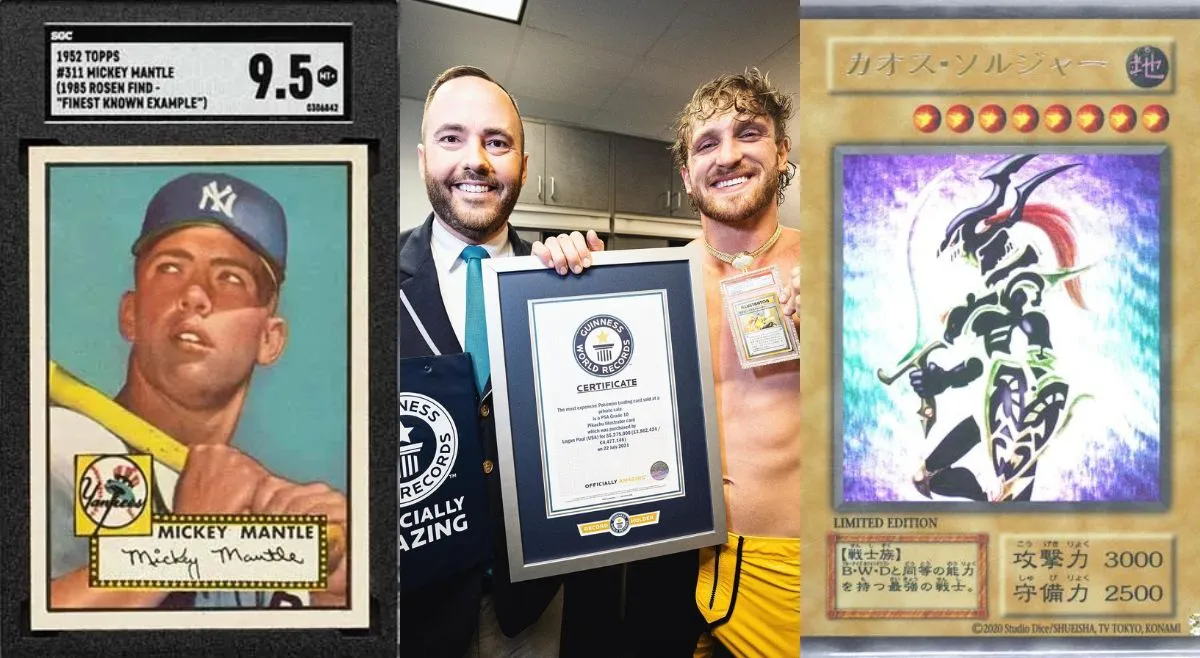
In late 2022, a 1952 Topps Mickey Mantle, graded an SGC 9.5 "Mint+," sold for $12.6 million, setting a record that has defined the market into 2026. This card is considered the "Holy Grail" of post-war baseball. Its value stems from its legendary origin story: Topps famously dumped thousands of unsold cases of the 1952 high-number series into the Atlantic Ocean in 1960 to clear warehouse space. This mass destruction created an artificial scarcity for the Mantle card that persists today.
T206 Honus Wagner - $7.25 Million
The T206 Honus Wagner is the most famous card in existence. Even in poor condition (PSA 1 or 2), this card consistently sells for over $1 million. The $7.25 million private sale recorded recently solidified its place as the ultimate blue-chip collectible. It represents the "Pre-War" era of tobacco cards, where players were depicted in lithographic art rather than photography.
Modern Era: Steph Curry and LeBron James
Modern cards rely on "RPAs" (Rookie Patch Autos). These cards include a piece of a jersey worn by the player and their authentic signature.
- 2009-10 Panini National Treasures Steph Curry (Logoman 1-of-1): Sold for $5.9 million.
- 2003-04 Upper Deck Exquisite Collection LeBron James RPA (/23): Has commanded prices upwards of $5.2 million. These cards are "manufactured rarities," meaning the company intentionally limited production to create immediate value.
Trading Card Games (TCG): Pokémon and Magic: The Gathering
The TCG market experienced a massive "institutionalization" between 2020 and 2026. What was once seen as a children's hobby is now a verified sector for high-net-worth individuals.
Pikachu Illustrator (PSA 10) - $5.275 Million
The most expensive Pokémon card ever sold is the Pikachu Illustrator. Unlike cards found in booster packs, this was a prize given to winners of an illustration contest in 1997-1998. Only 39 copies were originally distributed. The record-breaking PSA 10 copy was acquired by influencer Logan Paul in a trade-and-cash deal valued at over $5 million. The "Illustrator" is the only Pokémon card to break the $5 million barrier, largely because it is the only one with a "unique" status in a Grade 10.
Magic: The Gathering: The One Ring (1-of-1) - $2 Million+
In 2023, Wizards of the Coast released a single, one-of-a-kind "The One Ring" card. It was found by a retail worker in Canada and subsequently sold to the musician Post Malone for an estimated $2 million. This sale was a watershed moment for MTG, proving that a single card from a modern set could rival the "Power Nine" cards (like the Black Lotus) in value if the scarcity was absolute (1-of-1).
Comparison of Top Sales Across Categories
The following table compares the top cards based on verified sales and their defining characteristics.
| Card Name | Category | Highest Sale Price | Key Value Driver |
|---|---|---|---|
| 1952 Topps Mickey Mantle | Baseball | $12.6 Million | High-Grade (SGC 9.5), Post-War Grail |
| T206 Honus Wagner | Baseball | $7.25 Million | Historical Scarcity (Tobacco Card) |
| Steph Curry National Treasures | Basketball | $5.9 Million | 1-of-1 Logoman, Modern RPA |
| Pikachu Illustrator (PSA 10) | Pokémon | $5.275 Million | Contest Prize, Only Known PSA 10 |
| 1914 Baltimore News Babe Ruth | Baseball | $7.2 Million | Rookie Year, Pre-Major League |
| The One Ring (MTG) | TCG | $2.0 Million | 1-of-1 Manufactured Scarcity |
| 1993 Magic Alpha Black Lotus | TCG | $800,000+ | Game Utility & "Power Nine" History |
The Role of Professional Grading Services
Without third-party authentication, the high-end card market would collapse due to the risk of counterfeits and "trimmed" cards (cards that have been physically altered to look sharper). The three primary authorities are:
- PSA (Professional Sports Authenticator): The industry leader in volume. Their 1-10 scale is the global standard for resale value.
- BGS (Beckett Grading Services): Known for "Sub-grades" (Centering, Corners, Edges, Surface). A "BGS Black Label" (all 10s) is often considered the most prestigious modern grade.
- SGC (Sportscard Guaranty Corporation): Gained significant market share in the vintage baseball sector, particularly with the record-breaking Mickey Mantle sale.
Authentication provides "liquidity." A collector in London can buy a card from a seller in Tokyo with 100% confidence because the grading slab is tamper-proof and the certification number is verifiable online via PSA's official database.
Market Trends in 2026: The "New Normal"
By 2026, the market has transitioned from the speculative "gold rush" seen earlier in the decade to a more stable, data-driven environment. Several key shifts have occurred:
- Fractional Ownership: Companies like Rally and Collectable allow investors to buy "shares" of a million-dollar card. This has kept prices high by allowing the "crowd" to outbid individual billionaires.
- AI-Driven Grading: Grading companies now use high-resolution AI scanning to detect microscopic surface scratches that the human eye might miss, making "Gem Mint" grades even harder to achieve.
- Global Expansion: The interest in Pokémon and high-end soccer cards (Erling Haaland, Kylian Mbappé) in Europe and Asia has brought thousands of new high-net-worth collectors into the ecosystem.
FAQ: Understanding High-Value Cards
How do I know if my old cards are worth money?
Most cards from the "Junk Wax Era" (roughly 1987–1994) were overproduced and have little value. To have significant value, a card typically needs to be from before 1970, a highly limited modern "1-of-1" or "low-numbered" rookie card, or a rare promotional TCG card. Check the "Pop Report" on the PSA or Beckett websites to see how rare your specific card is in high grades.
Why is a 1-of-1 card more valuable than a vintage card?
A 1-of-1 card (like the Steph Curry Logoman) has a "supply of one," which creates a monopoly for the owner. While a vintage card might be more historically significant, a 1-of-1 creates a "ceiling-less" auction environment where two wealthy fans can drive the price to any height because there is no alternative copy to buy.
Does the condition really matter that much?
Yes. In many cases, a card graded a PSA 8 may be worth $500, while the same card in a PSA 10 could be worth $5,000 or more. Collectors pay a massive premium for perfection because "Gem Mint" copies represent the absolute best surviving example of that specific piece of history.
Is the card market a bubble?
While the 2020-2021 period saw "bubble-like" behavior, the 2026 market is supported by institutional transparency, insurance-backed valuations, and a global collector base. Like any asset, prices fluctuate, but the most expensive cards have historically acted as "Giffen goods"—items where demand remains high even as prices rise due to their status as Veblen goods.
Practical Recommendation for Collectors and Investors
If you are looking to enter the high-end card market, prioritize authentication and liquidity. Never purchase a raw (ungraded) card for a high price, as the risk of alteration or hidden damage is too great. Focus on "Blue Chip" legends—players like Mickey Mantle, Michael Jordan, and Tom Brady—or "Reserved List" TCG items that have a proven multi-decade track record of growth. For those with smaller budgets, "grading the gap" (buying high-quality raw cards and submitting them for professional grading) remains the most common way to build equity in the hobby.
Image Gallery