Fur Elise Piano Sheet Music PDF: The Essential Guide for All Skill Levels
Finding a high-quality Fur Elise piano sheet music PDF allows you to access Ludwig van Beethoven’s most famous work instantly. Depending on your skill level, you can download the original "Urtext" version for advanced play or simplifie...
Finding a high-quality Fur Elise piano sheet music PDF allows you to access Ludwig van Beethoven’s most famous work instantly. Depending on your skill level, you can download the original "Urtext" version for advanced play or simplified arrangements designed for beginners. Most digital versions are available via public domain repositories or educational platforms.
Contents
Understanding the "Für Elise" Composition
"Für Elise," formally known as Bagatelle No. 25 in A minor, is perhaps the most recognized piece of solo piano music in history. Composed by Ludwig van Beethoven around 1810, the piece was not actually published during his lifetime. It was discovered 40 years after his death by scholar Ludwig Nohl. The title itself remains a point of historical debate; many musicologists believe Nohl misread Beethoven's handwriting and that the piece was actually dedicated to "Therese" Malfatti, a woman Beethoven proposed to in 1810.
In 2026, the piece remains a staple of piano pedagogy. For students, it serves as a bridge between elementary playing and intermediate classical repertoire. The composition is structured in a Poco Moto (little motion) tempo, which gives it a flowing, lyrical quality. While the "A" section is accessible to many beginners, the full work contains technical challenges that require a firm grasp of dynamics, phrasing, and hand independence.
Types of Fur Elise Sheet Music PDFs
When searching for a PDF, you will encounter several different versions. Choosing the one that matches your current technical ability is crucial for avoiding frustration and developing proper technique.
1. The Original Urtext Version
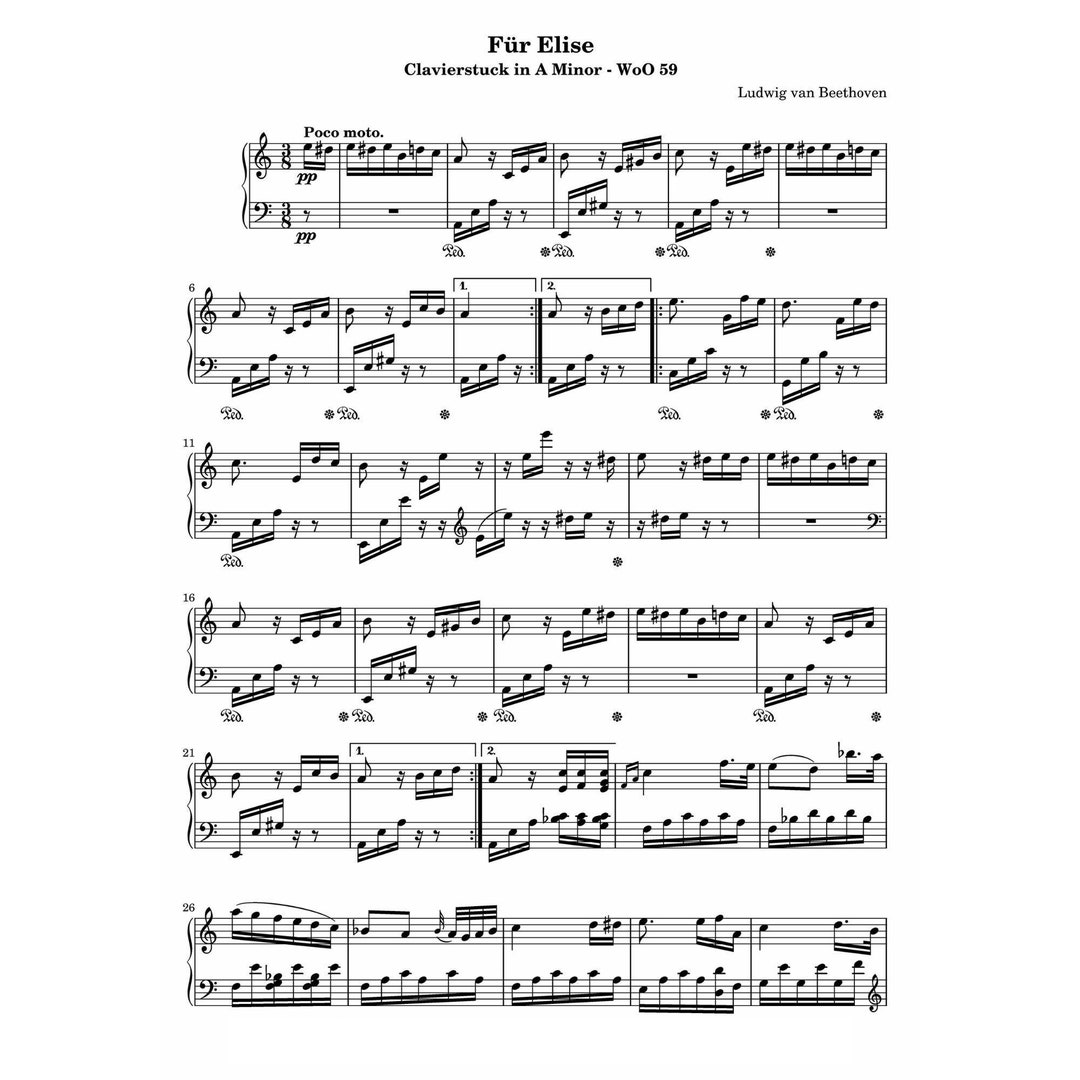
An Urtext edition aims to reproduce the composer's original intent as closely as possible, without added fingerings or dynamic markings from modern editors. This is the version serious students and professional pianists use. It includes the complete A-B-A-C-A structure, including the fast 32nd-note runs and the repeated-note "pedal point" section in the Bass.
2. Intermediate Arrangements
These versions keep the full structure of the piece but might include helpful fingering suggestions and more modern notation layouts. They are ideal for students who can handle the technical difficulty but appreciate guidance on which fingers to use for the more complex chromatic passages.
3. Simplified or "Easy Piano" Versions
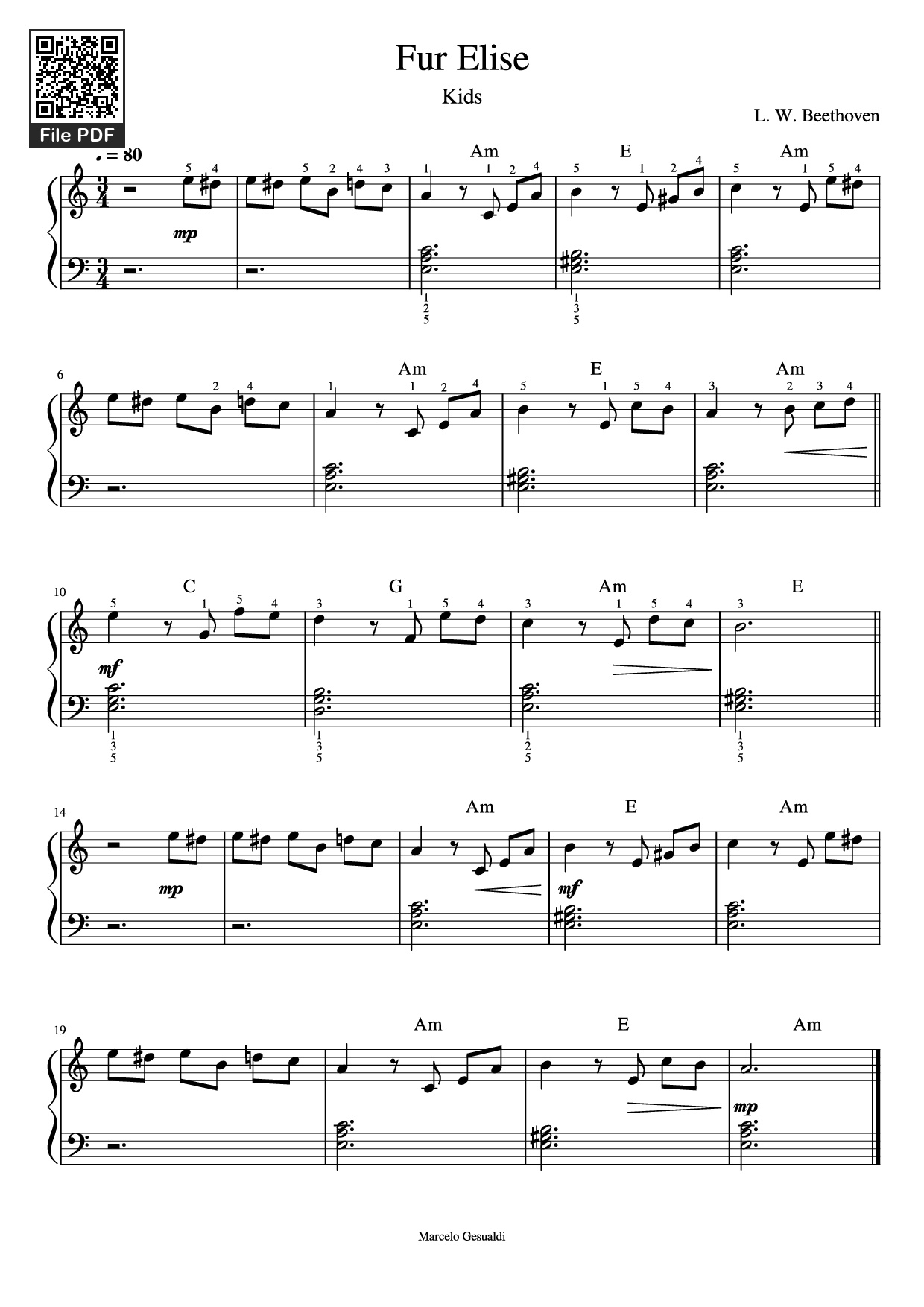
Many PDFs labeled "Easy Piano" focus exclusively on the famous "A" section—the part everyone recognizes. These arrangements often simplify the left-hand arpeggios into basic chords and may even transpose the piece into a simpler key, though A minor is already quite accessible. In 2026, many digital libraries offer these for free to encourage early-stage learners.
Technical Analysis and Difficulty Breakdown
The piece is written in 3/8 time, which gives it a dance-like, waltz-adjacent feel. To play it correctly from a PDF, you must understand the three distinct sections that make up its Rondo form (A-B-A-C-A).
The A Section (The Main Theme)
This is the most famous part of the piece, characterized by the alternating E and D# in the right hand. The challenge here is not the notes themselves but the legato phrasing. The left hand plays broken chords (arpeggios) that must provide a steady rhythmic foundation without overpowering the melody.
The B Section (The F Major Episode)
This section is much brighter and more "classical" in style. It involves rapid right-hand scales and a shift to F major. Many students who learn the A section by ear struggle here because it requires formal note-reading and better finger dexterity.
The C Section (The Agitated Section)
The C section returns to A minor but with a much more dramatic tone. It features a repeated A in the left hand (a pedal point) while the right hand plays diminished chords and a descending chromatic scale. This is the most difficult part of the PDF to master, requiring strength in the weak fingers of the right hand.
| Version Type | Difficulty Level | Target Audience | Key Features |
|---|---|---|---|
| Original Urtext | Intermediate (Grade 5-6) | Serious Students | Full A-B-A-C-A structure; 32nd notes. |
| Easy Piano | Beginner (Grade 1-2) | Hobbyists / Children | Focuses on Theme A; simplified left hand. |
| Big Note | Early Beginner | Young Children | Extra-large notes; often includes note names. |
| Jazz/Modern Arrangement | Intermediate | Advanced Players | Re-harmonized chords; syncopated rhythms. |
How to Evaluate a Sheet Music PDF for Quality
Not all PDFs are created equal. Since the music is in the public domain, anyone can create and upload a version of "Für Elise." To ensure you are practicing from a high-quality document, look for the following criteria:
- Engraving Quality: The notes should be crisp and dark. Avoid scanned copies of old, yellowed books which can be hard to read on tablets or when printed.
- Fingering Marks: For beginners, a PDF with small numbers above the notes is essential. These numbers indicate which finger to use (1 for thumb, 5 for pinky).
- Measure Numbers: These are vital if you are working with a teacher, as they allow you to quickly find specific sections of the music.
- Source Attribution: Reliable PDFs usually state the editor or the publishing house. Reputable sources include IMSLP (International Music Score Library Project) and official university music archives.
Practice Strategies for Mastering "Für Elise"
Once you have downloaded your PDF, you should approach the piece methodically. Many students make the mistake of playing the famous beginning over and over while neglecting the harder middle sections.
Step 1: Hand-Separate Practice
Start with the left hand alone. The arpeggios in "Für Elise" move across the keyboard. If your left hand is not "on autopilot," your right hand will struggle to express the melody. Use the PDF to identify the chord shapes (A minor, E major, C major) and practice moving between them smoothly.
Step 2: The Chromatic "Turn"
In the B and C sections, there are rapid chromatic movements. Look at your PDF and circle these areas. Practice these slowly using a metronome. In 2026, most digital sheet music apps allow you to highlight these sections directly on the PDF for focused repetition.
Step 3: Pedaling Technique
The PDF may or may not include pedal markings. "Für Elise" requires "syncopated pedaling," where you lift and depress the sustain pedal just after hitting the chord. This prevents the sound from becoming "muddy." A common mistake is holding the pedal down through the entire main theme; instead, clear the pedal every time the harmony changes.
Where to Safely Download the PDF
Because Beethoven has been deceased for nearly two centuries, his music is no longer under copyright. This means you should never have to pay a high price for a basic PDF of "Für Elise."
- IMSLP/Petrucci Music Library: This is the most authoritative source for public domain scores. You can find dozens of different editions here, from 19th-century prints to modern scholarly editions.
- Standard Music Repositories: Sites like Mutopia Project or various university music departments often host clean, modern re-typesets of the score in PDF format.
- Digital Apps: If you use a tablet for music, apps like Henle Library or MuseScore provide interactive PDFs that allow for transposition and playback.
Common Mistakes to Avoid
- Playing Too Fast: The "Poco Moto" marking means "with motion," but it is not a race. Many players rush the A section, which makes the difficult B and C sections feel impossible when they arrive at the same tempo.
- Neglecting the Dynamics: The PDF will likely show pp (pianissimo) at the start. "Für Elise" is meant to be intimate and delicate. Avoid banging the keys.
- Flat Fingers: The C section's repeated notes require curved fingers to maintain speed and clarity. If your fingers are flat, you will lose the rhythmic "bite" required for that section.
FAQs About Fur Elise Piano Sheet Music
Is "Für Elise" suitable for a total beginner?
The famous main theme (Section A) is suitable for someone who has been playing for 3-6 months. However, the complete piece is considered intermediate. Total beginners should look for a "Simplified" or "Theme Only" PDF.
What grade level is "Für Elise"?
In most conservatory systems, such as the RCM (Royal Conservatory of Music) or ABRSM, the full version of "Für Elise" is classified as Grade 7. The simplified versions are often found in Grade 1 or 2 books.
Why do some PDFs have different notes in the middle?
Because the original manuscript was lost and later reconstructed, there are slight variations between editions. Some older versions have a different note in the right-hand accompaniment during the B section. Modern "Urtext" editions are generally considered the most accurate to Beethoven’s intent.
Can I play "Für Elise" on a keyboard with fewer than 88 keys?
Yes. The piece does not use the extreme highs or lows of the piano. A 61-key keyboard is usually sufficient to play the entire piece without running out of room.
How long does it take to learn the piece?
An intermediate student can usually learn the notes of the full piece in 2-4 weeks. However, mastering the expression and the speed of the C section may take several months of consistent practice.
Next Steps for Pianists
After downloading your Fur Elise piano sheet music PDF, start by mastering the first 8 measures. Ensure your fingering is consistent every time you play. Once you can play the main theme from memory with a steady beat, move on to the F-major section (Section B). For the best results, use a PDF that includes fingering numbers to ensure you are building the correct muscle memory from day one.
Image Gallery