How Powerful Is Iran's Military? A Comprehensive Analysis for 2026
Iran’s military power is defined by its massive ballistic missile arsenal, advanced drone technology, and an extensive network of regional proxies. While its conventional air and sea forces rely partly on aging equipment, Iran excels i...
Iran’s military power is defined by its massive ballistic missile arsenal, advanced drone technology, and an extensive network of regional proxies. While its conventional air and sea forces rely partly on aging equipment, Iran excels in asymmetric warfare, utilizing the Islamic Revolutionary Guard Corps (IRGC) to project influence and deter superior conventional adversaries across the Middle East.
Contents
As of 2026, Iran remains one of the most formidable military actors in the Middle East. Its strength is not measured by traditional Western metrics of carrier groups or fifth-generation stealth fighters, but by its ability to disrupt global energy markets, conduct high-precision long-range strikes, and engage in "gray zone" warfare that complicates the traditional defense strategies of its rivals. To understand the true extent of Iranian power, one must analyze its unique dual-structure military, its domestic defense industry, and its specialized asymmetric doctrines.
The Dual-Structure Military: Artesh and the IRGC
One of the most distinctive features of the Iranian defense establishment is its two-tier military system. This structure was designed post-1979 to ensure the survival of the revolutionary government by creating a system of checks and balances between traditional national defense and ideological protection.
The Islamic Republic of Iran Army (Artesh)
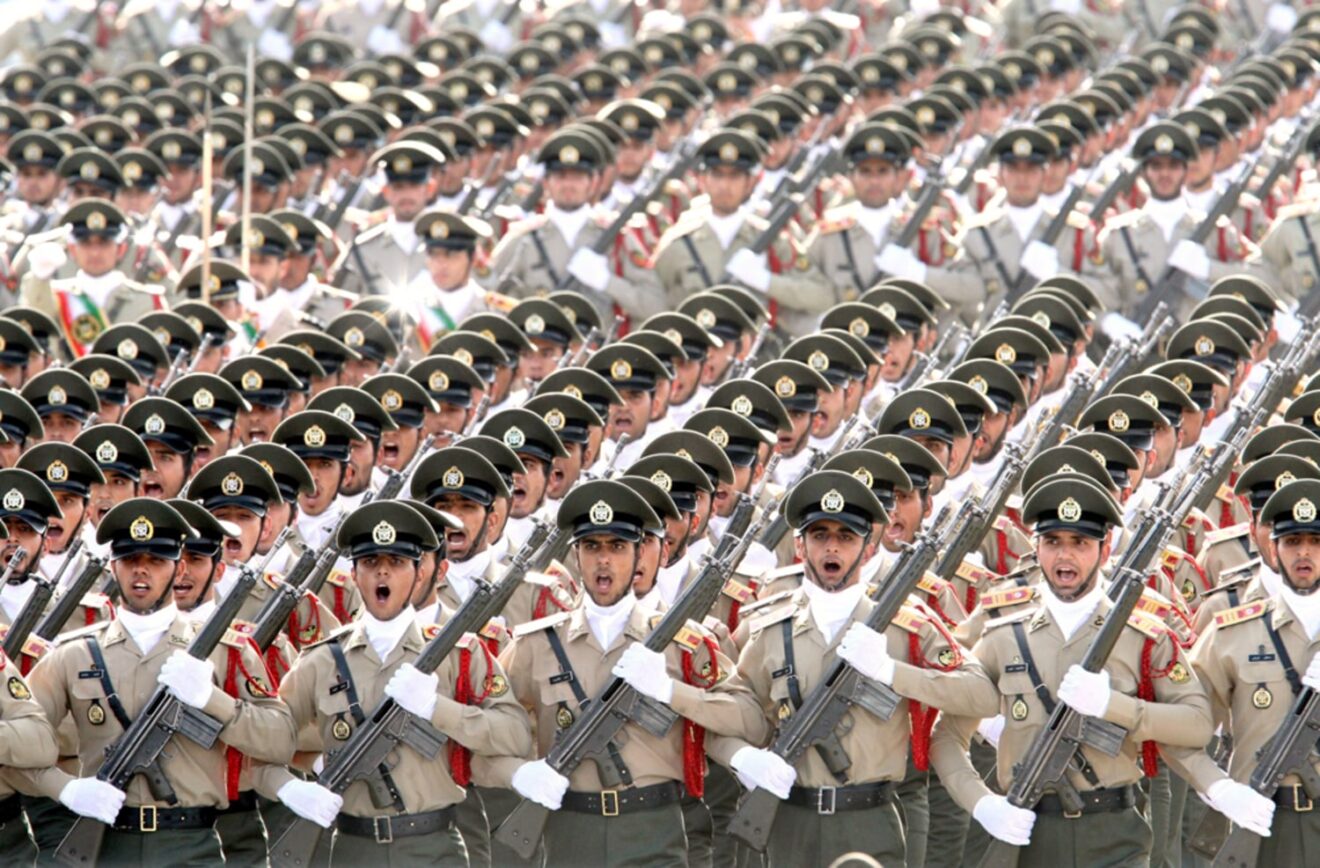
The Artesh is the traditional national military, tasked with defending Iran's territorial integrity and borders. It includes the Ground Forces, Navy, Air Force, and Air Defense Force. While numerically significant, the Artesh has historically received less funding and political priority than the IRGC. In 2026, the Artesh remains primarily a defensive force, maintaining large numbers of main battle tanks (like the domestically produced Karrar) and legacy aircraft.
The Islamic Revolutionary Guard Corps (IRGC)
The IRGC is an elite branch dedicated to protecting the Islamic system and projecting power abroad. It operates its own ground, naval, and air forces (the Aerospace Force) and controls the Basij paramilitary volunteer force. The IRGC’s Quds Force is the primary vehicle for Iran's regional influence, managing relationships with non-state actors in Lebanon, Iraq, Yemen, and Syria. The IRGC's dominance in 2026 is reflected in its control over the nation’s strategic missile program and its significant influence over the Iranian economy.
Strategic Capabilities: Missiles and Hypersonics
Iran possesses the largest and most diverse missile arsenal in the Middle East. Lacking a modern air force, Tehran has invested decades of resources into developing "strategic depth" through ballistic and cruise missiles. These weapons serve as Iran’s primary deterrent against high-tech adversaries like Israel or the United States.
By 2026, Iran has successfully moved beyond simple Scud-based technology. The inventory now includes:
- Ballistic Missiles: The Shahab and Sejjil series provide regional reach, with ranges exceeding 2,000 kilometers. This allows Iran to strike targets across the Middle East and parts of Southeastern Europe.
- Hypersonic Technology: Following the unveiling of the Fattah-1 and Fattah-2, Iran has claimed the ability to bypass advanced missile defense systems like the Patriot and Iron Dome. While the exact maneuverability of these missiles at terminal speeds remains a subject of international debate, the psychological and strategic impact on regional defense planning is profound.
- Precision Guidance: Older "dumb" missiles have been replaced or upgraded with GPS and terminal guidance systems, transforming them into precision-strike weapons capable of hitting specific hangars, command centers, or oil infrastructure.
This "missile diplomacy" allows Iran to threaten significant costs for any military intervention, effectively creating a "no-go zone" for adversaries who fear a massive retaliatory barrage.
Drone Warfare and the "UAV Superpower" Status
Iran’s rise as a global drone power is perhaps the most significant shift in regional military dynamics over the last decade. Iranian Unmanned Aerial Vehicles (UAVs) have been utilized extensively in regional conflicts and have been exported to various international actors.
The Iranian drone fleet is characterized by its cost-effectiveness and versatility. The Shahed-136 "suicide" or loitering munition became globally recognized for its ability to saturate air defenses through "swarming" tactics. These drones are cheap to produce, easy to launch from the back of trucks, and difficult to detect on radar due to their small size and low altitude flight paths.
Beyond suicide drones, Iran operates sophisticated reconnaissance and strike UAVs such as the Mohajer-6 and the Ababil series. These platforms provide Iran with persistent surveillance over the Persian Gulf and the ability to conduct targeted strikes without risking pilots. In 2026, the integration of Artificial Intelligence (AI) into these drone swarms has further enhanced their ability to overwhelm sophisticated Western-made air defense networks.
Naval Power: Asymmetric Warfare in the Persian Gulf
The Iranian Navy is divided between the Artesh Navy (a "Blue Water" force) and the IRGC Navy (a "Brown Water" coastal force). The IRGC Navy dominates the strategic Strait of Hormuz, through which approximately 20% of the world’s oil passes.
Rather than building large destroyers that would be vulnerable to airstrikes, Iran focuses on a "Thousand Cuts" strategy. This involves:
- Fast Attack Craft: Hundreds of small, highly maneuverable boats armed with anti-ship missiles and torpedoes.
- Mines: Sophisticated sea mines that can be deployed rapidly to block shipping lanes.
- Submarines: A mix of Kilo-class diesel-electric subs and domestically produced midget submarines (Ghadir class) that are ideal for the shallow, cluttered waters of the Persian Gulf.
- Coastal Defense Missiles: Land-based anti-ship cruise missiles (ASCMs) that can cover the entire width of the Gulf.
According to the International Institute for Strategic Studies (IISS), this asymmetric approach makes any conventional naval operation in the Persian Gulf extremely risky and expensive for foreign navies.
Conventional Weaknesses and the Russian Connection
Despite its strengths, the Iranian military faces significant conventional limitations. The most glaring weakness is the Islamic Republic of Iran Air Force (IRIAF). For decades, the IRIAF relied on pre-1979 American hardware, such as F-14 Tomcats and F-4 Phantoms.
However, the landscape has begun to shift by 2026 due to deepening military cooperation with Russia. The acquisition of Su-35 Flanker-E fighter jets has provided Iran with its first modern fourth-generation air superiority fighters. While these do not match the stealth capabilities of the F-35, they significantly narrow the gap in aerial combat and provide a much-needed boost to Iran's air defense interceptions.
Furthermore, Iran continues to struggle with the impact of long-term sanctions on its heavy industry. While it is remarkably self-sufficient in missile and drone production, it lags in high-end sensors, turbine engines, and advanced composite materials compared to the Stockholm International Peace Research Institute (SIPRI) rankings of global military powers.
Comparative Military Strength Table (2026 Estimates)
| Capability | Iran (Total) | Regional Context | Strategic Role |
|---|---|---|---|
| Active Personnel | ~610,000 | Largest in Middle East | Internal security & regional projection |
| Ballistic Missiles | 3,000+ | Regionally Dominant | Primary deterrent/Strategic strike |
| UAV/Drones | Thousands | Global Export Leader | Asymmetric "Air Force" |
| Submarines | ~20-25 | Specialized for Gulf | Coastal denial & ambush |
| Modern Fighters | Limited (Su-35) | Weak vs. Israel/GCC | Improving air defense |
| Main Battle Tanks | ~1,600 | Mixed (Old & New) | Defensive border operations |
The "Axis of Resistance" and Proxy Power
The true extent of Iranian military power cannot be measured by looking at the borders of Iran alone. Through the IRGC-Quds Force, Iran maintains a "forward defense" doctrine. This involves supporting a network of non-state actors known as the "Axis of Resistance."
- Hezbollah (Lebanon): Acts as a massive deterrent on Israel’s northern border with its own arsenal of 150,000+ rockets.
- The Houthis (Yemen): Capable of disrupting the Red Sea and Bab al-Mandab Strait, as seen in recent years.
- Popular Mobilization Forces (Iraq): Ensure Iranian political and military influence within Iraqi borders.
This network allows Iran to fight "away games," keeping conflict far from Iranian soil while exerting pressure on regional rivals and global energy corridors. It provides Tehran with "plausible deniability" during many operations, further complicating the response from the international community.
Cyber Warfare and Electronic Capabilities
Iran has emerged as one of the world's most active and capable cyber actors. Following the Stuxnet attack on its nuclear facilities in 2010, the Iranian government invested heavily in the Iranian Cyber Council.
In 2026, Iran’s cyber capabilities are used for both espionage and offensive operations. This includes targeting critical infrastructure, financial institutions, and government sectors in rival nations. Cyber warfare is viewed as a "low-cost, high-impact" tool that fits perfectly into Iran’s asymmetric doctrine, allowing it to strike at the heart of more technologically advanced nations without firing a physical shot.
Frequently Asked Questions (FAQ)
Can Iran's military close the Strait of Hormuz?
Yes, Iran has the capability to temporarily close or severely disrupt the Strait of Hormuz using a combination of sea mines, fast-attack boats, and coastal missile batteries. While the U.S. and its allies could eventually reopen the strait, the initial economic shock and the cost in naval assets would be catastrophic for global markets.
How does Iran's military compare to Israel's?
Israel holds a significant lead in conventional technology, particularly in air power (F-35 stealth fighters) and cyber-intelligence. However, Iran possesses "strategic depth" and a much larger missile inventory. Israel’s defense is focused on interception and preemptive strikes, while Iran’s strategy focuses on saturation and attrition through its regional proxies.
Is Iran's military entirely self-sufficient?
Largely, yes. Due to decades of sanctions, the Ministry of Defense and Armed Forces Logistics (MODAFL) has developed a robust domestic industry. Iran produces its own tanks, missiles, drones, and small warships. However, it still requires foreign imports for high-end microchips and advanced aviation components.
What is the role of the Basij in Iranian defense?
The Basij is a large paramilitary volunteer force under the IRGC. While they are not a "front-line" professional army, they provide a massive pool of manpower for internal security, logistics, and "human wave" defensive tactics if Iran were ever invaded.
Does Iran have nuclear weapons in 2026?
As of 2026, Iran is widely considered a "nuclear-threshold" state. While official policy remains that its program is for civilian purposes, it possesses the enrichment capacity and delivery systems (missiles) necessary to produce a weapon in a very short timeframe if the political decision were made. This "breakout" capability acts as a final layer of military deterrence.
Final Assessment and Recommendation
Iran’s military power is highly specialized. It is not designed to win a traditional land invasion of a distant country; rather, it is built to make any attack on Iran prohibitively expensive and to exert dominant influence over regional affairs. For analysts and policymakers, the focus should remain on Iran’s asymmetric proliferation—specifically the transfer of drone and missile technology to non-state actors—which remains the most volatile element of Tehran’s military posture.
Those monitoring regional security should prioritize the development of multi-layered, integrated air and missile defense systems (IAMD) to counter the increasing sophistication of Iranian-made loitering munitions and hypersonic missiles. Understanding that Iran’s strength lies in its "gray zone" activities is the first step in formulating a balanced strategic response.
Image Gallery