Choosing a Marketing Agency for Nonprofits: A Strategic Guide for 2026
A marketing agency for nonprofits is a specialized firm that provides strategic communication, digital advertising, and fundraising support tailored to the unique regulatory and operational needs of tax-exempt organizations. These agen...
A marketing agency for nonprofits is a specialized firm that provides strategic communication, digital advertising, and fundraising support tailored to the unique regulatory and operational needs of tax-exempt organizations. These agencies bridge the gap between social impact and technical execution, helping nonprofits maximize limited budgets through tools like the Google Ad Grant, donor retention systems, and mission-driven storytelling.
Contents
In 2026, the landscape for nonprofit growth has shifted significantly. With donors demanding higher levels of transparency and digital platforms utilizing increasingly complex AI algorithms, the "one-size-fits-all" approach to marketing no longer yields sustainable results. For a nonprofit organization (NPO), selecting the right agency partner is not just about hiring a service provider; it is about finding a strategic ally that understands the nuances of 501(c)(3) regulations, the psychology of philanthropy, and the technical requirements of modern digital fundraising.
The Strategic Role of Specialized Nonprofit Marketing
Generic marketing agencies often prioritize commercial metrics like "return on ad spend" (ROAS) based on immediate sales. However, nonprofit success is measured through multifaceted KPIs such as lifetime donor value (LDV), recurring gift conversion, and brand trust. A specialized marketing agency for nonprofits understands that the "buyer’s journey" for a donor is emotional and values-based rather than purely transactional.
Bridging Mission and Market
Nonprofits often struggle with internal "silos" where the programming team and the development team operate independently. A specialized agency acts as a bridge, translating complex social outcomes into compelling narratives that resonate with specific audience segments. This involves more than just writing copy; it requires deep data analysis to understand who the current supporters are and where the "lookalike" audiences reside in the 2026 digital ecosystem.
Navigating Regulatory and Ethical Constraints
Marketing for nonprofits involves strict adherence to ethical fundraising standards and data privacy laws. Agencies in this niche are well-versed in the Better Business Bureau (BBB) Wise Giving Alliance standards, ensuring that all marketing claims are verifiable and that donor data is handled with the highest level of security. In 2026, as data privacy regulations have tightened globally, having an agency that understands the intersection of HIPAA (for healthcare NPOs) or FERPA (for educational NPOs) with marketing technology is a critical prerequisite.
Core Services Offered by Nonprofit Agencies
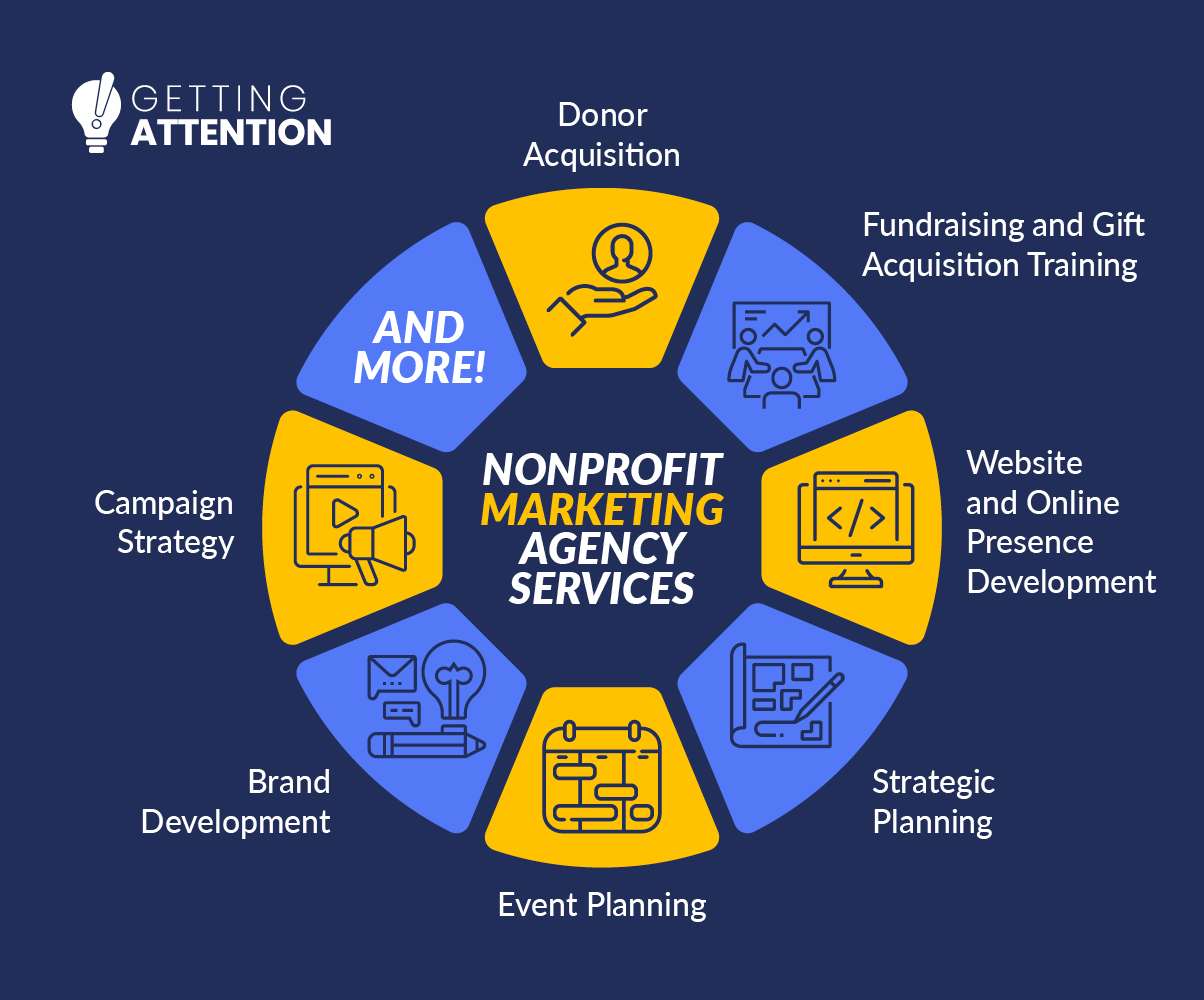
When evaluating a marketing agency for nonprofits, it is essential to look beyond basic social media management. The most effective agencies provide a holistic suite of services designed to build a self-sustaining "growth engine" for the organization.
1. Google Ad Grants Management
The Google Ad Grants program continues to be a cornerstone for NPO visibility, providing up to $10,000 per month in in-kind search advertising. However, the technical requirements to maintain eligibility—including minimum click-through rates (CTR) and conversion tracking—have become more stringent. A specialized agency focuses on maximizing this "free" spend to drive high-intent traffic to donation pages and volunteer sign-up forms.
2. Multi-Channel Fundraising Integration
In 2026, donor touchpoints are fragmented across email, SMS, social platforms, and connected TV (CTV). Agencies now use sophisticated CRM integrations to ensure that a donor who sees an ad on Instagram receives a consistent message when they open their email two days later. This "omnichannel" approach is vital for major gift cultivation and sustaining monthly giving programs.
3. Impact Reporting and Data Visualization
Donors today want to see the direct results of their contributions. Leading agencies provide technical support for "impact dashboards," which use real-time data to show how many trees were planted, meals served, or students educated. This level of transparency, powered by modern API integrations between field operations and marketing websites, is a key driver of donor retention.
Evaluating Technical Expertise and Agency Models
Not all nonprofit agencies are created equal. The choice often depends on the size of the NPO, the primary goal (e.g., brand awareness vs. urgent capital campaign), and the existing internal capacity.
Comparison of Agency Models for Nonprofits
| Agency Type | Best For | Key Advantages | Typical Cost Structure |
|---|---|---|---|
| Boutique NPO Specialist | Small to mid-sized NPOs | Deep mission alignment; high-touch service. | Monthly retainer ($3k–$7k) |
| Performance Fundraising Group | Large-scale direct response | Focused on immediate ROI and donor acquisition. | Retainer + percentage of funds raised |
| Full-Service Digital Firm | Enterprise-level NPOs | Broad capabilities (PR, Video, Web Dev). | High retainer ($10k+) |
| Grant-Focused Agency | New or resource-strapped NPOs | Specific focus on Google/Microsoft Ad Grants. | Flat fee for grant management |
The Impact of AI and Automation in 2026
By 2026, artificial intelligence has become deeply embedded in nonprofit marketing workflows. A competent agency should be leveraging AI not just for content creation, but for predictive analytics. This includes identifying which one-time donors are most likely to become recurring supporters and automating "lapsed donor" win-back sequences.
Moreover, "hyper-personalization" is now the standard. Agencies use AI to dynamically change the content of a website or email based on the donor's previous interactions. For example, if a supporter has previously shown interest in "ocean conservation" rather than "land preservation," the agency’s systems ensure the images and stories they see are tailored to that specific passion. This relevance is the primary factor in reducing donor churn in the current landscape.
Common Mistakes When Hiring an Agency
One of the most frequent errors nonprofits make is hiring an agency based solely on a creative portfolio without investigating their technical track record in the nonprofit sector. A commercial agency might produce a beautiful video that fails to include a clear call-to-action (CTA) compatible with nonprofit payment processors like Classy, Blackbaud, or Givebutter.
Avoid these pitfalls:
- Ignoring CRM Compatibility: Ensure the agency has experience working with your specific donor database (e.g., Salesforce NPSP, Virtuous, or Raiser's Edge).
- Overlooking SEO: Many agencies focus on paid ads because they show immediate results, but organic search visibility is more sustainable long-term.
- Lack of Transparency in Reporting: If an agency cannot explain the difference between "vanity metrics" (likes and follows) and "impact metrics" (donations and volunteer hours), they are likely not the right fit for an NPO.
Managing Costs and Expectations
Budgets are always a sensitive topic in the nonprofit world. However, the "overhead myth"—the idea that nonprofits should spend as little as possible on administration and marketing—has been largely debunked by data showing that organizations that invest in professional marketing grow significantly faster and have more stable revenue streams.
Most agencies in 2026 operate on a retainer model, which provides a predictable monthly cost. When calculating the expected return on investment (ROI), nonprofits should look at the "Cost Per Acquisition" (CPA) of a new donor. If an agency can bring in a donor for $50 who has a projected lifetime value of $500, the investment is clearly justified.
Practical Steps for Selection
- Define Your Primary Objective: Are you looking for a 20% increase in year-end giving, or do you need to overhaul your brand identity for a younger demographic?
- Audit Your Current Assets: Before reaching out to agencies, know the status of your Google Ad Grant, the health of your email list, and the conversion rate of your current website.
- Request Case Studies with Hard Data: Ask for examples where the agency solved a problem similar to yours, specifically looking for donor retention stats rather than just "increased traffic."
- Verify NPO-Specific Knowledge: Ask how they handle "restricted funds" messaging and how they stay compliant with Candid (formerly GuideStar) transparency rankings.
FAQ
How much does a marketing agency for nonprofits typically cost? In 2026, retainers for specialized nonprofit agencies generally range from $3,000 to $15,000 per month, depending on the scope of services. Some smaller agencies offer "grant management only" packages for as low as $1,000 per month. It is important to ensure that the fee includes strategy and reporting, not just technical execution.
Can a nonprofit use a regular commercial marketing agency? While possible, it is often inefficient. Commercial agencies may not understand the specific constraints of the Google Ad Grant or the technical integration requirements of nonprofit-specific CRMs. Furthermore, the messaging required to solicit a donation is fundamentally different from the messaging used to sell a product.
What is the "Google Ad Grant" and why do I need an agency for it? The Google Ad Grant provides $10,000 per month in search advertising for eligible 501(c)(3) organizations. While the "money" is free, the management is not. Google has strict rules regarding keyword quality, click-through rates, and account structure. Agencies ensure your account isn't suspended and that the traffic actually turns into supporters.
How do we measure the success of our marketing agency? Success should be measured by "Conversion Actions." These include direct donations, newsletter sign-ups, volunteer applications, and event registrations. A good agency will provide a monthly dashboard linking marketing spend directly to these outcomes, allowing the board of directors to see a clear ROI.
Does our nonprofit need an agency if we have an internal marketing person? Agencies often complement internal staff. An internal marketing manager usually handles day-to-day social media and community management, while the agency provides high-level strategy, technical SEO, complex ad management, and data analysis that requires specialized software and expertise.
Next Actions for Nonprofit Leaders
To begin the process of scaling your mission, perform an internal audit of your digital presence. Identify your most successful fundraising channel from the past 12 months and your biggest bottleneck (e.g., "we have traffic but no one signs up"). Once these are identified, schedule discovery calls with at least three agencies that specialize in your specific sub-sector—whether that be environmental, educational, or humanitarian aid—to compare their strategic approach to your 2026 goals.
Image Gallery