The Expansion of Denver ESL Programs in 2026: A Comprehensive Guide
Denver’s ESL programs have undergone a period of unprecedented growth, driven by a surge in international migration and increased state funding for adult education. In 2026, the city offers a robust tiered system ranging from free comm...
Denver’s ESL programs have undergone a period of unprecedented growth, driven by a surge in international migration and increased state funding for adult education. In 2026, the city offers a robust tiered system ranging from free community-based survival English at Emily Griffith Technical College to specialized academic pathways at the Community College of Denver, focusing on workforce integration and digital literacy.
Contents
The Drivers of Growth in Denver’s Language Landscape
The expansion of English as a Second Language (ESL) programs in the Denver metropolitan area is not an accidental development but a strategic response to shifting demographics. Between 2023 and 2025, Denver became a primary destination for thousands of new arrivals, particularly from Central and South America. This demographic shift created an immediate and sustained demand for language services that transcended traditional classroom settings. By 2026, the city has transitioned from emergency response measures to a permanent, well-funded infrastructure of linguistic support.
Economic necessity serves as the second major driver. Colorado’s labor market, particularly in sectors like healthcare, hospitality, and construction, has faced chronic labor shortages. State and local leaders realized that the fastest way to bridge the employment gap was to empower the existing immigrant population with English proficiency. Consequently, "Workforce ESL" has emerged as a dominant sub-sector, where language instruction is paired directly with technical training. This dual-purpose education model ensures that students are not just learning vocabulary, but are simultaneously gaining the skills necessary to enter the Colorado workforce in high-demand roles.
Furthermore, state-level policy changes have provided the financial backbone for this growth. The Colorado Department of Education (CDE) has increased its allocation for the Adult Education and Literacy Act, allowing local providers to expand their evening and weekend offerings. These funds have been instrumental in reducing waitlists that previously stretched for months, ensuring that more Denverites can access the education they need to participate fully in civic and economic life.
Primary Categories of ESL Programs in Denver
The growth of the sector has led to a more specialized ecosystem. In 2026, prospective students in Denver are no longer faced with a one-size-fits-all model. Instead, the landscape is divided into three distinct categories: Community-Based, Academic, and Vocational.
Community-Based and Non-Profit Programs
Community-based programs are often the first point of entry for new residents. These programs, frequently hosted by non-profits and libraries, focus on "Survival English"—the language skills needed for daily tasks such as grocery shopping, navigating public transportation, and communicating with healthcare providers. Organizations like Focus Points Family Resource Center have expanded their holistic approach, integrating ESL with early childhood education and food security programs. This model recognizes that language learning does not happen in a vacuum; students are more successful when their basic needs and familial responsibilities are addressed alongside their education.
Academic ESL (IEP and Bridge Programs)
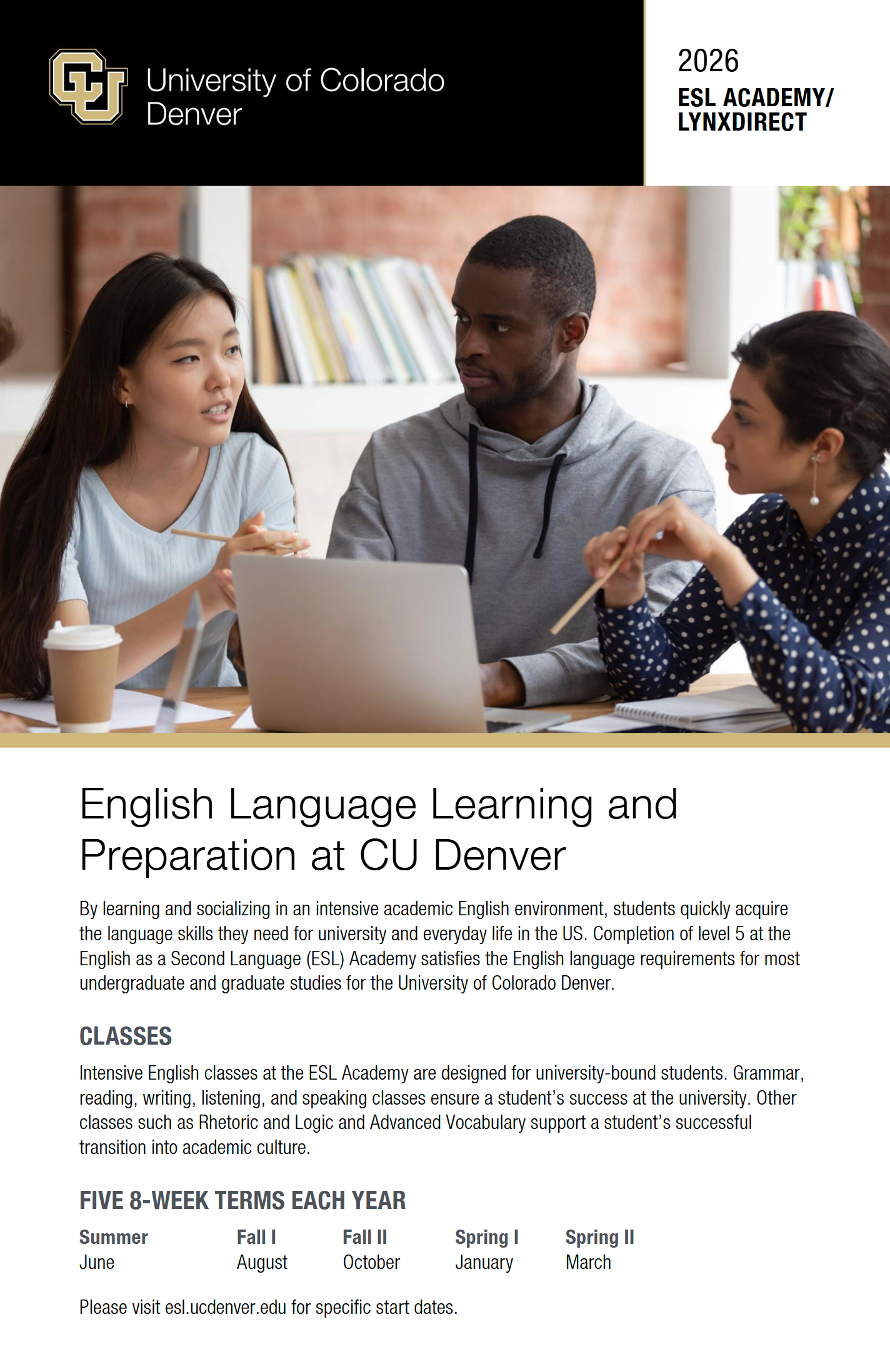
For those seeking to enter higher education, Denver’s colleges provide Intensive English Programs (IEP). These are rigorous, credit-bearing or preparatory courses designed to move students from intermediate levels to college-level proficiency. The Community College of Denver (CCD) and the University of Colorado Denver have both expanded their "bridge" programs. These allow students to begin taking core academic classes in their native language or at a modified pace while finishing their ESL requirements. This prevents the "ESL trap" where students spend years on language before ever touching their intended major.
Vocational and Workforce ESL
The most significant growth in 2026 is found in vocational ESL. Emily Griffith Technical College, a cornerstone of Denver’s adult education for over a century, has pioneered the "Integrated Education and Training" (IET) model. In these programs, an ESL instructor and a technical instructor co-teach. For example, a student learning HVAC repair is taught the specific English terminology for tools and safety protocols in tandem with the mechanical skills. This reduces the time-to-employment and ensures that language barriers do not prevent skilled workers from obtaining licensure in Colorado.
Leading Institutions and Program Specifics
Navigating the numerous providers in the Denver area requires understanding the specific strengths and target audiences of the major institutions.
Emily Griffith Technical College (EGTC)
EGTC remains the largest provider of adult ESL in the city. Their growth has been characterized by accessibility. In 2026, they offer levels 1 through 6 of English language acquisition. Their programs are highly subsidized, often resulting in little to no cost for eligible Denver residents. Their campus in downtown Denver and various satellite locations ensure that students in different neighborhoods have local access.
Denver Public Schools (DPS) Multilingual Education
For the K-12 population, the Denver Public Schools Multilingual Education (MLE) department has seen a massive influx of funding. The district’s growth is focused on "Dual Language" models where both English and Spanish (or other native languages) are used for instruction. This approach preserves the student's primary language while developing English proficiency, which research shows leads to better long-term academic outcomes. In 2026, DPS has expanded these services to include more comprehensive support for families, offering evening ESL classes for the parents of enrolled students to ensure a supportive home environment for learning.
The Community College of Denver (CCD)
The Community College of Denver serves as the primary gateway for those pursuing associate degrees or transferring to four-year universities. Their ESL program is bifurcated into "Foundational" and "Academic" tracks. The growth here is visible in their state-of-the-art language labs and the integration of AI-assisted learning tools that provide students with personalized pronunciation and grammar coaching outside of classroom hours.
Comparison of Denver ESL Program Types (2026 Status)
| Program Type | Primary Provider(s) | Typical Cost | Ideal For |
|---|---|---|---|
| Community ESL | Focus Points, Denver Public Library | Free / Low Cost | Newcomers, daily life skills |
| Vocational ESL | Emily Griffith Technical College | Highly Subsidized | Career seekers, trade skills |
| Academic ESL | Community College of Denver, CU Denver | Tuition-based | Future degree-seeking students |
| K-12 MLE | Denver Public Schools (DPS) | Free for students | Children and teenagers |
| Private Intensive | Spring International Language Center | Market Rate | International students, fast-track |
Enrollment Requirements and Accessibility
In 2026, the enrollment process for Denver ESL programs has been streamlined, though requirements vary by institution. Most public programs require a placement test, often the CASAS (Comprehensive Adult Student Assessment Systems) or the TABE (Test of Adult Basic Education), to determine the student's starting level.
Documentation and Eligibility:
- Public Programs: Many state-funded programs at Emily Griffith or CCD require proof of Colorado residency but do not necessarily require proof of citizenship for non-credit adult education. However, federal financial aid for credit-bearing academic ESL typically requires specific immigration statuses.
- Cost and Financial Aid: While many community programs are free, academic programs at the college level carry tuition costs. In 2026, many students utilize the "Colorado Opportunity Fund" or specific workforce grants aimed at "upskilling" the local population.
- Schedule Flexibility: Recognizing that many ESL learners are working full-time, the growth in Denver’s programs has manifested in a massive increase in hybrid and evening options. Most providers now offer at least 40% of their curriculum online or through asynchronous modules.
Technology and Innovation in Language Learning
A defining feature of the growth in 2026 is the integration of educational technology. Denver has become a testing ground for VR-enhanced language learning. Several programs now use virtual reality headsets to simulate high-stakes environments, such as job interviews or medical emergencies, allowing students to practice their English in a low-risk, immersive setting.
Furthermore, the Asian Pacific Development Center (APDC) and other culturally specific organizations have introduced mobile-first learning platforms. These apps provide localized content, such as navigating Denver’s RTD (Regional Transportation District) system or understanding Colorado-specific labor laws, which makes the language learning process immediately relevant to the student's life in the Mile High City.
Frequently Asked Questions
Are there free ESL classes available in Denver in 2026?
Yes, several organizations provide free or low-cost ESL instruction. The Denver Public Library offers informal "English Conversation Circles," while Emily Griffith Technical College provides highly subsidized formal classes. Many non-profits like Focus Points also offer free instruction, though they may have waitlists due to high demand.
How long does it take to complete an ESL program?
The duration depends on the student’s starting level and their goals. Generally, it takes 6 to 12 months to move up one proficiency level in a part-time program. To reach "academic" or "professional" proficiency from a beginner level typically requires 2 to 3 years of consistent study.
Can I work while enrolled in an ESL program?
Most programs in Denver are designed specifically for working adults. Classes are frequently offered in the early mornings, late evenings, and on weekends. Additionally, the rise of hybrid learning allows students to complete a significant portion of their coursework on their own schedule.
Do Denver ESL programs help with job placement?
Vocational ESL programs, particularly those at Emily Griffith Technical College, have built-in career services. These include assistance with resume writing, interview preparation, and direct connections to local employers who are looking for bilingual or multilingual staff.
Is there support for non-Spanish speaking immigrants?
While a significant portion of Denver’s ESL resources are geared toward Spanish speakers, the programs are designed for all nationalities. The city has seen growth in support for speakers of Arabic, Vietnamese, Dari, and Pashto. Providers like the APDC specifically cater to the Asian and Pacific Islander communities with linguistically diverse staff.
Next Steps for Prospective Students
If you are looking to enroll in a Denver ESL program in 2026, your first step should be to identify your primary goal: Is it for a job, for college, or for daily life?
- For Daily Life: Contact the Denver Public Library or a local community center like Focus Points to join a conversation group or introductory class.
- For Career Advancement: Visit the Emily Griffith Technical College website to explore their Integrated Education and Training (IET) programs.
- For University Preparation: Schedule an appointment with an academic advisor at the Community College of Denver to take a placement test.
Denver's commitment to language access ensures that regardless of your starting point, there is a structured pathway to help you achieve English proficiency and integrate into the city's vibrant community.
Image Gallery