Understanding the Samoa vs. American Samoa Time Zone Differences
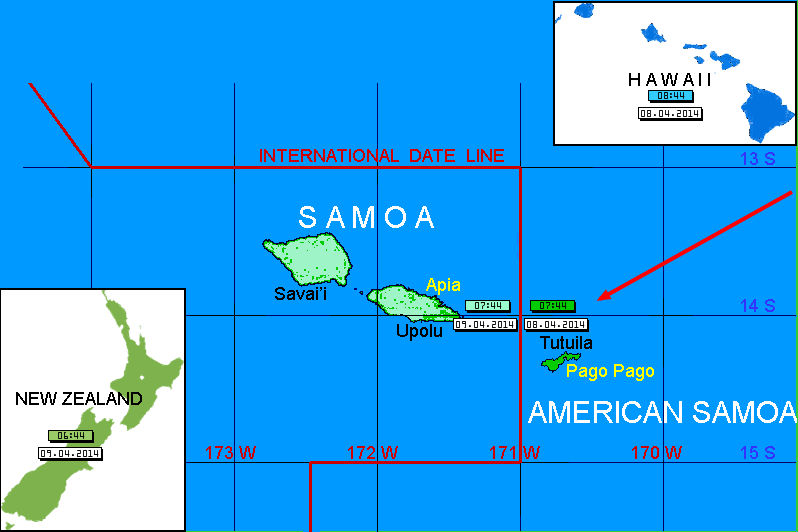
Although separated by only 164 kilometers of ocean, Samoa and American Samoa operate on a 24-hour time difference. Samoa sits west of the International Date Line at UTC+13, while American Samoa remains to the east at UTC-11. They share...
Although separated by only 164 kilometers of ocean, Samoa and American Samoa operate on a 24-hour time difference. Samoa sits west of the International Date Line at UTC+13, while American Samoa remains to the east at UTC-11. They share the same clock time but exist on different calendar days.
Contents
The temporal divide between the Independent State of Samoa (formerly Western Samoa) and the United States territory of American Samoa is one of the most significant geographical and chronological anomalies in the world. While residents on both sides of the divide can technically see the same sunset across the same stretch of the Pacific Ocean, they do so on different dates. Understanding this difference requires a look at the International Date Line (IDL), historical economic shifts, and the specific UTC offsets that govern these island groups in 2026.
The Geographical Paradox of the Samoan Islands
The Samoan archipelago is a chain of islands in the South Pacific, divided politically into two entities. To the west lies the Independent State of Samoa, a sovereign nation consisting primarily of the islands of Upolu and Savai'i. To the east lies American Samoa, an unincorporated territory of the United States, centered around the island of Tutuila.
In physical distance, the leap from Apia (the capital of Samoa) to Pago Pago (the capital of American Samoa) is negligible—roughly a 35-minute flight. However, in terms of global positioning for timekeeping, the two are worlds apart. As of 2026, the International Date Line snakes between these two island groups, creating a "time curtain" that separates today from tomorrow.
The 2011 International Date Line Shift
The primary reason for the current 24-hour gap is a strategic move made by the Independent State of Samoa in late 2011. For 119 years prior, Samoa had been on the same side of the International Date Line as the United States. This arrangement dated back to 1892, when King Laupepa was persuaded by American merchants to shift the country’s time to align with trade partners in San Francisco.
However, by the early 21st century, Samoa’s economic reality had shifted. The nation’s most vital trading partners were no longer in North America but were instead its closest neighbors: Australia, New Zealand, and China. Being 21 to 23 hours behind Sydney and Auckland meant that Samoa lost two working days every week. When it was Friday in Samoa, it was already Saturday in Australia. When Australia returned to work on Monday, it was still Sunday in Samoa.
To rectify this, the Samoan government passed the Line Order Act. At the end of December 29, 2011, Samoa skipped December 30 entirely, jumping straight to December 31. This moved the nation from the east of the International Date Line (UTC-11) to the west (UTC+13). Tokelau, a territory of New Zealand, followed suit for similar reasons.
Why American Samoa Stayed Behind
While the Independent State of Samoa moved west to embrace its future with Australasia, American Samoa chose to remain at UTC-11. As a territory of the United States, its primary administrative, legal, and economic ties are with the U.S. mainland, particularly Hawaii and the West Coast.
By remaining east of the Date Line, American Samoa maintains a closer chronological connection to the United States. For example, when it is midday on Monday in American Samoa (UTC-11), it is 1:00 PM in Honolulu (UTC-10) and 3:00 PM or 4:00 PM on the U.S. West Coast, depending on Daylight Saving Time. If American Samoa had moved with its western neighbor, it would be Tuesday morning while Washington D.C. was still finishing its Monday afternoon, complicating federal communications and administrative synchronization.
Technical Breakdown: UTC+13 vs. UTC-11
To understand the mechanics of the difference in 2026, one must look at the Coordinated Universal Time (UTC) offsets. UTC is the primary time standard by which the world regulates clocks and time.
- Samoa (Independent State): Operates at UTC+13.
- American Samoa: Operates at UTC-11.
The mathematical difference between +13 and -11 is exactly 24 hours. This leads to a unique situation where the clock time—the hour and the minute—is identical in both Apia and Pago Pago. If a traveler in Apia looks at their watch at 10:00 AM on a Tuesday, a person in Pago Pago is also looking at 10:00 AM, but their calendar reads Monday.
The End of Daylight Saving Time in Samoa
A common source of confusion in previous years was the use of Daylight Saving Time (DST) in the Independent State of Samoa. From 2010 to 2021, Samoa observed DST, shifting to UTC+14 during the southern hemisphere summer. This created a 25-hour difference with American Samoa (which does not observe DST).
However, in September 2021, the Samoan government announced the abolition of Daylight Saving Time. The decision was based on several factors, including public health concerns regarding sleep patterns and the lack of significant energy savings. Consequently, as of 2026, Samoa remains at a constant UTC+13 year-round. This has simplified regional logistics, as the 24-hour difference between the two Samoas is now consistent throughout the year.
Comparative Overview of Time and Date
The following table illustrates how the days and times align between the two locations. This is particularly useful for businesses and travelers planning cross-border activities.
| Event / Location | Independent State of Samoa (Apia) | American Samoa (Pago Pago) | Time Difference |
|---|---|---|---|
| Standard Time Zone | UTC+13 | UTC-11 | 24 Hours |
| Date Line Position | West of IDL (Tomorrow) | East of IDL (Yesterday) | 1 Day |
| Example: Monday Morning | Monday 8:00 AM | Sunday 8:00 AM | 24 Hours |
| Example: New Year's Eve | Jan 1, 12:00 AM (First to celebrate) | Dec 31, 12:00 AM (24 hours to go) | 24 Hours |
| Business Week Start | Monday 9:00 AM | Sunday 9:00 AM | 24 Hours |
| Weekend Overlap | Saturday (Samoa) is Friday (Am. Samoa) | Sunday (Samoa) is Saturday (Am. Samoa) | 24 Hours |
Practical Implications for Travel and Business
The 24-hour time difference creates unique scenarios for logistics and tourism. These are not merely academic curiosities; they dictate the flow of commerce and daily life in the region.
The "Time Travel" Flight
One of the most famous tourist experiences in the region is the flight between Faleolo International Airport (W. Samoa) and Pago Pago International Airport (Am. Samoa). Because the flight takes roughly 35 minutes but crosses the International Date Line, travelers can effectively "travel back in time." A passenger departing Samoa on Tuesday morning will land in American Samoa on Monday morning, often arriving "before" they departed according to the local calendar.
Scheduling and Communication
For businesses operating in both jurisdictions, the calendar offset is a significant hurdle. There are only four days a week where the business workdays overlap:
- Samoa's Tuesday through Friday corresponds to American Samoa's Monday through Thursday.
- When it is Monday in Samoa, it is Sunday in American Samoa (offices closed).
- When it is Friday in American Samoa, it is Saturday in Samoa (offices closed).
This leaves a narrow window for real-time collaboration. Most professional organizations in the region utilize asynchronous communication or schedule critical meetings during the mid-week "sweet spot."
Religious Observances
The time zone shift of 2011 also created complexities for religious groups, particularly those who observe a specific Sabbath. For Seventh-day Adventists and other denominations that prioritize Saturday or Sunday worship, the question arose: does the "Sabbath" follow the sun or the calendar? If the country skipped Friday, did the seventh day of the week also skip a day, or should believers continue to count every seventh day regardless of the new calendar? This led to varied practices among different congregations in Apia, with some moving their worship day to align with the new calendar and others maintaining the "original" seven-day cycle.
Common Misconceptions
When researching the Samoa time difference, several myths frequently appear. It is important to clarify these using the current standards of 2026.
- "They are only one hour apart." This is incorrect. While the clocks show the same minutes and hours, they are 24 hours apart. A one-hour difference occurs between American Samoa and Hawaii, or between Samoa and Fiji during certain times of the year, but not between the two Samoas.
- "Samoa is the first place to see the sun." While Samoa (UTC+13) is among the first, parts of Kiribati (UTC+14) actually see the new day earliest. However, Samoa is significantly ahead of most of the world.
- "The Date Line is a straight line." The International Date Line is not a physical or legal entity defined by international law; it is a matter of custom and national sovereignty. Each country chooses which side it wants to be on, which is why the line "zigs and zags" around the Samoan islands.
FAQ: Navigating the Samoan Time Gap
Can I celebrate the same birthday twice in the Samoas?
Yes. This is a popular activity for travelers. You can celebrate your birthday in the Independent State of Samoa, then take a short flight to American Samoa later that day. Because you cross the International Date Line moving east, you will arrive back in the previous day, allowing you to celebrate the same date all over again.
Does American Samoa ever plan to join the same time zone as Samoa?
Currently, there is no significant political movement in American Samoa to change its time zone. The territory's reliance on U.S. federal systems, banking, and air traffic control makes staying aligned with the United States more practical than aligning with its western neighbor.
How does the time difference affect shipping and freight?
Shipping companies must be extremely precise with "Expected Time of Arrival" (ETA) notices. A ship traveling from Apia to Pago Pago might depart on the 10th and arrive on the 9th. Logistics software used in the region is specifically configured to handle "Date Line crossings" to prevent errors in customs processing and warehouse scheduling.
Which Samoa is "ahead" in time?
The Independent State of Samoa is ahead. It is one of the first countries in the world to start a new day. American Samoa is "behind" and is one of the last places on Earth to finish a day.
Are there any other places with a similar 24-hour gap?
The most similar situation exists between the Diomede Islands in the Bering Strait. Big Diomede (Russia) and Little Diomede (USA) are only about 3.8 kilometers apart, but they have a 21 to 23-hour time difference because the International Date Line passes between them. However, the Samoan example is more prominent due to the larger populations and frequent travel between the islands.
Recommendations for Travelers and Coordinators
If you are planning to interact with both Samoa and American Samoa in 2026, keep these practical steps in mind:
- Double-Check Hotel Bookings: When flying from Apia to Pago Pago, ensure your hotel reservation in American Samoa is for the night before you think it should be. You will land on the previous calendar day.
- Sync Digital Calendars: Use tools like Google Calendar or Outlook that allow for "Time Zone" settings. Specifically, set one event to "Samoa Time" and the other to "Samoa Standard Time (American Samoa)" to see how they overlay.
- Verify Holiday Dates: Public holidays often fall on different days. For example, American Samoa celebrates U.S. federal holidays like Thanksgiving or the 4th of July, which are not observed in the Independent State. Conversely, Samoa has its own Independence Day and religious holidays that may not align.
By recognizing that the 24-hour difference is a permanent fixture of the region's geography and politics, you can navigate the "Samoan time warp" with ease and precision.
Image Gallery