Best Loans for Credit Card Debt: How to Consolidate High-Interest Balances in 2026
The best loans for credit card debt are fixed-rate personal consolidation loans that offer significantly lower annual percentage rates (APRs) than your existing credit cards. Consolidating combines multiple revolving balances into a si...
The best loans for credit card debt are fixed-rate personal consolidation loans that offer significantly lower annual percentage rates (APRs) than your existing credit cards. Consolidating combines multiple revolving balances into a single structured monthly payment, lowering overall interest costs, establishing a clear payoff date, and accelerating your path toward financial independence.
Contents
Understanding How Debt Consolidation Loans Work
Carrying balances across multiple credit cards often exposes consumers to compound interest rates exceeding 20% to 30% APR. Because credit cards operate as revolving credit, monthly minimum payments primarily cover accruing interest rather than reducing the principal balance. This structure can trap borrowers in decades-long repayment cycles.
A debt consolidation loan replaces revolving credit card balances with a single fixed-rate installment loan. When you take out a consolidation loan, the lender disburses funds to pay off your specified credit card accounts. Moving forward, you make one fixed monthly payment to the new lender over a set period, typically ranging from two to seven years.
- REVOLVING CREDIT CARD DEBT
- Card A (24% APR) + Card B (28% APR) + Card C (21% APR)
- Variable Rates | Compounding Interest | Indefinite Payoff Timeline
- DEBT CONSOLIDATION LOAN
- SINGLE INSTALLMENT LOAN
- One Fixed Rate (e.g., 9.5% APR) | One Fixed Monthly Payment
- Defined Amortization Term (e.g., 36 or 60 Months)
The mathematical benefit of debt consolidation relies on securing a loan APR that is substantially lower than the average weighted interest rate across your credit cards. According to the Federal Reserve Board, average commercial bank credit card rates routinely remain near historical highs, whereas personal loan rates for qualified borrowers are noticeably lower.
Lowering your APR ensures that a larger portion of your monthly payment directly reduces your principal balance from day one, cutting years off your debt timeline and saving thousands of dollars in cumulative interest.
Top Loan Options for Paying Off Credit Card Debt
Selecting the right financial instrument depends on your credit profile, available collateral, and total balance size. Borrowers seeking to eliminate credit card debt generally choose among four primary loan categories.
1. Unsecured Personal Loans
Unsecured personal loans represent the most common method for consolidating credit card debt. Because these loans do not require collateral—such as a home or vehicle—eligibility and interest rates are determined primarily by your credit score, income, debt-to-income (DTI) ratio, and financial history.
- Best For: Borrowers with good-to-excellent credit (FICO scores of 670 or higher) seeking fixed monthly payments without putting personal assets at risk.
- Key Advantages: Fixed interest rates, predictable payment schedules, rapid disbursement timelines (often within 24 to 48 hours), and no risk of asset forfeiture.
- Key Disadvantages: Borrowers with fair or poor credit face significantly higher interest rates and origination fees, which can reduce overall savings.
2. Home Equity Loans and HELOCs
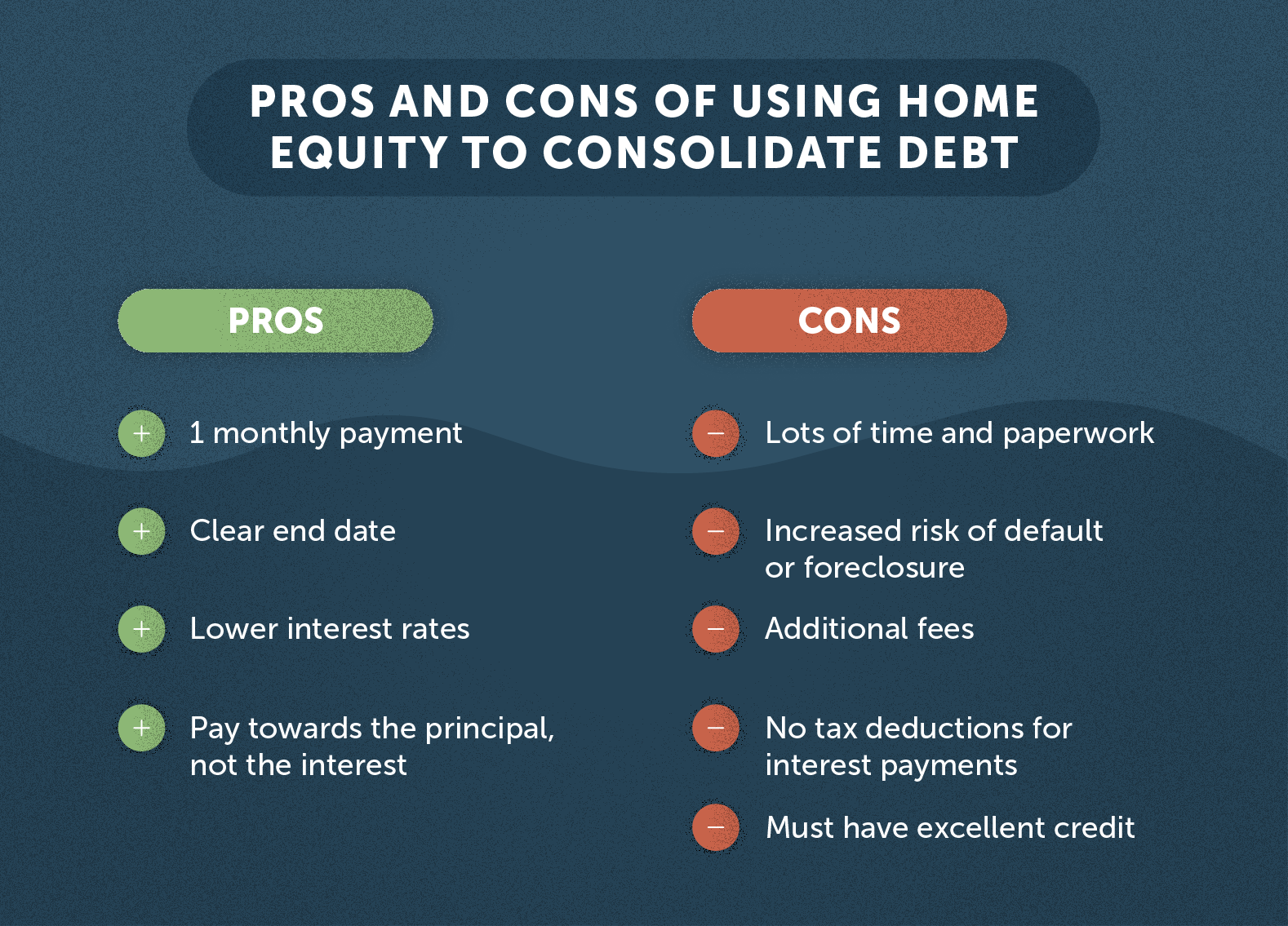
Homeowners can leverage their accumulated home equity to secure a consolidation loan through a fixed-rate home equity loan or a home equity line of credit (HELOC). Because these loans are secured by real estate, lenders face less risk and can offer substantially lower APRs than unsecured personal loans.
- Best For: Homeowners with substantial equity who need to consolidate large credit card balances (exceeding $30,000) and want the lowest possible interest rate.
- Key Advantages: Significantly lower interest rates compared to unsecured personal loans; access to larger borrowing amounts.
- Key Disadvantages: Your home serves as collateral. Failing to make payments risks foreclosure. Additionally, closing costs and lengthy underwriting procedures can slow down access to funds.
3. Balance Transfer Credit Cards
While technically a revolving credit line rather than a traditional loan, 0% APR balance transfer credit cards serve a similar functional purpose. These cards offer an introductory 0% APR period—typically lasting 12 to 21 months—on balances transferred from other banks.
- Best For: Debtors with good-to-excellent credit who can realistically pay off their entire balance within the 0% APR promotional period.
- Key Advantages: Complete elimination of interest charges during the promotional window, allowing 100% of monthly payments to reduce principal.
- Key Disadvantages: Balance transfer fees (usually 3% to 5% of the transferred amount) apply up front. If the balance is not fully repaid before the promotional period expires, the remaining balance triggers standard credit card interest rates.
4. 401(k) Loans
If your employer's retirement plan rules permit, you can borrow up to 50% of your vested 401(k) balance (up to a maximum of $50,000). You pay the principal and interest back into your own retirement account via automatic payroll deductions.
- Best For: Individuals with low credit scores who have built up significant retirement savings and lack access to competitive unsecured loan rates.
- Key Advantages: No credit check required, low interest rates, and interest payments return to your own retirement funds.
- Key Disadvantages: Borrowed capital misses out on market growth. If you leave your employer, the full loan balance usually becomes due on a shortened schedule; failure to repay results in income tax penalties and early withdrawal fees assessed by the Internal Revenue Service.
Key Factors to Compare Before Choosing a Consolidation Loan
Evaluating consolidation loans requires looking beyond advertised starting rates. Lenders structure loans differently, and hidden costs can diminish expected savings if left unexamined.
- ANNUAL PERCENTAGE RATE (APR)
- Nominal Interest Rate (Base Cost of Money)
- Origination Fee (1% to 10% Deducted)
Annual Percentage Rate (APR) vs. Nominal Rate
Always compare lenders based on Annual Percentage Rate (APR) rather than base interest rates. The APR reflects the true annual cost of borrowing, including the baseline interest rate alongside upfront finance fees, such as origination fees.
Origination Fees
Many personal loan providers charge an upfront origination fee ranging from 1% to 10% of the loan amount. This fee is typically deducted from loan proceeds before disbursement. For instance, if you borrow $20,000 with a 5% origination fee, you will receive $19,000 in net cash while remaining responsible for repaying the full $20,000 principal balance. Ensure your loan total accounts for any origination fee so you receive enough net proceeds to cover your full credit card balances.
Repayment Term Length
Personal loan terms generally span 24, 36, 48, 60, or 72 months. Choosing a longer term lowers your mandatory monthly payment, which provides immediate cash flow relief. However, extending the repayment window increases the total interest paid over the life of the loan. Select the shortest loan term that yields a comfortable monthly payment.
Direct Payoff Services
Select lenders offer direct creditor payoff services. During loan funding, the lender sends funds directly to your credit card issuers to settle your account balances, rather than depositing cash into your bank account. This automated distribution minimizes the temptation to spend loan proceeds on non-essential expenses.
Comprehensive Comparison of Consolidation Loan Options
The table below highlights key functional differences across primary debt consolidation methods:
| Loan Type | Typical APR Range | Credit Score Requirement | Origination / Setup Fees | Primary Advantage | Major Risk or Drawback |
|---|---|---|---|---|---|
| Unsecured Personal Loan | 6.99% – 35.99% | Fair to Excellent (580–850) | 0% – 10% of loan total | Predictable fixed monthly payments; no collateral needed | High interest rates and fees for lower-tier credit scores |
| Balance Transfer Card | 0% Intro (then 18% – 29%) | Good to Excellent (670–850) | 3% – 5% transfer fee | 0% interest for up to 21 months | Standard high rates apply to remaining balance after promo period |
| Home Equity Loan / HELOC | 6.50% – 12.00% | Good to Excellent (660–850) | $0 – $2,000 (closing costs) | Significantly lower interest rates for large balances | Real estate pledged as collateral; risk of foreclosure |
| 401(k) Loan | Prime + 1% to 2% | None (No credit check) | Minimal administrative fee | Interest paid back to own account; no credit inquiry | Opportunity cost of lost market gains; tax penalties if unpaid upon job exit |
Step-by-Step Guide: How to Apply for a Debt Consolidation Loan
Successfully consolidating credit card debt requires systematic planning. Executing the following steps helps ensure you secure maximum interest savings while protecting your long-term credit profile.
- Step 1: Audit Balances & APRs
- Step 2: Check Credit Profile
- Step 3: Pre-Qualify (Soft Checks)
- Step 4: Calculate Total Costs
- Step 5: Formally Apply & Pay Off
- Step 6: Repay & Protect Credit
Step 1: Audit Your Current Credit Card Balances
Compile a list of every active credit card balance. Document the following details for each account:
- Current outstanding balance
- Current variable APR
- Minimum monthly payment requirement
Calculate your aggregate debt total and determine your weighted average interest rate. This figure serves as your target threshold; any consolidation loan you accept must feature an APR noticeably below this average to make consolidation worthwhile.
Step 2: Review Your Credit Score and Credit Reports
Obtain your credit reports from AnnualCreditReport.com, the free federally authorized platform managed by Equifax, Experian, and TransUnion under the Fair Credit Reporting Act. Review your records for errors, duplicate balances, or outdated collection notices. Correcting inaccuracies before applying for a loan can improve your overall credit score tier and qualify you for better interest rates.
Step 3: Get Pre-Qualified with Multiple Lenders
Most modern online lenders offer a soft credit check pre-qualification process. Pre-qualification estimates your potential loan amount, APR, and term options without negatively impacting your credit score. Request pre-qualification offers from at least three to five distinct institutions, including online lenders, local credit unions, and national banks.
Step 4: Compare True Costs and Select a Loan Structure
Evaluate pre-qualification offers using net math rather than baseline rate advertising:
- Subtract all upfront origination fees from the initial loan amount to confirm net proceeds will cover your credit card debt.
- Multiply your estimated monthly payment by the total number of repayment months to calculate the total cost of loan performance.
- Compare the total loan cost against your projected cost of staying on your existing credit card repayment trajectory.
Step 5: Formally Apply and Complete Creditor Payoffs
Select your preferred lender and submit a formal application. This stage triggers a hard credit inquiry, which temporarily dips your credit score by a few points. Submit required documentation, including pay stubs, W-2 forms, tax returns, and government identification.
Once approved, request that the lender utilize direct payoff to settle your credit card balances. If direct payoff is unavailable, transfer the disbursed funds directly to your credit card accounts immediately upon receipt. Confirm that every card shows a zero balance.
Step 6: Maintain Healthy Financial Habits
Once your credit card balances hit zero, resist the urge to close the accounts unless they carry expensive annual fees. Keeping your accounts open preserves your credit history length and increases your total available credit line, which lowers your credit utilization ratio. Avoid using those cards for new revolving purchases while paying down your consolidation loan.
How Debt Consolidation Affects Your Credit Score
Consolidating credit card debt alters your credit score profile in stages, delivering a short-term initial dip followed by long-term structural credit growth.
- Credit Score Trajectory Over Time
- Baseline Score
- Short-Term Dip (Hard Inquiry & New Account)
- Long-Term Improvement (Lower Utilization & On-Time Payments)
Short-Term Effects (0 to 90 Days)
- Hard Inquiry Impact: Formally applying for a consolidation loan prompts a hard inquiry on your credit reports, typically dropping your FICO score by 3 to 8 points.
- Average Age of Accounts: Adding a new credit account reduces the overall average age of your credit history, which accounts for 15% of your FICO score calculation.
Medium- to Long-Term Effects (3 Months and Beyond)
- Credit Utilization Drop: Revolving credit utilization accounts for 30% of your FICO score. Personal loans are classified as installment debt rather than revolving credit. Transferring balances from credit cards to an installment loan instantly reduces your revolving utilization ratio to 0%, often yielding a significant credit score boost within one to two billing cycles.
- Diversified Credit Mix: Adding an installment loan to a profile previously dominated by credit cards diversifies your credit mix, which accounts for 10% of your credit score.
- On-Time Payment History: Making consistent, on-time monthly payments on your installment loan builds a solid payment history—the single largest factor (35%) in consumer credit scoring models.
Common Pitfalls to Avoid
While debt consolidation provides an effective structured strategy for eliminating debt, several operational mistakes can compromise your progress.
- Running Up New Card Balances (The Re-Amortization Cycle): Paying off credit cards frees up revolving credit limits. Accumulating new charges on cleared cards while managing a new consolidation loan doubles your overall debt load and can lead to financial distress.
- Focusing Exclusively on Monthly Payment Size: Choosing a long 72-month loan term reduces your monthly payment obligation, but it can increase the total cumulative interest paid over the life of the loan. Make sure your target loan reduces total borrowing costs, not just monthly cash requirements.
- Ignoring Prepayment Penalties: Select lenders charge prepayment penalties if you pay off your loan early. Review loan terms carefully to ensure you can make extra principal payments or settle the loan balance early without incurring fees.
Alternatives to Debt Consolidation Loans
If high interest rates, poor credit scores, or high debt-to-income ratios make securing a debt consolidation loan unviable, consider alternative strategies:
Debt Management Plans (DMPs)
Nonprofit credit counseling agencies offer Debt Management Plans. Under a DMP, the agency negotiates directly with your credit card companies to lower interest rates and waive fee penalties. You make a single consolidated monthly payment to the credit counseling organization, which disburses funds to your creditors over three to five years. DMPs do not require loan approval or good credit scores, though accounts included in the program are typically closed to future purchases.
Debt Settlement
Debt settlement involves negotiating with creditors to accept a lump-sum payment that is less than the total balance owed. While settlement reduces principal obligations, it requires allowing accounts to become severely delinquent first. This creates long-lasting negative entries on your credit report and can carry taxable income liabilities on forgiven balances.
Chapter 7 or Chapter 13 Bankruptcy
When total consumer debt exceeds 50% of annual gross income and cannot realistically be repaid within five years, legal bankruptcy protection through federal courts offers a formal mechanism to discharge debts or restructure obligations under court oversight.
Frequently Asked Questions
What credit score is required to get a debt consolidation loan?
Most personal loan providers require a minimum credit score of 580 to 600 for approval. However, securing interest rates low enough to beat average credit card APRs typically requires a credit score of 670 (Good) or higher. Applicants with scores above 740 receive the lowest advertised APRs and minimal origination fees.
Is it better to get a personal loan or use a 0% APR balance transfer card?
A 0% APR balance transfer card is usually the more cost-effective choice if your total debt balance is small enough to pay off completely within the 12-to-21-month promotional period, even after accounting for the upfront transfer fee. If your balance requires 24 to 84 months to clear, a fixed-rate personal loan provides greater long-term stability and protects you from steep APR spikes when promotional periods expire.
Can I get a debt consolidation loan with bad credit?
Yes, options exist for bad-credit applicants (FICO scores below 580), including secured personal loans (backed by a vehicle or savings account), co-signed loans, or debt management plans offered by nonprofit counseling agencies. However, unsecured bad-credit consolidation loans often carry APRs up to 35.99% plus high origination fees, which may negate any financial benefit.
Will taking out a consolidation loan close my credit cards automatically?
No. Paying off a credit card balance with loan funds leaves the account open with a zero balance. Unless you call the card issuer to request account closure, the credit line remains active. Keeping accounts open with zero balances is generally recommended to maximize your total available credit and improve your credit utilization ratio.
Are personal loan origination fees negotiable?
Origination fees charged by direct online lenders are generally non-negotiable automated risk assessments based on your credit score and DTI ratio. However, you can effectively avoid these costs by comparing multiple lenders and opting for financial institutions—such as many credit unions and select online banks—that explicitly offer no-origination-fee personal loans.
Practical Action Steps
If high-interest credit card debt is slowing your financial progress, take these immediate actions:
- Calculate Your Base Target: Total your existing credit card balances, calculate your weighted average interest rate, and establish a clear monthly budget target.
- Request Pre-Qualifications: Apply for soft-check pre-qualifications across three distinct online lenders and a local credit union to review real APR offers without harming your credit score.
- Confirm True Savings: Select the loan option with the lowest overall cost—taking APR, origination fees, and repayment terms into account—and execute a direct-payoff strategy to settle your credit card balances cleanly.
Disclaimer: This article provides general financial educational information and does not constitute formal legal, tax, or investment advice. Interest rates, fee structures, and credit requirements vary by lender and individual borrower profiles. Consult a certified financial planner or credit counselor to evaluate strategies tailored to your financial situation.
Image Gallery