Understanding Edward Jones CD Rates: A Comprehensive Guide for 2026 Investors
To understand Edward Jones CD rates, it is essential to recognize that the firm offers brokered CDs rather than traditional bank CDs. These rates are determined by the yields offered by various third-party banks nationwide, which Edwar...
To understand Edward Jones CD rates, it is essential to recognize that the firm offers brokered CDs rather than traditional bank CDs. These rates are determined by the yields offered by various third-party banks nationwide, which Edward Jones aggregates for its clients. Consequently, these rates often exceed those of local brick-and-mortar banks, reflecting the competitive national market, though they are subject to fluctuations based on Federal Reserve policy and secondary market demand.
Contents
For investors seeking stability in 2026, Certificates of Deposit (CDs) remain a cornerstone of conservative portfolio management. However, when you step into the world of a major brokerage like Edward Jones, the mechanics of a CD change significantly compared to what you might find at a local credit union. Understanding these rates requires a deep dive into the nature of brokered certificates, the impact of the current interest rate environment, and the specific structural nuances of the Edward Jones platform.
What Defines Edward Jones CD Rates?
Edward Jones does not function as a bank; rather, it is a broker-dealer. This distinction is the most critical factor in how their CD rates are established. When you "buy a CD" through Edward Jones, you are actually purchasing a portion of a larger deposit placed with an FDIC-insured institution. Because Edward Jones has access to a vast network of issuing banks, they can shop for the highest available yields across the country.
In 2026, these rates are influenced by several macroeconomic factors:
- The Federal Funds Rate: The primary driver of all fixed-income yields.
- Issuer Competition: Banks across the United States compete for liquidity, leading them to offer higher rates to brokerage firms to attract large-scale capital.
- Term Length: Historically, longer-term CDs (e.g., 5-year or 10-year) offer higher rates than short-term (e.g., 3-month or 6-month) options, though this "yield curve" can invert during periods of economic uncertainty.
Because these are brokered products, the rates you see on your Edward Jones statement or website are "net yields." This means the compensation for the firm is typically built into the price or the yield offered by the issuing bank, rather than charged as a separate visible commission to the retail investor.
The Core Mechanism: Brokered CDs Explained
To understand the rates, one must understand the product. A brokered CD is a certificate of deposit that is issued by a bank and then sold to investors through a brokerage firm. This differs from a "direct CD," which you purchase directly from the bank that holds the money.
Liquidity and the Secondary Market
One of the most misunderstood aspects of Edward Jones CD rates is how they interact with liquidity. With a bank CD, if you need your money early, you pay an Early Withdrawal Penalty (EWP), often calculated as three to six months of interest.
With an Edward Jones brokered CD, there is typically no "early withdrawal" option through the issuing bank. Instead, you must sell the CD on the secondary market. The "rate" you locked in at purchase remains the same, but the market value of the CD will fluctuate. If interest rates have risen since you bought your CD, your CD’s value on the secondary market will likely decrease, potentially resulting in a loss of principal if sold before maturity. Conversely, if rates have fallen, your CD could be worth more than its face value.
FDIC Insurance Limits
Edward Jones rates are often attractive to high-net-worth individuals because of how they handle FDIC insurance. While a single bank limits FDIC coverage to $250,000 per depositor, per ownership category, Edward Jones can spread a multi-million dollar investment across dozens of different banks. Because each CD is issued by a different institution, the investor maintains full FDIC protection across the entire balance, provided no more than $250,000 is placed with any single issuing bank.
How to Find Current Edward Jones CD Rates in 2026
Edward Jones provides several avenues for clients to monitor current yields. It is important to note that brokered CD rates can change daily—sometimes even hourly—based on market demand and the availability of specific issues.
- The Edward Jones Client Portal: Active clients can log into their accounts to see the "New Issue" CD inventory. This list displays the current yields, the issuing bank, and the maturity date.
- Consultation with a Financial Advisor: The hallmark of the Edward Jones model is the individual advisor. Advisors have access to real-time inventory screens that show both new-issue CDs and secondary-market CDs.
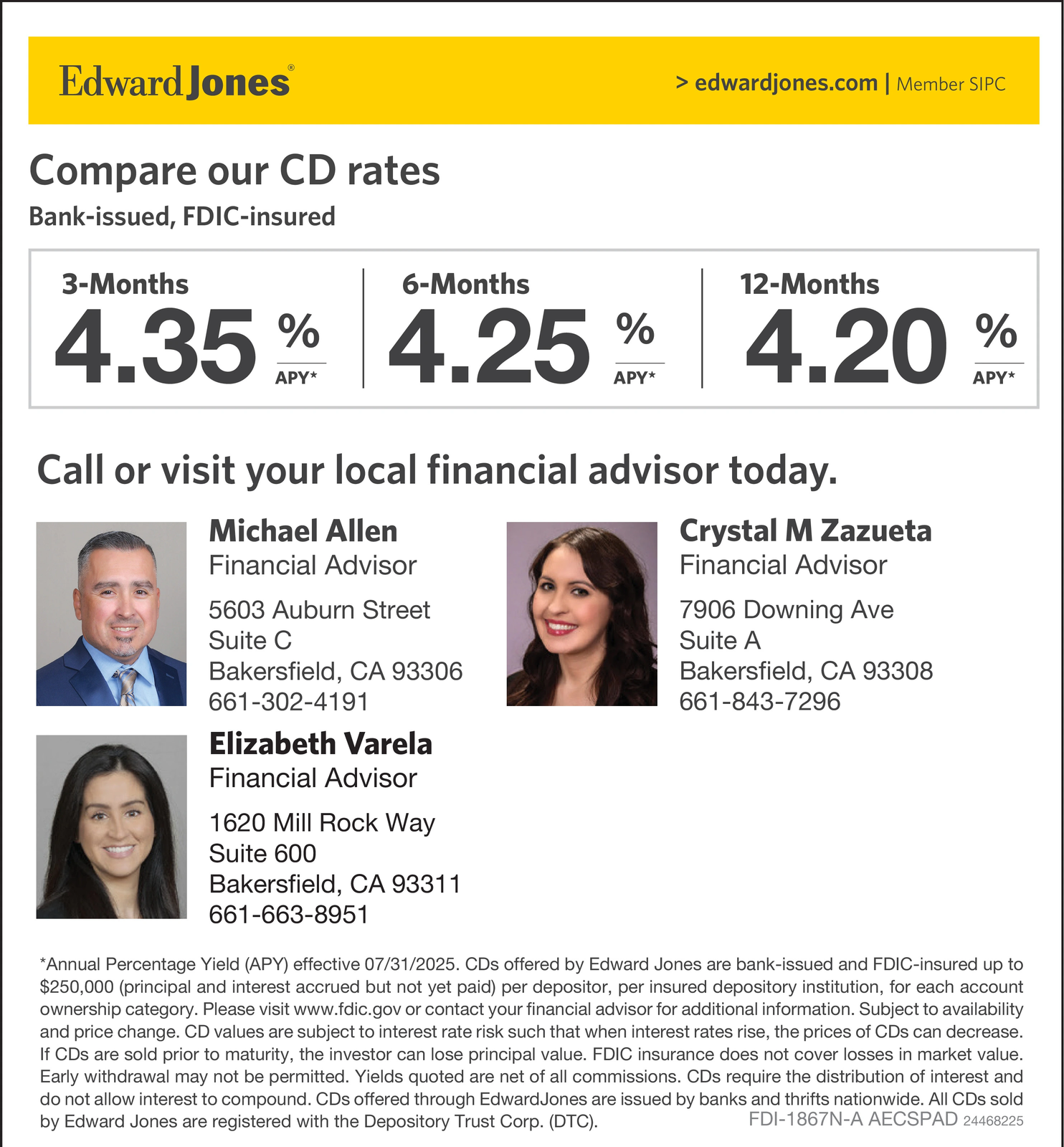
- Public Website Listings: Edward Jones frequently publishes a "Rates" page that provides a snapshot of current yields for various terms (3-month, 6-month, 1-year, etc.). However, these are often "indicative rates" and may vary based on the specific amount invested or the availability of the product at the moment of execution.
Callable CDs: A Higher Yield with a Catch
When browsing Edward Jones CD rates, you will often notice some yields that are significantly higher than others for the same term. These are usually Callable CDs.
A callable CD gives the issuing bank the right, but not the obligation, to "call" or redeem the CD before it reaches its full maturity date. For example, if you buy a 5-year CD that is "callable after 1 year," and interest rates drop significantly, the bank will likely call the CD, pay you your principal and earned interest, and stop the investment. You are then forced to reinvest your money at the now-lower current market rates.
To compensate investors for this "call risk," banks offer a higher initial interest rate. When evaluating Edward Jones rates, always check the "Call Protected" status. If a CD is call-protected, the bank cannot take it back early, providing you with more certainty for your long-term planning.
Comparing Brokered CDs vs. Traditional Bank CDs
To make an informed decision, it is helpful to see how the Edward Jones offering compares to a standard savings institution.
| Feature | Edward Jones (Brokered) CD | Traditional Bank (Direct) CD |
|---|---|---|
| Yield Source | National market (multiple banks) | Single bank's internal pricing |
| Early Access | Sell on secondary market (Market value risk) | Early Withdrawal Penalty (Predictable cost) |
| FDIC Coverage | Can exceed $250k through multiple issuers | Limited to $250k per institution |
| Acquisition | Through a Financial Advisor or Brokerage | Direct at bank branch or website |
| Interest Payment | Monthly, Quarterly, or at Maturity | Monthly, Quarterly, or at Maturity |
| Callability | Often available (higher rates) | Rarely available |
Strategy: Building a CD Ladder at Edward Jones
Given that CD rates in 2026 may be volatile, many Edward Jones advisors recommend a "laddering" strategy. This involves spreading an investment across multiple CDs with different maturity dates. For example, instead of putting $100,000 into a single 5-year CD, an investor might put $20,000 into a 1-year, 2-year, 3-year, 4-year, and 5-year CD respectively.
As each CD matures, the investor has the option to:
- Access the cash without penalty or market loss.
- Reinvest the funds into a new 5-year CD at the then-current rates.
This strategy helps mitigate interest rate risk. If rates rise, you have money maturing soon that can be reinvested at higher yields. If rates fall, you have longer-term CDs locked in at the previous, higher rates. The brokered platform at Edward Jones is particularly well-suited for this because all these different CDs from different banks appear on a single consolidated statement.
Potential Risks and Considerations
While CD rates at Edward Jones are generally considered "safe" due to FDIC insurance, they are not without risks:
- Inflation Risk: If the CD rate is 4% but inflation is 5%, the "real" purchasing power of your money is actually decreasing.
- Market Risk: As mentioned, selling before maturity on the secondary market can lead to a loss of principal if rates have risen.
- Opportunity Cost: Locking funds into a CD prevents you from investing in other assets, like stocks or bonds, which may offer higher long-term returns.
Investors should also be aware of "step-up" CDs, where the interest rate increases at pre-set intervals. While these look attractive, the initial rate is often lower than a standard fixed-rate CD, so calculating the Annual Percentage Yield (APY) over the full life of the CD is essential.
Summary of Next Actions
If you are considering investing based on current Edward Jones CD rates, follow these steps:
- Determine your timeline: Only invest funds in a CD that you do not anticipate needing before the maturity date to avoid secondary market fluctuations.
- Check for Callability: Decide if you are willing to accept the risk of the bank redeeming your CD early in exchange for a higher rate.
- Verify FDIC Insurance: Ensure that your total deposits at any one issuing bank (including funds you might already have at that bank outside of Edward Jones) do not exceed $250,000.
- Compare APYs: Always look at the Annual Percentage Yield, which accounts for the effect of compounding interest, rather than just the base interest rate.
Frequently Asked Questions
Are Edward Jones CD rates better than bank rates? Generally, Edward Jones CD rates are higher than those at major national "big-box" banks because Edward Jones can source CDs from smaller, regional banks across the country that are hungry for deposits and willing to pay a premium. However, they may be comparable to the top-tier rates found at online-only banks.
Is there a fee to buy CDs at Edward Jones? For "new issue" CDs, there is typically no explicit transaction fee charged to the client. The issuing bank pays the brokerage firm a "concession" or commission, which is already factored into the yield you see. For secondary market CDs, there may be a markup or markdown included in the price.
Can I lose money in an Edward Jones CD? If you hold the CD until maturity, your principal is protected by the issuing bank and backed by FDIC insurance (up to limits). You only face a risk of losing principal if the issuing bank fails and your deposit exceeds FDIC limits, or if you choose to sell the CD on the secondary market before it matures during a period of rising interest rates.
How often is interest paid on these CDs? Interest payment schedules vary by the specific CD. Some pay monthly, others semi-annually, and some only at maturity. When you view the rate with your advisor, you can specify your preference for cash flow.
What happens when my Edward Jones CD matures? Upon maturity, the principal and any remaining interest are typically deposited into your Edward Jones "Cash Account" or "Money Market" sweep account. Unlike some banks, brokered CDs do not usually "auto-renew" into a new CD; you must actively choose a new investment.
Specific Recommendation: For most conservative investors in 2026, a non-callable, laddered CD strategy at Edward Jones offers the best balance of yield and flexibility. This avoids the risk of having your high-yield investments taken back by banks if rates fall, while providing regular liquidity intervals. Always request a "CD Inventory Report" from your advisor to compare the different issuing banks and their respective ratings before committing capital.
Disclaimer: This information is for educational purposes only and does not constitute financial, legal, or tax advice. Interest rates and financial regulations are subject to change. Consult with a qualified financial professional before making investment decisions. FDIC insurance covers the failure of an insured bank, not market losses or brokerage firm failure.
Image Gallery