How Hot Does Water Boil in Everyday Cooking? The Science of Kitchen Temperatures
Under standard atmospheric pressure at sea level, water boils at exactly 212°F (100°C). However, in everyday cooking, the actual temperature at which water boils varies based on elevation, ambient air pressure, dissolved ingredients li...
Under standard atmospheric pressure at sea level, water boils at exactly 212°F (100°C). However, in everyday cooking, the actual temperature at which water boils varies based on elevation, ambient air pressure, dissolved ingredients like salt or sugar, and whether the pot is open or under pressure inside a specialized appliance.
Contents
The Baseline: Understanding Standard Boiling Point at Sea Level
To understand how hot water gets when cooking, it helps to start with standard physical baseline conditions. In standard thermodynamics, pure water at sea level—where atmospheric pressure measures 1 atmosphere (atm), or approximately 14.7 pounds per square inch (psi) / 101.325 kPa—reaches its boiling point at 212°F (100°C).
When liquid water reaches this thermal threshold, it undergoes a phase change from liquid to gas (water vapor). During this phase transition, water absorbs thermal energy known as the latent heat of vaporization.
One of the most important principles in culinary science is that liquid water in an open container cannot exceed its boiling point temperature. Once water starts actively boiling at 212°F at sea level, turning up the burner on your stove does not make the liquid water any hotter. Instead, increasing the burner heat simply supplies energy more rapidly, causing the water to turn into steam faster and boil off more violently.
Heat Input -> Reaches 212°F (100°C) -> Phase Change to Steam (Temperature Remains Constant)
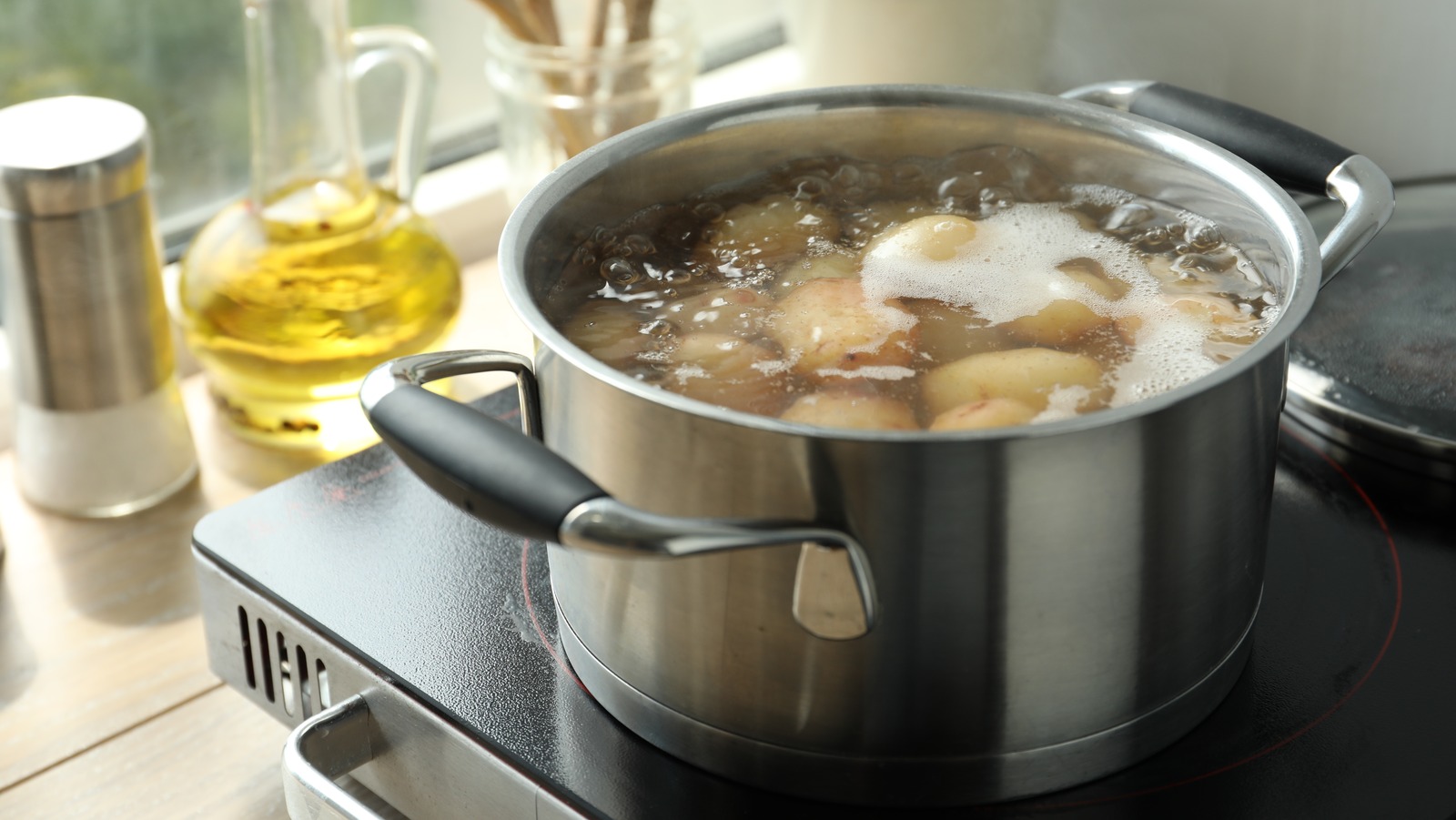
Whether you maintain a gentle simmer or a vigorous, rolling boil, the water surrounding your food remains at essentially the exact same temperature, provided the container is open to the atmosphere and the liquid consists primarily of water.
Water Temperatures Across Common Cooking Stages
Home cooks rarely use a culinary thermometer to check water temperatures for boiling, relying instead on visual cues. However, different visual stages of heated water correspond to specific temperature ranges that drastically alter how food cooks.
1. Quivering / Poaching Stage (160°F to 180°F / 71°C to 82°C)
At this stage, tiny pinhead-sized bubbles form on the bottom and sides of the pot but do not rise to the surface. The liquid surface remains relatively still, with slight shimmers or gentle quivers. This temperature zone is ideal for delicate foods like eggs, fish, and tender poultry, as high heat would toughen proteins or cause fragile items to fall apart.
2. Slow Simmer (185°F to 200°F / 85°C to 93°C)
Small bubbles begin rising periodically to the surface, breaking gently. Wisps of steam are clearly visible. A slow simmer provides enough heat to gently break down connective tissues in tough cuts of meat during long braises without boiling away volatile flavor compounds or cause heavy agitation.
3. Rapid Simmer (200°F to 211°F / 93°C to 99°C)
Bubbles break continuously across the entire surface of the pot, and the water shows steady movement. This stage is frequently confused with a full boil, but the water has not quite reached its maximum thermodynamic limit. Rapid simmering is common for reducing sauces, cooking root vegetables, and making soups.
4. Full Rolling Boil (212°F / 100°C at Sea Level)
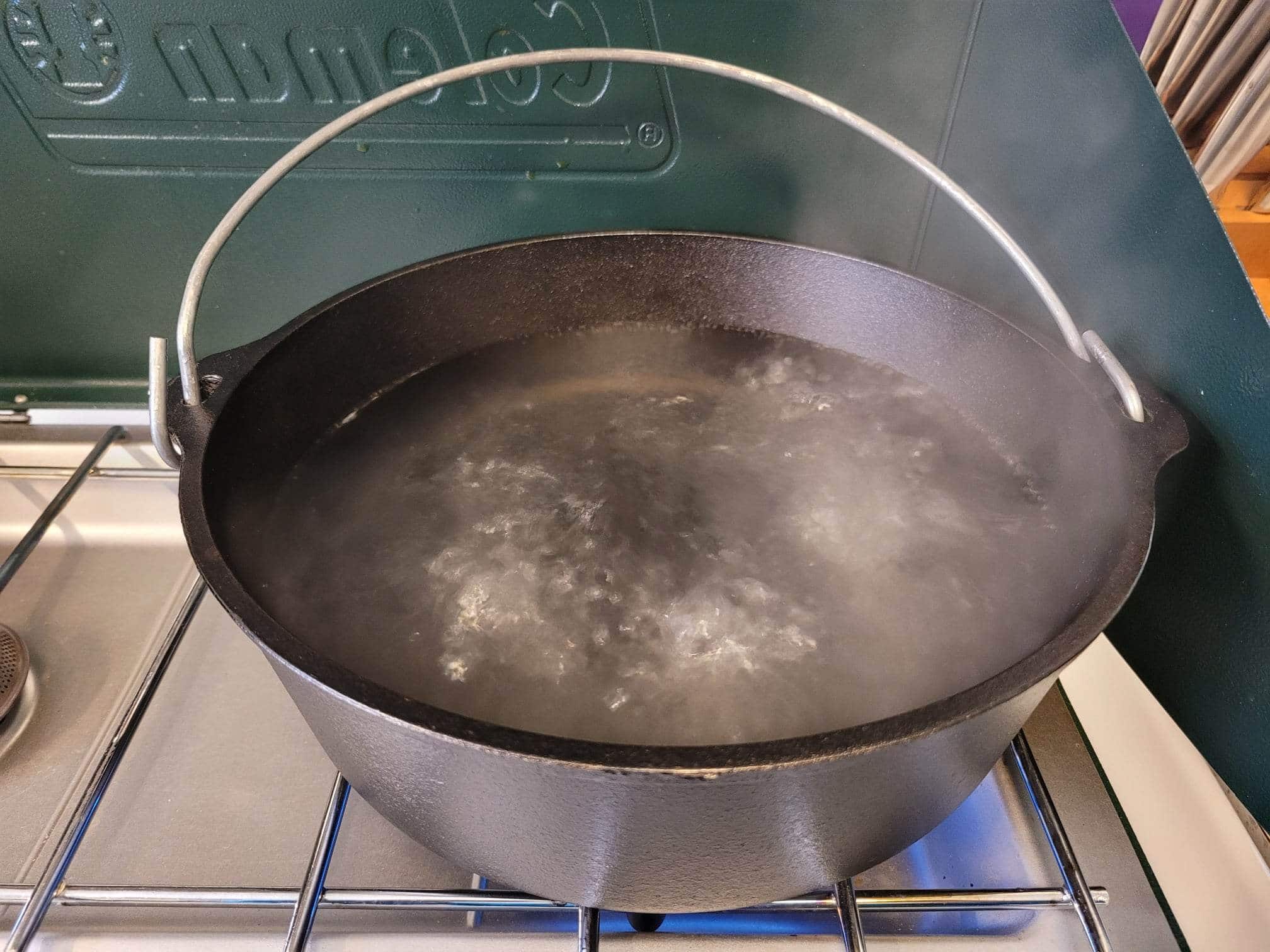
Violent, energetic agitation occurs throughout the pot. Large bubbles break rapidly across the entire surface, and stirring the pot does not stop the boiling action. This is the maximum temperature water can achieve in an unpressurized pot at sea level. It provides maximum turbulence and heat transfer, ideal for cooking dried pasta rapidly or blanching green vegetables.
Altitude and Elevation: Why Water Boils Cooler in Mountain Kitchens
The single biggest factor altering the boiling temperature of water in home cooking is geographic altitude. Boiling occurs when the vapor pressure of the liquid equals the surrounding atmospheric pressure holding it down. Because atmospheric pressure decreases as elevation increases, less thermal energy is required for water molecules to escape into gas.
As a general rule, water's boiling point drops approximately 1°F for every 500-foot increase in elevation (or roughly 1°C for every 300 meters).
Higher Altitude -> Lower Air Pressure -> Lower Boiling Temperature -> Longer Cooking Times
For cooks living in high-altitude environments, this lower boiling temperature presents real practical challenges:
- Denver, Colorado (~5,280 ft / 1,609 m): Water boils at approximately 202°F (94.4°C).
- Santa Fe, New Mexico (~7,000 ft / 2,134 m): Water boils at approximately 198°F (92.2°C).
- Leadville, Colorado (~10,150 ft / 3,094 m): Water boils at approximately 192.5°F (89.2°C).
Because boiling water is significantly cooler at high altitudes, chemical reactions like starch gelatinization and protein denaturing occur more slowly. Boiling an egg or cooking dried beans in an open pot at 7,000 feet takes noticeably longer than at sea level because the water simply cannot get as hot.
The Impact of Salt and Ingredients on Boiling Point
A common kitchen belief is that adding salt to water makes it boil at a much higher temperature or causes it to reach a boil significantly faster. While solutes do technically alter the physical properties of water, the practical effect in home cooking is minimal.
Salt Water (The Ebullioscopic Effect)
When a solute like sodium chloride (table salt) dissolves in water, it disrupts the ability of water molecules to escape into a gaseous state. This phenomenon, known as boiling point elevation, raises the temperature required to boil the solution.
However, the magnitude of this change is tiny in everyday cooking:
- Adding 1 tablespoon (about 18 grams) of table salt to 1 quart (about 1 liter) of water raises the boiling point by only about 0.15°C (0.27°F).
- To raise the boiling point of water by just 2°F (1.1°C), you would need to add nearly 4 tablespoons of salt per liter, rendering the water far too salty to eat.
Therefore, salting pasta water is crucial for flavor absorption, but it does not meaningfully change how hot the water boils.
Sugar Syrups and Concentrated Liquids
Unlike light saltwater, solutions with extremely high concentrations of dissolved solids—such as sugar syrups used in candy making—experience substantial boiling point elevation. As water evaporates from a boiling sugar syrup, the concentration of sugar increases, driving the boiling temperature higher and higher:
- Thread Stage (80% sugar content): Boils at ~230°F to 235°F (110°C–112°C)
- Soft Ball Stage (85% sugar content): Boils at ~235°F to 245°F (112°C–118°C)
- Hard Crack Stage (99% sugar content): Boils at ~300°F to 310°F (149°C–154°C)
In these scenarios, the liquid gets significantly hotter than 212°F because it is no longer pure water, but a dense syrup solution.
Pressurized Cooking: Pushing Water Past Its Normal Limits
While an open pot caps water's temperature at its standard boiling point, enclosing liquid in a sealed environment changes the thermodynamic equation completely.
How Pressure Cookers Work
A pressure cooker or modern electric multi-cooker creates a sealed chamber that traps the steam generated by heating water. As steam accumulates inside the sealed vessel, the internal atmospheric pressure rises dramatically above ambient air pressure.
Most standard stovetop and electric pressure cookers operate at a gauge pressure of 10 to 15 psi above normal atmospheric pressure:
- At 15 psi above atmospheric pressure: The total internal pressure reaches approximately 29.7 psi. Under this heightened pressure, water does not boil until it reaches approximately 250°F (121°C).
Standard Open Pot (Sea Level): Max Temp = 212°F (100°C) Sealed Pressure Cooker (15 psi): Max Temp = 250°F (121°C)
This 38°F (21°C) increase in boiling temperature drastically accelerates cooking times—reducing cook times by up to 70% compared to traditional boiling. Furthermore, temperatures of 250°F allow mild Maillard browning reactions to occur in moist environments, developing deep caramel colors and complex flavors that are chemically impossible in an open pot of boiling water at 212°F.
Technical Comparison of Cooking Stages and Temperatures
The following table summarizes how different cooking methods, atmospheric pressures, and ingredient additions affect the maximum achievable boiling temperature of liquid in everyday cooking.
| Cooking Stage / Setup | Approx. Boiling Temp (°F) | Approx. Boiling Temp (°C) | Pressure Condition | Primary Culinary Use |
|---|---|---|---|---|
| High Altitude (10,000 ft) | 192.5°F | 89.2°C | Low (~10.1 psi) | Boiling eggs/pasta (requires extra time) |
| High Altitude (5,000 ft) | 202.0°F | 94.4°C | Moderate (~12.2 psi) | General boiling at elevation |
| Poaching Stage (Sea Level) | 160°F – 180°F | 71°C – 82°C | Standard (14.7 psi) | Delicate proteins, fish, eggs |
| Simmering Stage (Sea Level) | 185°F – 205°F | 85°C – 96°C | Standard (14.7 psi) | Soups, stews, braises, stock |
| Standard Boil (Sea Level) | 212.0°F | 100.0°C | Standard (14.7 psi) | Boiling pasta, blanching vegetables |
| Lightly Salted Water (1 tbsp/L) | 212.3°F | 100.15°C | Standard (14.7 psi) | Flavoring pasta, potatoes |
| Soft Candy Stage (85% Sugar) | 235°F – 245°F | 112°C – 118°C | Standard (14.7 psi) | Fudge, pralines, soft caramels |
| Pressure Cooker (15 psi) | 250.0°F | 121.0°C | High (~29.7 psi total) | Tough meats, beans, stocks, quick cooking |
Common Cooking Myths About Boiling Water
Myth 1: Turning up the stove heat makes boiling water cook food faster
Once water reaches a full rolling boil in an open pot, its temperature stays constant. Increasing stove heat produces more steam and evaporates water faster, but the water surrounding your food remains at the exact same temperature. To speed up cooking beyond this limit, you must use a pressure cooker.
Myth 2: Hot water from the tap boils faster on the stove
While starting with hot tap water saves a few minutes of heating time on the stove, it is generally discouraged for culinary use. Hot water heaters can dissolve mineral deposits, micro-sediment, and trace heavy metals from home plumbing lines. It is always safer to start with cold, filtered water and bring it to a boil on the stove.
Myth 3: Putting a lid on a pot changes the boiling temperature
Covering a pot traps steam, which reduces evaporative cooling and builds up a tiny amount of heat energy inside the air space of the pot. This allows water to reach its boiling point much faster. However, once the water reaches a boil, an unpressurized pot lid does not meaningfully raise the liquid's temperature beyond its standard boiling point.
Frequently Asked Questions
Can water get hotter than 212°F (100°C) without a pressure cooker?
In plain liquid form inside an open kitchen vessel, pure water cannot exceed 212°F (100°C) at sea level. Any additional thermal energy added to the pot goes entirely into converting the liquid water into steam. The resulting steam can be heated above 212°F (superheated steam), but the liquid water itself stays locked at its boiling point until it completely evaporates.
Why do recipes instruct cooks to bring water to a "rolling boil"?
A rolling boil ensures that the entire vessel has uniformly reached its maximum temperature of 212°F (100°C) and provides strong mechanical movement. This continuous churning motion prevents individual pieces of pasta or dumplings from sticking together and ensures immediate heat transfer when cold ingredients are dropped into the pot.
How much salt is needed to raise the boiling point of water noticeably?
To raise the boiling point of water by just 1°F (0.56°C), you would need to add approximately 2 ounces (around 56 grams or roughly 3.5 tablespoons) of table salt per quart of water. This creates a solution far too salty for palatable human consumption, proving that salting water is performed for culinary seasoning rather than heat modification.
Why does food take longer to boil at high elevations?
At higher elevations, lower atmospheric pressure allows water to boil at cooler temperatures (for example, ~202°F in Denver compared to 212°F at sea level). Because chemical reactions in cooking rely on heat intensity to break down starches and denature proteins, cooking in cooler boiling water requires extended time to achieve the same result.
What temperature does liquid oil boil at compared to water?
Cooking oils do not contain water and do not boil in the traditional sense; instead, they undergo thermal decomposition at high temperatures known as their smoke point. Most common cooking oils (like canola, peanut, or avocado oil) can reach temperatures between 375°F and 500°F (190°C–260°C) before smoking, which is why frying in oil cooks food far faster and crispier than boiling in water.
Practical Recommendations for Home Cooks
Understanding how boiling temperatures work allows for better precision and control in the kitchen:
- Use Visual Stages for Precise Cooking: Reserve a full rolling boil (212°F) strictly for pasta, blanching vegetables, or reducing stocks quickly. For poaching eggs or fish, lower your burner heat to maintain a gentle shimmer (160°F–180°F) to preserve delicate textures.
- Adjust for Elevation: If you live above 2,000 feet, expect boiled items like beans, root vegetables, and hard-boiled eggs to take longer than standard recipe timings suggest.
- Invest in a Pressure Cooker for Tough Foods: When cooking long-braise items like beef chuck roast, dried beans, or bone broths, use a pressure cooker to raise the water temperature to 250°F (121°C), cutting total cooking time dramatically.
- Don't Waste Energy on High Burner Settings: Once your water reaches a steady boil, turn down the burner flame or induction setting to the minimum level required to maintain that boil. Running the burner on maximum high only wastes gas or electricity without raising the cooking temperature a single degree.
Image Gallery