Digital Marketing Process: Structured Steps and Key Considerations
A successful digital marketing process follows a structured six-stage framework: research and market analysis, strategic planning, creative development, multi-channel execution, continuous performance optimization, and post-campaign re...
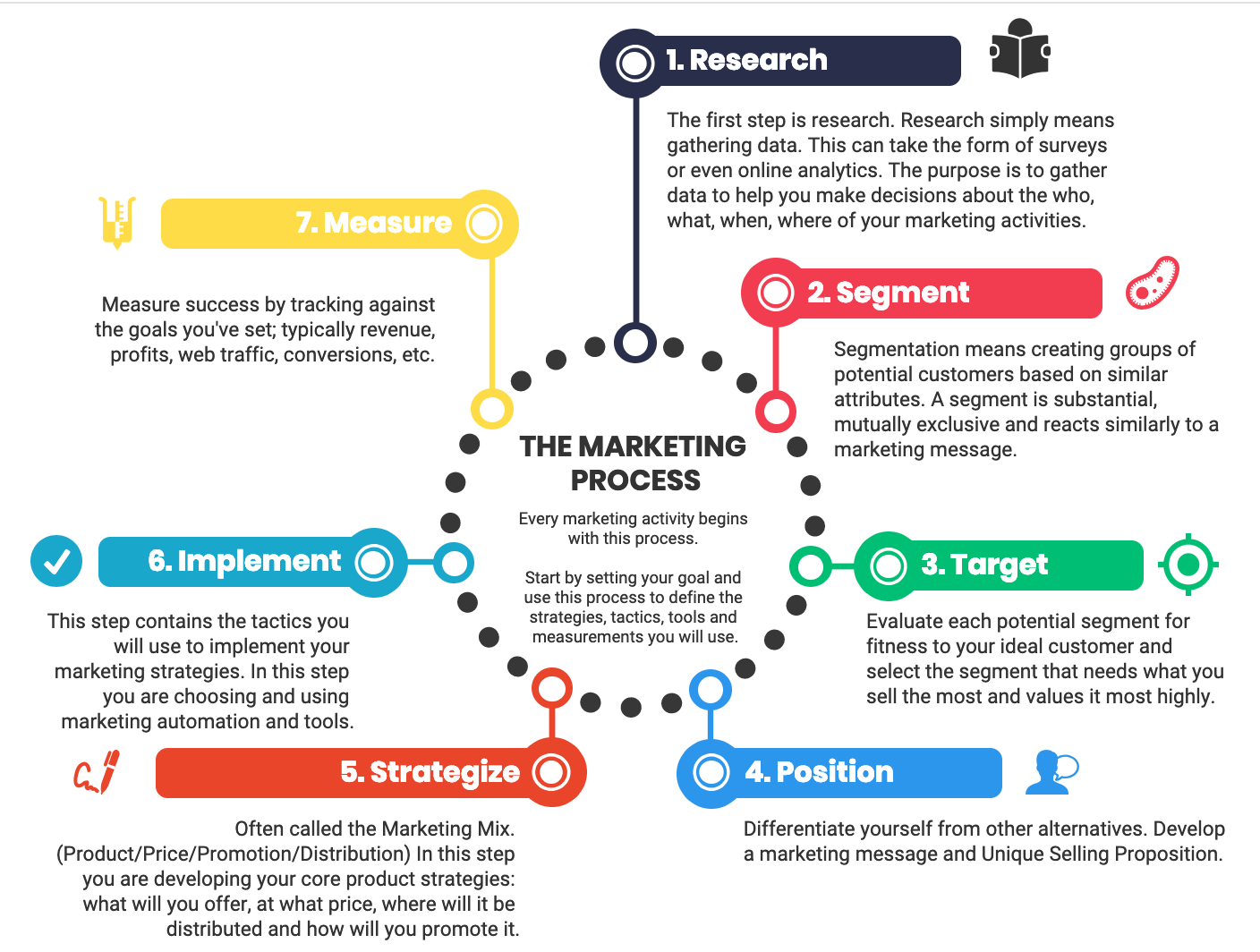
A successful digital marketing process follows a structured six-stage framework: research and market analysis, strategic planning, creative development, multi-channel execution, continuous performance optimization, and post-campaign reporting. Implementing this sequence ensures aligned business objectives, accurate conversion tracking, efficient resource allocation, regulatory compliance, and scalable customer acquisition across diverse digital channels.
Contents
Understanding the Structured Digital Marketing Lifecycle
A digital marketing process is not a collection of isolated campaigns; it is a systematic, repeatable framework designed to move target audiences through the customer acquisition funnel. Without a structured workflow, organizations risk fragmented messaging, wasted media spend, poor data hygiene, and unmeasurable business outcomes.
By standardizing each phase from initial research to campaign scaling, enterprise organizations and growing businesses establish strategic alignment between marketing activities and revenue goals. A mature digital marketing process bridges the gap between high-level brand strategy and day-to-day execution across organic search, paid media, email, and social channels.
The 6 Essential Steps of the Digital Marketing Process
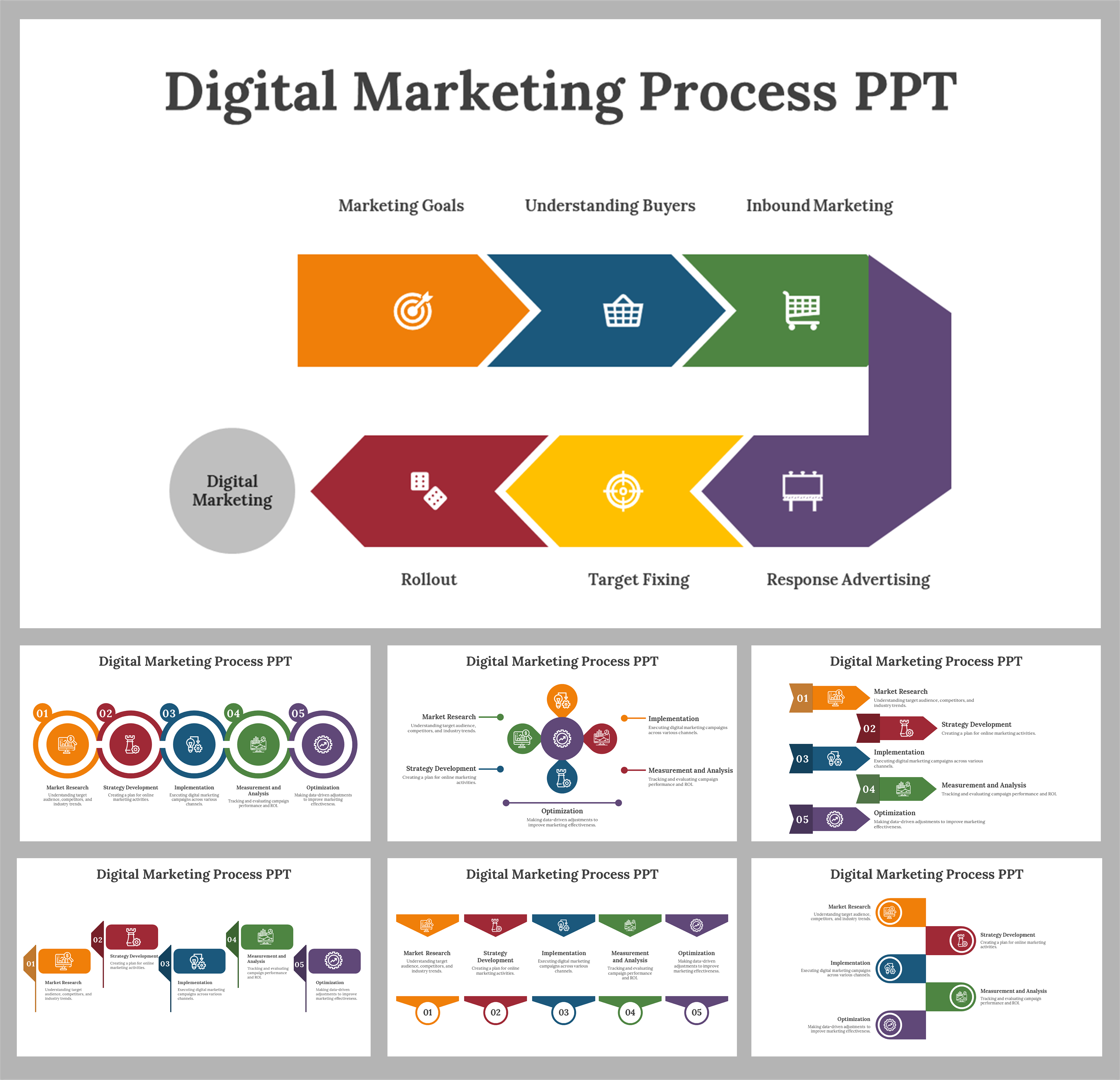
- Research & Market Analysis
- Audience Segmentation
- Competitor Benchmarking
- Strategy & Channel Selection
- SMART KPIs
- Positioning
- Channel Architecture
- Content & Creative Asset Development
- Asset Creation
- Personalization
- Funnel Mapping
- Multi-Channel Campaign Launch
- Tagging & Tracking
- QA Testing
- Media Deployment
- Data Analytics & Continuous Optimization
- A/B Testing
- Conversion Optimization
- Bid Adjustment
- Measurement, Reporting & Scaling
- Attribution Analysis
- ROI Evaluation
- Budget Scaling
Step 1: Research, Audit, and Market Analysis
Every effective digital marketing initiative begins with comprehensive data gathering. Before committing financial or human resources to campaign execution, teams must conduct a thorough diagnostic audit of existing assets, audience behaviors, and competitive landscapes.
- Audience Segmentation and Buyer Personas: Identify quantitative demographics (age, location, job title, income) and qualitative psychographics (pain points, professional challenges, media consumption habits).
- Competitor Benchmarking: Analyze competitors' keyword footprints, ad creatives, backlink profiles, social engagement rates, and positioning tactics.
- Internal Asset Audit: Evaluate existing website architecture, historical campaign performance, email subscriber health, conversion rate benchmarks, and current technology stack integrations.
- SWOT and PESTLE Analysis: Assess internal strengths and weaknesses against external market opportunities, technological shifts, and regulatory changes affecting data privacy.
Skipping this foundational step leads to generic messaging and poorly targeted media buy strategies that quickly exhaust budgets without delivering qualified sales pipeline.
Step 2: Strategic Goal Setting and Channel Selection
Once market dynamics are established, translate analytical insights into clear, actionable campaign architectures. Strategic planning defines what success looks like and determines where media dollars and operational efforts will yield the highest return.
- Establishing SMART Goals: Define objectives that are Specific, Measurable, Achievable, Relevant, and Time-bound. Rather than targeting general "brand growth," set goals such as "increasing qualified B2B demo requests by 25% within Q3."
- Defining Key Performance Indicators (KPIs): Map high-level goals to concrete metrics, including Customer Acquisition Cost (CAC), Customer Lifetime Value (CLV), Return on Ad Spend (ROAS), Cost Per Lead (CPL), and Organic Impression Share.
- Value Proposition and Messaging Framework: Draft core value messaging tailored to each target segment, ensuring consistent differentiation across all touchpoints.
- Channel Architecture Mapping: Select the appropriate channel mix based on customer touchpoints:
- Search Engine Optimization (SEO): Long-term organic lead generation and authoritative search visibility.
- Pay-Per-Click (PPC) Advertising: Immediate high-intent customer capture via search platforms and programmatic networks.
- Content Marketing & Social Media: Top-of-funnel brand discovery, community engagement, and lead nurturing.
- Email and Automation: Middle- and bottom-of-funnel conversion retention and cross-sell execution.
Step 3: Content and Creative Asset Development
Content serves as the engine of the digital marketing process. During this phase, marketing teams produce high-performing visual, written, and interactive assets aligned with specific buyer funnel stages.
- Funnel Stage Mapping: Produce top-of-funnel (TOFU) educational resources (blog posts, infographics), middle-of-funnel (MOFU) evaluation assets (whitepapers, webinar registrations, product comparison guides), and bottom-of-funnel (BOFU) conversion drivers (case studies, ROI calculators, free trial landing pages).
- Creative Design and Ad Production: Build variations of display banners, short-form video ads, ad copy variants, and responsive email templates optimized for both desktop and mobile viewports.
- Landing Page Engineering: Design focused landing pages featuring clear call-to-action (CTA) buttons, fast load speeds, social proof elements, and minimal friction forms.
Step 4: Multi-Channel Campaign Execution and Launch
The execution phase converts strategy and creative assets into active live campaigns. Rigorous technical setup and quality assurance (QA) protocols are vital to prevent tracking discrepancies and wasted budget.
- Tracking Infrastructure Integration: Deploy essential data capture tools, including Google Analytics 4 (GA4), custom event triggers, server-side Google Tag Manager containers, and platform-specific conversion pixels (Meta Pixel, LinkedIn Insight Tag).
- UTM Architecture Standardization: Enforce consistent tracking link parameters across all distribution channels to enable accurate cross-channel attribution reporting.
- Pre-Launch QA Audit: Verify that landing page forms route correctly to Customer Relationship Management (CRM) databases, links are functional, ad policy requirements are met, and budget caps are applied.
- Synchronized Media Activation: Launch campaigns simultaneously across designated organic and paid channels according to the planned content calendar and media schedule.
Step 5: Data Analytics, Performance Tracking, and Continuous Optimization
Digital marketing processes require continuous refinement. Once campaigns go live, managers monitor performance telemetry to make real-time adjustments that lower acquisition costs and increase throughput.
- A/B and Multivariate Testing: Systematically test ad headlines, hero images, CTA colors, landing page layouts, and email subject lines to isolate variables that drive conversion lift.
- Bid and Budget Optimization: Shift capital away from underperforming ad sets, target keywords, or demographics toward high-yield placements and audiences.
- Conversion Rate Optimization (CRO): Identify drop-off points in web user flows using heatmaps, session recordings, and funnel analytics to optimize user experiences.
Step 6: Review, Reporting, and Iterative Scaling
The final stage evaluates overall campaign performance against initial SMART goals, converts raw metrics into executive insights, and feeds findings back into the research phase for subsequent campaigns.
- Attribution Analysis: Evaluate performance using multi-touch, data-driven, or first-touch attribution models to understand how channels assist conversions across the buyer journey.
- Executive Reporting: Summarize business-level metrics—such as net revenue generated, sales pipeline pipeline velocity, and return on investment—for key stakeholders and board members.
- Documentation and Knowledge Sharing: Record key takeaways, target audience insights, creative fatigue thresholds, and technical learnings in an internal knowledge base to improve future campaign planning.
Comparative Analysis of Digital Marketing Process Phases
The table below breaks down each strategic phase, outlining key operational focus areas, concrete deliverables, and the metrics used to track performance.
| Process Phase | Primary Focus / Objective | Core Technical Deliverables | Primary KPIs & Success Metrics |
|---|---|---|---|
| 1. Research & Audit | Market discovery and baseline performance evaluation | Persona documents, Competitor matrices, SEO/Tech audit reports | Market share gap, Benchmark conversion rates |
| 2. Strategy & Planning | Goal setting, messaging alignment, and channel architecture | Campaign brief, Channel mix strategy, Content calendar | Target CAC, ROAS targets, Planned CPL thresholds |
| 3. Asset Development | Creative production aligned to buyer journey stages | Ad copy variations, Display banners, Dedicated landing pages | Asset turnaround time, Page speed load scores |
| 4. Execution & Launch | Technical tag deployment and media activation | UTM taxonomy, Tag manager setup, Live media campaigns | Impression delivery, Tracking accuracy, Indexation speed |
| 5. Continuous Optimization | In-flight testing and conversion rate refinement | A/B test variations, Updated bid strategies, Heatmap studies | Click-Through Rate (CTR), Cost Per Action (CPA), Conversion Rate |
| 6. Reporting & Scaling | Revenue attribution and performance evaluation | Attribution dashboard, Executive ROI deck, Post-mortem docs | Net ROAS, Customer Lifetime Value (CLV), Pipeline Contribution |
Critical Key Considerations for Execution
Executing a structured digital marketing process requires navigating operational, technical, legal, and financial constraints. Organizations must account for these factors during strategic planning.
Data Privacy and Regulatory Compliance
Modern digital marketing operates under strict privacy laws and browser-level data restrictions. Organizations must design compliance directly into their tracking and data collection architecture:
- Global Privacy Standards: Ensure full adherence to global and regional laws such as the European Union’s General Data Protection Regulation (GDPR) and the California Consumer Privacy Act (CCPA/CPRA).
- Consent Management Platforms (CMP): Implement robust CMP banners to gather explicit user consent for cookie tracking, telemetry, and retargeting activities.
- First-Party Data Strategy: Mitigate the impact of third-party cookie deprecation by building robust first-party data capture mechanisms, such as gated tools, newsletters, and customer loyalty portals.
MarTech Integration and Data Hygiene
A digital marketing process is only as reliable as the technology stack supporting it. Enterprise workflows often require seamless synchronization between disparate software systems:
- CRM and Marketing Automation Sync: Ensure bi-directional data synchronization between platforms such as Salesforce, HubSpot, or Marketo to maintain accurate lead scoring and lifecycle stage updates.
- Centralized Data Repositories: Aggregate multi-channel marketing data within cloud data warehouses (e.g., Snowflake, BigQuery) to build unified reporting dashboards via business intelligence tools.
- Data Hygiene Standards: Enforce routine cleanup schedules to delete invalid email addresses, remove duplicate contact records, and standardize field formats across marketing tools.
Budgeting, Attribution Models, and Financial Planning
Proper financial governance prevents media budget overspend while maximizing long-term revenue return:
- Attribution Selection: Recognize the limitations of single-touch attribution (first-click or last-click) in complex B2B or high-consideration B2C sales cycles. Utilize multi-touch or data-driven attribution models where appropriate.
- Flexible Budget Allocation: Reserve 10% to 15% of the total marketing budget for experimental testing—such as evaluating emerging advertising platforms, innovative ad formats, or niche publisher placements.
- Incremental Lift Testing: Run geo-matched lift tests or conversion holdout studies to verify whether paid media campaigns generate true incremental conversions rather than claiming credit for organic demand.
Common Pitfalls in the Digital Marketing Lifecycle
Even experienced marketing teams encounter operational bottlenecks. Avoiding these structural mistakes preserves budget and campaign momentum:
- Launching Without Conversion Tracking Validation: Deploying ad spend before verifying that conversion tags fire accurately leads to corrupted analytics data that cannot be remediated post-campaign.
- Siloed Channel Management: Managing SEO, paid search, social media, and email in isolation results in disjointed customer messaging, competing keyword bids, and inaccurate attribution modeling.
- Ignoring Top-of-Funnel Nurturing: Allocating 100% of media budgets to bottom-of-funnel retargeting or brand search quickly exhausts high-intent audience pools without generating fresh pipeline interest.
- Failing to Iteratively Refresh Creatives: Allowing ad creative to run without updates for extended periods causes creative fatigue, leading to declining Click-Through Rates (CTR) and climbing Costs Per Acquisition (CPA).
Frequently Asked Questions
What is the most critical step in the digital marketing process?
While every phase plays an essential role, Step 1 (Research and Market Analysis) is foundational. Failing to conduct thorough audience segmentation, competitor analysis, and technical audits leads to flawed messaging, improper channel selection, and misallocated budgets during execution.
How long does it take to see results from a new digital marketing process?
Timelines vary significantly by channel. Paid media channels (PPC, programmatic display, paid social) can generate traffic and conversion data within 24 to 48 hours of launch. Conversely, organic channels like SEO and content marketing typically require 3 to 6 months to establish domain authority and achieve consistent rankings.
What is the difference between digital marketing strategy and execution?
Strategic planning defines the overall direction, business objectives, audience selection, messaging, and channel mix (the Why and What). Execution encompasses the tactical implementation—such as writing ad copy, setting up tracking pixels, configuring bid strategies, and managing launch schedules (the How).
How often should a digital marketing strategy be reviewed and updated?
Tactical optimization (such as adjusting ad bids, refreshing creative variants, and refining keyword lists) should occur weekly or bi-weekly. Comprehensive strategic reviews—evaluating overall revenue attribution, technology integrations, and high-level messaging—should take place on a quarterly or semi-annual basis.
Why is first-party data capture becoming more important in digital marketing?
Increasing browser privacy restrictions, cookie deprecation, and regulatory frameworks (like GDPR and CCPA) make third-party tracking less reliable. Developing strong first-party data capture mechanisms ensures organizations retain direct access to actionable customer insights without relying on external tracking networks.
Strategic Recommendation and Next Steps
To build a resilient digital marketing process, start by conducting a comprehensive audit of your organization's current workflows, tracking infrastructure, and content assets. Identify structural gaps between research, execution, and analytics, and prioritize fixing broken conversion tracking before deploying additional ad spend. Establish standardized operational playbooks for channel execution and data management to ensure consistent, scalable results across all future marketing initiatives.
Image Gallery