How the MPF Shapes Retirement in Hong Kong: System Structure, Performance, and Strategic Planning
The Mandatory Provident Fund (MPF) shapes retirement in Hong Kong by serving as the primary mandatory privately managed pillar of the city’s multi-tiered retirement protection framework. Enacted under the MPF Schemes Ordinance and over...
The Mandatory Provident Fund (MPF) shapes retirement in Hong Kong by serving as the primary mandatory privately managed pillar of the city’s multi-tiered retirement protection framework. Enacted under the MPF Schemes Ordinance and overseen by the Mandatory Provident Fund Schemes Authority (MPFA), the system requires both employers and employees to contribute 5% of relevant monthly income into investment funds. It transforms workplace earnings into compounding capital designed to support workers after age 65.
Contents
The Structural Architecture of the MPF System
Hong Kong introduced the Mandatory Provident Fund system in December 2000 to address a rapidly aging demographic and formalize retirement savings for a workforce that previously relied primarily on personal savings and family support. The MPF framework functions as a fully funded, defined-contribution scheme. Unlike defined-benefit pension schemes, which guarantee a specific monthly payout upon retirement, an employee's ultimate MPF payout depends entirely on total contributions paid into the account and the long-term investment performance of the selected funds.
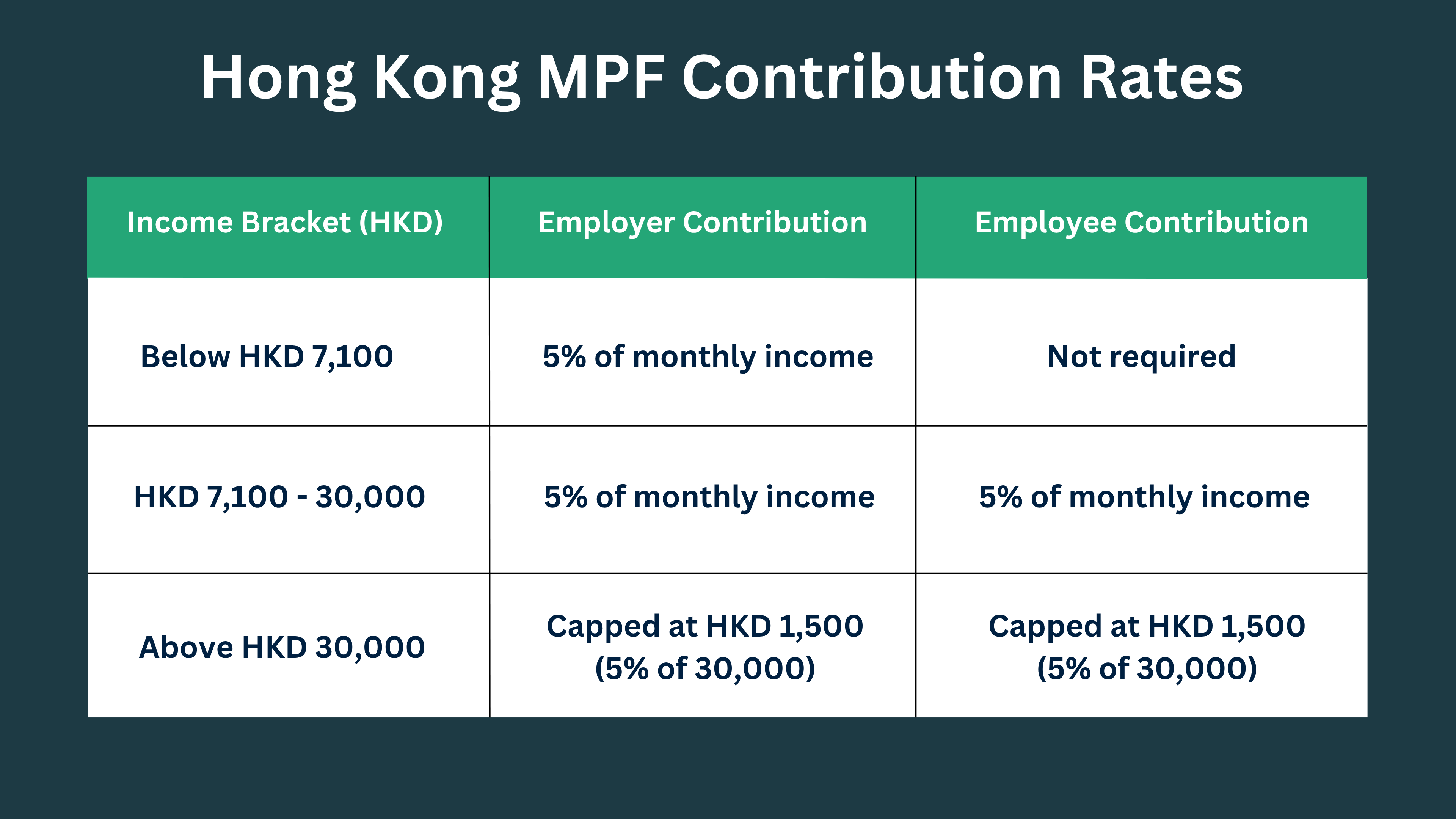
Under the framework of the MPF Schemes Ordinance, coverage extends to most employees aged 18 to 64 who have been employed for 60 days or more, as well as self-employed persons (SEPs). Employers and employees must each contribute 5% of the employee’s relevant monthly income to an approved MPF scheme, subject to statutory minimum and maximum income thresholds.
| Monthly Relevant Income | Employer Contribution | Employee Contribution |
|---|---|---|
| Income Below HKD 7,100 | 5% mandatory contribution | Exempt from mandatory contribution |
| Income HKD 7,100 to HKD 30,000 | 5% of relevant income | 5% of relevant income |
| Income Above HKD 30,000 | Capped at HKD 1,500/month | Capped at HKD 1,500/month |
For self-employed individuals, the requirement mirrors employee contributions: they must pay 5% of their relevant income into an MPF scheme, capped at maximum mandatory contributions of HKD 1,500 per month (or HKD 18,000 annually).
Employers must deduct the employee's contribution from their wages and remit both employee and employer portions to the designated scheme trustee on or before the 10th day of each calendar month. The system is decentralized in administration but strictly regulated by the MPFA, which licenses corporate trustees, approves investment funds, and enforces compliance across thousands of participating firms.
The Role of MPF in Hong Kong’s Multi-Pillar Retirement Model
The World Bank advocates a multi-pillar framework for old-age financial security, and Hong Kong’s retirement protection ecosystem mirrors this structure. Within this context, the MPF acts as Pillar 2—a mandatory, privately managed occupational retirement scheme.
- Pillar 0 & 1 (Non-contributory Social Safety Nets): Includes the Social Security Allowance (SSA) Scheme (comprising the Old Age Allowance and Old Age Living Allowance) and Comprehensive Social Security Assistance (CSSA), funded via general government revenue to support low-income seniors.
- Pillar 2 (Mandatory Occupational Scheme): The MPF system and voluntary Occupational Retirement Schemes Ordinance (ORSO) schemes, aimed at capital accumulation through employment.
- Pillar 3 (Voluntary Personal Savings): Personal investments, insurance policies, annuities, and voluntary MPF top-ups.
- Pillar 4 (Informal Support & Public Services): Family financial support, public housing, and subsidized healthcare services.
While the MPF provides a baseline of wealth accumulation for millions of workers, financial planners widely note that relying exclusively on mandatory MPF contributions is rarely sufficient to maintain an individual's pre-retirement lifestyle. Because statutory mandatory contributions cap out at a combined HKD 3,000 per month (HKD 1,500 each from employer and employee), high-income professionals experience a diminishing income replacement rate over time.
For example, a worker earning HKD 30,000 per month receives a total mandatory contribution equivalent to 10% of their gross earnings. However, for an executive earning HKD 100,000 per month, the maximum combined mandatory contribution of HKD 3,000 represents just 3% of monthly salary. Consequently, the MPF is designed to form the bedrock of retirement security, requiring supplementary voluntary contributions and broader personal investment portfolios to achieve adequate financial freedom.
Investment Options and Portfolio Allocation in the MPF Market
MPF scheme participants can choose from a range of constituent funds offered by approved trustees. These funds span diverse asset classes, risk profiles, and geographic exposures, allowing employees to tailor their portfolios to their age, risk tolerance, and retirement timeline.
- Risk-Return Spectrum of MPF Fund Types (Low Risk / Low Return to High Risk / High Return):
- MPF Conservative Funds (Money Market / Cash Deposits)
- Guaranteed Funds (Capital Preservation with Specific Conditions)
- Bond Funds (Global & Regional Fixed Income)
- Mixed Assets Funds (Balanced Equity & Fixed Income Spans)
- Equity Funds (Hong Kong, Asian, US, Global, Sector-Specific)
Key Constituent Fund Categories
- Equity Funds: Invest predominantly in listed stocks to achieve long-term capital growth. Options include regional funds (e.g., Hong Kong Equity, Asian Equity, US Equity, European Equity) and global equity funds. Equity funds carry higher short-term volatility but historically yield higher long-term returns.
- Mixed Assets Funds: Diversify capital across equities and fixed-income securities. Often categorized by asset ratio (e.g., 80% Equity / 20% Bond vs. 20% Equity / 80% Bond), these funds balance growth with downside mitigation.
- Bond Funds: Focus on sovereign, supranational, and corporate debt instruments to generate stable interest income and preserve capital relative to volatile stock markets.
- Guaranteed Funds: Offer capital guarantees or return guarantees upon meeting specific conditions, such as holding the investment until a designated maturity date or reaching retirement age.
- MPF Conservative Funds: Money market funds designed to preserve principal by investing in short-term Hong Kong Dollar deposits and high-quality money market instruments. Under statutory regulations, administrative fees for conservative funds can only be deducted if investment returns exceed the prescribed monthly bank interest rate set by the MPFA.
The Default Investment Strategy (DIS)
To safeguard members who lack the time, expertise, or inclination to select individual funds, the MPFA introduced the Default Investment Strategy (DIS) across all schemes. Often referred to as the "Core Accumulation Strategy," the DIS is a standardized, fee-capped investment choice that automatically adjusts risk based on the scheme member's age.
The DIS utilizes two standardized constituent funds:
- Core Accumulation Fund (CAF): Allocates approximately 60% of assets to higher-risk assets (primarily global equities) and 40% to lower-risk assets (global fixed income).
- Age 65 Plus Fund (A65F): Allocates approximately 20% of assets to higher-risk assets and 80% to lower-risk assets.
DIS Automatic De-Risking Allocation Profile
| Member Age | Core Accumulation Fund (CAF) | Age 65 Plus Fund (A65F) |
|---|---|---|
| Below Age 50 | 100% | 0% |
| Age 50 to 64 | Decreases ~6.7%/yr | Increases ~6.7%/yr |
| Age 65 and Above | 0% | 100% |
Under the DIS de-risking mechanism, all assets remain 100% invested in the CAF until age 50. Between ages 50 and 65, the trustee automatically transfers approximately 6.7% of the asset portfolio from the CAF to the A65F once per year. By age 65, 100% of the member's DIS assets are held in the lower-risk A65F fund. Furthermore, the DIS is subject to a statutory total management fee cap of 0.75% per annum of net asset value, significantly lower than the average administrative costs of traditional active MPF equity funds.
Regulatory Framework, Comparative Specifications, and Withdrawal Protocols
Understanding the operational rules governing MPF accounts—from contribution rates to tax deductions and withdrawal requirements—is critical for effective long-term retirement planning in Hong Kong.
Key Specifications of the MPF System
| Specification Dimension | Operational Rule / Policy Parameter | Legislative / Regulatory Details |
|---|---|---|
| Mandatory Contribution Rate | 5% (Employer) + 5% (Employee) | Mandatory for relevant income between HKD 7,100 and HKD 30,000 per month. |
| Maximum Monthly Contribution | HKD 1,500 (Employer) + HKD 1,500 (Employee) | Maximum total mandatory contribution is capped at HKD 3,000 per month. |
| Tax Deductible Voluntary Contributions (TVC) | Up to HKD 60,000 per tax year | Tax deduction cap shared between TVC and Qualifying Deferred Annuity Policies (QDAP) under Inland Revenue Department rules. |
| Default Investment Strategy (DIS) Management Fee Cap | Max 0.75% per annum | Covers management, trustee, and administrative expenses; out-of-pocket expenses capped at 0.20%. |
| Statutory Retirement Age | Age 65 | Lump-sum or installment withdrawal available upon reaching age 65. |
| Early Withdrawal Conditions | Age 60 (early retirement), total incapacity, terminal illness, permanent departure, small balance | Requires statutory declaration and supporting documentation approved by MPFA guidelines. |
| SP/LSP Offsetting Abolition | Effective May 1, 2025 | Employers can no longer use mandatory MPF contributions to offset Severance Payments or Long Service Payments. |
Statutory Withdrawal Conditions
MPF accrued benefits derived from mandatory contributions are strictly locked up until the member reaches the statutory retirement age of 65. However, early withdrawal of accrued benefits is permitted under specific legislative exceptions:
- Early Retirement at Age 60: Members who reach age 60 and permanently cease employment or self-employment can claim their accrued benefits by signing a statutory declaration.
- Permanent Departure from Hong Kong: Members leaving Hong Kong permanently to reside elsewhere without intention to return for employment or resettlement may claim early withdrawal. This justification can only be used once in a lifetime; fraudulent claims incur severe legal penalties under Hong Kong law.
- Total Incapacity / Terminal Illness: Members who become permanently unfit to perform the type of work they were engaged in immediately before becoming incapacitated, or who suffer from an illness that reduces life expectancy to 12 months or less, can request early withdrawal with medical certification.
- Small Balance Claim: Members holding a balance not exceeding HKD 5,000 in a single scheme, with no contributions made for at least 12 months, and who do not intend to become employed or self-employed again, may apply for payout.
Members reaching age 65 have the flexibility to withdraw their accrued benefits as a lump sum, in installments, or retain the funds within the MPF scheme for continued investment.
Recent Reforms: The eMPF Platform and Offsetting Abolition
The MPF ecosystem has undergone major structural reforms designed to lower costs, enhance administrative efficiency, and improve wealth preservation for Hong Kong's workforce.
The eMPF Platform
Developed and launched by the MPFA through its subsidiary, the eMPF Platform Company Limited, the eMPF Platform serves as a centralized digital infrastructure that consolidates the administration of all MPF schemes across all approved trustees into a single online platform.
- Traditional Decentralized Model:
- Employee / Employer
- Trustee A (Paper/Portal)
- Trustee B (Paper/Portal)
- Trustee C (Paper/Portal)
- Employee / Employer
- eMPF Centralizedized Ecosystem:
- Employee / Employer
- eMPF Centralized Digital Hub
- Standardized Processing
- Direct Fee Reduction
- eMPF Centralized Digital Hub
- Employee / Employer
Key objectives and benefits of the eMPF Platform include:
- Operational Centralization: Employers and employees manage all MPF accounts across different trustees through a single unified portal and mobile application.
- Cost Reduction: Centralizing administrative workflows significantly reduces operational overhead for trustees. The resulting cost savings are passed directly to scheme members through reduced administrative fees.
- Portability Simplification: Employees changing jobs can consolidate personal MPF accounts with a few clicks, eliminating paper forms and multi-week processing delays.
Abolition of the MPF Offsetting Mechanism
Historically, Hong Kong law permitted employers to use the accrued benefits derived from their mandatory (and voluntary) MPF contributions to offset statutory Severance Payments (SP) and Long Service Payments (LSP) owed to employees upon termination.
The Hong Kong SAR Government officially abolished the offsetting of statutory SP and LSP against employer mandatory MPF contributions, taking effect on May 1, 2025 (known as the "Transition Date"). Under this reformed structure:
- Employers can no longer use accrued benefits generated from mandatory MPF contributions made after the transition date to offset post-transition SP or LSP liabilities.
- Employer contributions made prior to the transition date remain eligible for offsetting against pre-transition SP/LSP entitlements, preserving historical arrangements while securing future retirement capital for employees.
This reform ensures that employee MPF balances remain intact upon job termination, protecting the compounding power of mandatory contributions for retirement.
Maximizing MPF Capital: Tax Deductible Voluntary Contributions (TVC)
To incentivize residents to build supplementary retirement savings beyond mandatory limits, the government introduced Tax Deductible Voluntary Contributions (TVC) under the Inland Revenue Ordinance.
Mechanics of TVC
Employees and self-employed persons can open a dedicated TVC account with an approved MPF scheme trustee of their choice, independent of their employer's chosen scheme. Contributions made directly into this account qualify for a personal salary tax deduction.
- Maximum Tax Deduction Cap: Up to HKD 60,000 per tax year (shared jointly between TVC and Qualifying Deferred Annuity Policies - QDAP).
- Tax Savings: Depending on the individual's marginal tax bracket (ranging up to 17%), making the maximum HKD 60,000 TVC contribution can yield up to HKD 10,200 in direct tax savings per year.
- Lock-in Requirement: Unlike regular voluntary contributions, TVC funds are subject to the same statutory withdrawal restrictions as mandatory contributions and cannot be withdrawn until age 65 (except under statutory early withdrawal exemptions).
TVC Tax Savings Potential Illustration Annual TVC Contribution: HKD 60,000
| Marginal Tax Bracket | Annual Tax Savings Calculation | Tax Savings |
|---|---|---|
| 2% | HKD 60,000 x 2% | HKD 1,200 |
| 6% | HKD 60,000 x 6% | HKD 3,600 |
| 10% | HKD 60,000 x 10% | HKD 6,000 |
| 14% | HKD 60,000 x 14% | HKD 8,400 |
| 17% (Top Rate) | HKD 60,000 x 17% | HKD 10,200 |
For working professionals in higher tax brackets, TVC provides an immediate risk-free return through tax relief, while compounding long-term capital growth within the chosen constituent funds.
Actionable Steps to Optimize Your MPF Portfolio
To build long-term wealth and optimize retirement security through the MPF, account holders should apply active governance to their accounts:
1. Consolidate Inactive Personal Accounts
Changing employers throughout a career often leads to multiple personal accounts across various trustees. Scattered accounts increase administrative complexity and make tracking overall asset allocation difficult. Scheme members should utilize the centralized eMPF Platform to consolidate legacy personal accounts into a single high-performing scheme with competitive Fund Expense Ratios (FER).
2. Match Asset Allocation to Your Risk Profile and Horizon
Avoid choosing funds based solely on short-term market headlines. Younger employees with decades until retirement should generally allocate a higher percentage to growth-oriented equity funds to combat long-term inflation. As members approach retirement age, they should systematically de-risk their portfolio toward fixed income and capital preservation instruments—a process handled automatically if enrolled in the Default Investment Strategy (DIS).
3. Monitor Fund Expense Ratios (FER)
Management fees directly erode long-term net investment returns. Review the Fund Expense Ratio of your selected funds via the periodic statements or official portal tools provided by the MPFA. Where active equity funds fail to consistently outperform their benchmark indices, low-cost index-tracking constituent funds or fee-capped DIS options present cost-effective alternatives.
4. Utilize TVC for Tax Efficiency
Taxpayers in high marginal income tax brackets should consider allocating surplus savings into TVC accounts up to the annual HKD 60,000 deduction cap. This strategy combines immediate annual tax relief with long-term compound growth.
5. Perform Annual Portfolio Rebalancing
Conduct an annual review of your MPF account. Rebalance fund holdings if market fluctuations cause your actual asset allocation to deviate significantly from your intended long-term strategy.
Frequently Asked Questions
What happens to my MPF if I change jobs in Hong Kong?
When changing jobs, your accrued benefits from employer and employee mandatory contributions in your current employer’s scheme are transferred to a personal account under your control. You can choose to leave the funds in a personal account with the existing trustee, transfer the balance to a personal account with another trustee of your choice, or consolidate the balance into your new employer's MPF scheme using the centralized eMPF Platform.
Can non-permanent residents or expats withdraw their MPF when leaving Hong Kong?
Yes. Expatriates and non-permanent residents who leave Hong Kong permanently with no intention of returning for employment or resettlement can apply for early withdrawal of their mandatory and voluntary MPF accrued benefits under the "permanent departure" statutory exemption. Applicants must submit a statutory declaration, proof of right of abode elsewhere, and supporting documentation to the scheme trustee. This early withdrawal option can only be exercised once in a lifetime.
How does the Default Investment Strategy (DIS) protect older investors?
The DIS implements an automatic annual de-risk mechanism starting at age 50. Between ages 50 and 65, the trustee automatically reallocates approximately 6.7% of the portfolio each year from the growth-oriented Core Accumulation Fund (60% equities) into the lower-risk Age 65 Plus Fund (80% bonds and secure fixed income). This automated process reduces exposure to stock market volatility as members near retirement.
Are MPF returns subject to capital gains tax or income tax in Hong Kong?
No. Hong Kong does not levy capital gains tax or dividend tax on investment returns earned within MPF schemes. Furthermore, mandatory contributions and qualified TVC payments receive income tax deductions subject to statutory annual limits, and lump-sum or installment payouts drawn upon statutory retirement are fully exempt from Hong Kong salaries tax.
What is the difference between MPF Mandatory Contributions and Special Voluntary Contributions (SVC)?
Mandatory contributions are legally required (5% employer / 5% employee up to capped limits) and locked up until statutory retirement age. Special Voluntary Contributions (SVC) are optional payments made directly by an employee to a trustee; unlike mandatory contributions or TVC, SVC funds can generally be deposited and withdrawn at any time without tax deductions or age-65 lock-in restrictions, depending on specific trustee scheme terms.
Image Gallery