Navigating Workers' Compensation in Southern California: An Irvine Guide
Workers' compensation in Irvine, California, operates under a mandatory, no-fault system regulated by the California Department of Industrial Relations (DIR) Division of Workers' Compensation (DWC). Employers in Orange County must prov...
Workers' compensation in Irvine, California, operates under a mandatory, no-fault system regulated by the California Department of Industrial Relations (DIR) Division of Workers' Compensation (DWC). Employers in Orange County must provide coverage for workplace injuries, while injured employees receive statutory medical care, disability payments, and vocational retraining benefits regardless of fault.
Contents
Professional Disclaimer
This guide provides general educational information regarding California workers' compensation laws and local administrative procedures in Irvine and Orange County. It does not constitute legal or financial advice. Statutory benefit rates, filing deadlines, and administrative rules are subject to legislative changes. Consult a qualified California workers' compensation attorney or licensed insurance professional for advice on specific legal or insurance matters.
The Legal Framework for Workers' Compensation in Irvine
California Labor Code Section 3700 requires every employer in the state—including those in Irvine and the broader Southern California region—to maintain workers' compensation insurance, even if they employ only one worker. This requirement applies to full-time, part-time, temporary, and seasonal employees. Out-of-state businesses operating within Irvine city limits or dispatching personnel to Orange County job sites must also ensure compliance with California statutory standards.
Under California's no-fault mandate, an injured worker does not need to establish employer negligence to qualify for benefits. In exchange for guaranteed statutory benefits, California Labor Code Section 3600 establishes workers' compensation as the exclusive remedy for workplace injuries. This precludes employees from filing standard civil tort lawsuits against their employers for negligence, subject to narrow statutory exceptions such as willful physical assault by the employer or fraudulent concealment of the injury.
Coverage Options for Irvine Employers
Employers in Southern California generally satisfy their legal obligation through one of three avenues:
- Admitted Insurance Carriers: Purchasing a policy through a commercial insurance carrier licensed by the California Department of Insurance.
- State Compensation Insurance Fund (SCIF): Obtaining coverage through California's public enterprise fund, which serves as a guaranteed carrier for state businesses.
- Self-Insurance: Enterprise employers with substantial financial reserves can obtain authorization from the DIR Office of Self-Insurance Plans (OSIP) to self-insure their workers' compensation liabilities.
Failure to secure workers' compensation coverage in California is a misdemeanor under Labor Code Section 3700.5. The DWC Division of Labor Standards Enforcement (DLSE) can issue stop orders shutting down business operations, accompanied by civil penalties up to $1,500 per employee in non-insured workplaces, escalating to higher fines if an un-insured injury occurs.
Step-by-Step Workers' Compensation Claim Process
Filing a claim in Irvine requires strict adherence to statutory timelines established by California law. A failure by either the employee or employer to meet these deadlines can jeopardize benefit eligibility or expose employers to penalties.
- INJURY REPORTING & IMMEDIATE AID
- Employee reports injury within 30 days (LC 5400). Employer directs emergency care.
- CLAIM FORM ISSUANCE (DWC-1)
- Employer provides DWC-1 form within 1 working day of notice (LC 5401).
- CLAIM FILING & INTERIM CARE
- Employee completes employee section; employer submits completed form to insurer.
- Insurer must authorize up to $10,000 in interim medical treatment during review.
- DECISION PERIOD (90 DAYS)
- Claims administrator accepts or denies liability. Absence of denial within 90 days creates a legal presumption of compensability (LC 5402).
- DISPUTE RESOLUTION & ADJUDICATION
- Unresolved disputes (QME, UR denials) proceed to the DWC Santa Ana District Office serving Irvine and Orange County.
Step 1: Injury Reporting and Immediate Medical Care
Under California Labor Code Section 5400, an injured worker must provide written notice of the injury to their employer within 30 days of the occurrence, or within 30 days of discovering that an illness or injury was work-related (such as cumulative trauma or repetitive strain injuries common in office or tech settings across Irvine's commercial corridors).
Step 2: Provision of the DWC-1 Form
Within one working day of receiving notice or knowledge of a workplace injury that results in lost time beyond the shift or requires treatment beyond first aid, the employer must provide the worker with a California DWC-1 Claim Form.
Step 3: Interim Medical Care Authorization
Once the employee returns the signed DWC-1 form, the claims administrator must authorize medical treatment within one working day. Under California Labor Code Section 5402, the administrator must pay for up to $10,000 in medical treatment under state evidence-based guidelines while the claim is being investigated.
Step 4: Liability Determination
The claims administrator has up to 90 days to accept or deny liability for the claim. If liability is not denied within the 90-day window, the injury is legally presumed compensable under Labor Code Section 5402, a presumption rebuttable only by evidence discovered subsequent to the 90-day period.
Core Statutory Benefits Under California Law
California's workers' compensation system structures compensation into five distinct benefit categories, each designed to cover specific financial and physical impacts of a work injury.
- CALIFORNIA WORKERS' COMPENSATION BENEFITS
- Medical Treatment (MTUS / UR / IMR)
- Temporary Disability (TD) (2/3 Wages)
- Permanent Disability (PD) (AMA Guides)
- Supplemental Job Displacement Voucher ($6k)
- Death Benefits (Dependents)
1. Medical Treatment
Injured workers receive all medically necessary care required to cure or relieve the effects of the injury without copays or deductibles. Treatment must conform to the Medical Treatment Utilization Schedule (MTUS), which enforces evidence-based clinical practice guidelines.
2. Temporary Disability (TD) Benefits
If an injury prevents an employee from performing their usual work during recovery, they are entitled to Temporary Disability indemnity.
- Calculation: Payments are calculated at two-thirds (66.67%) of the worker's average weekly wage (AWW) prior to the injury, subject to statutory minimum and maximum caps set annually by the DWC.
- Duration: For most injuries, TD benefits are limited to a maximum of 104 aggregate weeks within a five-year period from the date of injury (Labor Code Section 4656). Certain severe conditions, such as high-grade burns or chronic lung disease, may extend up to 240 weeks.
3. Permanent Disability (PD) Benefits
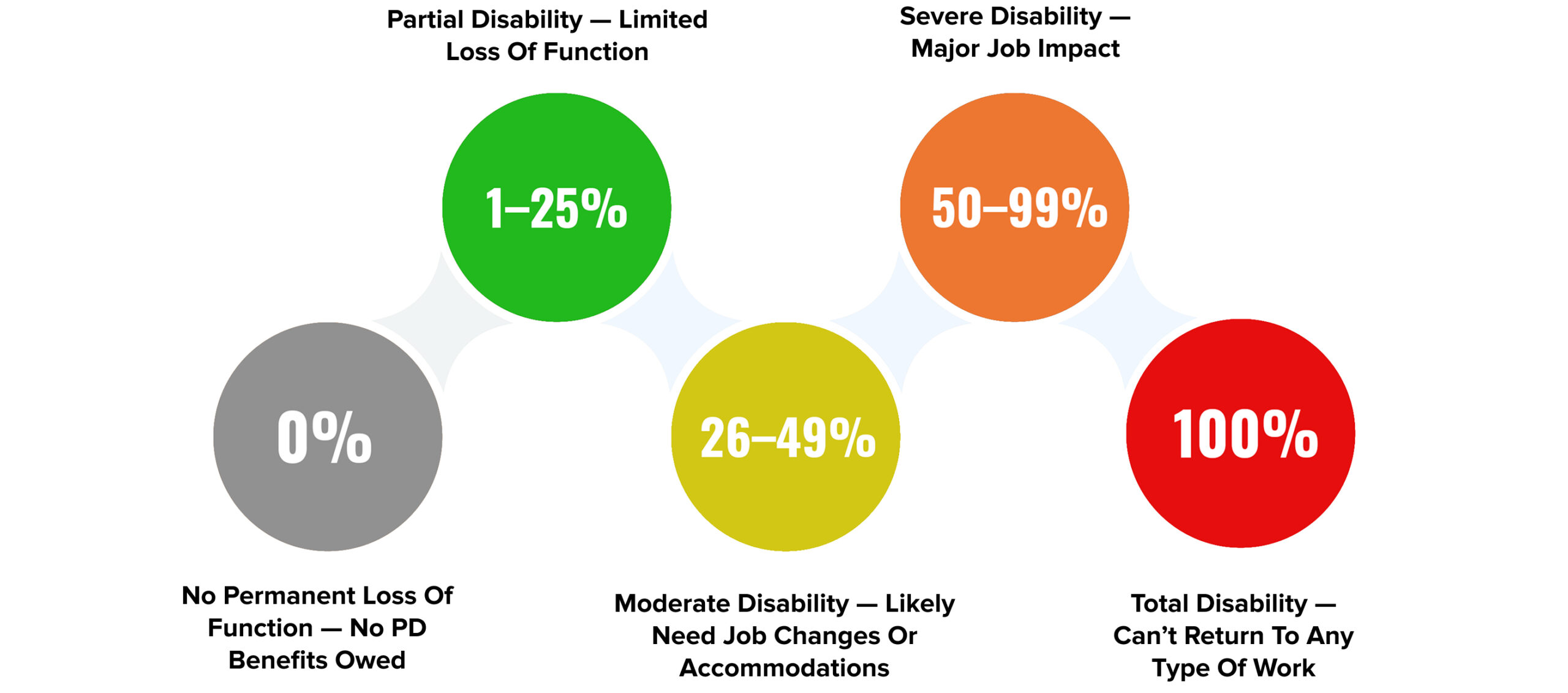
If a workplace injury causes lasting physical or mental impairment that reduces the worker's earning capacity after reaching Maximum Medical Improvement (MMI), the worker qualifies for Permanent Disability indemnity.
- Disability ratings are calculated using the American Medical Association (AMA) Guides to the Evaluation of Permanent Impairment (5th Edition), modified by age, occupation, and diminished future earning capacity adjustments under state-mandated rating schedules.
4. Supplemental Job Displacement Benefit (SJDB)
If an injury results in permanent disability preventing a return to regular duties, and the employer does not offer modified or alternative work within 60 days of the MMI finding, the worker receives a non-transferable $6,000 educational voucher. This voucher covers tuition, training, and credentialing at accredited California schools, along with a $500 stipend for computer equipment.
5. Death Benefits
In the event of a fatal workplace injury, burial expenses up to statutory limits are provided alongside periodic indemnity payments to total or partial dependents, distributed according to the number of eligible dependents under California Labor Code Section 4702.
Medical Treatment Networks, UR, and Dispute Resolution
Medical care within the Southern California workers' compensation system follows strict regulatory oversight to manage costs and ensure standardized care standards.
- PRIMARY TREATING PHYSICIAN (PTP)
- Diagnosis and treatment recommendation based on MTUS evidence-based guidelines.
- UTILIZATION REVIEW (UR)
- Insurance physician reviews treatment request (RFA). Approves, modifies, or denies.
- INDEPENDENT MEDICAL REVIEW (IMR)
- If UR denies/modifies, worker appeals to Maximus Federal Services (IMR state vendor).
- Decisions are binding; Workers' Compensation Judges cannot overturn medical merit.
Medical Provider Networks (MPNs)
Most insurance carriers and self-insured employers in Irvine maintain a DWC-approved Medical Provider Network (MPN). Unless an employee has validly predesignated a personal physician prior to the injury under Labor Code Section 4600, treatment must be obtained from a physician within the employer's MPN.
Utilization Review (UR)
Every treatment recommendation made by a Primary Treating Physician (PTP) must undergo Utilization Review (UR). A licensed physician employed or contracted by the insurer evaluates whether the requested care complies with MTUS clinical criteria.
Independent Medical Review (IMR)
If UR denies or modifies a requested treatment, the decision cannot be appealed directly to a Workers' Compensation Administrative Law Judge (WCALJ) regarding medical necessity. Instead, the dispute must be submitted to Independent Medical Review (IMR), administered through state contractor Maximus Federal Services. The IMR medical panel's determination is legally binding on all parties.
Qualified Medical Evaluators (QME)
When medical-legal disputes arise regarding the origin of an injury, the extent of permanent impairment, or return-to-work capacity, parties select a Qualified Medical Evaluator (QME) through a randomized three-physician panel issued by the DWC Medical Unit. Unrepresented workers select one physician from the panel for an evaluation; represented parties follow a specific statutory strike process.
Local Jurisdiction and Dispute Resolution in Irvine
Administrative disputes and formal hearings for workers' compensation claims originating in Irvine are handled through the local DWC District Office serving central and southern Orange County.
The Santa Ana DWC District Office
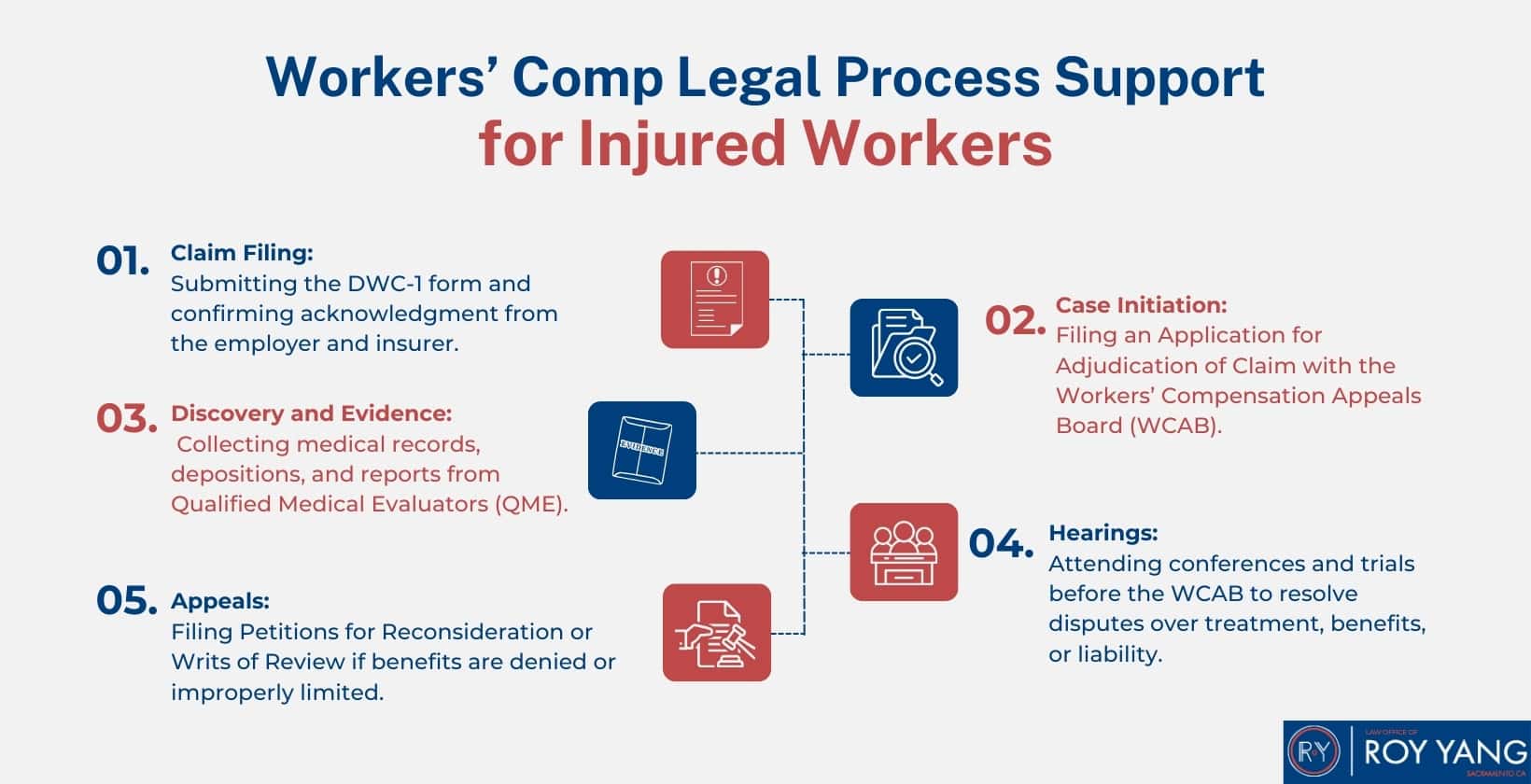
Irvine falls under the venue of the Santa Ana District Office of the Division of Workers' Compensation. All formal legal documents, including Applications for Adjudication of Claim, Compromise and Release (C&R) agreements, and Stipulations with Request for Award, are filed with this office directly or electronically through the state's Electronic Adjudication Management System (EAMS).
District Office: Santa Ana DWC District Office
Address: 605 W. Santa Fe Avenue, Santa Ana, CA 92701
Jurisdiction: Central and South Orange County, including Irvine, Costa Mesa, Newport Beach, Tustin, and surrounding municipalities.
Filing System: Electronic Adjudication Management System (EAMS)
DWC SANTA ANA DISTRICT OFFICE VENUE
- Address: 605 W. Santa Fe Avenue, Santa Ana, CA 92701
- System: EAMS (Electronic Adjudication Management System)
- Dispute Resolution Pathways:
- Mandatory Settlement Conference (MSC)
- Trial Hearing WCALJ Decision
Comparison of California Workers' Compensation Benefits
The following table summarizes the legal standards, calculation formulas, and statutory limits governing primary workers' compensation benefits in California.
| Benefit Type | Primary Eligibility Trigger | Calculation Formula / Statutory Amount | Statutory Limits / Limitations |
|---|---|---|---|
| Temporary Total Disability (TTD) | Inability to work during active recovery period | 66.67% of pre-injury Average Weekly Wage (AWW) | Max 104 aggregate weeks within 5 years of injury date; subject to annual state max/min caps |
| Temporary Partial Disability (TPD) | Work restricted; modified duties result in lower wage | 66.67% of difference between pre-injury AWW and actual modified earnings | Combined period limited under the 104-week statutory rule |
| Permanent Disability (PD) | Residual permanent impairment after reaching MMI | Calculated via AMA Guides (5th Ed.), adjusted by age, occupation, and FEC | Fixed weekly rate based on percentage rating (1% to 99%); paid over set number of weeks |
| Supplemental Job Displacement (SJDB) | Permanent disability prevents return; employer offers no modified work | Non-transferable $6,000 voucher + $500 computer stipend | Valid only at accredited or state-approved educational/vocational institutions |
| Death Benefits | Work-related injury or illness resulting in employee death | Lump-sum burial allowance + ongoing indemnity payments to dependents | $250,000 to $320,000+ depending on number of total/partial dependents; burial capped by statute |
Common Compliance Pitfalls and Mistakes
Employers and employees operating in Irvine frequently encounter administrative and legal errors that complicate workers' compensation claims.
- COMMON SYSTEM PITFALLS
- EMPLOYER COMPLIANCE PITFALLS
- Failure to post DWC notice at jobsite
- Misclassifying employees as ICs
- Retaliation against claimants (LC 132a)
- EMPLOYEE CLAIM PITFALLS
- Missing 30-day reporting window
- Seeking out-of-network non-MPN care
- Gaps in treating physician notes
- EMPLOYER COMPLIANCE PITFALLS
Employer Pitfalls
- Misclassification of Independent Contractors: Classifying workers as 1099 independent contractors to avoid insurance coverage is illegal under California's strict employment test established by Assembly Bill 5 (AB 5) and Labor Code Section 2775. Employers who misclassify face severe tax civil litigation and retroactive workers' compensation premium assessments.
- Labor Code Section 132a Retaliation: It is illegal to discharge, threaten to discharge, or discriminate in any way against an employee because they filed or intend to file a workers' compensation claim. A violation carries penalties up to $10,000, mandatory job reinstatement, and back pay.
- Failure to Post Mandatory Notices: Employers must post the official "Notice to Employees - Injuries Caused By Work" poster in a conspicuous location detailing insurance coverage details and medical network access. Failure to do so invalidates the employer's right to control initial medical treatment.
Employee Pitfalls
- Delayed Injury Reporting: Delaying formal written notification beyond 30 days provides insurance carriers a defense to deny the claim if late notice prejudiced their ability to investigate the incident.
- Unauthorized Non-MPN Treatment: Seeking treatment outside the established Medical Provider Network without proper pre-designation or legal authorization can result in unpaid medical bills and non-admissibility of medical reports in legal proceedings.
- Inconsistent Statements: Discrepancies between medical history reported to emergency personnel, primary treating physicians, and claim administrators are primary grounds for claim denial.
Frequently Asked Questions
What should an Irvine employee do if an employer refuses to provide a DWC-1 form?
If an employer fails or refuses to provide the DWC-1 form upon request, the injured worker should submit written notice of the injury detailing the date, time, and nature of the incident via certified mail. The employee can then contact the DWC Information and Assistance (I&A) Officer at the Santa Ana District Office or consult a workers' compensation attorney to file an Application for Adjudication of Claim directly with the state.
Can an employer force an injured worker to use personal paid time off (PTO) during disability?
No. Employers cannot require an employee to consume accrued sick leave or PTO in lieu of receiving statutory Temporary Disability payments. However, an employee may voluntarily elect to use accrued PTO or sick leave to supplement TTD payments in order to receive full regular pay, provided the employer's HR policies permit such coordination of benefits.
How does pre-designation of a physician work in California?
Under Labor Code Section 4600, an employee can be treated by their personal physician immediately following a work injury if, prior to the injury, they provided written notice to their employer predesignating their personal doctor. The physician must be the employee's regular primary care doctor, maintain the employee's medical records, and agree in writing prior to the injury to act as the treating workers' compensation physician.
What happens if a workers' compensation insurance claim is completely denied?
If the claims administrator issues a formal Notice of Denial, the injured worker must file an Application for Adjudication of Claim with the DWC Santa Ana District Office to open a formal court file. The dispute will proceed through discovery, which usually includes a QME evaluation, followed by a Mandatory Settlement Conference (MSC) and, if necessary, a trial before a Workers' Compensation Administrative Law Judge.
Are remote and hybrid workers in Irvine covered by workers' compensation?
Yes. Under California law, remote and telecommuting workers are covered by workers' compensation if the injury arises out of and occurs in the course of their employment (AOE/COE). The physical location of the injury (such as a home office in Irvine) does not invalidate coverage, provided the employee was performing work-related tasks during authorized working hours at the time of the injury.
Actionable Next Steps for Employers and Employees
For Employers in Irvine
- Audit Insurance Policies: Review commercial policies annually to confirm that all Southern California locations, remote employees, and operational entities are properly covered under active policies.
- Update Workplace Postings: Confirm that mandatory DWC notices, MPN contact details, and pre-designation forms are posted in breakrooms and distributed via online portals to hybrid personnel.
- Train Supervisory Personnel: Train managers to immediately report all incidents to HR or the claims department within 24 hours to ensure compliance with the one-day DWC-1 issuance requirement.
For Injured Employees in Irvine
- Report Injuries Immediately: Provide written notice to your employer immediately following an injury or diagnosis of a work-related illness.
- Request the DWC-1 Form: Complete and return the employee portion of the DWC-1 claim form promptly, keeping a copy of the completed document for your records.
- Adhere to Approved Care Networks: Seek treatment from physicians within the designated MPN, ensuring that all physical restrictions issued by doctors are provided directly to your employer's HR department.
- Consult Local Assistance: For unresolved administrative disputes, contact the DWC Information and Assistance Unit at the Santa Ana District Office or seek professional representation from a California-licensed workers' compensation attorney.
Image Gallery