Western Workers Compensation Claim Center Overview: Filing, Processing, and Rights
A Western workers compensation claim center acts as the centralized administrative hub that processes, evaluates, and manages workplace injury and occupational illness claims across Western U.S. states. Operating under private insuranc...
A Western workers compensation claim center acts as the centralized administrative hub that processes, evaluates, and manages workplace injury and occupational illness claims across Western U.S. states. Operating under private insurance carriers, third-party administrators (TPAs), or state-run compensation funds, these centers coordinate medical care, disburse wage replacement benefits, and resolve coverage disputes in accordance with state labor laws.
Contents
What Is a Western Workers Compensation Claim Center?
A workers compensation claim center is an operational facility or dedicated department responsible for managing insurance claims filed by employees who sustain job-related injuries or illnesses. In the Western United States, claims administration is handled through several institutional frameworks depending on the state's regulatory structure and the employer's coverage model:
- Private Insurance Carriers and TPAs: In states like Arizona, California, Colorado, Nevada, Oregon, and Utah, employers typically purchase coverage from commercial insurance carriers (such as Western National Insurance Group or national underwriters) or hire Third-Party Administrators (TPAs) to manage self-insured claims.
- State Insurance Funds: Several Western states maintain public or quasi-public insurance funds. For example, California operates the State Compensation Insurance Fund (State Fund), while Oregon relies heavily on SAIF Corporation.
- Monopolistic State Funds: Washington State operates a monopolistic state fund through its Department of Labor & Industries (L&I), meaning most non-self-insured employers must coverage directly through the state.
- Insolvency Guaranty Associations: Organizations like Western Guaranty Fund Services (WGFS) serve as a safety net, stepping in to process and pay claims when an authorized property and casualty insurer becomes insolvent within participating Western jurisdictions.
Regardless of the specific corporate or governmental entity operating the claim center, its legal core function remains uniform: evaluating employer injury reports, verifying benefit eligibility under applicable state statutory guidelines, managing medical treatments, and disbursing state-mandated disability payments.
Core Functions and Operational Structure of a Claim Center
When an injury report is submitted, the claim center initiates a multi-stage administrative workflow governed by statutory timelines. Understanding how these internal departments operate helps both injured workers and employers navigate the claims process effectively.
- Injury Occurs & Reported
- Claims Intake & Initial Registration
- Assigns File & Claims Adjuster
- Adjudication & Investigation Unit
- Determines Acceptance, Delay, or Denial
- If Accepted:
- Medical Care & Case Management (UR/PPO)
- Indemnity & Benefit Disbursement Unit
- Return-to-Work & Resolution / Closure
Claims Intake and Initial Assignment
Upon receiving an employer's first report of injury or the worker’s formal claim form, the intake unit creates an official file, assigns a unique claim number, and routes the file to a specialized claims adjuster (or claims examiner). The adjuster serves as the primary point of contact for the worker, employer, and medical providers.
Investigation and Adjudication
The adjuster reviews the incident details to confirm that the injury occurred within the course and scope of employment. This phase involves verifying employment status, reviewing medical records, examining wage statements, and evaluating accident reports. If liability is unclear, the claim center may place the claim in a temporary "delay" status while gathering additional evidence.
Medical Case Management and Utilization Review
Claim centers employ nurse case managers and utilization review (UR) specialists to monitor medical treatment plans. The claim center reviews proposed surgeries, physical therapy requests, diagnostic imaging, and prescription medications to ensure they meet evidence-based medical necessity guidelines established by the state’s workers’ compensation board.
Indemnity and Benefit Disbursement
When an injured worker is unable to perform their duties or earns reduced wages during recovery, the indemnity department calculates and distributes wage loss benefits. These include Temporary Total Disability (TTD), Temporary Partial Disability (TPD), and Permanent Partial Disability (PPD) compensation based on statutory formulas linked to the worker's Average Weekly Wage (AWW).
Step-by-Step Guide to Filing a Claim Through a Western Claim Center
Navigating a workers' compensation claim requires strict adherence to notification deadlines and procedural rules. Missing a legal cutoff can forfeit your right to financial and medical benefits.
Step 1: Formal Injury Notification to the Employer
Report any workplace accident or occupational condition to a supervisor in writing immediately. State statutes set strict deadlines for reporting injuries:
- California: Written notice within 30 days of the injury or discovery of an occupational illness.
- Colorado: Written notice within 10 days of the incident.
- Washington: Immediate notification to the employer, with formal claims submitted to L&I or the self-insured administrator within one year.
Step 2: Completion of Official Claim Forms
After receiving notice, the employer must provide the employee with the designated state claim form:
- In California, the employee fills out the employee section of Form DWC 1.
- In Oregon, Form 801 is completed jointly by the worker and employer.
- In Washington, the Worker's Report of Industrial Injury is submitted online or via a physician’s office.
The employer submits their portion of the form to the claim center, which triggers the official adjudication clock.
Step 3: Initial Medical Evaluation
Seek medical attention immediately. In emergency cases, treatment can be rendered at any urgent care or emergency department. For ongoing care, state laws dictate physician selection rules:
- Employer/Insurer Choice States: States such as California permit employers or insurers to direct care within an established Medical Provider Network (MPN) or Preferred Provider Organization (PPO) during the first 30 days, unless the employee pre-designated a personal physician prior to the injury.
- Employee Choice States: States like Washington and Oregon grant injured workers broader freedom to choose their initial attending physician, provided the provider is certified by the state workers' compensation board.
Step 4: Claim Center Determination
The claim center must formally accept, delay, or deny the claim within statutory time limits:
- California: The adjuster has 90 days to accept or deny a claim, but must authorize up to $10,000 in medical treatment while the decision is pending.
- Oregon: The insurer must accept or deny the claim within 60 days of employer notice.
- Colorado: Insurers must file a Notice of Contest or admission of liability within 20 days of receiving notice.
If accepted, the center begins paying medical bills and processing wage replacement checks. If denied, the center issues a formal Notice of Denial detailing the specific reasons and appeal rights.
Regulatory Framework Across Western State Jurisdictions
Workers' compensation is governed at the state level. Claim centers operating across Western regions must adapt their procedures to each state's laws.
| State Jurisdiction | Primary Regulatory Authority | Employee Notice Deadline | Claim Center Adjudication Deadline | Primary Dispute Resolution Body |
|---|---|---|---|---|
| California | Division of Workers' Compensation (DWC) | 30 Days | 90 Days (up to $10k treatment during review) | Workers' Compensation Appeals Board (WCAB) |
| Washington | Department of Labor & Industries (L&I) | Immediate / 1 Year Form Limit | 30 to 60 Days | Board of Industrial Insurance Appeals (BIIA) |
| Oregon | Workers' Compensation Division (WCD) | 90 Days | 60 Days | Workers' Compensation Board (WCB) |
| Colorado | Division of Workers' Compensation (DWC) | 10 Days | 20 Days | Office of Administrative Courts (OAC) |
| Arizona | Industrial Commission of Arizona (ICA) | 1 Year (Notice to ICA) | 21 Days | Industrial Commission Hearing Division |
| Nevada | Division of Industrial Relations (DIR) | 7 Days (Form C-1) | 30 Days | Department of Administration Hearing Office |
Types of Benefits Administered by Workers Comp Claim Centers
Claim centers calculate, verify, and disburse statutory benefits categorized into four main areas:
- Workers' Compensation Benefits
- Medical Care
- Temporary Disability
- Permanent Disability
- Vocational Re-Train
1. Medical Benefits
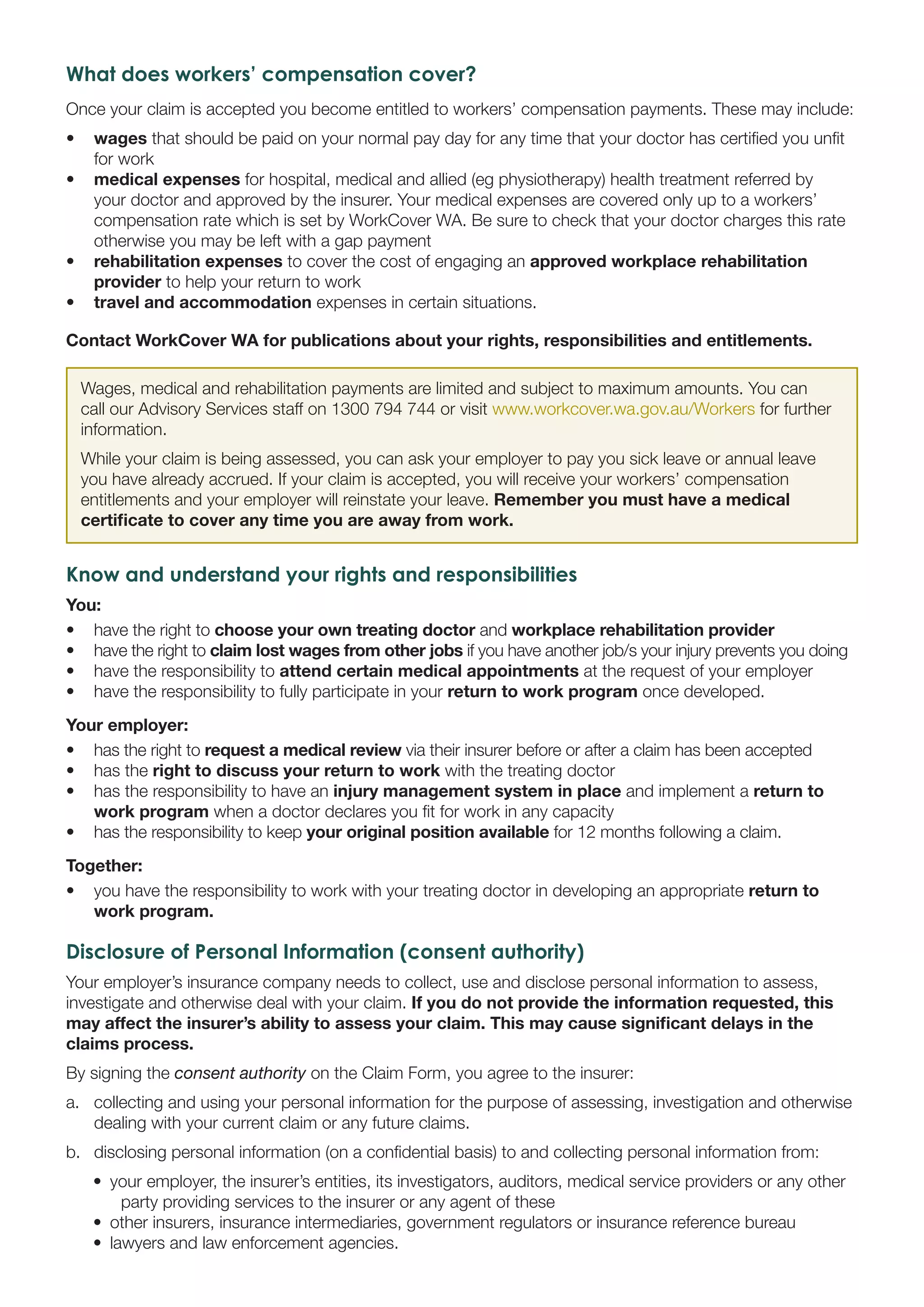
Claim centers cover all reasonably required medical care to cure or relieve the effects of the injury. Covered services typically include doctor visits, hospital stays, surgeries, prescription drugs, physical therapy, medical equipment, and travel reimbursement for medical appointments.
2. Temporary Disability Benefits (Wage Replacement)
If an injury prevents a worker from performing their usual job duties during recovery, the claim center provides wage replacement benefits:
- Temporary Total Disability (TTD): Paid when an employee cannot work at all. It typically equals two-thirds (66.67%) of the worker's average weekly wage, subject to state-mandated minimum and maximum caps.
- Temporary Partial Disability (TPD): Paid when an employee returns to modified, light-duty work at a lower wage, compensating for a portion of the difference between pre-injury and post-injury earnings.
3. Permanent Disability Benefits
If a work injury results in permanent physical impairment or loss of earning capacity that remains after reaching Maximum Medical Improvement (MMI), the claim center pays permanent disability compensation. Amounts are determined by a physician's impairment rating (often based on the American Medical Association Guides to the Evaluation of Permanent Impairment) combined with state-specific rating schedules.
4. Vocational Rehabilitation and Supplemental Benefits
When an injured worker cannot return to their former occupation due to permanent restrictions, claim centers administer vocational retraining benefits. In California, this comes as a Supplemental Job Displacement Benefit (SJDB) voucher. In Washington and Oregon, state-approved vocational counselors create structured retraining plans funded through the claim system.
Resolving Common Claim Delays and Disputes
Disagreements frequently arise between injured workers and claim centers over medical treatments, wage calculations, or claim acceptances. Knowing how to handle these disputes ensures claims stay on track.
Common Causes for Claim Denial
- Lack of Timely Reporting: Failing to notify an employer or file forms within state-mandated timelines.
- Disputed Causation: Claim adjusters arguing that the injury did not occur at work or stems from a pre-existing condition.
- Lack of Medical Evidence: Insufficient physician documentation linking the medical condition directly to job duties.
- Employment Status Disputes: Employers misclassifying workers as independent contractors to avoid coverage obligations.
Navigating Utilization Review (UR) Medical Denials
If a claim center denies a physician's treatment request via Utilization Review, the decision cannot simply be overruled by the adjuster. In states like California, injured workers must challenge the UR decision through an Independent Medical Review (IMR), where an independent physician reviews the medical records to issue a binding determination.
Administrative Appeals and Legal Representation
If a claim is formally denied or benefits are wrongfully suspended, the worker can file an administrative appeal with the state’s governing workers' compensation board (e.g., requesting a hearing before an Administrative Law Judge at the WCAB in California or filing an appeal with the BIIA in Washington).
During an appeal, injured workers have the right to hire a qualified workers' compensation attorney. Attorney fees are regulated by state law and are typically paid as a contingency percentage (usually 10% to 15%) subtracted directly from awarded disability benefits or settlements, requiring no upfront out-of-pocket costs from the worker.
Frequently Asked Questions
How long does a Western workers compensation claim center have to accept or deny a claim?
Adjudication timelines depend on the specific state jurisdiction. For instance, claim centers in California have up to 90 days to issue a final acceptance or denial, though they must pay up to $10,000 in authorized medical treatment during the review period. Arizona requires a decision within 21 days, Colorado within 20 days, Nevada within 30 days, and Oregon within 60 days.
What should I do if my claim center denies my request for medical treatment?
First, review the written explanation provided in the Utilization Review (UR) or treatment denial letter. Speak with your treating physician to submit additional diagnostic reports, medical history, or a detailed Letter of Medical Necessity. If the claim center upholds the denial, file a formal appeal through your state’s independent medical review process or appeal board before statutory dispute filing deadlines expire.
Can I choose my own doctor when dealing with a workers' compensation claim center?
Doctor selection rules vary by state law. In Washington and Oregon, workers generally have the freedom to select their initial treating doctor from approved state provider networks. In California and Colorado, employers or their claim centers direct care within an established Medical Provider Network (MPN) or designated panel for the first 30 days, unless the worker filed a valid pre-designation of a personal physician prior to the injury.
What happens if the insurance company operating the claim center goes bankrupt?
If a licensed property and casualty insurer becomes insolvent, claims handling shifts to a state guaranty association. Across several Western states, entities like Western Guaranty Fund Services (WGFS) step in to administer claims, cover authorized medical treatment, and issue indemnity payments in accordance with statutory guaranty fund limits and state laws.
How are wage loss benefits calculated by the claim center?
Wage replacement benefits—primarily Temporary Total Disability (TTD)—are generally calculated as two-thirds (66.67%) of your Average Weekly Wage (AWW) earned prior to the injury. The AWW is calculated using gross earnings, including overtime and bonuses, over a designated period (often 52 weeks). Payments are subject to minimum and maximum caps set annually by state legislatures.
Strategic Recommendations for Injured Workers and Employers
To protect legal rights and ensure efficient claim processing through a Western workers compensation claim center, both parties should follow these essential steps:
For Injured Workers:
- Document everything in writing immediately following an incident, keeping copies of all submitted injury notices, medical receipts, and claim forms.
- Attend all scheduled doctor appointments and strictly follow prescribed treatment plans to prevent claim adjusters from alleging non-compliance.
- Maintain direct, professional communication with your assigned claims adjuster, providing updated work-status notes from your doctor after every visit.
- Consult a specialized workers' compensation attorney if your claim is denied, delayed, or if benefit payments are unexpectedly stopped.
For Employers:
- Provide state-mandated claim forms to injured employees within 24 hours of receiving notice of a workplace incident.
- Submit the employer’s portion of the injury report to your claim center immediately to avoid administrative penalties.
- Offer modified, light-duty work options when medically cleared by treating physicians to minimize indemnity costs and support successful return-to-work outcomes.
Image Gallery