Max Hall and the Arizona Cardinals: NFL Career, BYU Legacy, and Life After Football
Former Brigham Young University (BYU) star quarterback Max Hall joined the Arizona Cardinals in 2010 as an undrafted free agent. Brief as it was, his tenure with the Cardinals proved memorable, highlighted by a surprising victory over...
Former Brigham Young University (BYU) star quarterback Max Hall joined the Arizona Cardinals in 2010 as an undrafted free agent. Brief as it was, his tenure with the Cardinals proved memorable, highlighted by a surprising victory over the defending Super Bowl champion New Orleans Saints before injuries halted his NFL career.
Contents
From Mesa Native to BYU Legend
Max Hall’s connection to Arizona predates his professional career with the Arizona Cardinals. Raised in Mesa, Arizona, Hall attended Mountain View High School, where he established himself as one of the state's top high school quarterbacks. He came from a notable football pedigree: his grandfather, Wilford "Whizzer" White, was an All-American running back at Arizona State University (ASU), and his uncle, Danny White, was a star quarterback at ASU before enjoying a long career with the Dallas Cowboys.
Despite those deep ties to Arizona State, Hall elected to attend BYU following a two-year mission for The Church of Jesus Christ of Latter-day Saints in Request, Iowa. After redshirting in 2006 behind John Beck, Hall took over as BYU's starting quarterback in 2007 under head coach Bronco Mendenhall.
Max Hall's College Record at BYU (2007–2009):
- Starting Record: 32–7 (Winningest QB in BYU History)
- Passing Yards: 11,372
- Touchdown Passes: 94
- Completed Passes: 903 / 1,382 (65.3%)
During his three seasons as starter (2007 to 2009), Hall delivered remarkable statistical consistency:
- 2007 Season: Led BYU to an 11–2 record, passing for 3,848 yards and 26 touchdowns, culminating in a Las Vegas Bowl victory over UCLA.
- 2008 Season: Threw for 3,957 yards and 35 touchdowns while taking the Cougars to another 10–3 finish and a top-25 national ranking.
- 2009 Season: Finished his senior year with 3,560 passing yards, 33 touchdowns, and an 11–2 record, capped by an emotional 44–20 win over Oregon State in the Las Vegas Bowl.
When Hall concluded his college career in 2009, his 32 victories made him the winningest starting quarterback in BYU football history, surpassing legends such as Jim McMahon, Steve Young, Ty Detmer, and Steve Sarkisian.
Entering the NFL: The 2010 Arizona Cardinals QB Situation
Despite his college success, NFL scouts questioned Hall's prototype size (listed at 6-foot-1) and arm strength. He went undrafted in the 2010 NFL Draft. Shortly after the draft concluded, the Arizona Cardinals signed Hall as an undrafted free agent, giving the hometown quarterback a chance to compete for a roster spot in Phoenix.
The 2010 season marked a major transition point for the Arizona Cardinals organization. Longtime quarterback Kurt Warner retired following the 2009 season after leading the team to Super Bowl XLIII in 2008 and a playoff appearance in 2009. Head coach Ken Whisenhunt and general manager Rod Graves faced the challenge of replacing a Future Hall of Fame quarterback without an established long-term successor.
Arizona Cardinals 2010 QB Depth Chart Progression:
- Week 1–4: Derek Anderson (Starter)
- Week 5–6: Max Hall (Named Starter after Anderson's Struggles)
- Late Season: Rotation involving Anderson, Hall, and Rookie John Skelton
The team signed veteran free agent Derek Anderson to serve as the starter, while holding onto Matt Leinart and drafting Fordham quarterback John Skelton in the fifth round. During training camp, the Cardinals released Leinart, promoting Anderson to starter and opening up the backup role for Hall.
Anderson struggled early in the 2010 regular season, throwing numerous interceptions and struggling to sustain drives. Through the first four games, Arizona sat at 2–2, but the offense lacked consistency. Seeking a spark, Whisenhunt made the bold decision ahead of Week 5 to bench Anderson and name the rookie undrafted free agent, Max Hall, as the starting quarterback against the New Orleans Saints.
Max Hall’s Signature NFL Moment: Upsetting the Saints
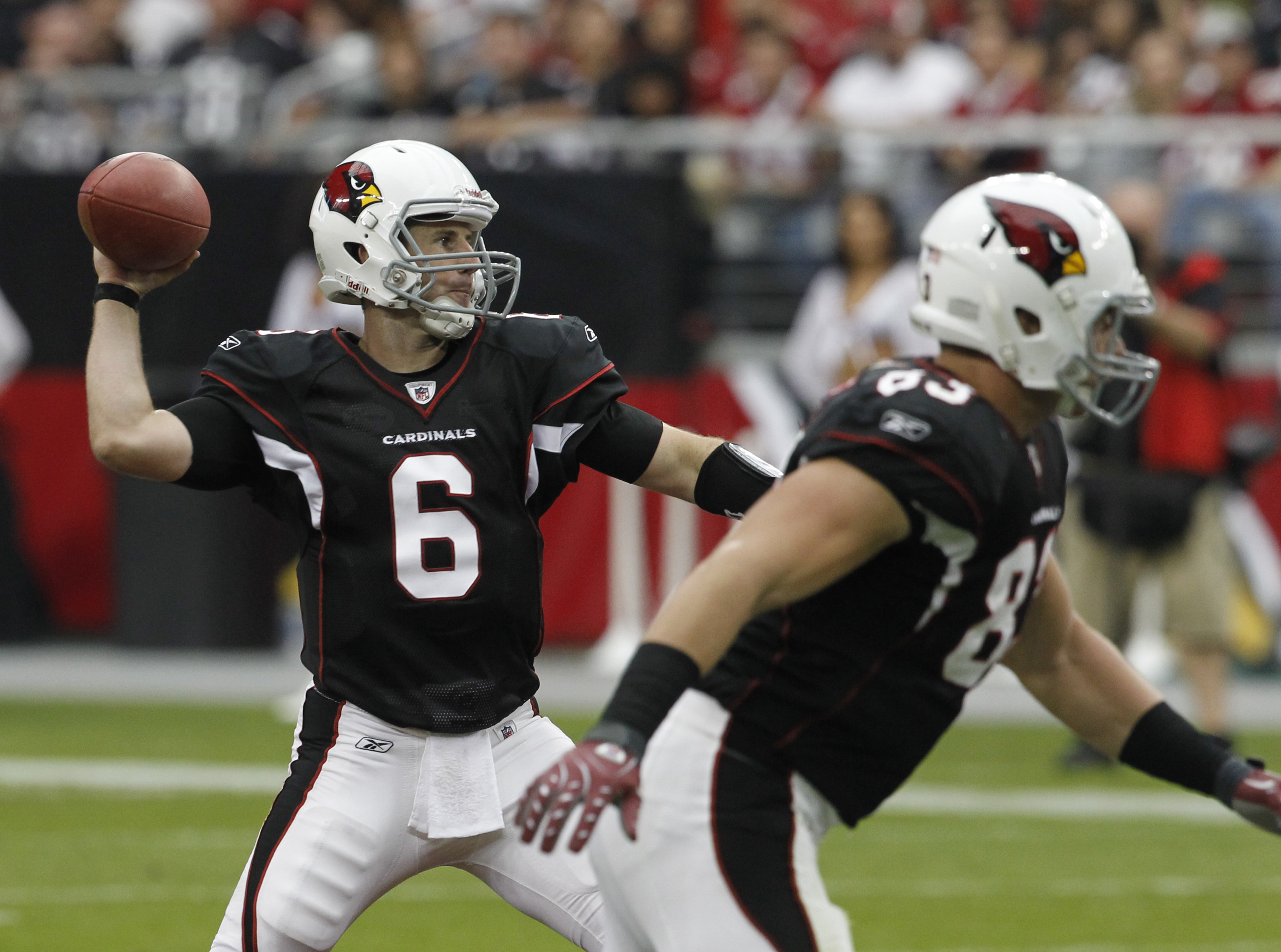
On October 10, 2010, Max Hall made his first career NFL start at University of Phoenix Stadium in Glendale, Arizona. The challenge could hardly have been greater: the visiting opponent was the defending Super Bowl champion New Orleans Saints, led by future Hall of Fame quarterback Drew Brees.
Hall’s stat line in that game was modest, but his game management and toughness helped keep Arizona competitive throughout four physical quarters.
Week 5 Breakdown: Cardinals 30, Saints 20 (Oct 10, 2010):
- Max Hall Passing: 17 of 27 (63.0%), 168 Yds, 0 TD, 1 INT
- Defensive Impact: 2 Fumble Return Touchdowns by Arizona Defense
- Kicking: Jay Feely conversion on critical 4th-quarter Field Goals
Arizona's defense forced multiple turnovers, returning two fumbles for touchdowns. Hall avoided catastrophic mistakes against a blitz-heavy Saints defense. Despite leaving the game briefly after taking a heavy hit, Hall returned to lead a late scoring drive that sealed a 30–20 victory for the Cardinals.
The win marked one of the few instances in NFL history where an undrafted rookie quarterback defeated the reigning Super Bowl champions in his very first career start. The home crowd cheered the local Mesa native, and for a brief window, Hall looked like the inspiring solution to Arizona’s post-Kurt Warner rebuilding phase.
Complete NFL Career Statistics & Game Breakdown
Hall's momentum proved difficult to maintain as the physical toll of the NFL took its toll. In his second start (Week 6 against the Seattle Seahawks), Hall suffered a concussion early in the game after completing 4 of 6 passes for 36 yards with an interception. The Cardinals fell 23–10.
He returned to start in Week 8 against the Tampa Bay Buccaneers, but struggled significantly, throwing two interceptions in a 38–35 loss before being replaced by Derek Anderson. Later in the season, during a December matchup against the Denver Broncos, Hall suffered a severe shoulder injury that placed him on Season-Ending Injured Reserve.
The table below summarizes Max Hall's game participation during the 2010 NFL regular season with the Arizona Cardinals:
| Game / Date | Opponent | Result | Pass Comp / Att | Yds | TD | INT | Notes / Status |
|---|---|---|---|---|---|---|---|
| Week 3 (Sep 26) | vs. Oakland Raiders | W 24–23 | 2 / 3 | 3 | 0 | 0 | Made NFL debut in relief appearance |
| Week 5 (Oct 10) | vs. New Orleans Saints | W 30–20 | 17 / 27 | 168 | 0 | 1 | 1st Career Start; Beat defending SB Champions |
| Week 6 (Oct 17) | @ Seattle Seahawks | L 10–23 | 4 / 6 | 36 | 0 | 1 | Left game with head injury (concussion) |
| Week 8 (Oct 31) | vs. Tampa Bay Bucs | L 35–38 | 8 / 16 | 71 | 0 | 2 | Started; benched during game for D. Anderson |
| Week 9 (Nov 7) | @ Minnesota Vikings | L 24–27 (OT) | 0 / 0 | 0 | 0 | 0 | Played limited snaps in relief package |
| Week 14 (Dec 12) | vs. Denver Broncos | W 43–13 | 8 / 26 | 92 | 1 | 2 | Threw 1st career NFL TD pass; suffered shoulder injury |
Max Hall Career NFL Regular Season Totals
- Games Played (Started): 6 (3)
- Record as Starter: 1–2
- Completions / Attempts: 39 / 78
- Completion Percentage: 50.0%
- Passing Yards: 370
- Touchdown Pass / Interceptions: 1 / 6
- Passer Rating: 35.7
Following the 2010 season, the Cardinals reworked their quarterback room by acquiring Kevin Kolb in a trade with the Philadelphia Eagles and drafting Patrick Peterson in the first round to bolster the roster overall. The team released Max Hall in August 2011 during training camp roster cuts.
Post-NFL Transition: CFL, Personal Battles, and Advocacy
After his departure from Arizona, Hall sought to extend his playing career in professional football. In 2012, he signed with the Kansas City Chiefs for a brief preseason stint before moving to the Canadian Football League (CFL).
The CFL Chapter
In 2013, Hall signed with the Winnipeg Blue Bombers of the CFL. He earned the starting job midway through the season, appearing in 9 games, completing 111 of 210 passes for 1,499 yards, 8 touchdowns, and 11 interceptions. However, persistent physical injuries again limited his effectiveness, leading to his retirement from professional football in early 2014.
Post-NFL Career Path:
- 2013: Winnipeg Blue Bombers (CFL Quarterback)
- 2014: Official Retirement from Professional Football
- 2014–2019: High School Coaching & Personal Rehabilitation
- 2020–Present: Football Coaching, Offensive Mentorship, Mental Health Advocacy
Personal Struggles and Overcoming Addiction
The physical toll of Hall's football career left lasting scars. Over his years in college and professional football, Hall endured numerous severe concussions and structural injuries, including his shoulder dislocation in Arizona. To manage chronic pain, he became dependent on prescription opioid painkillers—a dependency that escalated rapidly after his playing days ended.
In August 2014, Hall hit a low point when he was arrested in Gilbert, Arizona, on misdemeanor shoplifting and drug possession charges. The incident made national headlines, given his local visibility as a former BYU star and Cardinals starter.
Rather than running from the event, Hall used it as a turning point. He entered an intensive rehabilitation facility, got clean, and publicly addressed his addiction. Over the subsequent decade, Hall has been open about his battle with opioid dependency, traveling to high schools, university programs, and community groups to speak on addiction recovery, mental health, and the dangers of sports-related prescription medication reliance.
Coaching Career and Current Status
Following his recovery, Hall dedicated his professional life to coaching and player development, leveraging his experience at the collegiate and NFL levels to train the next generation of quarterbacks.
- High School Offense: Hall served as the offensive coordinator at American Fork High School in Utah, where he built high-scoring offensive systems and mentored college-bound quarterbacks.
- Private Quarterback Instruction: He partnered with private quarterback academies (including 3DQB Motion Mechanics) to provide technical instruction on throwing mechanics, pocket presence, and film evaluation to high school and collegiate athletes.
- Community Involvement: Hall remains actively involved in youth athletics across the Southwest, while remaining a respected alumni figure for both BYU Athletics and the local Arizona sports community.
Frequently Asked Questions
Did Max Hall get drafted into the NFL?
No, Max Hall was not selected in the 2010 NFL Draft. He signed with the Arizona Cardinals as an undrafted free agent shortly after the draft concluded.
What was Max Hall’s record as a starter for the Arizona Cardinals?
Max Hall posted a 1–2 record in his 3 career starts for the Arizona Cardinals during the 2010 NFL regular season. His single victory was a 30–20 upset over the New Orleans Saints in Week 5.
What were Max Hall’s overall college stats at BYU?
Over three seasons as BYU's starting quarterback from 2007 to 2009, Hall completed 903 of 1,382 passes for 11,372 yards, 94 touchdowns, and 44 interceptions. He led BYU to a 32–7 record, making him the winningest quarterback in school history.
Why did Max Hall retire from professional football?
Hall retired due to accumulated injuries, including multiple concussions and shoulder damage suffered during his stints in the NFL and CFL. These physical setbacks, paired with the roster changes inherent to professional football, led to his retirement in early 2014.
What is Max Hall doing today?
Hall works as a high school football coach, private quarterback coach, and motivational speaker. He regularly advocates for drug addiction awareness and mental health support, drawing from his personal journey of overcoming opioid addiction following his football career.
Summary and Key Takeaway
Max Hall’s tenure with the Arizona Cardinals illustrates how quickly opportunity and adversity intersect in professional sports. Though his NFL career lasted only six games in 2010, his victory over the defending Super Bowl champions remains a unique chapter in franchise history. Beyond the field, Hall's open reflection on his career injuries and recovery from addiction has established a lasting legacy as a coach, mentor, and advocate.
Image Gallery