How VoIP Calling Reshapes Communication: Architectural and Operational Transformations
Voice over Internet Protocol (VoIP) reshapes communication by replacing legacy public switched telephone networks (PSTN) with IP-based packet switching. By converting analog audio into digital data packets, VoIP enables unified communi...
Voice over Internet Protocol (VoIP) reshapes communication by replacing legacy public switched telephone networks (PSTN) with IP-based packet switching. By converting analog audio into digital data packets, VoIP enables unified communications, seamless CRM integrations, AI-driven voice analytics, and global mobility—dramatically reducing infrastructure costs while elevating operational flexibility for modern remote and hybrid enterprise environments.
Contents
The Fundamental Shift: Circuit-Switched PSTN to Packet-Switched IP Networks
To understand how VoIP reshapes communication, one must first examine the core difference between traditional telephony and internet-based voice transmission. Traditional voice communication relied on the Public Switched Telephone Network (PSTN), an infrastructure built on circuit switching. In a PSTN call, fixed copper wires or dedicated digital trunks establish a continuous, exclusive physical circuit between two callers for the full duration of a conversation. This model guarantees channel bandwidth but is inherently inefficient, reserving fixed capacity regardless of whether someone is speaking or silent.
- PSTN (Circuit Switching):
- Caller
- Dedicated Physical Circuit
- Receiver
- VoIP (Packet Switching):
- Caller
- Data Packets via IP Network
- Receiver
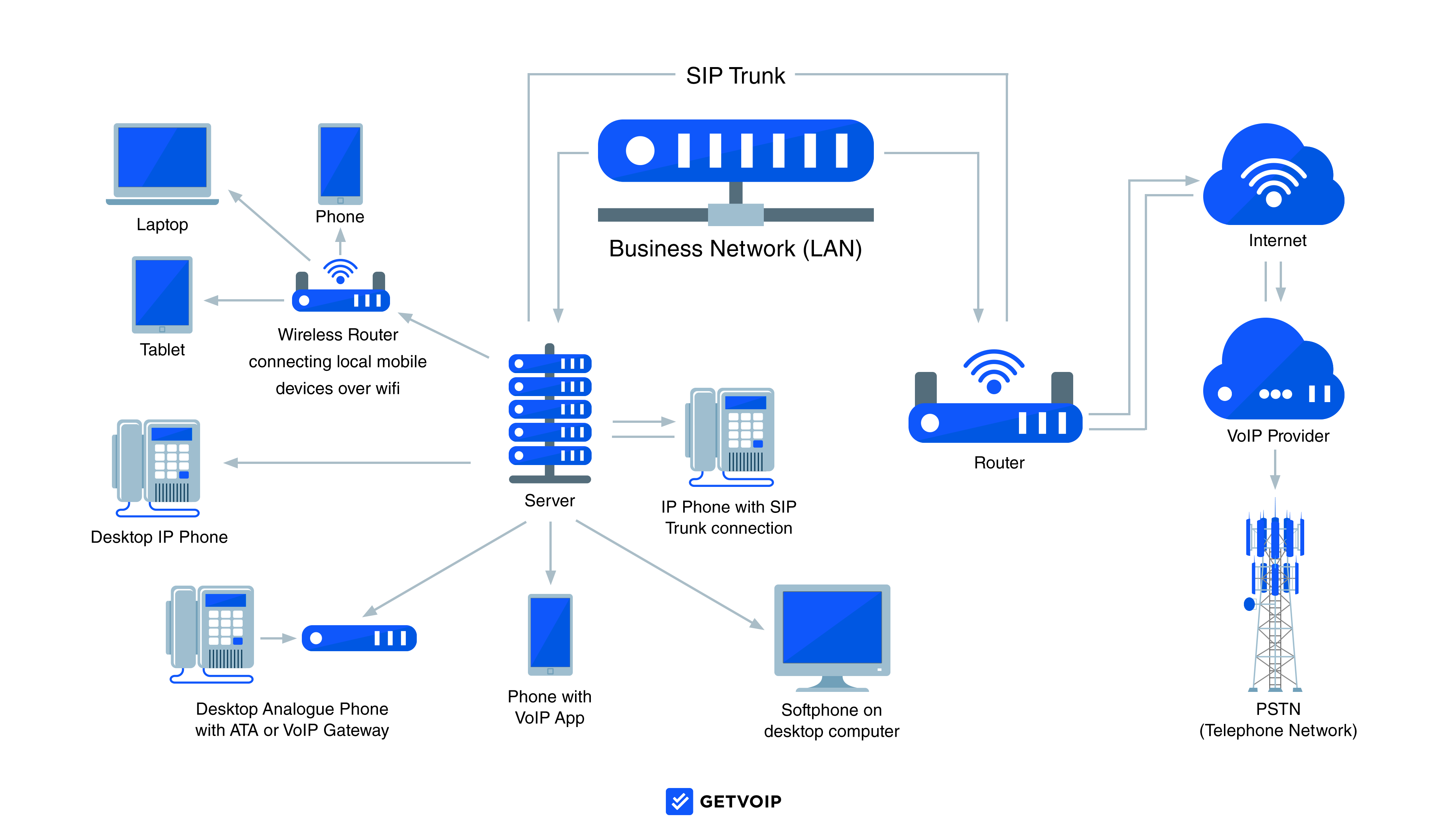
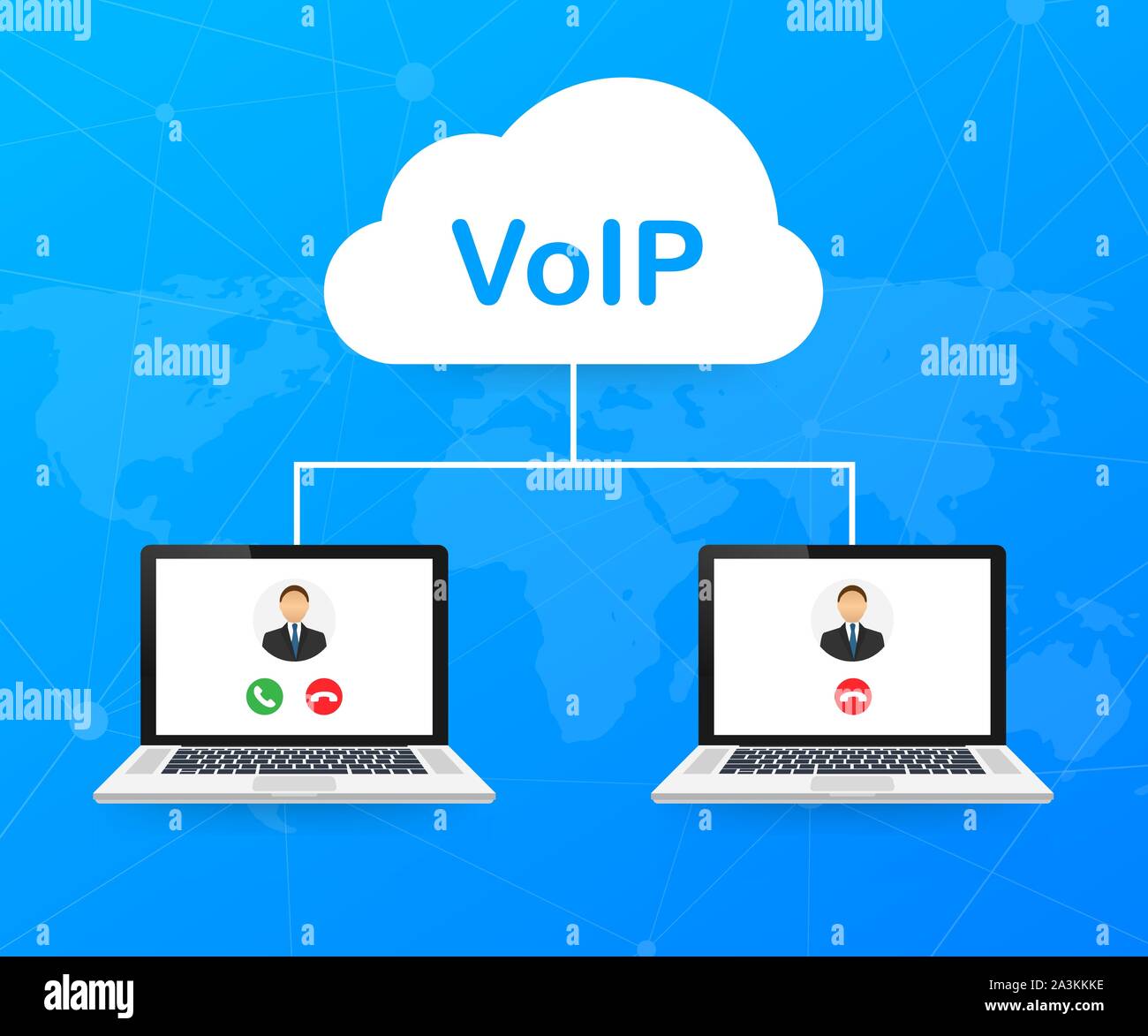
VoIP breaks this limitation by leveraging packet-switched networks. Instead of maintaining a open circuit, VoIP converts analog audio signals into digital binary code, divides that data into discrete IP packets, and routes those packets across local area networks (LANs) or the global internet.
VoIP Architecture:
- Analog Voice
- Codec Encoding (G.711 / Opus / G.729)
- SIP Signaling Protocol (Session Border Controller (SBC))
- RTP Packet Stream (IP Network Routing)
- Jitter Buffer & Decoding (Receiver Audio Output)
Key technical protocols govern this transmission:
- Session Initiation Protocol (SIP): A application-layer control protocol that sets up, maintains, and terminates real-time voice, video, and messaging sessions between endpoints.
- Real-time Transport Protocol (RTP): The specialized transport protocol that delivers real-time audio and video payload packets over User Datagram Protocol (UDP).
- Audio Codecs: Software or hardware algorithms—such as G.711 (uncompressed audio), G.729 (compressed for low bandwidth), and Opus (adaptable wideband codec)—that sample, compress, and decode the acoustic signal.
By shifting voice from dedicated copper circuits to shared data networks, organizations eliminate the need for parallel telecom wiring, reduce physical equipment footprints, and laying the groundwork for digital communications ecosystems.
Architectural Evolution: From Legacy PBX to UCaaS
Before VoIP reached maturity, enterprise telephony depended on on-premises Private Branch Exchange (PBX) hardware housed in dedicated server rooms. These legacy PBX units required physical wiring to every desk phone, proprietary expansion cards, and costly maintenance contracts with local telecommunication providers.
- Legacy PBX Structure:
- Desk Phones
- Physical In-House PBX Unit
- T1/PRI Copper Trunks
- Telecom CO
- Modern Cloud UCaaS Structure:
- Softphone/IP Phone/Mobile
- IP Router / QoS
- Cloud UCaaS Platform
- Global Carrier Networks
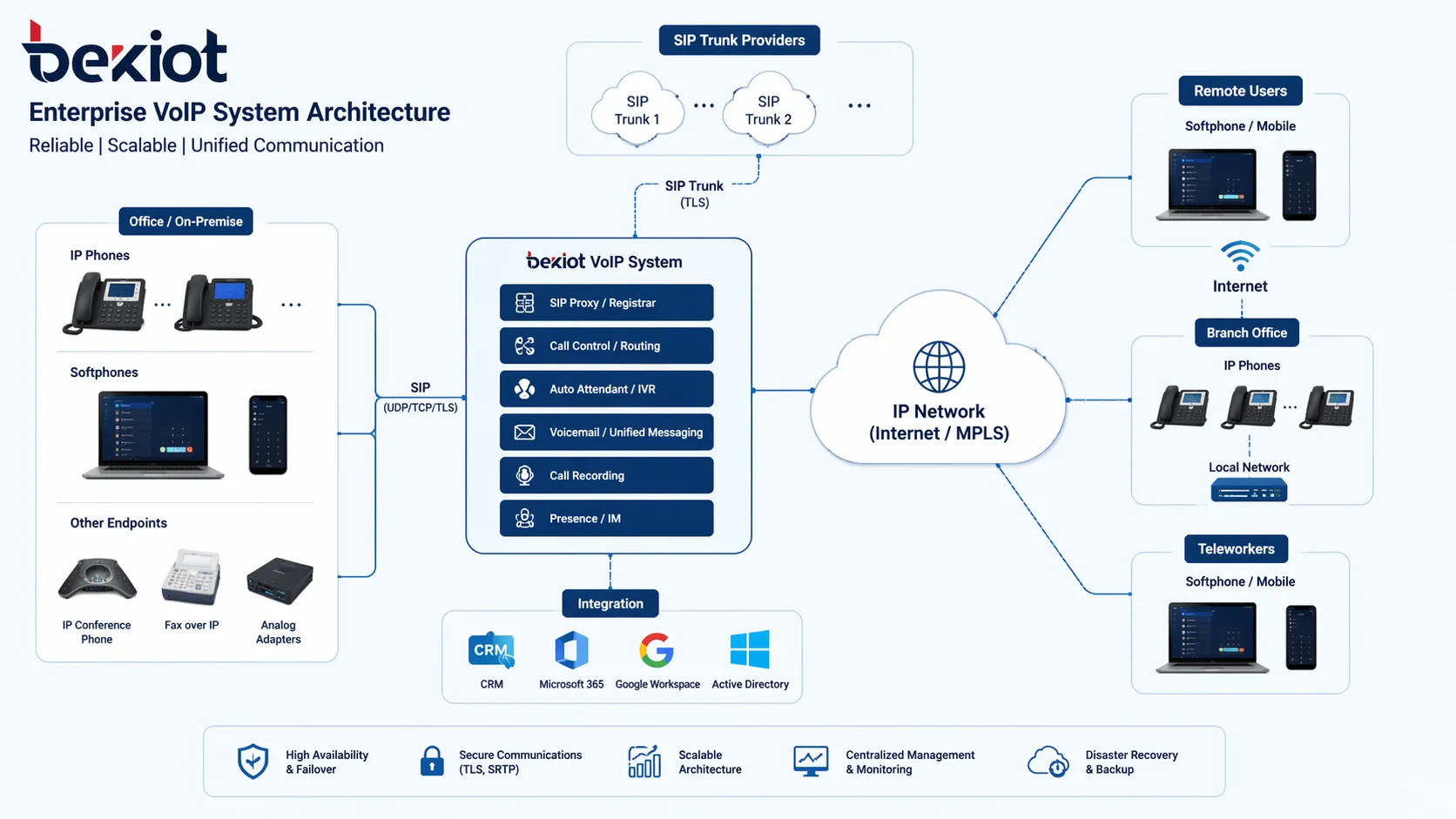
The adoption of VoIP catalyzed an architectural shift from hardware-bound PBX systems to Unified Communications as a Service (UCaaS). UCaaS leverages cloud-hosted VoIP engines to consolidate multiple communication channels into a unified interface:
- Omnichannel Convergence: Rather than managing separate systems for landlines, video conferencing, SMS, team chat, and fax, UCaaS aggregates all interaction types within a unified software platform.
- Device-Agnostic Endpoints: Voice channels are no longer bound to a physical desk set. Through softphone applications, users make and receive business calls from desktop computers, laptops, tablets, or smartphones while maintaining a single professional phone number identity.
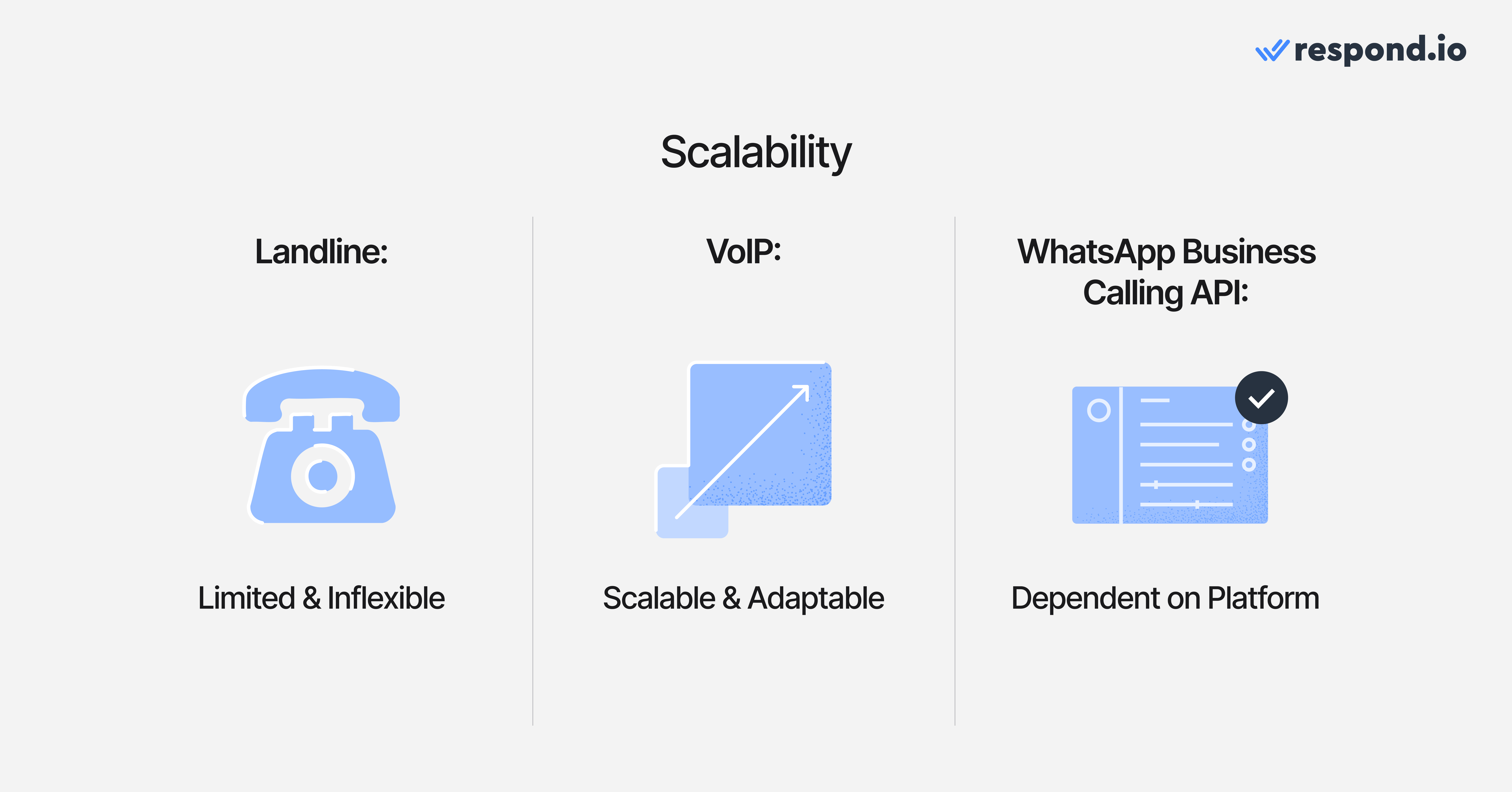
- Dynamic Scalability: Adding a new phone line or opening a regional office no longer requires physical line installation or hardware card upgrades. Administrators provision extensions, configure interactive voice response (IVR) call flows, and assign user permissions in minutes through web-based administrative consoles.
Enterprise Business Impact: Analytics, Automation, and CRM Synchronization
The digitization of voice converts spoken communication into structured data streams. This capability transforms a telephone call from a isolated real-time event into an integrated asset for business processes.
Customer Relationship Management (CRM) Integration
Modern VoIP platforms integrate directly with CRM tools such as Salesforce, HubSpot, and Microsoft Dynamics through Application Programming Interfaces (APIs). Key automated functions include:
- Screen Pops: When an incoming call arrives, the VoIP system identifies the caller ID, queries the CRM database, and presents the relevant customer history, active tickets, and account notes to the agent before the call is answered.
- Automated Call Logging: Duration, timestamps, call disposition notes, and call recordings automatically attach to matching customer records without manual user entry.
- Click-to-Dial: Sales and support representatives initiate outbound calls directly from web interfaces or CRM records, eliminating dialing errors and accelerating outreach throughput.
Speech Analytics and Artificial Intelligence
VoIP architecture allows real-time media streams to route through machine learning engines. Advanced implementations feature:
- Real-Time Speech-to-Text Transcription: Automated conversion of spoken dialog into text transcripts for instant archival, search indexing, and compliance monitoring.
- Sentiment Analysis: Natural Language Processing (NLP) algorithms evaluate vocal pitch, tone, and word selection to determine customer satisfaction during interactions, flagging escalated calls for immediate supervisor assistance.
- Intelligent Conversational Routing: AI-driven IVR platforms evaluate customer voice responses to determine intent, routing inquiries directly to the appropriate agent based on skill-based algorithms rather than static touch-tone menus.
Comparing Infrastructure Models: PSTN vs. On-Premises IP-PBX vs. Cloud UCaaS
Selecting the right voice delivery architecture requires balancing capital expenditure, operational overhead, and flexibility. The table below outlines how these telecommunication models compare across core operational metrics.
| Feature / Metric | Legacy PSTN / T1 Trunks | On-Premises IP-PBX | Cloud UCaaS (Hosted VoIP) |
|---|---|---|---|
| Primary Transmission Medium | Dedicated Analog/T1 Copper Lines | Private Data Network + SIP Trunks | Public Internet / SD-WAN / Cloud |
| Signaling Protocols | SS7 / ISDN PRI | SIP / H.323 | SIP WebRTC / Proprietary Cloud APIs |
| Upfront Capital Cost (CapEx) | High (Physical PBX, wiring) | High (Server appliances, licensing) | Very Low (Hardware-optional) |
| Ongoing Maintenance (OpEx) | High (Telecom trunk fees, field technicians) | Moderate (Internal IT maintenance required) | Low (Predictable per-user monthly subscription) |
| Scalability | Slow (Requires physical line installs) | Moderate (Bounded by hardware capacity) | Instantaneous (Cloud provisioning) |
| Remote Work Support | Extremely limited (Call forwarding only) | Requires VPN or Session Border Controller | Native (Softphones & Mobile Apps) |
| Feature Integration (CRM/AI) | Non-existent or complex custom middleware | Moderate (Requires custom API connectors) | Native (Out-of-the-box marketplace integrations) |
Technical Prerequisites and Network Quality of Service (QoS)
Because VoIP shares bandwidth with transactional internet traffic (such as email, web browsing, and file transfers), voice packets require specific network management parameters to maintain clear, delay-free audio. Unlike data files, which can tolerate minor transmission delays, human speech requires real-time packet delivery.
Core Network Metrics
To achieve high-quality voice transmission—measured by a Mean Opinion Score (MOS) above 4.0 out of 5.0—networks must meet strict benchmark parameters:
- Bandwidth Capacity: Approximately 80 to 100 kilobits per second (kbps) per concurrent uncompressed call (G.711 codec), or 25 to 45 kbps for compressed codecs (G.729 or adaptive Opus).
- One-Way Latency: The delay between packet transmission and reception should remain under 150 milliseconds (ms) to prevent audio lag and overlapping speech.
- Jitter: The variation in packet arrival times must remain under 30 ms. High jitter results in robotic or broken sound quality.
- Packet Loss: Dropped packets must not exceed 1% of total transmitted data. Excessive packet loss leads to silent gaps and missing words.
Quality of Service (QoS) Routing:
- Data Packets (Email / Web / Downloads)
- Standard Queue (BE)
- Output Interface
- Voice Packets (SIP / RTP Media Stream)
- Priority Queue (EF) (DSCP Tag: EF / CS4)
- Output Interface
Network Optimization Mechanisms
Network engineers deploy specific configurations to shield real-time voice traffic from data network congestion:
- Differentiated Services Code Point (DSCP) Tagging: Voice packets are marked at Layer 3 with high-priority headers—typically Expedited Forwarding (EF) or DSCP 46—instructing network routers to process voice packets ahead of non-real-time data.
- Voice Virtual Local Area Networks (VLANs): Voice endpoints are isolated onto a dedicated Virtual LAN at Layer 2. This segmentation shields audio traffic from broadcast storms and high-volume workstation traffic.
- Software-Defined Wide Area Networking (SD-WAN): Modern enterprises use SD-WAN edge devices to dynamically route VoIP traffic over the optimal WAN path (e.g., MPLS, direct fiber, or high-speed broadband) based on real-time latency and jitter measurements.
Security Architecture and Regulatory Compliance
Moving telecommunications to IP networks introduces modern cybersecurity requirements. Because VoIP data flows over standard IP protocols, voice networks are vulnerable to eavesdropping, spoofing, denial-of-service (DoS) attacks, and unauthorized toll usage if left unmanaged.
VoIP Security Architecture:
- IP Phone / Softphone
- TLS Encryption: SIP Signaling (Call Setup & Teardown)
- SRTP Encryption: Audio Media Payload (RTP Packets)
- Network Perimeter Firewall / Session Border Controller (SBC)
- Intrusion Detection System
- Toll Fraud Prevention
- Cloud Provider
Core VoIP Security Protocols
- Transport Layer Security (TLS): Encrypts SIP call-control signaling, preventing malicious actors from intercepting, hijacking, or spoofing call metadata, extension routing, or caller identities.
- Secure Real-time Transport Protocol (SRTP): Applies Advanced Encryption Standard (AES) encryption to raw voice media payloads, ensuring that packet captures taken over public networks yield unreadable audio streams.
- Session Border Controllers (SBCs): Dedicated security appliances situated at the network perimeter. SBCs inspect incoming and outgoing SIP traffic, protect internal IP topologies from public exposure, prevent Denial of Service (DoS) attacks, and stop unauthorized toll fraud (where attackers hijack PBX lines to route expensive long-distance calls).
Regulatory Compliance Mandates
Deploying enterprise VoIP requires adherence to strict legal and emergency response frameworks:
- E911 and Location Tracking: In the United States, telecommunications compliance under Kari's Law and the RAY BAUM'S Act dictates that any VoIP platform must transmit accurate dispatchable location details to public safety answering points (PSAPs) when an emergency call is dialed. Because softphones move across networks, systems must update dynamic location markers automatically based on local IP subnet identification or Wi-Fi access point data.
- Call Recording Data Governance: Organizations that record phone calls for training or compliance must meet stringent regulatory standards. System setups must enforce explicit call consent announcements (complying with one-party or two-party consent laws) and ensure recorded audio files stored in the cloud are encrypted at rest under guidelines such as the General Data Protection Regulation (GDPR) or the Health Insurance Portability and Accountability Act (HIPAA).
Implementation Roadmap: Transitioning to IP Voice
Migrating from legacy systems to a enterprise VoIP infrastructure requires a systematic deployment strategy to protect operational uptime and preserve voice quality.
Migration Flowchart:
- Network Readiness & Bandwidth Audit
- Assess available bandwidth, packet loss, jitter, and MOS.
- Deployment Model & Provider Selection
- Choose Cloud UCaaS vs. On-Premises IP-PBX via SIP Trunking.
- QoS Optimization & Perimeter Security Setup
- Configure DSCP tagging, Voice VLANs, and SBC firewalls.
- Endpoint Provisioning & E911 Mapping
- Assign IP phones/softphones and register dispatch addresses.
- Number Porting, Pilot Testing, and Cutover
- Test SIP signaling paths, verify LNP, and complete cutover.
Step 1: Network Assessment and Bandwidth Audit
Perform a comprehensive network assessment to measure current throughput, router hardware capabilities, and switch provisioning. Calculate peak concurrent call requirements across all corporate locations to ensure local internet connections can handle voice traffic alongside routine data usage.
Step 2: Deployment Model and Provider Selection
Determine whether a hosted Cloud UCaaS platform or an On-Premises IP-PBX utilizing SIP Trunking aligns best with internal technical skills, data sovereignty policies, and financial budgets. Evaluate vendor Service Level Agreements (SLAs), verifying guarantees of 99.999% uptime (often referred to as "five-nines" availability) backed by redundant geographic data centers.
Step 3: Network Infrastructure Optimization
Deploy managed PoE (Power over Ethernet) network switches to power IP desktop units directly through Ethernet cables, avoiding extra power adapters. Configure network routers to prioritize voice traffic using DSCP class tags, establish dedicated Voice VLANs, and implement local SBC appliances to guard against network intrusions.
Step 4: Endpoint Provisioning and E911 Mapping
Assign hardware IP endpoints, desktop softphone software, and mobile applications to users based on role needs. Populate the enterprise E911 database with exact physical addresses, floor designations, and room numbers for every stationary endpoint and dynamically tracked remote user network segment.
Step 5: Local Number Porting (LNP) and System Cutover
Coordinate Local Number Porting (LNP) with existing telecom providers to transfer established business phone numbers to the new VoIP host. Run parallel testing on temporary test numbers to verify IVR routing, auto-attendant menus, call queues, and emergency call routing prior to final cutover.
Frequently Asked Questions
How does VoIP maintain voice clarity over congested networks?
VoIP maintains audio clarity by using Quality of Service (QoS) policies on network hardware. Routers identify voice traffic using specialized header tags (such as DSCP Expedited Forwarding) and place voice packets in priority queues ahead of standard web traffic. Additionally, advanced codecs like Opus adapt dynamic compression algorithms in real time based on fluctuating network conditions to prevent audio dropouts.
Can VoIP systems operate during power outages or internet disruptions?
VoIP software requires active internet connection paths and standard electrical power to function. However, cloud-hosted UCaaS setups offer continuous uptime through automated call redundancy. If a local site loses power or connection, cloud platforms automatically reroute incoming calls to pre-configured mobile softphones, secondary office locations, external mobile phone numbers, or automated voicemail boxes.
What is the technical difference between cloud VoIP and SIP trunking?
Cloud VoIP (UCaaS) is a fully managed service where the call control infrastructure, PBX engine, and software features are hosted entirely in the cloud by a third-party vendor. SIP trunking, by contrast, provides virtual voice connectivity to an on-premises IP-PBX hardware server owned and operated locally by the customer, acting as a digital replacement for traditional copper telephone trunks.
How do emergency E911 requirements affect VoIP systems?
Under regulations such as Kari's Law and the RAY BAUM'S Act, VoIP providers and organizations must ensure that any call placed to 911 automatically routes to the appropriate public emergency service while transmitting detailed locational data—such as building designation, floor number, and office location. Modern VoIP platforms use dynamic location tracking that updates these parameters automatically as softphone users change network subnets.
How much internet bandwidth does a single VoIP call consume?
Bandwidth consumption depends on the audio codec used. An uncompressed high-definition audio call utilizing the G.711 codec requires roughly 80 to 100 kbps of symmetrical (upload and download) bandwidth per concurrent call. Efficient or dynamic codecs, such as G.729 or Opus, use advanced compression to reduce bandwidth consumption down to 20 to 45 kbps per call without significant drops in voice quality.
Strategic Guidance for Communication Infrastructure
Upgrading enterprise communications from traditional circuit-switched infrastructure to a modern VoIP platform requires balancing operational efficiency, security controls, and infrastructure readiness. Business leaders and IT directors should begin by performing a complete audit of their existing telecommunication contracts, active physical extensions, and local network capacities.
Prioritize vendor solutions that offer flexible API integration ecosystems, verified E911 compliance features, robust SLA guarantees, and end-to-end encryption standards (TLS/SRTP). By building a secure, high-capacity, and QoS-optimized IP network foundation, organizations transform voice calling from an isolated legacy asset into an integrated driver of operational productivity and enterprise collaboration.
Image Gallery