Understanding Life Insurance Cost Per Year and Renters Insurance Deductibles
Managing personal financial protection requires balancing fixed ongoing policy payments against unexpected out-of-pocket expense limits. The annual cost of a life insurance policy typically ranges from $200 to $500 per year for a healt...
Managing personal financial protection requires balancing fixed ongoing policy payments against unexpected out-of-pocket expense limits. The annual cost of a life insurance policy typically ranges from $200 to $500 per year for a healthy adult purchasing a standard term policy, whereas a renters insurance deductible is the fixed out-of-pocket amount—usually $250, $500, or $1,000—you pay before insurance covers a property claim.
Contents
Life Insurance Costs Per Year: What to Expect and How Rates Are Set
Life insurance provides financial support to designated beneficiaries upon the policyholder's death. Unlike property insurance policies, life insurance contracts do not include a deductible. Instead, the total financial obligation consists entirely of the ongoing premium paid annually or monthly.
Understanding how life insurance premiums are calculated helps individuals budget accurately over multi-year policy terms.
Term vs. Permanent Life Insurance Annual Pricing
The overall cost per year for life insurance depends largely on the structure of the policy chosen:
- Term Life Insurance: This is the most straightforward and cost-effective form of life coverage. It covers a specific period, such as 10, 20, or 30 years. For a non-smoking 30-year-old purchasing a 20-year term policy with a $500,000 death benefit, typical annual premiums average between $240 and $400 per year. Because term policies do not build cash value and only pay out if death occurs within the specified term, insurance carriers can offer higher coverage limits for lower recurring fees.
- Whole Life Insurance (Permanent): Permanent policies provide lifetime coverage and include a cash value accumulation component. Because the payout is guaranteed as long as premiums are maintained, annual premiums are substantially higher—often five to ten times more expensive than term policies for the same coverage amount. A healthy 30-year-old might pay $2,500 to $5,000 per year for a $500,000 whole life policy.
Key Factors Shaping Your Annual Life Insurance Premium
Insurance underwriters evaluate several key risk factors when determining your exact yearly premium:
- Age and Gender: Younger applicants receive lower annual rates because statistical mortality risk is lower. Women statistically live longer than men, leading to slightly lower base rates for female applicants across comparable age brackets.
- Health Status and Medical History: Carriers evaluate blood pressure, cholesterol levels, body mass index (BMI), personal medical history, and family medical background. Pre-existing conditions like diabetes or heart disease raise annual premiums.
- Tobacco and Nicotine Use: Smokers and nicotine users pay significantly higher annual premiums—frequently double or triple the rates offered to non-smokers.
- Coverage Amount and Term Length: Higher death benefit amounts (e.g., $1,000,000 vs. $250,000) increase the annual premium proportional to the carrier’s exposure. Longer term lengths also carry higher annual premiums because the probability of a claim increases as the insured ages.
- Payment Frequency: Paying premiums in a single annual lump sum is generally cheaper than monthly payments. Most carriers charge a small administrative installment fee when splitting annual totals into twelve monthly billing cycles.
For detailed industry standards on underwriting and rate structures, policyholders can review guidance from the National Association of Insurance Commissioners (NAIC).
How Renters Insurance Deductibles Work
While life insurance pricing centers on annual premium payments, renters insurance balances a low premium with an out-of-pocket deductible. Renters insurance protects tenants against loss or damage to personal belongings caused by covered perils (such as fire, theft, or severe water leaks) and provides personal liability coverage.
What Is a Renters Insurance Deductible?
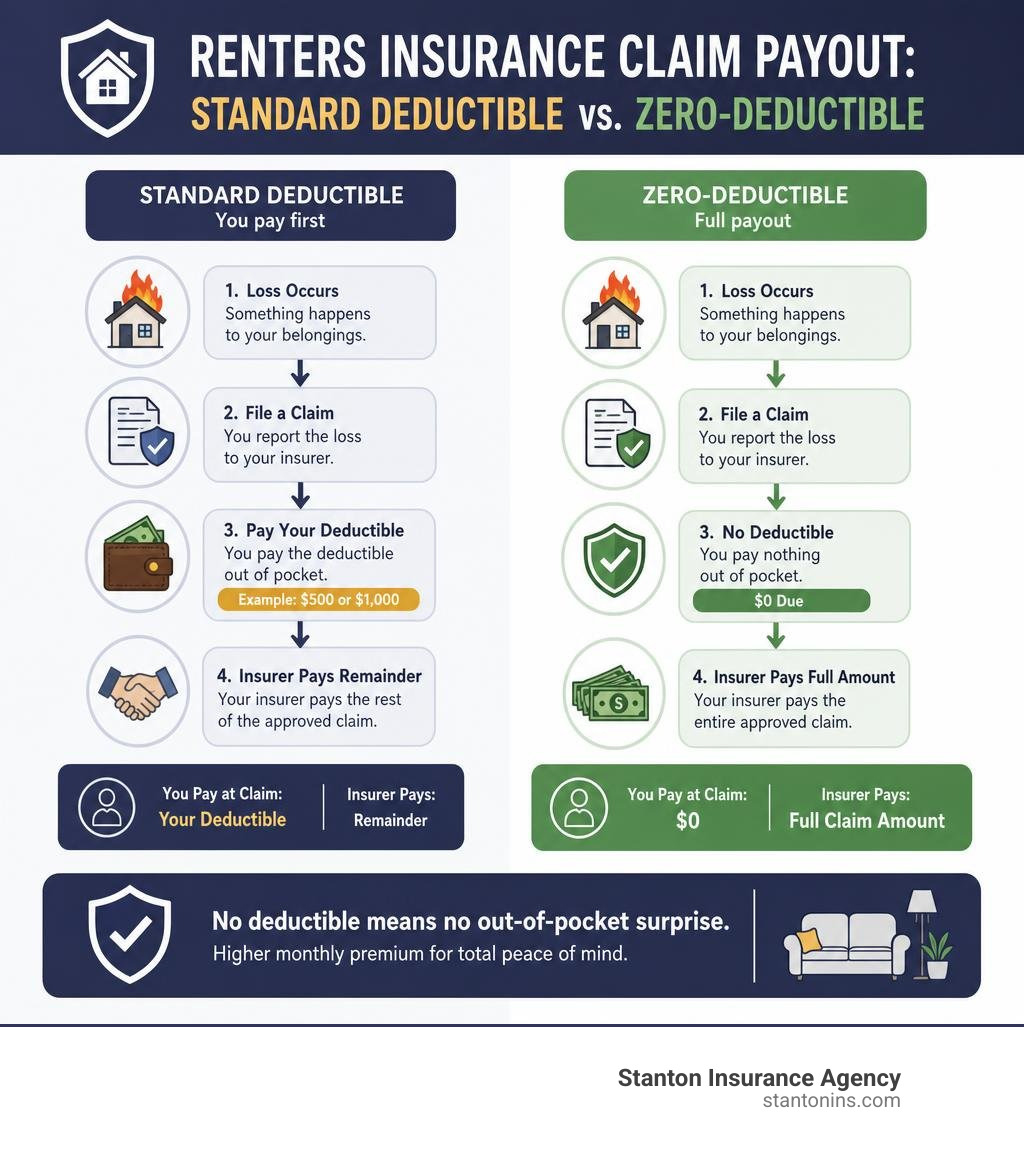
A renters insurance deductible is the specified dollar amount a tenant must pay out-of-pocket before the insurance company pays any funds toward a covered property damage or loss claim.
For instance, if a covered apartment theft results in $3,000 worth of stolen electronics and personal items, and your renters insurance policy carries a $500 deductible, your insurance company will reimburse you $2,500 ($3,000 loss minus the $500 deductible).
Unlike health insurance policies that feature annual aggregate deductibles, a renters insurance deductible applies per claim incident. If you file two separate claims in a single policy year, you must pay the deductible for each individual event.
Common Renters Insurance Deductible Amounts
Most standard renters insurance policies offer flat deductible choices, typically set at:
- $250 Deductible: Low out-of-pocket risk when filing a claim, but carries a slightly higher monthly or annual policy premium.
- $500 Deductible: The standard industry baseline choice, providing a balanced trade-off between manageable out-of-pocket costs and lower ongoing premiums.
- $1,000 Deductible: High out-of-pocket exposure per claim, yielding the lowest possible annual renters insurance premium.
Renters insurance policies themselves are generally very affordable, averaging $150 to $250 per year (roughly $12 to $20 per month) according to data compiled by the Insurance Information Institute (III).
Total Claim Value ($3,000) - Policy Deductible ($500) = Net Insurer Payout ($2,500)
Comparing Life Insurance Costs and Renters Insurance Deductibles
To effectively plan household risk management, it helps to understand how life insurance premiums and renters insurance deductibles interact within a personal budget.
| Insurance Metric / Feature | Life Insurance (Term) | Renters Insurance |
|---|---|---|
| Primary Financial Metric | Annual Premium Cost | Policy Deductible + Annual Premium |
| Average Cost Range | $200 – $500 per year ($500k term) | Premium: $150 – $250/yr; Deductible: $250 – $1,000 per claim |
| Out-of-Pocket Claim Fee | $0 (No deductible applies to death benefits) | $250, $500, or $1,000 per incident |
| Primary Benefit Trigger | Death of the policyholder | Covered property loss, theft, or liability claim |
| Payment Recipient | Named beneficiaries | Policyholder or third-party liability claimant |
| Flexible Cost Driver | Health, age, term length, benefit size | Deductible level, personal property value limit |
| Impact of Higher Deductible | N/A (No deductibles exist) | Lowers annual renters insurance premium |
Balancing Life Premiums and Renters Deductibles in Your Budget
Managing both insurance policies effectively requires analyzing ongoing annual fixed costs against potential emergency expenses.
1. Calculate Your Total Fixed Annual Costs
Add your annual life insurance premium and your annual renters insurance premium together to establish your baseline protection budget.
- Example: A $300 annual term life policy + a $180 annual renters insurance policy = $480 in predictable annual fixed expenses ($40 per month).
2. Match Your Renters Deductible to Your Emergency Fund
Select a renters insurance deductible that aligns directly with your liquid savings. Choosing a $1,000 deductible saves money on your annual renters insurance premium, but it creates a financial hazard if you cannot afford $1,000 on short notice following a loss.
- If your cash emergency fund holds less than $1,000, select a $250 or $500 deductible.
- If you maintain a robust cash buffer ($3,000+), select a $1,000 deductible to reduce your annual premium cost.
3. Consider Payment Schedules
Many insurers charge small processing fees for monthly billing schedules. Paying your life insurance annual premium in one yearly payment can save 3% to 7% overall compared to twelve monthly installments. The same principle applies to renters insurance, which is often cheapest when paid upfront as a single annual charge.
Common Insurance Budgeting Mistakes
Policyholders frequently make financial errors when configuring life insurance term lengths and property deductibles.
- Selecting a Renters Deductible You Cannot Afford: Choosing a high deductible purely to lower your monthly renters insurance payment can leave you unable to file a claim when damage occurs. If an incident happens and you cannot pay the deductible, the insurer will not process the claim balance.
- Filing Small Claims Below the Deductible: Filing a claim for $400 worth of damage when you have a $500 deductible results in zero payout from the carrier while generating a claim record on your insurance history, which can increase future premiums.
- Purchasing Cash Value Life Insurance Without Need: Renters and young professionals seeking affordable coverage often get pitched whole life insurance policies. For most consumer profiles, simple term life insurance combined with independent index fund investing provides superior financial flexibility at a fraction of the annual cost.
- Underestimating Property Value: Tenants frequently underreport the total replacement cost of their personal items, selecting low personal property limits to save money. Conduct an accurate home inventory to select adequate coverage limits alongside your target deductible.
Frequently Asked Questions
Does life insurance have a deductible?
No, life insurance policies do not have a deductible. When a life insurance claim is filed upon the policyholder’s death, the insurer pays the full agreed face value (death benefit) directly to the named beneficiaries, provided premiums were kept up to date and no policy exclusions were breached.
How does increasing a renters insurance deductible affect the annual cost?
Increasing your renters insurance deductible reduces the insurer's potential payout on small claims, lowering their operational risk. As a result, choosing a higher deductible (e.g., raising it from $250 to $1,000) typically lowers your overall yearly renters premium by 10% to 25%.
Can I use life insurance payouts to pay a renters insurance deductible?
While beneficiaries receive life insurance payouts as tax-free cash and can spend the money on any expense—including insurance deductibles—life insurance payouts only occur upon the policyholder's death. Therefore, life insurance proceeds cannot serve as a functional routine emergency fund for standard renters insurance claims during your lifetime.
What is the average combined cost of life and renters insurance per year?
For a healthy adult in their late 20s or 30s, a standard $500,000 term life policy ($250–$350/year) combined with a solid renters insurance policy ($150–$200/year) typically costs between $400 and $550 total per year, or roughly $35 to $45 per month.
Is the renters insurance deductible subtracted from the claim check?
Yes. The insurance company does not require you to pay them cash directly for your deductible. Instead, when a claim is approved, the insurer calculates the total approved dollar loss and subtracts the deductible amount from the final check issued to you.
Next Steps for Optimizing Your Coverage
To establish solid financial protection without overpaying, follow these concrete action steps:
- Audit Your Current Cash Reserves: Determine how much cash you can easily allocate toward an unexpected emergency. Set your renters insurance deductible to match this number.
- Request Multi-Policy Quotes: Check if your auto or life insurance provider offers bundled discounts for adding renters insurance. Many carriers offer 5% to 15% discounts across policies.
- Calculate Your Life Coverage Need: Multiply your gross annual income by 10 to 12 to find an baseline term life coverage amount, then lock in term rates while you are young and healthy to secure low yearly premiums.
- Review Policies Annually: Re-evaluate your renters deductible and life insurance term limits every 12 months to adjust for changes in income, savings, and personal assets.
Image Gallery