Choosing the Right Legacy iOS Modernization Development Firm in 2026
Modernizing an aging iOS application requires partnering with a specialized development firm capable of untangling legacy Objective-C or early Swift codebases, resolving deprecated API dependencies, and re-architecting monolithic struc...
Modernizing an aging iOS application requires partnering with a specialized development firm capable of untangling legacy Objective-C or early Swift codebases, resolving deprecated API dependencies, and re-architecting monolithic structures into modular, scalable frameworks. Businesses must evaluate technical proficiency, architectural patterns, migration strategies, and long-term maintenance capabilities when selecting a modernization partner.
Contents
Understanding the Scope of Legacy iOS Codebases
Before evaluating a specialized modernization firm, organizations must understand what constitutes legacy status within the Apple ecosystem. A legacy iOS application is typically characterized by an overreliance on Objective-C, outdated architectural patterns such as Massive View Controller, dependencies on deprecated third-party libraries via manual file management or obsolete package managers, and a lack of automated test suites.
Operating system updates demand constant adaptation. By 2026, mobile engineering standards mandate strict compliance with modern paradigms like SwiftUI, Swift Concurrency (async/await), and modular architectures like Composable Architecture (TCA) or clean architecture patterns. When an application fails to leverage these modern paradigms, technical debt accumulates, leading to frequent crashes, poor memory management, slow startup times, and an inability to pass modern App Store review guidelines regarding privacy and security standards.
Core Competencies Required in an iOS Modernization Partner
A qualified legacy iOS modernization development firm must possess a precise mix of refactoring skills, architectural vision, and deep familiarity with Apple's runtime environment. Evaluating these capabilities ensures the engineering partner can safely extract business logic from legacy wrappers without introducing regressions for active users.
- Bilingual Proficiency: Engineers must be equally fluent in legacy Objective-C and modern Swift, enabling safe bridging, refactoring, and incremental translation of class hierarchies.
- Architectural Migration Expertise: Experience transforming tightly coupled monolithic applications into modularized frameworks using Swift Package Manager (SPM).
- Concurrency Overhaul: Skill in replacing legacy Grand Central Dispatch (GCD) or callback-heavy code with modern Swift Concurrency patterns to eliminate race conditions and deadlocks.
- UI Framework Transition: Proficiency in migrating legacy UIKit view controllers and storyboards into declarative SwiftUI layouts where beneficial, or maintaining robust hybrid bridges when full rewrites are impractical.
- Automated Testing Integration: Ability to implement Unit and UI tests from scratch, securing the legacy codebase against future regressions during the modernization pipeline.
Strategic Approaches to Codebase Modernization
Engineering teams typically employ three distinct strategies when tackling legacy iOS modernization. A capable development firm will audit the existing software asset and recommend the path that aligns with business timelines, risk tolerance, and budget.
| Modernization Strategy | Best Use Case | Risk Level | Time-to-Market |
|---|---|---|---|
| Incremental Refactoring | Large enterprise apps with active user bases and continuous feature delivery requirements. | Low to Moderate | Extended (Continuous delivery model) |
| The Strangler Fig Pattern | Applications requiring gradual replacement of specific modules or microservices without touching the core. | Low | Moderate |
| Complete Rewriting | Highly unstable codebases where technical debt outweighs the original business logic value. | High | Fast initial delay, immediate modern output |
Choosing the incorrect strategy often leads to project abandonment. For instance, attempting a complete rewrite of a mission-critical financial application with a decade of accumulated business rules frequently results in missed feature parity and catastrophic user churn. A professional firm will advocate for an incremental or Strangler Fig approach whenever possible.
Evaluating Technical Maturity and Engineering Workflows
When vetting potential firms, decision-makers must look past marketing claims and examine concrete engineering practices. The development firm should demonstrate mastery over modern tooling, continuous integration pipelines, and memory management profiles.
Codebase Auditing and Profiling
An elite firm begins engagement not with code-writing, but with deep diagnostics. Using tools like Xcode Instruments (Leaks, Allocations, Time Profiler) alongside static analysis tools like SwiftLint and SonarQube, the firm uncovers hidden memory leaks, retain cycles, and performance bottlenecks embedded within legacy modules.
Dependency Management and Build Times
Legacy projects often suffer from slow compilation times due to outdated dependency managers like CocoaPods or obsolete Carthage configurations. Modernization requires migrating these dependencies to Swift Package Manager, optimizing derived data caching, and cleaning up build phases to accelerate developer velocity.
CI/CD and App Store Connect Automation
Updating legacy apps also means modernizing the deployment pipeline. The selected firm should configure robust GitHub Actions, Bitrise, or Xcode Cloud pipelines that automate code signing, provisioning profiles, test execution, and TestFlight distribution, ensuring smooth handoffs upon project completion.
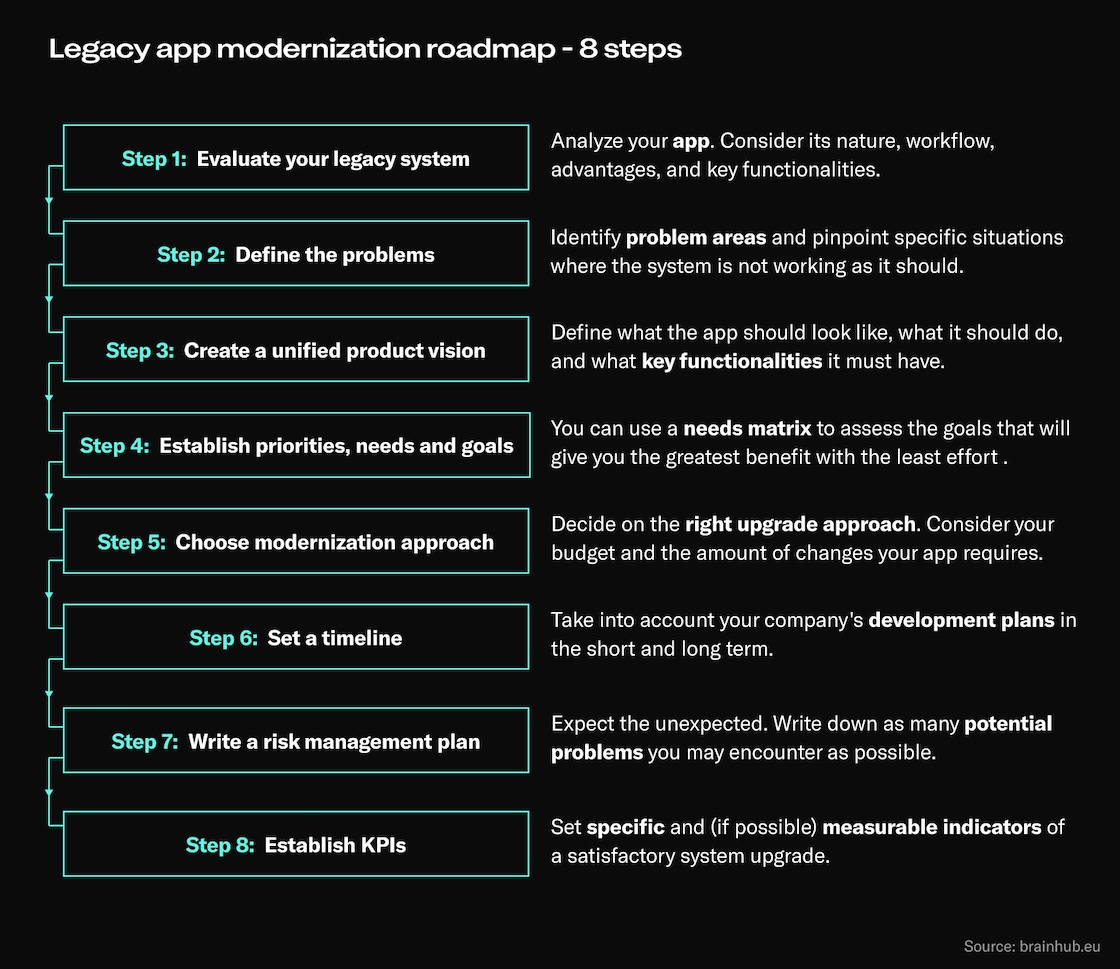
Step-by-Step Modernization Execution Process
A structured partnership follows a predictable, risk-mitigated lifecycle from initial discovery to final deployment and handover.
- Discovery and Architectural Audit: The firm analyzes the existing repository, maps out third-party dependencies, and documents undocumented business logic embedded in legacy views.
- Test Coverage Implementation: Before modifying a single line of production code, engineers write baseline unit and integration tests to capture existing behavior and prevent silent regressions.
- Core Framework Migration: The team updates deployment targets, resolves deprecated API calls, and bridges Objective-C headers to modern Swift modules.
- UI Modernization and Performance Tuning: Layouts are transitioned to Auto Layout best practices or SwiftUI, while memory footprints and network layers are optimized for modern iOS runtimes.
- Quality Assurance and User Acceptance Testing: Rigorous manual and automated test suites run across supported physical device matrices and OS versions.
- Staged Rollout and Monitoring: The modernized app is deployed via phased releases on the App Store, backed by real-time crash reporting and performance monitoring tools.
Common Pitfalls in iOS Legacy Modernization
Organizations frequently encounter avoidable roadblocks during the modernization lifecycle. Recognizing these traps helps stakeholders maintain control over budget and timeline expectations.
- The "Big Bang" Rewrite Trap: Insistently demanding a 100% rewrite from scratch rather than iterative refactoring, leading to massive delays and feature gaps.
- Neglecting Third-Party SDKs: Failing to audit whether legacy analytics, payment, or authentication SDKs are compatible with modern iOS versions and privacy manifests.
- Inadequate Test Coverage: Proceeding with structural changes without baseline tests, resulting in regression bugs that escape into production environments.
- Ignoring Developer Experience: Modernizing production code without updating local developer tooling, leaving the engineering team frustrated by slow compile times and broken build scripts.
Long-Term Maintenance and Post-Modernization Support
Modernization is not a one-time event; it is the establishment of a sustainable software lifecycle. Once the legacy code has been successfully transitioned to modern Swift, clean architecture, and automated CI/CD pipelines, internal teams require proper knowledge transfer. The ideal legacy iOS modernization development firm provides comprehensive documentation, architecture decision records (ADRs), and training sessions so internal engineers can maintain and scale the application independently moving forward.
Frequently Asked Questions
How long does a legacy iOS modernization project typically take?
Project duration varies based on codebase size, architectural complexity, and whether the strategy relies on incremental refactoring or modular extraction. Most enterprise modernization initiatives span anywhere from three to nine months of phased execution.
Should we completely rewrite our Objective-C app in Swift?
A complete rewrite is rarely recommended unless the underlying business model has entirely shifted or the existing code is beyond salvage. Incremental refactoring or modular extraction significantly lowers business risk and maintains continuous feature delivery.
How do you handle hidden business logic in undocumented legacy code?
Expert firms combine static code analysis, reverse engineering of existing user flows, and close collaboration with client product owners to uncover, document, and safely migrate obscured business logic.
Will modernization break compatibility with older iOS versions?
Modernization strategies are tailored to your target audience's device distribution metrics, allowing engineers to intentionally drop support for obsolete operating systems while maintaining stability for active user bases.
What is the financial ROI of modernizing a legacy iOS application?
Modernization drastically reduces crash rates, accelerates feature time-to-market, lowers developer onboarding costs, and ensures compliance with evolving App Store security and privacy mandates.
How do we ensure our internal team can maintain the app after modernization?
Reputable development firms emphasize knowledge transfer through documented architecture decisions, code reviews, pair programming sessions, and handover of fully automated CI/CD deployment pipelines.
Image Gallery