How Oklahoma Workers' Compensation Amounts Work: Rates, Limits, and Calculations
In Oklahoma, workers' compensation benefit amounts are determined by your Average Weekly Wage (AWW), the specific category of disability resulting from your injury, and annual statutory maximums set by state law. Under the Administrati...
In Oklahoma, workers' compensation benefit amounts are determined by your Average Weekly Wage (AWW), the specific category of disability resulting from your injury, and annual statutory maximums set by state law. Under the Administrative Workers' Compensation Act (Title 85A of the Oklahoma Statutes), cash wage-replacement benefits generally equal 70% of your pre-injury average weekly wage, capped by the State Average Weekly Wage (SAWW).
Contents
The Foundation of Compensation: Calculating Your Average Weekly Wage (AWW)
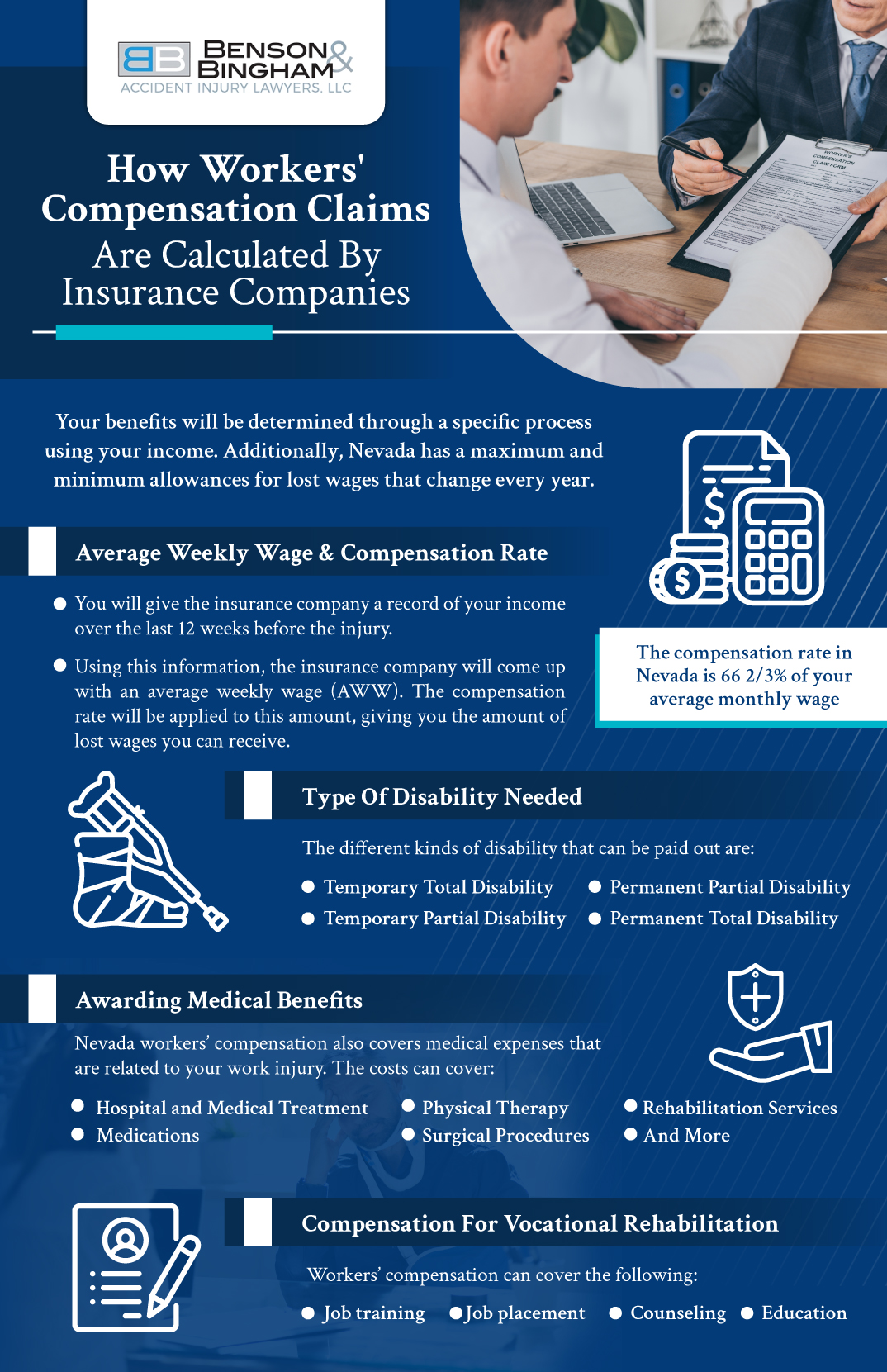
Before any monetary benefit can be disbursed, the Oklahoma Workers' Compensation Commission (OWCC) or the insurance carrier must calculate your Average Weekly Wage (AWW). The AWW serves as the benchmark baseline for all income-replacement claims, including temporary disability, permanent disability, and death benefits.
Under Oklahoma Statutes Title 85A § 59, the AWW is usually calculated using your gross earnings from the 52 calendar weeks immediately preceding the date of the work-related injury or occupational disease. The total gross earnings during this period—which include hourly wages, overtime pay, cash bonuses, and the fair market value of employer-provided board or lodging—are divided by 52.
AWW = Total Gross Earnings over 52 Weeks Prior to Injury / 52
Alternative AWW Calculation Scenarios
If you were employed for less than 52 weeks prior to the injury, state law provides alternative mechanisms to ensure a fair representation of your earning capacity:
- Short-Term Employment: If you worked for the employer for only a short period, your AWW may be calculated by multiplying your daily wage by the average number of days an employee in the same grade or employment class worked in the same location during the preceding year.
- Multiple Employers: If you worked concurrent jobs at the time of injury, wages earned from secondary employers may be included if the primary employer was aware of the concurrent work and the injury occurred during the scope of covered employment.
- Seasonal or Irregular Work: When standard 52-week averaging produces an unfair result due to seasonal lay-offs, the commission calculates earnings based on your annualized earning capacity in similar employment within the region.
Once the baseline AWW is established, specific statutory percentage formulas and state caps are applied to calculate your actual weekly compensation checks.
Breakdown of Disability Benefit Types and Payment Amounts
Oklahoma workers' compensation provides four distinct categories of indemnity (wage-loss) benefits. The exact financial amount you receive depends directly on which category your medical condition falls under, as determined by your treating physician or an Independent Medical Examiner (IME).
1. Temporary Total Disability (TTD)
Temporary Total Disability benefits apply when an injured worker is entirely unable to perform their job duties while recovering from an accepted work injury, but is expected to make a medical recovery.
- Payment Formula: 70% of the worker’s calculated AWW.
- Statutory Cap: The maximum weekly TTD benefit cannot exceed 100% of the Oklahoma State Average Weekly Wage (SAWW) in effect on the date of injury.
- Duration Limit: Payable for up to 104 weeks (2 years). However, extensions up to an additional 52 weeks may be granted by the OWCC for severe cases involving consequential surgeries, total joint replacements, or severe medical complications.
- Waiting Period: Oklahoma enforces a 3-calendar-day waiting period. TTD benefits are not paid for the first 3 days of disability unless the disability extends beyond 7 consecutive days, at which point the first 3 days are retroactively reimbursed.
2. Temporary Partial Disability (TPD)
If an injured employee is cleared to return to light-duty or restricted work but earns less than their pre-injury earnings (due to reduced hours or lower-paying modified duties), they qualify for Temporary Partial Disability.
- Payment Formula: 70% of the difference between the worker’s pre-injury AWW and their current post-injury earning capacity.
- Statutory Cap: Combined light-duty earnings plus TPD benefits cannot exceed the worker's pre-injury AWW or the maximum allowable weekly TTD rate.
- Duration Limit: TPD benefits are capped at a maximum cumulative duration of 52 weeks.
3. Permanent Partial Disability (PPD)
When an employee reaches Maximum Medical Improvement (MMI)—meaning their condition has stabilized and further medical treatment will not yield substantial improvement—a medical examiner assesses whether the worker has suffered a permanent physical impairment.
PPD benefits compensate for permanent loss of bodily function based on medical impairment ratings from the American Medical Association (AMA) Guides to the Evaluation of Permanent Impairment, 6th Edition.
- Payment Formula: 70% of the worker's pre-injury AWW, capped at the statutory PPD maximum rate established by the legislature for the specific date of injury.
- Duration Limit: The total number of weeks PPD is paid depends on whether the injury is categorized as a "scheduled" or "unscheduled" impairment.
4. Permanent Total Disability (PTD)
Permanent Total Disability is awarded when a work injury leaves an employee permanently and completely unable to perform any gainful employment for which they are reasonably suited by age, education, and experience.
- Payment Formula: 70% of the worker’s pre-injury AWW.
- Statutory Cap: 100% of the SAWW.
- Duration Limit: Payable until the employee reaches age 65, or for a period of 15 years (780 weeks), whichever duration is longer. PTD awards are periodically reviewed by the Oklahoma Workers' Compensation Commission to verify ongoing total incapacity.
Scheduled vs. Unscheduled Permanent Impairments
Oklahoma statutory law divides permanent partial disability into scheduled body parts and unscheduled (body as a whole) impairments. The category dictates the maximum number of weeks of financial compensation allowable.
Scheduled Impairments
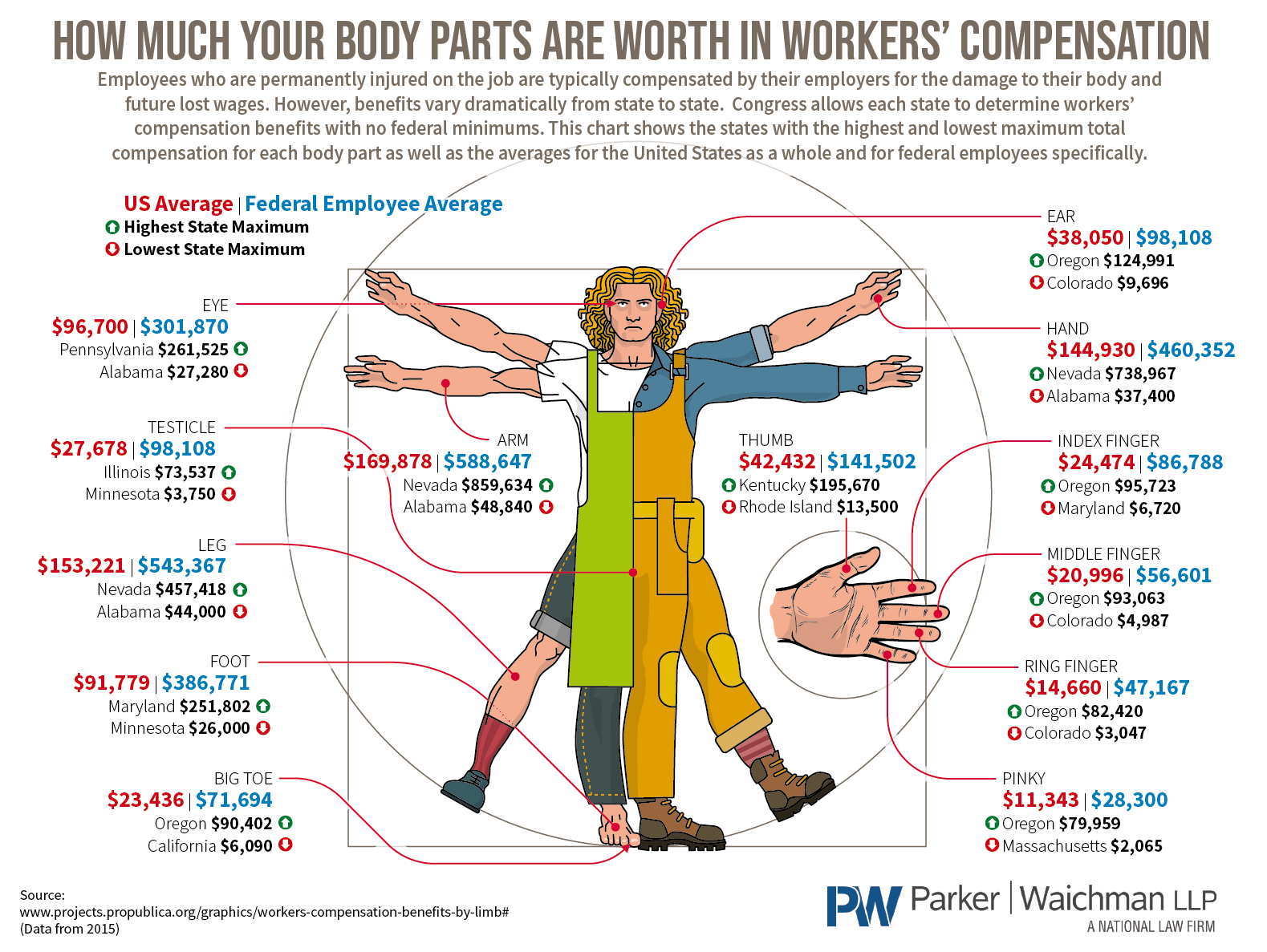
The Oklahoma Workers' Compensation Act sets specific maximum monetary durations for discrete bodily limbs and sensory organs. For example, the loss or total loss of use of specific body parts corresponds to fixed statutory week caps:
- Arm: Up to 275 weeks
- Leg: Up to 275 weeks
- Hand: Up to 220 weeks
- Foot: Up to 200 weeks
- Eye (Vision Loss): Up to 200 weeks
- Thumb: Up to 66 weeks
Calculation Example for Scheduled Loss: If a worker loses 20% functional use of a hand (220 weeks maximum) and has a qualifying average wage:
Award Duration = 220 weeks × 20% impairment = 44 weeks of PPD payments
Unscheduled Impairments (Body as a Whole)
Injuries affecting systemic regions—such as the spine, neck, brain, internal organs, or mental health secondary to physical injury—are classified as "body as a whole" (unscheduled) impairments.
- Maximum Week Cap: Unscheduled injuries carry a statutory maximum cap of 350 weeks.
- Calculation: The percentage of whole-person permanent impairment determined under the AMA Guides (6th Edition) is multiplied by 350 weeks. For instance, a 10% whole-body spinal impairment equals 35 weeks of PPD benefits (350 weeks × 10%).
Oklahoma Workers' Compensation Benefit Rates Summary
The table below outlines how each benefit category is calculated, statutory benefit rate caps, and duration limits under Oklahoma law.
| Benefit Category | Percentage of Wage Base | Maximum Weekly Benefit Cap | Statutory Maximum Duration |
|---|---|---|---|
| Temporary Total Disability (TTD) | 70% of pre-injury AWW | 100% of State Average Weekly Wage (SAWW) | 104 weeks (up to 156 weeks for severe surgeries/joint replacements) |
| Temporary Partial Disability (TPD) | 70% of wage loss differential | Cannot exceed max TTD rate or pre-injury AWW | 52 weeks maximum |
| Permanent Partial Disability (PPD) | 70% of pre-injury AWW | Statutory PPD weekly rate cap (legislatively fixed) | Scheduled: 10–275 weeks depending on body partUnscheduled: Up to 350 weeks |
| Permanent Total Disability (PTD) | 70% of pre-injury AWW | 100% of State Average Weekly Wage (SAWW) | Until age 65 or 15 years (780 weeks), whichever is longer |
| Survivorship / Death Benefits | 70% of pre-injury AWW divided among dependents | 100% of State Average Weekly Wage (SAWW) | Lump sum + weekly payments based on spouse/child dependency status |
Medical Coverage and Non-Indemnity Financial Benefits
In addition to direct wage replacement payments, Oklahoma workers' compensation covers extensive medical costs and non-wage expenses associated with a workplace injury.
100% Medical Care Coverage
Under Oklahoma law, all reasonable and necessary medical treatment related to the compensable injury must be paid entirely by the employer’s workers' compensation insurance carrier. The injured employee pays zero copays or deductibles. Covered medical expenses include:
- Emergency room visits and hospitalizations.
- Surgeries, specialist consultations, and diagnostic testing (MRIs, CT scans, X-rays).
- Prescription medications billed according to the Oklahoma Workers' Compensation Fee Schedule.
- Physical therapy, medical equipment (crutches, braces, wheelchairs), and prosthetics.
Note on Physician Selection: In Oklahoma, the employer or their insurance carrier generally holds the initial right to select the treating physician. However, injured workers have statutory rights to request an alternative physician or apply for an Independent Medical Examination through the OWCC if treatment is denied or inadequate.
Travel and Mileage Reimbursement
Injured workers who must travel outside their local municipality for medical appointments, diagnostic scans, or physical therapy sessions are entitled to mileage reimbursement. The reimbursement rate tracks the official standard mileage rate published annually by the State of Oklahoma or the IRS.
Vocational Rehabilitation Allowance
If a workplace injury prevents an employee from returning to their former occupation, the worker may be eligible for vocational rehabilitation services. This includes professional retraining, job placement assistance, or tuition assistance for trade courses, capped by statutory limits enforced by the OWCC.
Death Benefits for Fatal Workplace Injuries
When a workplace accident or occupational illness results in a fatal outcome, surviving family members are entitled to death benefits under 85A O.S. § 47.
Income Replacement Distributions
- Surviving Spouse (No Dependent Children): The surviving spouse receives a single lump-sum payment (statutorily set around $100,000 depending on injury date updates) plus weekly payments equal to 70% of the deceased worker’s AWW, capped at the SAWW, payable until remarriage or death. Upon remarriage, the spouse receives a final two-year lump sum payout.
- Surviving Spouse with Dependent Children: The lump sum and weekly payments are apportioned between the surviving spouse and minor children. Typically, the spouse receives 50% of the weekly benefit and the dependent children share the remaining 20%.
- Dependent Children Only: If there is no surviving spouse, dependent children share weekly benefits equal to 70% of the deceased employee's AWW, payable until age 18 (or age 23 if enrolled as a full-time student in an accredited educational institution).
Funeral and Burial Expenses
The employer or insurance carrier must pay reasonable funeral and burial expenses directly, capped by Oklahoma statute at a maximum of $10,000.
Key Factors That Can Reduce or Impact Your Settlement Amount
Several legal and administrative adjustments can reduce the final dollar amount an injured worker receives in Oklahoma.
1. Pre-Existing Conditions and Apportionment
Oklahoma law permits insurance carriers to reduce (apportion) PPD awards if medical records indicate that a portion of the worker's permanent disability was caused by a pre-existing physical condition or prior degenerative disease. The doctor must specify what percentage of the disability stems directly from the new work injury versus pre-existing impairment.
2. Refusal of Suitable Light-Duty Work
If an employer offers a light-duty or modified job position within the physical restrictions set by the authorized treating physician, the employee must accept it. Refusing suitable modified work without a valid medical reason usually results in the immediate termination of TTD benefits.
3. Attorney Fees Statutory Cap
Legal representation in Oklahoma workers' compensation cases is structured on a contingent fee basis strictly regulated by state law. Under 85A O.S. § 82:
- Attorney fees are capped at 20% of the total indemnity (disability) benefits awarded or negotiated in a compromise settlement.
- Attorney fees cannot be deducted from payment of medical bills or direct medical care.
4. Overpayment and Social Security Disability (SSDI) Offsets
If an insurance carrier accidentally overpays TTD or continues payments after a worker returns to full duty, the overpayment amount may be credited against future PPD payments. Additionally, receiving federal Social Security Disability Insurance (SSDI) simultaneously may trigger federal offset rules to prevent total combined payments from exceeding 80% of your pre-disability earnings.
Essential Steps to Protect Your Benefit Calculations
To ensure you receive the maximum statutory compensation entitled to you under Oklahoma law, follow these procedural steps immediately following a workplace injury:
- Report the Injury in Writing Immediately: Notify your supervisor or manager in writing within 30 days of the accident or diagnosis of an occupational disease. Failure to provide timely written notice can forfeit your right to receive wage benefits entirely under 85A O.S. § 56.
- Verify Wage Records: Review the wage statements submitted by your employer to the insurance carrier. Ensure that overtime earnings, bonuses, shift differentials, and second-job earnings are fully accounted for in your AWW calculation.
- File Form 3 with the OWCC: File an official Employee's Claim for Compensation (Form 3) with the Oklahoma Workers' Compensation Commission to formally establish your claim in the state system.
- Attend All Medical Appointments: Adhere strictly to treatment plans outlined by authorized physicians. Missing appointments or failing to follow medical instructions can be cited by insurance adjusters to suspend benefit checks.
- Review Settlement Offers Carefully: Permanent Disability awards can be settled as a Structured Settlement or a Lump-Sum Compromise Settlement (Form 14 Joint Petition). Once a Joint Petition settlement is approved by a Commission Administrative Law Judge, rights to future medical care and monetary compensation for that injury are permanently released.
Frequently Asked Questions
What is the maximum weekly benefit rate for workers' comp in Oklahoma?
For Temporary Total Disability (TTD) and Permanent Total Disability (PTD), the maximum weekly payment rate is 100% of the State Average Weekly Wage (SAWW) calculated by the Oklahoma Employment Security Commission. The SAWW is updated annually; the cap applied to your claim depends on your exact date of injury.
Are workers' compensation benefits taxable in Oklahoma?
No. Income-replacement payments provided through workers' compensation—including TTD, TPD, PPD, and lump-sum settlements—are exempt from both federal income tax and Oklahoma state income tax under Internal Revenue Code § 104(a)(1).
Can my employer fire me for filing a workers' compensation claim?
No. Oklahoma law explicitly prohibits employers from discharging, demoting, or retaliating against an employee simply because the worker filed a good-faith workers' compensation claim or testified in a commission proceeding. Retaliatory discharge opens the employer to civil liability outside the workers' compensation system.
How long does it take to receive the first TTD benefit check?
After your employer and their insurance carrier receive medical notice of your disability, the carrier must begin paying TTD benefits or issue a formal denial within 15 days of receiving notice. Payments are generally issued on a bi-weekly basis.
What happens if my workers' compensation claim is denied?
If an insurance adjuster denies your claim or refuses to authorize necessary medical care, you must file a Request for Hearing (Form 9) with the Oklahoma Workers' Compensation Commission. An Administrative Law Judge will schedule a pre-hearing conference or trial to evaluate evidence, review medical records, and issue a binding order regarding benefit entitlement.
Next Steps for Injured Oklahoma Workers
Understanding how workers' compensation amounts are calculated helps ensure you receive full legal entitlements after a workplace injury. Begin by obtaining copies of your pay stubs for the 52 weeks prior to your injury to independently calculate your Average Weekly Wage. Cross-reference this figure against the TTD and PPD benefit statements provided by your employer's insurance adjuster.
If you identify discrepancies in wage calculations, face denials of necessary medical treatment, or receive a Permanent Partial Disability impairment rating that seems too low, consult a qualified Oklahoma workers' compensation attorney or contact the Oklahoma Workers' Compensation Commission Counselor Program for free legal advice and guidance regarding your administrative rights.
Image Gallery