What You Pay for PMI on a Conventional Loan: Rates, Costs, and Calculation Guide
For a conventional mortgage, private mortgage insurance (PMI) typically costs between 0.2% and 2.0% of your total loan amount per year. For a $400,000 loan, this equates to roughly $800 to $8,000 annually, or approximately $67 to $667...
For a conventional mortgage, private mortgage insurance (PMI) typically costs between 0.2% and 2.0% of your total loan amount per year. For a $400,000 loan, this equates to roughly $800 to $8,000 annually, or approximately $67 to $667 per month. Your exact rate depends primarily on your credit score, loan-to-value (LTV) ratio, loan type, and premium payment structure.
Contents
What Is PMI and Why Is It Required on Conventional Loans?
Private mortgage insurance is an insurance policy that protects the mortgage lender—not the borrower—if you default on your home loan obligations. When financing a home with a conventional loan (a loan backed by private entities such as Fannie Mae or Freddie Mac rather than government agencies like the FHA or VA), lenders generally require PMI whenever your down payment is less than 20% of the home's purchase price.
In mortgage industry terms, putting less than 20% down results in a loan-to-value (LTV) ratio greater than 80%. Statistical data accumulated over decades indicates that loans with higher LTV ratios carry a greater statistical risk of default. PMI mitigates this financial risk for mortgage companies, making it possible for institutions to approve buyers who have strong credit and income but have not built up a 20% cash down payment.
It is important to distinguish PMI from homeowners insurance. Homeowners insurance covers property damage and personal liability in the event of fires, storms, or accidents. PMI covers financial losses incurred by the mortgage owner if the loan goes into foreclosure. Despite providing protection solely to the lender, the cost of the PMI premium is paid entirely by the borrower.
Key Factors That Determine Your PMI Rate
PMI pricing is risk-based, meaning mortgage insurance providers use risk matrices to set annual premium factors based on borrower risk profiles. Unlike government-backed loans with fixed insurance premiums, conventional PMI costs vary widely based on several distinct variables.
- Key PMI Rate Drivers
- Credit Score: Higher score = Lower PMI rate
- Down Payment/LTV: Higher LTV = Higher PMI rate
- Loan Type: Fixed rate vs. Adjustable (ARM)
1. Credit Score (FICO)
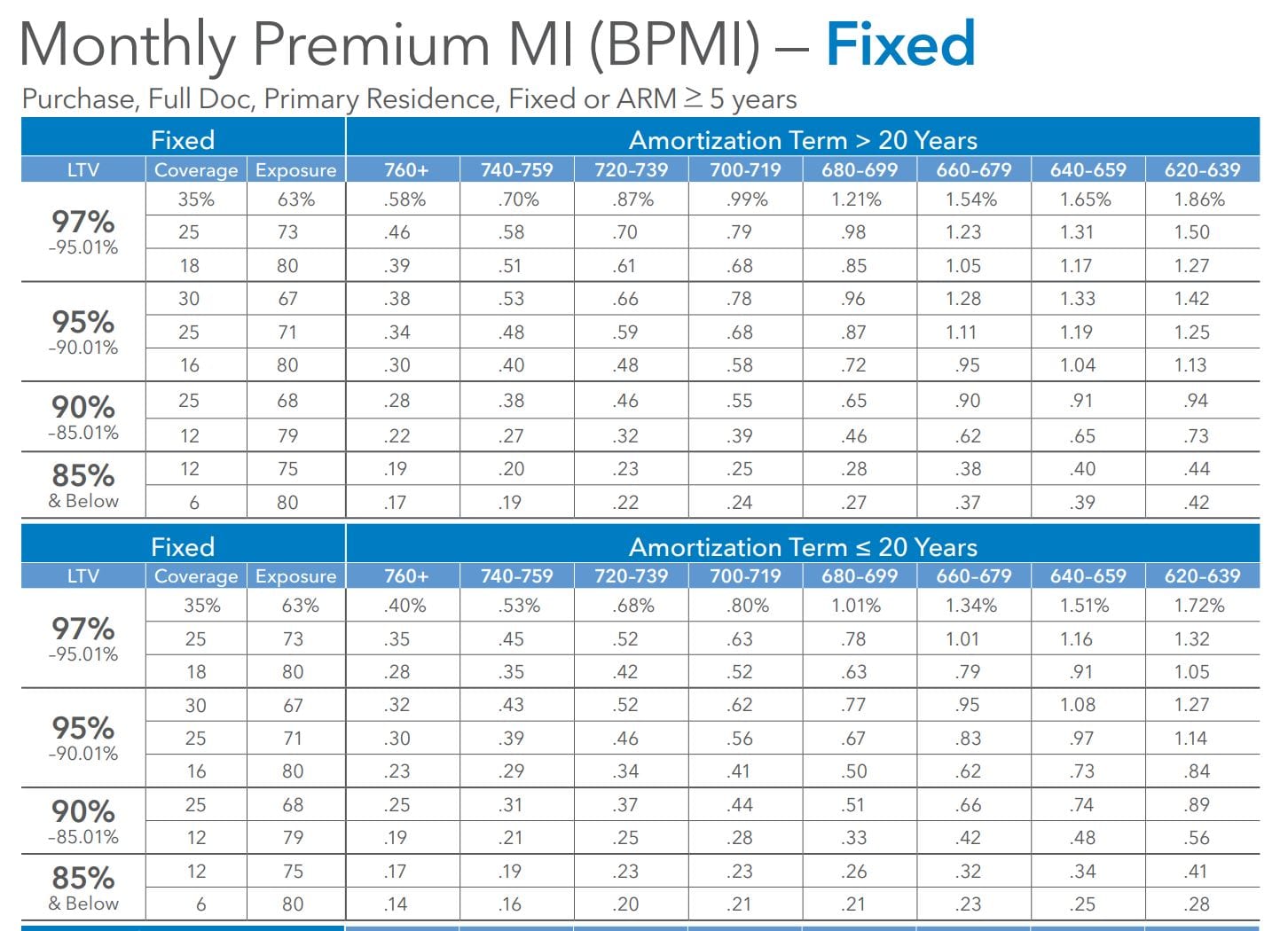
Your credit score is often the single most influential variable determining your PMI rate. Private mortgage insurers establish tiered rate tables that reward higher credit scores with lower rates. For instance, a borrower with a 760 FICO score will pay significantly lower monthly PMI premiums than a borrower with a 640 score, even if both put down the exact same 5% down payment.
2. Loan-to-Value (LTV) Ratio
Your LTV ratio represents the loan amount divided by the appraised home value (or purchase price, whichever is lower). Down payments are structured in standard brackets:
- 95.01% to 97% LTV (3% down payment): Highest PMI premium tiers.
- 90.01% to 95% LTV (5% down payment): Moderate-to-high PMI premiums.
- 85.01% to 90% LTV (10% down payment): Lower PMI premiums.
- 80.01% to 85% LTV (15% down payment): Lowest PMI premium tiers.
As your LTV decreases, the insurer's potential loss exposure shrinks, resulting in a lower annual premium percentage.
3. Debt-to-Income (DTI) Ratio and Loan Type
Borrowers with higher debt-to-income ratios (typically above 45%) may face small rate adjustments or surcharges from private mortgage insurers. Additionally, fixed-rate 30-year mortgages generally carry lower PMI rates than adjustable-rate mortgages (ARMs), as fixed-rate structures carry less interest-rate risk for the lender. Short-term fixed loans, such as 15-year conventional mortgages, also feature lower PMI rates due to faster equity accumulation.
4. Occupancy Type and Property Structure
Single-family, primary residences receive the best baseline PMI pricing. If you purchase a multi-unit property (such as a duplex or triplex) or a secondary vacation home while financing with a conventional loan requiring mortgage insurance, private insurers apply pricing add-ons that increase the overall premium.
How Conventional Loan PMI Is Calculated
PMI is calculated as an annual percentage of the original principal loan amount, which is then divided into 12 equal installments and added to your monthly mortgage payment (consisting of principal, interest, taxes, and standard insurance, often abbreviated as PITI).
The Math Behind Monthly PMI
To calculate your monthly PMI, use the following formula:
$$\text{Monthly PMI Payment} = \frac{\text{Original Loan Amount} \times \text{Annual PMI Rate}}{12}$$
Step-by-Step Example 1: High Credit Score, Low Down Payment
- Home Purchase Price: $400,000
- Down Payment: 5% ($20,000)
- Base Loan Amount: $380,000 (95% LTV)
- Credit Score: 750 (Excellent)
- Assumed Annual PMI Rate Factor: 0.44%
$$\text{Annual Cost} = $380,000 \times 0.0044 = $1,672$$
$$\text{Monthly Cost} = \frac{$1,672}{12} = $139.33\text{ per month}$$
Step-by-Step Example 2: Fair Credit Score, Low Down Payment
- Home Purchase Price: $400,000
- Down Payment: 5% ($20,000)
- Base Loan Amount: $380,000 (95% LTV)
- Credit Score: 660 (Fair)
- Assumed Annual PMI Rate Factor: 1.35%
$$\text{Annual Cost} = $380,000 \times 0.0135 = $5,130$$
$$\text{Monthly Cost} = \frac{$5,130}{12} = $427.50\text{ per month}$$
As illustrated, credit quality dramatically impacts long-term borrowing costs. Over three years, the borrower with a 660 credit score would pay over $10,000 more in total PMI charges than the borrower with a 750 score on the exact same property.
PMI Cost Estimates by Credit Score and Down Payment
The following baseline matrix provides representative annual PMI rate ranges for standard 30-year fixed-rate conventional loans on a primary single-family residence. Actual pricing varies by mortgage insurance carrier (such as Enact, Radian, MGIC, or Essent) and specific borrower profiles.
| Credit Score Range | 3% Down Payment (97% LTV) | 5% Down Payment (95% LTV) | 10% Down Payment (90% LTV) | 15% Down Payment (85% LTV) |
|---|---|---|---|---|
| 760+ | 0.45% – 0.65% | 0.35% – 0.50% | 0.22% – 0.35% | 0.15% – 0.25% |
| 720 – 759 | 0.65% – 0.90% | 0.50% – 0.70% | 0.30% – 0.48% | 0.20% – 0.32% |
| 680 – 719 | 0.95% – 1.35% | 0.75% – 1.05% | 0.45% – 0.70% | 0.30% – 0.45% |
| 640 – 679 | 1.45% – 2.05% | 1.15% – 1.60% | 0.75% – 1.10% | 0.45% – 0.70% |
| 620 – 639 | 1.85% – 2.40% | 1.50% – 2.10% | 0.95% – 1.45% | 0.60% – 0.90% |
Note: Table figures represent typical annual premium percentages. Multiply the percentage by your initial loan balance and divide by 12 to estimate your monthly payment.
Standard Premium Structures: How You Can Pay PMI
Borrowers purchasing a home via conventional financing have several options for how mortgage insurance premiums are structured and paid.
1. Borrower-Paid Monthly PMI (BPMI)
This is the most common payment method. Premium amounts are broken into monthly installments integrated directly into your billing statement. BPMI requires no extra cash upfront at closing, and the monthly fee is canceled once you reach specified equity milestones.
2. Single-Premium PMI
With single-premium mortgage insurance, you pay the entire coverage cost upfront as a lump sum during loan closing, or you finance the lump sum directly into your total mortgage balance.
- Pros: Eliminates a recurring monthly insurance charge, lowering your overall monthly obligation.
- Cons: Upfront funds are non-refundable in most cases if you sell or refinance the home shortly after purchase.
3. Split-Premium PMI
Split-premium coverage combines elements of monthly and single-premium plans. You pay a smaller upfront percentage at closing (e.g., 0.50% to 1.00% of the loan amount) and a reduced ongoing monthly fee. This structure balances upfront cash reserves with a manageable monthly housing expense.
4. Lender-Paid Mortgage Insurance (LPMI)
Under an LPMI arrangement, the mortgage lender pays the upfront insurance premium to the insurer on your behalf. In exchange, the lender increases your permanent interest rate—typically by 0.25% to 0.75%—for the duration of the loan.
- Trade-off: LPMI yields a smaller visible breakdown on monthly statements, but the elevated interest rate cannot be automatically removed once you reach 20% equity. To eliminate LPMI, you must refinance the mortgage entirely.
Comparing Conventional PMI vs. FHA MIP
Many home buyers compare conventional financing with government-backed Federal Housing Administration (FHA) loans. FHA loans require a Mortgage Insurance Premium (MIP) consisting of both an upfront fee and an annual recurring fee.
| Feature | Conventional PMI | FHA MIP |
|---|---|---|
| Upfront Cost | None (for standard BPMI) | 1.75% of loan balance |
| Annual Cost | 0.20% - 2.00% | 0.15% - 0.75% |
| Based On | Credit & LTV | LTV & Loan Term |
| Cancellable? | Yes (at 80%/78% LTV) | Rarely (Life of loan) |
As governed by standard loan rules detailed by the Consumer Financial Protection Bureau (CFPB), conventional PMI can be canceled once sufficient home equity is reached. Conversely, for FHA loans originated with less than 10% down, annual MIP remains active for the entire 30-year life of the loan, unless the borrower refinances into a conventional product.
Legal Rules for Removing PMI: The Homeowners Protection Act
One of the largest financial advantages of conventional PMI over government mortgage insurance is that PMI is temporary. The federal Homeowners Protection Act of 1998 (HPA) sets national mandates governing when and how private mortgage insurance must be canceled on residential mortgages.
- HPA Statutory Equity Milestones
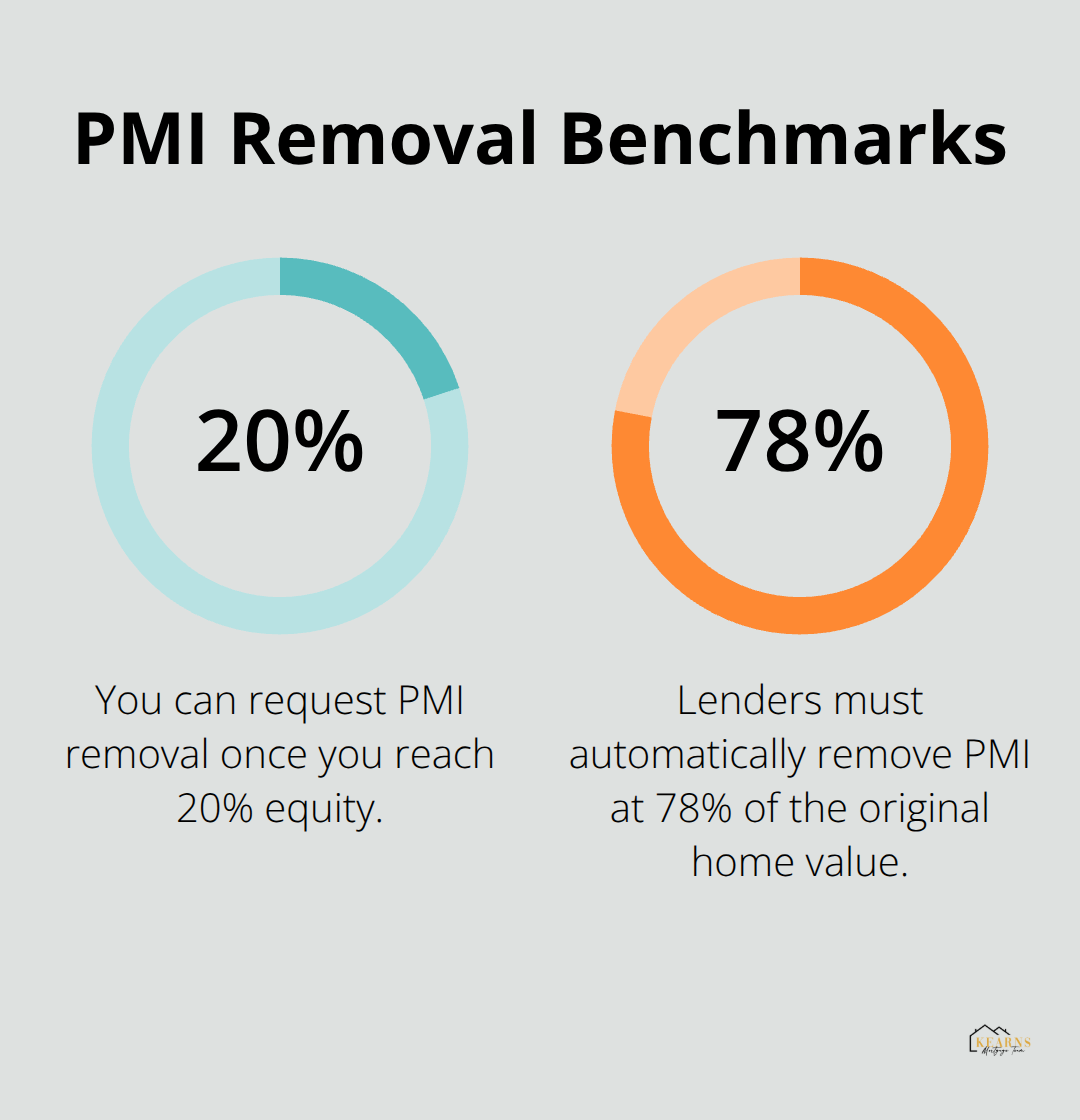
- Borrower Request (80%): Initiated by homeowner written request when loan reaches 80% LTV of original value.
- Automatic Termination (78%): Servicer MUST cancel when principal schedule reaches 78% LTV based on original property value.
1. Borrower-Requested Cancellation (80% LTV)
Under the HPA, you have the legal right to submit a written request to your mortgage servicer to cancel borrower-paid monthly PMI when the principal balance of your mortgage drops to 80% of the original home purchase price or appraised value.
To qualify for cancellation at 80% LTV:
- You must submit a formal written request to your loan servicer.
- You must possess a good payment history (no payments 30 days past due in the past 12 months, and no payments 60 days past due in the past 24 months).
- You must demonstrate that the property value has not declined below its original value (lenders typically verify this via an appraisal or automated valuation model).
- You must certify that there are no subordinate liens or second mortgages against the property.
2. Automatic Termination (78% LTV)
If you do not submit a manual request, your mortgage servicer is legally required under the HPA to automatically terminate BPMI once your loan balance reaches 78% LTV based on the original amortization schedule, provided your mortgage payments are current.
3. Midpoint Termination
If your loan balance has not reached 78% LTV through standard payments (e.g., if you had a interest-only period or custom terms), the servicer must cancel PMI coverage on the first day of the month immediately following the midpoint of your loan's contractual amortization schedule (such as year 15 of a 30-year mortgage), provided payments are up to date.
Removing PMI Early via Property Appreciation
Standard HPA rules evaluate equity relative to the original purchase value. However, Fannie Mae and Freddie Mac established guidelines allowing homeowners to remove PMI early based on current market valuation:
- 2-to-5 Year Loan Age: You can request PMI removal if your loan balance is 75% or less of the home's updated market value.
- 5+ Year Loan Age: You can request PMI removal if your loan balance is 80% or less of the updated market value.
- Substantial Improvements: If you completed documented structural additions or renovations that significantly boosted home value, you can request an appraisal to remove PMI regardless of how long you have held the loan.
Practical Strategies to Avoid or Minimize PMI Costs
If you are planning to purchase a home or currently pay monthly PMI on a conventional mortgage, several actionable strategies can help minimize or eliminate these costs entirely.
- PMI Minimization Strategies
- Improve Credit Score
- Pay Down Principal Faster
- Piggyback (80/10/10 Loans)
- Reappraise Home Value Later
1. Optimize Your Credit Score Prior to Application
Because PMI rates are tiered based on credit score, taking steps to boost your score before applying for a conventional mortgage can lower your rate significantly. Moving from a 679 credit score to a 720 score can reduce annual PMI expenses by hundreds of dollars per year.
2. Utilize a "Piggyback" Loan Structure (80-10-10)
A piggyback loan arrangement involves taking out two separate loans simultaneously during home purchase:
- First Mortgage: 80% of property value (avoids PMI).
- Second Mortgage (HELOC or Home Equity Loan): 10% of property value.
- Down Payment: 10% cash down payment.
Because the primary mortgage remains at exactly 80% LTV, no PMI is required. However, compare the interest rate on the second mortgage carefully against the cost of paying standard PMI; in higher interest-rate environments, piggyback loans can sometimes cost more than traditional PMI.
3. Make Extra Principal Payments
Once your loan is established, making extra payments directly toward your loan principal accelerates your progress toward 80% LTV. Even modest monthly prepayments can shave years off your PMI obligation.
4. Monitor Local Market Conditions for Reappraisal
If home values in your neighborhood rise substantially, contact your loan servicer to inquire about ordering a servicer-approved appraisal. Paying a $400 to $600 appraisal fee out-of-pocket can be a wise financial trade-off if it results in the immediate cancellation of a $150 monthly PMI charge.
Frequently Asked Questions
Is PMI tax-deductible on a conventional loan?
Historically, mortgage insurance premiums were deductible as qualified residence interest for taxpayers within specific income thresholds under temporary tax provisions. However, tax legislation varies by year and legislative action. Consult a certified public accountant (CPA) or tax professional to confirm the current tax treatment of private mortgage insurance premiums for your specific tax filing status.
Can I get a conventional loan with 3% down without paying PMI?
Generally, no. Standard Fannie Mae standard conventional products (such as Conventional 97 or HomeReady) require PMI when placing 3% down. While some specialized regional credit union programs or proprietary lender niche products market "no-PMI 3% down loans," these products typically adjust for risk by building higher baseline interest rates into the underlying loan terms.
What happens to my PMI if I refinance my conventional loan?
When you refinance a mortgage, your original loan is paid off completely and replaced with a new mortgage contract. If your new mortgage balance is under 80% of the newly appraised property value, the new loan will require no PMI. If the new loan's LTV exceeds 80%, new PMI terms and rates will be established based on your credit score and LTV at the time of refinancing.
Does PMI automatically go away if my home increases in value?
No. Servicers do not track local market appreciation automatically to drop PMI premiums. The automatic 78% termination threshold mandated by federal law relies strictly on your original amortization schedule and purchase price. To leverage rising home values to cancel PMI early, you must formally contact your loan servicer and request a property revaluation or new appraisal following their institutional procedures.
Is single-premium PMI cheaper than monthly PMI?
Single-premium PMI often costs less in total overall dollars than paying monthly PMI over a standard multi-year period. However, because single-premium payments are usually non-refundable, this strategy is generally best suited for buyers who intend to remain in their home for many years without refinancing or selling early.
Strategic Next Steps for Borrowers
Determining what you will pay for PMI requires analyzing how your credit score, down payment, and loan terms intersect. Before submitting a loan application:
- Request Full PMI Disclosure Quotes: Ask your loan officer to provide side-by-side PMI premium quotes from multiple mortgage insurance carriers (e.g., MGIC, Radian, Essent, Enact). Rates can vary between insurers for identical borrower profiles.
- Evaluate Upfront vs. Monthly Payment Options: Run side-by-side calculations to see whether standard borrower-paid monthly PMI, single-premium PMI, or higher down payment contributions make the best financial sense based on your cash flow and planned time horizon in the home.
- Track Equity Milestones: If you already hold a conventional loan with PMI, review your annual mortgage statement to track your progress toward 80% LTV, and contact your loan servicer as soon as your principal balance approaches the cancellation threshold.
Disclaimer: Mortgage rules, PMI pricing matrices, and underwriting guidelines are subject to change by financial institutions and government entities. This article provides general financial education and does not constitute personalized legal, tax, or financial advice. Consult a licensed mortgage professional or certified financial advisor to address specific lending situations.
Image Gallery