What a Deep Sea Vent Really Is: The Science of Hydrothermal Ecosystems
A deep sea vent—technically known as a hydrothermal vent—is a fissure in the ocean floor where geothermally heated water discharges from beneath the Earth's crust. Formed primarily along tectonic plate boundaries, these submarine geyse...
A deep sea vent—technically known as a hydrothermal vent—is a fissure in the ocean floor where geothermally heated water discharges from beneath the Earth's crust. Formed primarily along tectonic plate boundaries, these submarine geysers spew mineral-rich fluids at extreme temperatures into freezing seawater, sustaining unique ecosystems that thrive completely independent of sunlight through chemosynthesis.
Contents
Defining Deep Sea Vents: Geothermal Fissures on the Ocean Floor
Deep sea hydro-thermal vents are fundamental components of Earth’s planetary cooling system and geochemical cycles. Located thousands of meters below the surface—typically along mid-ocean ridge systems, back-arc basins, and volcanic arcs—these geological structures act as natural plumbing systems for the Earth's interior heat.
At these abyssal depths, ambient seawater sits near freezing (roughly 2°C to 4°C), and hydrostatic pressure reaches several hundred atmospheres. Hydrothermal vents form when cold seawater percolates down through fractures in the oceanic crust, drawn toward underground magma chambers. As the water descends, it experiences extreme heat and intense geological pressure, triggering profound chemical transformations before surging back up to the seabed.
Subsurface Circulation Pathway:
- Cold Seawater Infiltration
- Geothermal Heating (Magma Chamber)
- Chemical Alteration & Mineral Leaching
- Buoyant Hydrothermal Discharge
How Hydrothermal Circulation Works
The mechanics of hydrothermal venting depend on a continuous thermodynamic loop known as hydrothermal circulation:
- Infiltration: Seawater creeps miles deep into the ocean floor through structural faults and porous basalt.
- Superheating and Chemical Exchange: As seawater approaches sub-surface magma chambers, temperatures soar well beyond 300°C to 400°C. Under extreme pressures (often exceeding 200 to 300 bars), the superheated water does not boil into steam. Instead, it becomes highly reactive. The fluid loses dissolved oxygen and magnesium to surrounding rocks while leaching heavy metals (such as iron, copper, zinc, and manganese), hydrogen sulfide, methane, and silica from the basaltic crust.
- Buoyant Ascent: The modified fluid becomes less dense than the surrounding ocean water, causing it to rise rapidly through vertical conduits.
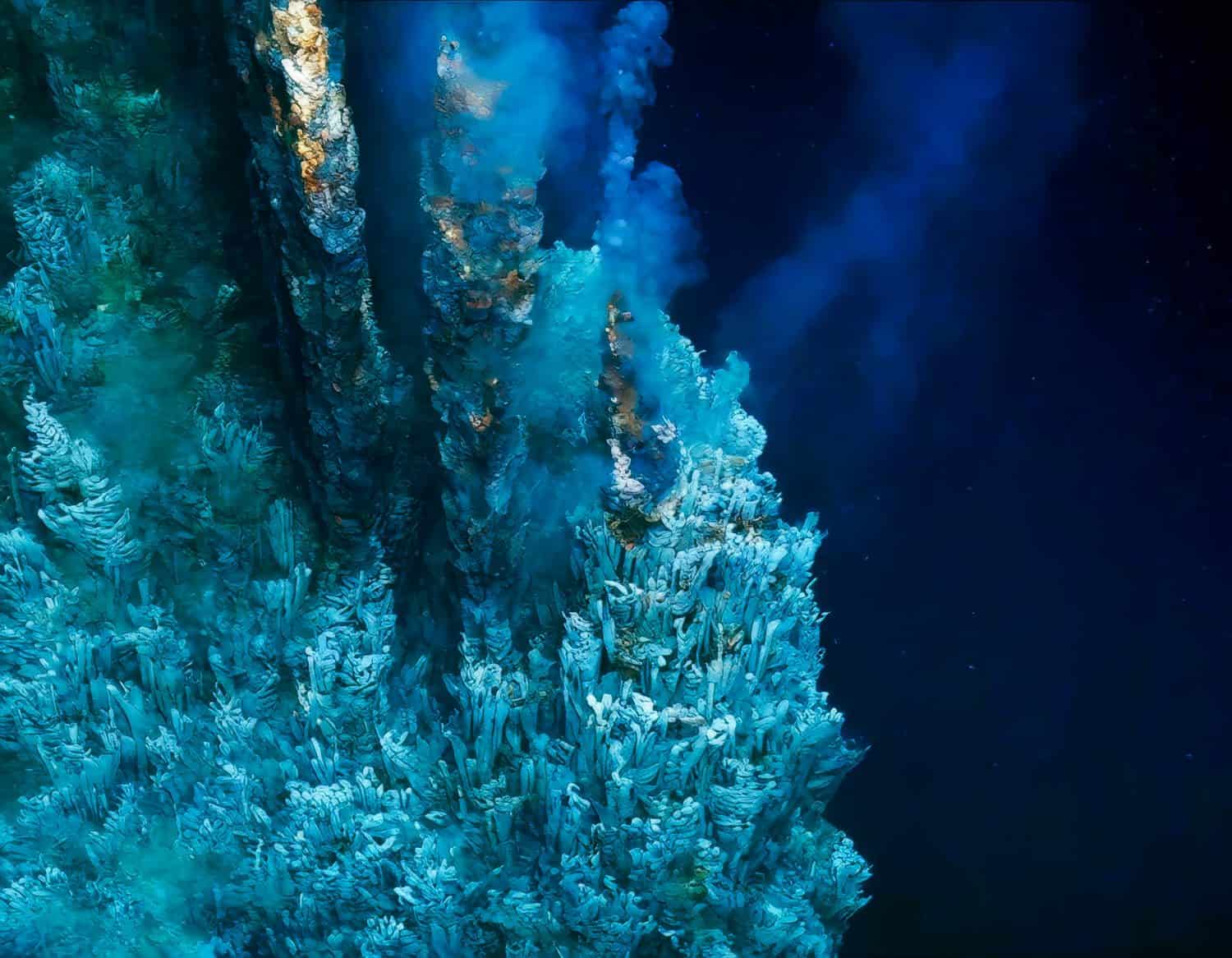
- Precipitation: Upon escaping into the cold, oxygen-rich abyssal ocean, the superheated fluid undergoes rapid thermal shock. Dissolved metals immediately combine with sulfur to form insoluble mineral precipitates, building chimney-like towers around the vent opening.
Types of Deep Sea Vents: Black Smokers vs. White Smokers
Hydrothermal vents are generally classified into two main structural types based on fluid composition, water temperature, and mineral content: black smokers and white smokers.
Hydrothermal Vent Types:
- Black Smokers
- Temp: 350°C - 400°C+
- High Iron & Copper Sulfides
- Highly Acidic (pH 2-3)
- Magmatic Heat Sources
- White Smokers
- Temp: 60°C - 300°C
- Rich in Barium, Calcium, Silica
- Alkaline to Neutral (pH 6-11)
- Tectonic Serpentinization (Lost City)
Black Smokers (Metal Sulfides and Extreme Heat)
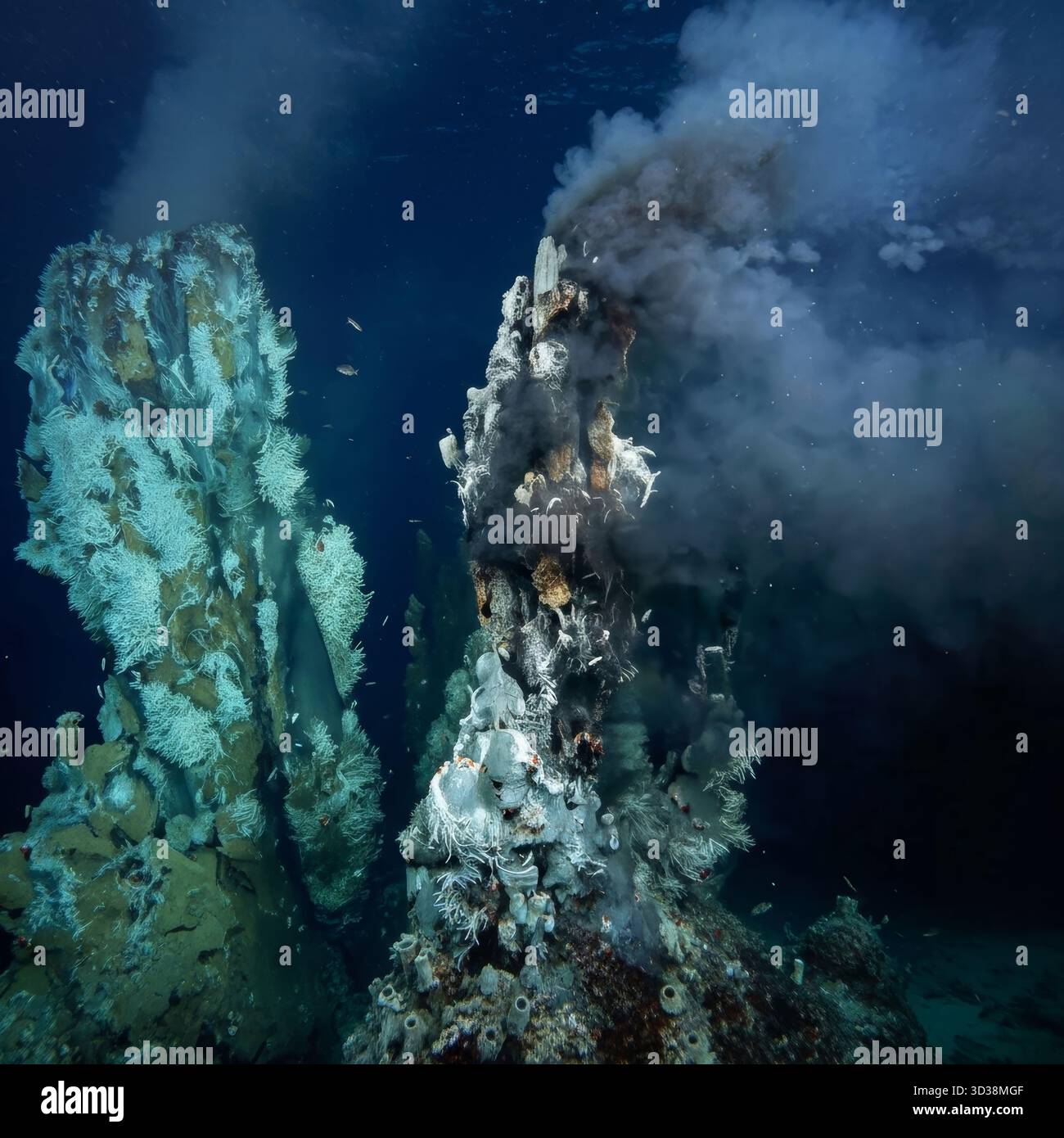
Black smokers are the hottest and most volatile hydrothermal features on the ocean floor. Venting fluids reach temperatures between 350°C and 400°C (and occasionally higher under extreme pressure).
The characteristic dark "smoke" emitted by these chimneys is not smoke at all, but rather microscopic mineral particles precipitating out of solution. When iron- and copper-rich acidic fluids (pH 2 to 3) hit cold seawater, iron monosulfide (pyrrhotite) and copper-iron sulfides (chalcopyrite) instantly solidify. Over time, these mineral deposits aggregate into vertical chimneys that can reach heights of several stories, growing at rates of up to several centimeters per day.
White Smokers (Alkaline Hydrothermal Fields and Mineral Carbonates)
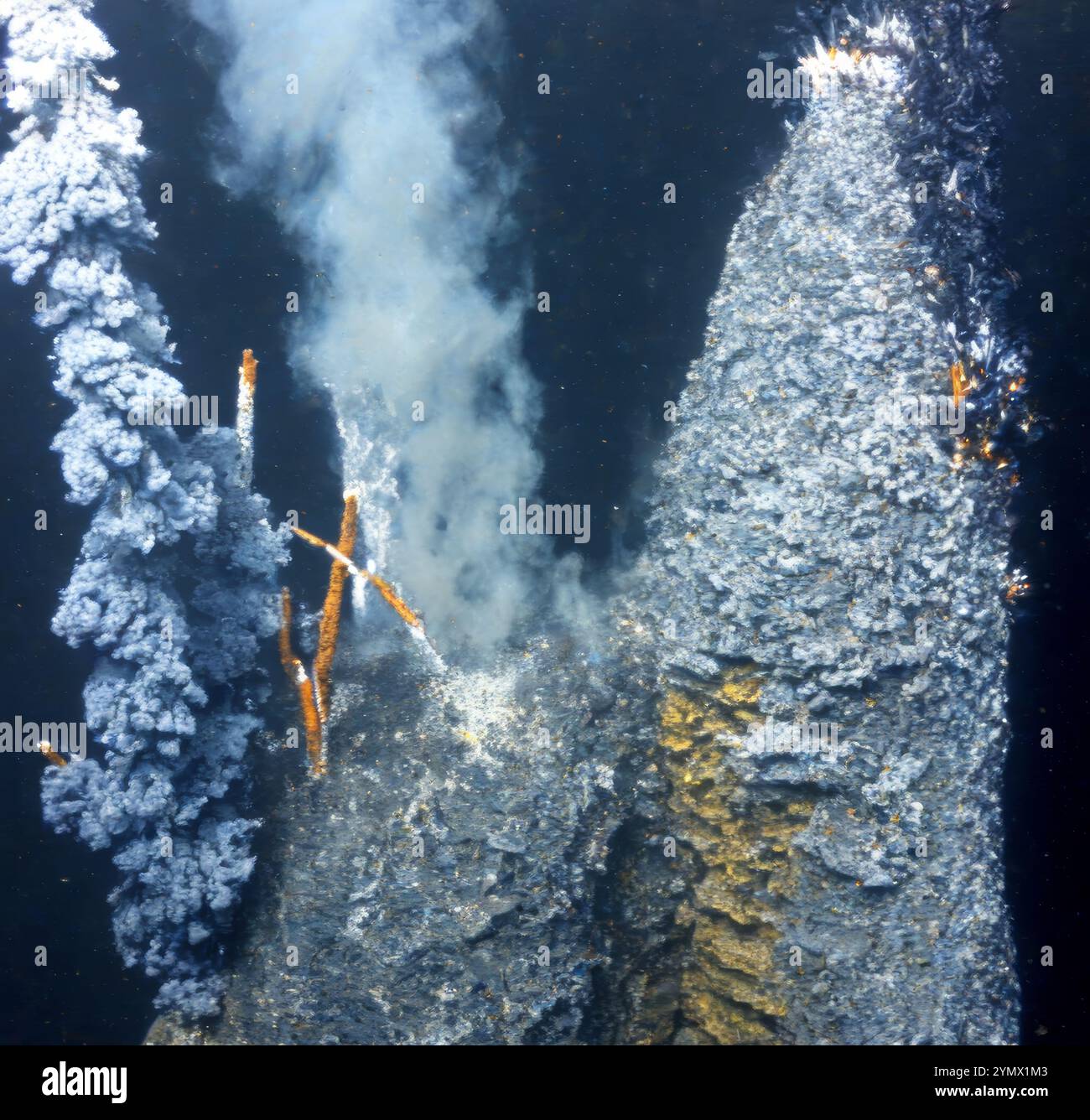
White smokers emit cooler, slower-moving fluids typically ranging from 60°C to 300°C. Their distinct pale coloration stems from precipitates rich in barium (barite), calcium (anhydrite), and silica, rather than heavy metal sulfides.
A notable sub-category of white smoker vents includes alkaline hydrothermal vents, such as the famous Lost City Hydrothermal Field located on the Mid-Atlantic Ridge. Unlike magmatically driven black smokers, alkaline vents are fueled by a geochemical process called serpentinization. This reaction occurs when seawater reacts directly with upper-mantle olivine rocks, generating heat, molecular hydrogen ($H_2$), methane, and highly alkaline fluids (pH 9 to 11). Instead of sulfide chimneys, serpentinization produces towering carbonate structures that can remain active for tens of thousands of years.
Comparative Analysis of Vent Systems
The following table summarizes the primary physical, geochemical, and biological characteristics distinguishing black smokers from white smokers and serpentinization fields:
| Parameter | Black Smokers | White Smokers (Magmatic) | Alkaline Vent Fields (e.g., Lost City) |
|---|---|---|---|
| Typical Fluid Temp. | 350°C to >400°C | 60°C to 300°C | 40°C to 90°C |
| Primary Fluid pH | Highly Acidic (pH 2 – 3) | Moderately Acidic (pH 3 – 5) | Highly Alkaline (pH 9 – 11) |
| Dominant Minerals | Iron, copper, and zinc sulfides | Anhydrite (calcium sulfate), silica, barite | Calcium carbonate (calcite, aragonite), brucite |
| Heat Source | Shallow sub-surface magma chambers | Off-axis magmatic residual heat | Chemical serpentinization reactions |
| Precipitate Appearance | Dense black clouds of dark sulfide particulate | Milk-white or light grey mineral plumes | White to tan porous carbonate towers |
| Dominant Energy Pathways | Sulfide oxidation ($H_2S$) | Sulfide and iron oxidation | Hydrogen ($H_2$) and methane ($CH_4$) oxidation |
| Lifespan of Chimney | Decades to centuries (dynamic, fragile) | Decades to centuries | Millennia to tens of thousands of years |
Life in the Dark: The Science of Chemosynthesis
Prior to the discovery of hydrothermal vents in 1977 near the Galápagos Rift by researchers aboard the submersible Alvin, marine biology operated under the assumption that all complex marine food webs relied on solar energy via photosynthesis. Hydrothermal vents proved that complex ecosystems can flourish in total darkness.
Primary Energy Transfer Comparison:
- Photosynthesis:
- Inputs: Sunlight + CO2 + H2O
- Outputs: Organic Carbon (Glucose) + Oxygen
- Chemosynthesis (Sulfide-Oxidizing):
- Inputs: H2S + O2 + CO2 + H2O
- Outputs: Organic Carbon + Sulfuric Acid
Primary Producers: Sulfide- and Methane-Oxidizing Microbes
In the absence of sunlight, vent ecosystems rely on chemosynthesis. Single-celled archaea and bacteria act as the primary producers. These specialized microbes harvest chemical energy stored in the chemical bonds of reduced compounds—such as hydrogen sulfide ($H_2S$), dissolved hydrogen ($H_2$), methane ($CH_4$), and ferrous iron ($Fe^{2+}$)—discharged by the vents.
By oxidizing these chemicals using dissolved oxygen or nitrates from surrounding seawater, chemosynthetic microbes synthesize organic carbon compounds, forming the base of the deep-sea food web.
Symbiotic Adaptations and Vent Food Webs
Many vent animals cannot consume microbes directly and instead rely on complex endosymbiotic relationships:
- Giant Tube Worms (Riftia pachyptila): Growing up to two meters long, these worms possess neither a mouth, gut, nor digestive tract. Instead, their internal cavity houses a specialized organ called a trophosome, packed with billions of chemolithoautotrophic bacteria. The tube worm’s bright red plume contains specialized hemoglobin that simultaneously binds dissolved hydrogen sulfide and oxygen from the water, delivering both to the internal bacteria in exchange for organic nutrients.
- Vent Shrimp (Rimicaris exoculata): Swarming black smoker chimneys on the Mid-Atlantic Ridge, these eye-less shrimp host dense colonies of episymbiotic sulfide-oxidizing bacteria on their modified mouthparts and gill cavities, feeding on the bacterial mats.
- Bathymodiolin Mussels and Vesicomyid Clams: These bivalves house chemosynthetic bacterial symbionts within their enlarged gill tissues, enabling them to carpet the basaltic rocks surrounding hydrothermal fluid seeps.
Higher trophic levels in these isolated biomes include predatory vent crabs, zoarcid fish, octopus species, and specialized polychaete worms, creating hyper-dense biological oases in the otherwise barren abyssal plain.
Global Distribution and Tectonic Environments
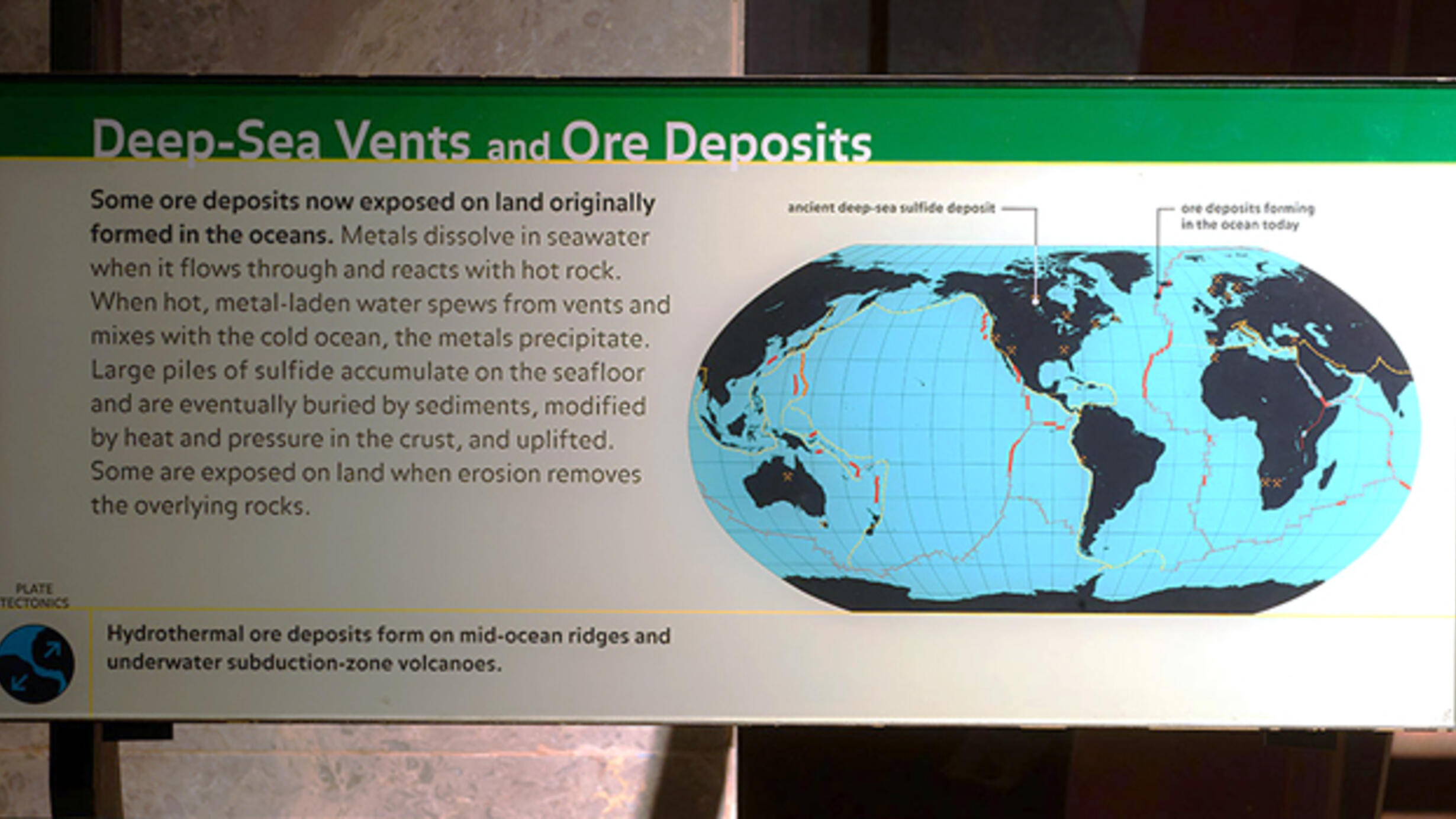
Hydrothermal vents are not uniformly distributed across the seafloor; they are localized along active tectonic margins and volcanic regions. Oceanographers classify hydrothermal zones based on their surrounding tectonic dynamics:
Global Tectonic Vent Settings:
- Mid-Ocean Ridges (e.g., East Pacific Rise, Mid-Atlantic Ridge)
- Spreading tectonic plates
- Magmatic fluid upwelling
- Back-Arc Basins & Arcs (e.g., Lau Basin, Mariana Arc)
- Subduction-related volcanism
- Variable mineral chemistry
- Mid-Ocean Ridge Systems: The majority of known hydrothermal fields occur along oceanic spreading centers. Fast-spreading ridges (such as the East Pacific Rise) feature frequent volcanic eruptions, resulting in short-lived but highly dynamic vent systems. Slow-spreading ridges (such as the Mid-Atlantic Ridge or the Gakkel Ridge in the Arctic Ocean) exhibit deeper axial valleys and host longer-lived hydrothermal fields, including both black smokers and serpentinization sites.
- Back-Arc Basins and Subduction Zones: In areas where one tectonic plate slides beneath another (subduction zones), such as the Western Pacific's Lau Basin and Mariana Arc, subduction-related volcanism drives hydrothermal discharge. Vents in these regions often yield fluids enriched in acidic volcanic gases, sulfur dioxide, and precious metals like gold and silver.
- Submarine Volcanoes and Seamounts: Shallow ocean volcanoes, such as those along the Ring of Fire, also host hydrothermal systems. These shallower systems often emit carbon dioxide bubbles and lower-temperature acidic fluids directly into the photic zone.
Scientific Significance: Origins of Life and Astrobiology
The study of deep sea vents extends far beyond oceanography; it directly informs fundamental questions regarding biochemistry and planetary exploration.
The Deep-Sea Origin of Life Hypothesis
Many astrobiologists and biochemists hypothesize that life on Earth may have originated within ancient hydrothermal vent systems—specifically within alkaline hydrothermal fields.
In primordial oceans, porous carbonate chimneys at alkaline vents provided natural micro-cavities that acted as inorganic cell membranes. The natural chemical gradient between warm, alkaline vent fluids (rich in $H_2$) and acidic, iron-rich ocean water created a natural proton motive force—similar to the electrochemical gradients that power modern cellular ATP synthesis. These mineral-rich micro-environments may have catalyzed the synthesis of the first organic molecules, RNA chains, and metabolic precursors before cellular membranes evolved. Detailed geochemical models supporting this origin-of-life framework are thoroughly reviewed in studies hosted by the National Center for Biotechnology Information (NCBI).
Implications for Ocean Worlds in Our Solar System
The discovery that complex life can thrive independent of solar radiation has transformed our understanding of habitability throughout the solar system.
Planetary missions by NASA and the European Space Agency (ESA) have confirmed that icy moons such as Europa (orbiting Jupiter) and Enceladus (orbiting Saturn) harbor global sub-surface oceans beneath thick ice shells. Measurements taken by the Cassini spacecraft confirmed the presence of molecular hydrogen, methane, and silica nanoparticles in the plumes ejected from Enceladus’s south pole—unmistakable geochemical signatures of active hydrothermal vents on its seafloor. Understanding Earth's hydrothermal systems provides a direct template for detecting potential extraterrestrial life within outer solar system ocean worlds.
Environmental Threats and Conservation: Deep-Sea Mining
While hydrothermal vents are resilient to extreme heat and pressure, they are vulnerable to human activity. Hydrothermal vents continuously deposit massive amounts of copper, zinc, gold, silver, and rare earth elements onto the seafloor, forming rich seafloor massive sulfide (SMS) deposits.
Commercial interest in deep-sea mining targeting these SMS deposits has raised ecological concerns among marine scientists:
- Physical Habitat Destruction: Mining operations involve heavy machinery grinding away active or inactive hydrothermal chimneys, directly destroying the specialized benthic habitats that depend on them.
- Sediment Plumes: Mining activities generate large underwater plumes of suspended silt and crushed particulate matter. These plumes can travel vast distances, clogging the delicate feeding mechanisms of filter-feeding vent organisms and blocking chemical signaling pathways.
- Toxic Heavy Metal Release: Excavating sulfide deposits releases toxic dissolved metals into the surrounding water column, altering local water chemistry and threatening non-vent abyssal species.
The international regulatory framework governing deep-sea mineral extraction in international waters is managed by the International Seabed Authority (ISA), which continues to evaluate environmental impacts, baseline scientific surveys, and potential marine protected area designations to safeguard vent biomes.
Frequently Asked Questions
How hot does the water in a deep sea vent get, and why doesn't it boil?
Hydrothermal fluid temperatures at black smokers frequently exceed 350°C to 400°C. The fluid remains liquid rather than boiling into steam because of the immense hydrostatic pressure exerted by the overlying ocean column at depths of 2,000 to 4,000 meters—where pressures can exceed 200 to 400 atmospheres, elevating the boiling point of water.
When were deep sea hydrothermal vents first discovered?
Hydrothermal vents were first discovered in 1977 by oceanographers from the Woods Hole Oceanographic Institution operating the crewed submersible Alvin. They found active hydrothermal chimneys and dense biological communities along the Galápagos Rift in the eastern Pacific Ocean.
How do animals survive the toxic chemicals emitted by vents?
Vent fauna have evolved specialized biochemical adaptations. Many species rely on symbiotic bacteria that process toxic chemicals like hydrogen sulfide before they can damage host tissues. Animals such as Riftia pachyptila possess specialized hemoglobin proteins that bind hydrogen sulfide safely, preventing it from inhibiting cellular respiration while transporting it to their internal symbionts.
Are deep sea vents permanent structures?
No, hydrothermal vents are geologically temporary features. Individual vent chimneys can remain active for anywhere from a few decades to several centuries, depending on local volcanic activity, seismic shifts, and tectonic plate movement. When underlying sub-surface magma chambers cool or mineral precipitation clogs internal plumbing, the fluid supply stops, causing the surrounding chemosynthetic community to collapse.
What is the difference between a hydrothermal vent and a cold seep?
While both sustain chemosynthetic ecosystems, hydrothermal vents are driven by geothermal heat, discharging superheated, highly mineralized fluids along volcanic plate boundaries. Cold seeps, by contrast, occur along continental margins where methane, hydrocarbons, and hydrogen sulfide leak out of seafloor sediments at ambient seawater temperatures without geothermal heating.
Key Takeaways and Next Actions
Understanding deep sea vents provides critical insights into geology, marine biology, and the limits of terrestrial life. To further explore hydrothermal systems and oceanic research:
- Review Oceanographic Data: Explore public ocean exploration logs hosted by organizations like the National Oceanic and Atmospheric Administration (NOAA) to view high-resolution imagery and live-streamed remotely operated vehicle (ROV) telemetry from active vent fields.
- Monitor International Policy: Stay informed on regulations surrounding deep-sea mining by tracking updates from the International Seabed Authority (ISA) regarding global seafloor preservation standards.
- Follow Planetary Science Advances: Track ongoing planetary missions, such as NASA's Europa Clipper, which investigate sub-surface ocean environments on ice moons that may host extraterrestrial hydrothermal networks.
Image Gallery