2004 Jeep Liberty Firing Order Explained
The 2004 Jeep Liberty features two primary engine options—the 2.4-liter four-cylinder (EDZ) and the 3.7-liter V6 (EKG)—each requiring a specific firing order to ensure proper ignition timing, smooth engine performance, and fuel efficie...
The 2004 Jeep Liberty features two primary engine options—the 2.4-liter four-cylinder (EDZ) and the 3.7-liter V6 (EKG)—each requiring a specific firing order to ensure proper ignition timing, smooth engine performance, and fuel efficiency. Understanding the exact sequence of spark delivery is essential when replacing spark plugs, installing ignition wires, troubleshooting misfires, or rebuilding the cylinder head.
Contents
Introduction to the 2004 Jeep Liberty Engine Lineup
When tackling ignition work or diagnostics on a 2004 Jeep Liberty, knowing the exact firing order prevents costly mistakes such as crossed plug wires or improper coil pack connections. The Jeep Liberty was offered with two distinct powerplants during this model year: a 2.4L PowerTech inline-four and a 3.7L PowerTech V6. Because these engines have entirely different cylinder layouts, block configurations, and distributorless ignition systems, their firing sequences and cylinder numbering conventions vary significantly.
Failing to maintain the correct sequence can cause severe engine misfires, rough idling, catalytic converter damage due to unburned fuel, and reduced fuel economy. This guide breaks down the firing orders for both engine options, details the cylinder numbering layouts, and provides actionable troubleshooting steps for DIY mechanics and technicians alike.
Understanding Cylinder Numbering and Engine Layouts
Before applying a firing order, you must know how Jeep numbers its cylinders. Manufacturers vary wildly in how they designate front-to-back and left-to-right cylinder banks, and confusing these can lead to misdiagnosed ignition issues.
2.4L Inline-4 Engine Layout
The 2.4L EDZ engine features four cylinders arranged in a straight line from front to back.
- Front of Engine (Radiator side): Cylinder 1
- Rear of Engine (Firewall side): Cylinder 4
- Sequence from front to rear: 1 - 2 - 3 - 4
3.7L V6 Engine Layout
The 3.7L EKG engine is a 90-degree V6. Jeep designates the cylinders on the passenger side (Right Bank) and driver side (Left Bank) using standard Chrysler conventions.
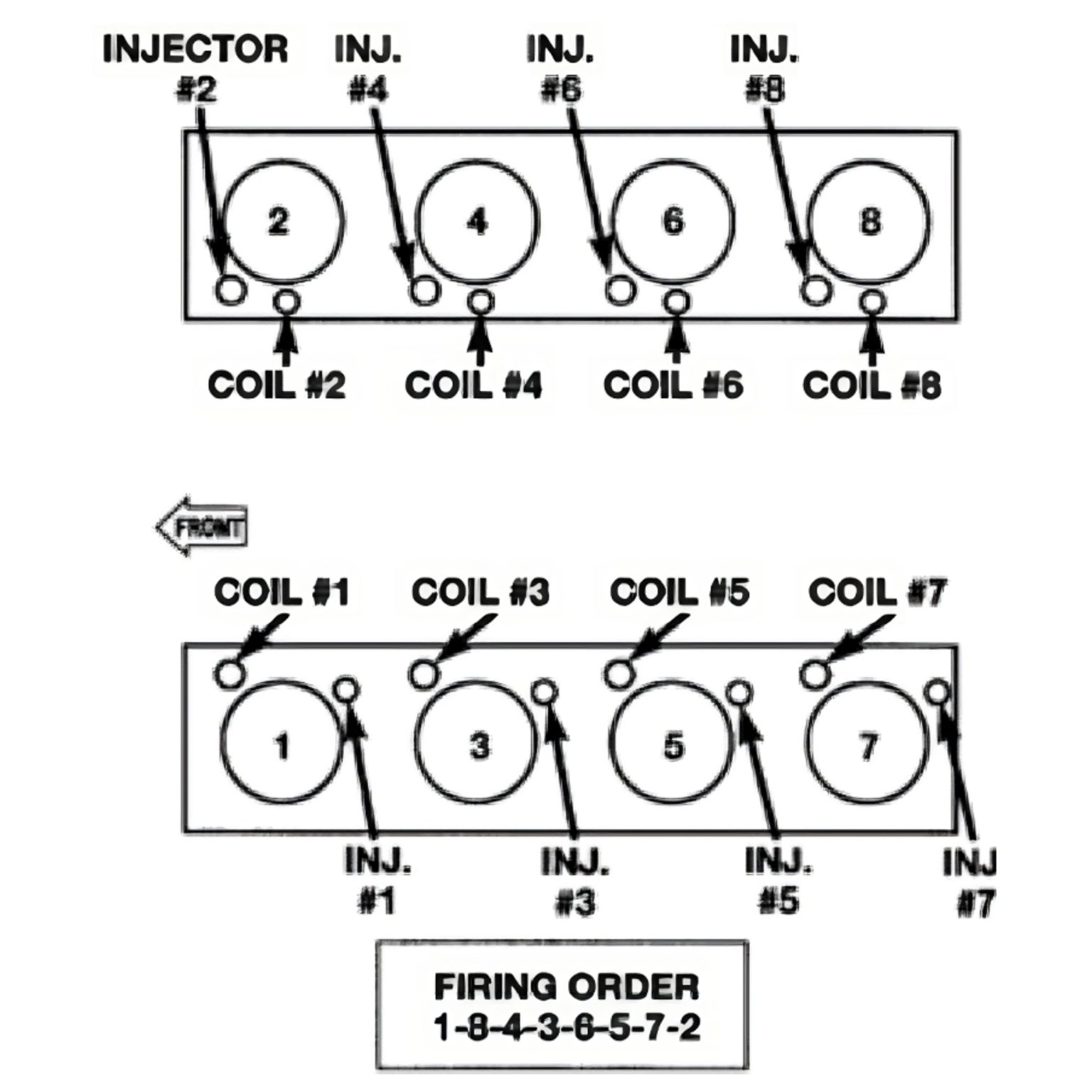
- Right Bank (Passenger Side): Cylinders 1, 3, and 5 (front to back)
- Left Bank (Driver Side): Cylinders 2, 4, and 6 (front to back)
- Front of Engine: Cylinders 1 (right) and 2 (left) are closest to the radiator, though one bank is slightly offset depending on connecting rod journal sharing.
| Engine Size | Cylinder Configuration | Cylinder Numbering Convention | Primary Ignition Type |
|---|---|---|---|
| 2.4L (EDZ) | Inline-4 | 1-2-3-4 (Front to Rear) | Waste-Spark Coil Pack |
| 3.7L (EKG) | V6 (90° V) | Right: 1-3-5 / Left: 2-4-6 | Coil-on-Plug (COP) |
2004 Jeep Liberty 2.4L Firing Order and Ignition Mechanics
The 2.4L inline-four engine utilizes a waste-spark ignition system controlled by a dual-tower coil pack mounted directly above the spark plugs.
Firing Order Sequence
The firing order for the 2004 Jeep Liberty 2.4L engine is 1 - 3 - 4 - 2.
How the System Works
In this inline configuration, pistons 1 and 4 move up and down together, while pistons 2 and 3 share a parallel stroke. However, they operate on different strokes of the four-stroke cycle (compression vs. exhaust). The powertrain control module (PCM) fires the dual-tower coil simultaneously for cylinders paired in companion rotation (1 and 4, or 2 and 3), sending a spark to the cylinder under compression and a "waste" spark to its companion cylinder during the exhaust stroke.
When replacing spark plug wires or testing the coil pack on the 2.4L, verify that the wire boots click securely onto both the spark plug terminals and the correct coil towers. Mixing up wires between cylinders 2 and 3 or 1 and 4 will instantly trigger a diagnostic trouble code (DTC) such as P0301, P0302, P0303, or P0304.
2004 Jeep Liberty 3.7L V6 Firing Order and Ignition Mechanics
The 3.7L PowerTech V6 engine found in the majority of 2004 Jeep Liberty models utilizes a coil-on-plug (COP) design. Instead of high-tension spark plug wires, an individual ignition coil sits directly on top of each spark plug.
Firing Order Sequence
The firing order for the 2004 Jeep Liberty 3.7L V6 engine is 1 - 2 - 3 - 4 - 5 - 6.
Cylinder Location Reference Table
To prevent crossed connections or mislabeled harnesses during a tune-up, reference the exact physical positions of the 3.7L V6 cylinders:
| Cylinder Number | Engine Bank | Physical Location |
|---|---|---|
| Cylinder 1 | Right Bank | Front (Passenger Side) |
| Cylinder 2 | Left Bank | Front (Driver Side) |
| Cylinder 3 | Right Bank | Middle (Passenger Side) |
| Cylinder 4 | Left Bank | Middle (Driver Side) |
| Cylinder 5 | Right Bank | Rear (Passenger Side) |
| Cylinder 6 | Left Bank | Rear (Driver Side) |
Diagnosing 3.7L Ignition Issues
Because the 3.7L uses individual coils rather than a central distributor or single coil pack, a firing order error typically manifests if the engine wiring harness connectors are swapped between adjacent cylinders during reassembly. The wiring harness connectors are molded to reach specific locations, but forcing a connector onto the wrong coil can disrupt the sequential firing signal sent by the camshaft and crankshaft position sensors.
Common Mistakes and Troubleshooting Misfires
When working on the ignition system of a 2004 Jeep Liberty, mechanics frequently encounter specific pitfalls that mimic or cause firing order failures.
1. Mistaking Cylinder Bank Numbers (3.7L V6)
The most common error on the 3.7L engine is assuming that cylinders are numbered sequentially from front to back on a single side (1-2-3 on the right, 4-5-6 on the left). Remember that Chrysler numbers the right bank odd (1, 3, 5) and the left bank even (2, 4, 6) from front to rear. Always inspect the intake manifold casting marks or factory service manuals if there is any ambiguity.
2. Damaged Ignition Coil Connectors
On older vehicles like the 2004 Liberty, the plastic locking tabs on the electrical connectors for the 3.7L ignition coils become brittle and snap off due to extreme under-hood heat cycles. A loose connector can intermittently drop power to a cylinder, creating symptoms identical to a mechanical firing order fault. Secure loose connectors with high-temp zip ties or replace the pigtail harnesses if necessary.
3. Oil Intrusion in Spark Plug Wells
Valve cover gasket leaks are common on the 3.7L V6. Oil pools inside the spark plug tubes, shorting out the exterior of the ignition coil boot and causing severe misfires. Always inspect the spark plug wells for oil before blaming an electrical or timing fault.
Frequently Asked Questions
What is the firing order for a 2004 Jeep Liberty 3.7L V6?
The firing order for the 3.7L V6 engine is 1 - 2 - 3 - 4 - 5 - 6. The cylinders are arranged with the odd numbers (1, 3, 5) on the passenger-side bank and the even numbers (2, 4, 6) on the driver-side bank, starting from the front of the engine block.
How do I know if my 2004 Jeep Liberty has a 2.4L or 3.7L engine?
You can identify your engine by checking the Vehicle Emission Control Information (VECI) label located under the hood, looking at the intake manifold plastic shroud which usually displays the displacement, or examining the eighth digit of your Vehicle Identification Number (VIN). An "K" or similar designation typically indicates the 3.7L V6, while a designated four-cylinder code denotes the 2.4L.
What symptoms occur if spark plug wires are mixed up on a 2.4L Liberty?
Crossing spark plug wires on the 2.4L engine results in an immediate dead miss, violent engine shaking, popping or backfiring through the intake or exhaust, a severe lack of acceleration, and a flashing Check Engine Light indicating catalytic-damaging misfires.
Do I need special tools to check the ignition coils on a 2004 Jeep Liberty?
Basic hand tools, including an 8mm or 10mm socket for the ignition coil fasteners and a 5/8-inch spark plug socket with a universal extension, are all that is required to access the spark plugs and coils on both the 2.4L and 3.7L engines. An OBD2 scanner is also recommended to read specific misfire codes.
Can a bad crankshaft position sensor mimic a firing order problem?
Yes. The Powertrain Control Module relies on signals from both the crankshaft position sensor and camshaft position sensor to determine injector pulse and spark timing sequence. If either sensor fails or has a dirty connector, the engine may misfire or fail to start entirely, presenting symptoms similar to ignition timing faults.
Summary and Next Actions
Accurately identifying your engine configuration—either the 2.4L inline-four or the 3.7L V6—is the critical first step before performing any ignition maintenance on a 2004 Jeep Liberty. Adhere strictly to the 1-3-4-2 sequence for the 2.4L or the 1-2-3-4-5-6 sequence for the 3.7L, and double-check all physical cylinder bank locations before securing plug wires or coil harnesses. If misfires persist after verifying the correct firing order, proceed to test spark plug gaps, check for oil contamination in the plug wells, and scan for active diagnostic trouble codes.
Image Gallery