Understanding the Delaware Corporations Division for Your Business
The Delaware Division of Corporations is the state government agency responsible for the formation, registration, and regulation of business entities within the State of Delaware. For business owners, it serves as the administrative ga...
The Delaware Division of Corporations is the state government agency responsible for the formation, registration, and regulation of business entities within the State of Delaware. For business owners, it serves as the administrative gateway for legalizing a company, maintaining its "good standing," and managing essential filings like annual reports, franchise tax payments, and UCC records.
Contents
For entrepreneurs, legal professionals, and corporate executives, the Delaware Division of Corporations is more than just a bureaucratic office; it is the operational engine behind the most popular corporate jurisdiction in the world. As of 2026, Delaware remains the preferred home for more than 65% of Fortune 500 companies and the vast majority of venture-backed startups. Understanding how to navigate this division is critical for ensuring your business remains compliant and enjoys the legal protections offered by Delaware’s sophisticated business laws.
The Strategic Importance of the Delaware Division of Corporations
The Division of Corporations operates under the Delaware Department of State. Its primary mandate is to provide a stable, efficient, and legally sound environment for business entities. While many states have similar departments, Delaware’s version is unique because of its high volume, specialized expedited services, and its integration with the Delaware General Corporation Law (DGCL).
Businesses choose to interact with this specific division because Delaware offers a level of legal predictability that other states struggle to match. The division works in tandem with the Delaware Court of Chancery, a non-jury trial court that focuses exclusively on business matters. When you file your formation documents with the Division of Corporations, you are essentially opting into a legal system that values director discretion and shareholder rights, supported by decades of case law.
Furthermore, the division is known for its "business-friendly" speed. In a high-stakes merger or an urgent IPO (Initial Public Offering) environment, the ability to process documents within hours rather than weeks is a significant competitive advantage. This efficiency has made the Delaware Division of Corporations the de facto standard for national and international corporate entity management.
Core Functions and Services Provided
Navigating the division requires an understanding of its specific service pillars. Whether you are launching a new LLC or managing an established C-Corporation, you will likely interact with the division for the following tasks:
1. Entity Formation and Incorporation
The first step for any business in Delaware is filing a Certificate of Incorporation (for corporations) or a Certificate of Formation (for Limited Liability Companies). The Division of Corporations reviews these documents to ensure they meet the statutory requirements of the DGCL or the Delaware Limited Liability Company Act. Once approved, the entity is legally "born" in the eyes of the law.
2. Maintenance of Good Standing
A "Certificate of Good Standing" (also known as a Certificate of Existence) is a document issued by the division confirming that a business is authorized to do business in the state, has filed all required reports, and has paid all necessary franchise taxes. Lenders, investors, and state regulators often require this certificate during due diligence processes or when a company seeks to expand its operations into other states.
3. Annual Reports and Franchise Tax Collection
One of the most critical interactions with the division is the annual filing requirement. Corporations must file an annual report and pay a franchise tax by March 1st of each year. LLCs and Partnerships do not file annual reports but must pay a flat annual tax by June 1st. The division provides the online portal through which these payments are processed. Failure to comply can lead to the "voiding" of the business entity, which can result in the loss of limited liability protection.
4. Uniform Commercial Code (UCC) Filings
The division also manages UCC filings, which are legal forms that creditors use to announce their interest in the personal property of a debtor. This is essential for businesses seeking commercial loans or equipment financing, as it creates a public record of the lien.
Mandatory Requirement: The Delaware Registered Agent
A unique aspect of dealing with the Delaware Division of Corporations is the legal requirement to maintain a Registered Agent within the state. Because many businesses incorporated in Delaware do not actually have a physical office there, the state requires a reliable point of contact for service of process and official government correspondence.
The Registered Agent acts as the liaison between your business and the Division of Corporations. They receive tax notices, legal summons, and official reminders from the Secretary of State. While an individual resident of Delaware can technically serve as a registered agent, most professional businesses hire a commercial registered agent service. These entities are registered with the division and provide a professional address and automated compliance reminders, ensuring that the business never misses a filing deadline that could jeopardize its legal status.
Understanding Delaware Franchise Taxes and Fees
The cost of maintaining a Delaware entity is often a source of confusion for new business owners. The Division of Corporations collects franchise taxes, which are not based on the company's income, but rather on its corporate structure or the number of authorized shares.
Calculation Methods for Corporations
For corporations, there are two primary ways to calculate the franchise tax:
- The Authorized Shares Method: This is the default method and is generally more expensive for companies with a high number of shares but low assets.
- The Assumed Par Value Capital Method: This method often results in a lower tax bill for startups with millions of authorized shares but relatively low gross assets. It requires providing the company’s total gross assets as reported on the federal tax return.
Flat Fees for LLCs
For Limited Liability Companies (LLCs), the process is significantly simpler. As of 2026, the Delaware Division of Corporations maintains a flat annual tax for LLCs, regardless of the company’s size or revenue. This predictability is one reason why the LLC remains the most popular entity choice for small to mid-sized enterprises.
| Entity Type | Primary Filing Document | Annual Requirement | Typical Deadline |
|---|---|---|---|
| C-Corporation | Certificate of Incorporation | Annual Report + Franchise Tax | March 1st |
| S-Corporation | Certificate of Incorporation | Annual Report + Franchise Tax | March 1st |
| LLC | Certificate of Formation | Annual Tax (No Report) | June 1st |
| LP / GP | Certificate of Ltd. Partnership | Annual Tax (No Report) | June 1st |
| Non-Profit | Certificate of Incorporation | Annual Report (Exempt from Tax) | March 1st |
Navigating Digital Filings and Expedited Services
In 2026, the Delaware Division of Corporations utilizes an advanced online portal for most filings. While paper filings are still accepted via mail or fax through a registered agent, the "Global Filing Service" allows for rapid processing.
The division is famous for its tiered expedited service levels, which are essential for high-velocity corporate transactions:
- One-Hour Service: For extreme emergencies, the division will process a filing within 60 minutes for a premium fee.
- Two-Hour Service: Often used for closing major acquisitions.
- Same Day Service: Documents must be received by a specific cutoff time (usually mid-morning).
- 24-Hour Service: The standard for most professional legal filings.
These services ensure that business founders are not held up by administrative delays when timing is of the essence. However, these expedited fees are in addition to the standard filing fees and must be authorized at the time of submission.
Common Mistakes When Dealing with the Division
Even experienced entrepreneurs can run into trouble with the Delaware Division of Corporations. Avoiding these common pitfalls is essential for long-term compliance:
- Failing to Update the Registered Agent: If your registered agent resigns or you stop paying their fee, and you do not appoint a new one, the Division of Corporations will eventually declare your entity "void."
- Incorrect Share Calculations: Choosing the "Authorized Shares" method when the "Assumed Par Value" method would be cheaper can result in a tax bill that is thousands of dollars higher than necessary.
- Name Availability Errors: Delaware has strict rules regarding name distinguishability. Just because a domain name is available doesn't mean the corporate name is available in the division’s database. It is highly recommended to perform a preliminary name search before drafting any legal documents.
- Missing the March 1st Deadline: For corporations, the penalty for filing an annual report late is $200 plus 1.5% interest per month. These fees can escalate quickly.
The Role of the Delaware General Corporation Law (DGCL)
The Division of Corporations operates within the bounds of the Delaware General Corporation Law (DGCL). This is a "enabling" statute rather than a "commanding" one. This means the law provides a flexible framework that allows corporations to tailor their bylaws and capital structures to their specific needs, rather than forcing them into a rigid template.
When the division accepts your filing, they are verifying that it complies with the DGCL. This legal environment is highly favorable to management, providing a "Business Judgment Rule" that protects directors from personal liability as long as they act in good faith and with reasonable care. Understanding this relationship helps business owners realize that the Division of Corporations is not just a filing office, but the administrative custodian of a very powerful legal shield.
Frequently Asked Questions
Can I file directly with the Delaware Division of Corporations?
While the state allows for direct filings via their website for certain tasks like franchise tax payments, most formation and amendment filings are traditionally handled through a Registered Agent. The division’s internal systems are designed to interface with professional filing services to ensure accuracy and high-volume processing.
What happens if my business is "Void" or "Charter Revoked"?
If you fail to pay your taxes or maintain a registered agent, the Division of Corporations will change your status to "Void" or "Revoked." In this state, your business loses its legal standing to sue in court, and you may lose your limited liability protection, potentially making you personally liable for business debts. You must file a "Certificate of Revival" and pay all back taxes and penalties to restore the entity.
Does Delaware require me to list my shareholders' names?
No. One of the primary advantages of the Delaware Division of Corporations is privacy. The state does not require the names of shareholders or members of an LLC to be listed in the public formation documents. You must, however, list at least one director and one officer (who can be the same person) on the Annual Report for corporations.
How do I check if a business name is available in Delaware?
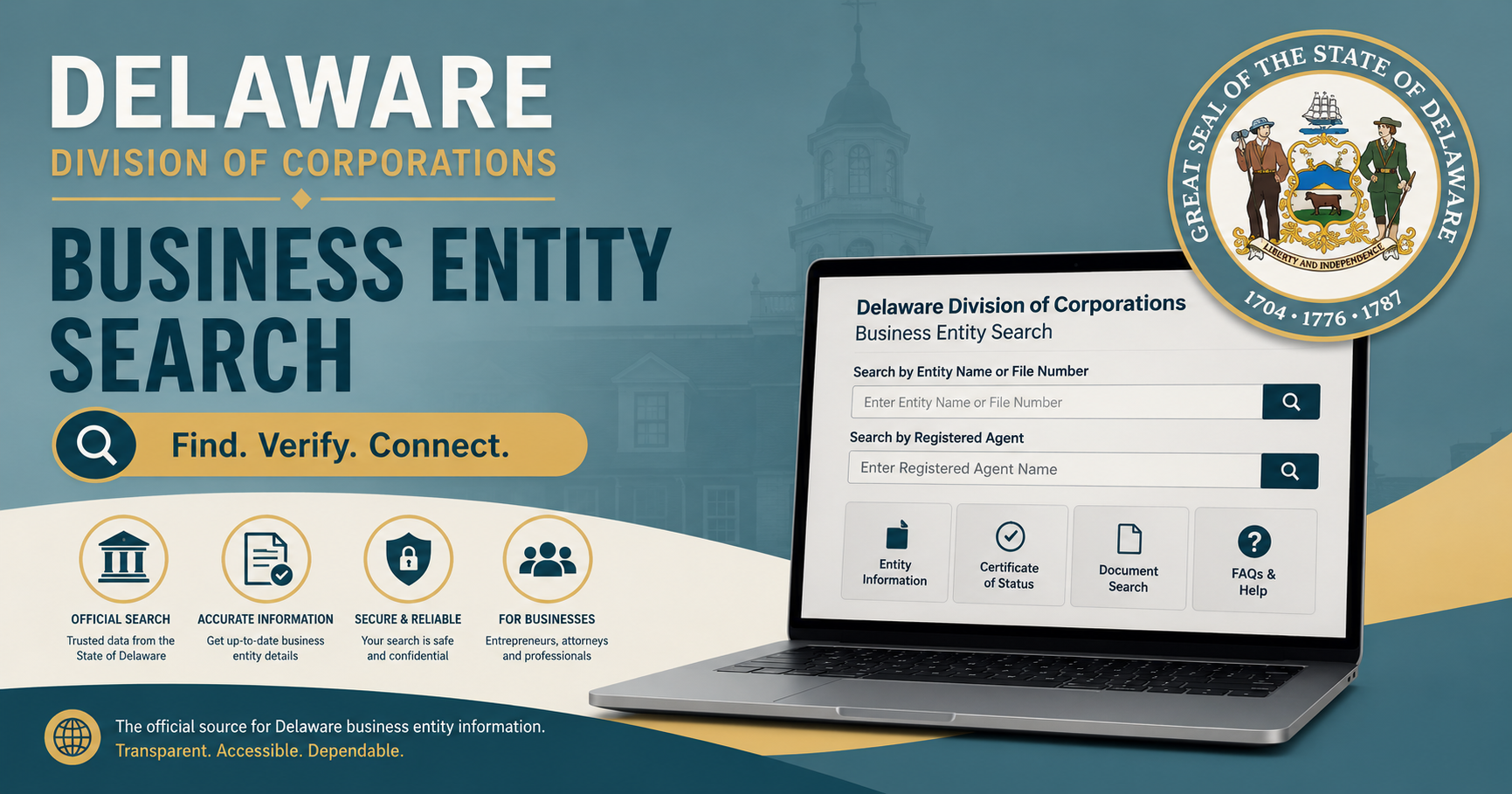
The Division of Corporations provides a free online name search tool. However, this search is only "preliminary." A name that appears available might still be rejected if it is deemed too similar to an existing name by the division's examiners. Most businesses reserve a name for a small fee before filing their full formation documents.
Is the franchise tax a tax on my profits?
No. The Delaware Franchise Tax is a tax on the privilege of being incorporated in Delaware. It has no relationship to your company's revenue or profit. Even if your company loses money, you are still required to pay the minimum franchise tax to the Division of Corporations to keep your entity active.
Moving Forward with Your Delaware Entity
Properly managing your relationship with the Delaware Division of Corporations is a cornerstone of corporate governance. By 2026, the shift toward fully digital, real-time compliance has made it easier than ever to maintain a company in Delaware, provided you remain diligent about deadlines.
If you are just starting, your first step should be to choose a reputable Delaware Registered Agent. They will facilitate your initial filing with the Division of Corporations and provide the necessary platform for your annual compliance. If you already have a Delaware entity, perform a "Status Search" on the division’s website at least once a year to ensure your company remains in "Good Standing." This proactive approach prevents the administrative and legal headaches that come with a lapsed corporate charter.
Image Gallery