Can You Claim Comparative Fault as a Defense in Louisiana Workers’ Compensation?
In Louisiana, you cannot claim comparative fault as a defense in a workers' compensation claim. Because Louisiana operates under a "no-fault" statutory system for workplace injuries, an employee’s own negligence, carelessness, or failu...
In Louisiana, you cannot claim comparative fault as a defense in a workers' compensation claim. Because Louisiana operates under a "no-fault" statutory system for workplace injuries, an employee’s own negligence, carelessness, or failure to exercise ordinary caution does not reduce or eliminate their entitlement to medical benefits and indemnity payments.
Contents
The Louisiana Workers’ Compensation Act was designed as a "Great Compromise." In this arrangement, employees gave up their right to sue employers for full tort damages (such as pain and suffering) in exchange for guaranteed, though limited, benefits regardless of who caused the accident. Consequently, the traditional tort defense of comparative negligence—which reduces a plaintiff’s recovery based on their percentage of fault—has no place in the workers' compensation administrative system as of 2026.
The Foundation of Louisiana’s No-Fault System
To understand why comparative fault is inapplicable, one must look at the legislative intent behind Louisiana Revised Statute § 23:1031. This statute dictates that if an employee receives a personal injury by an accident "arising out of and in the course of his employment," the employer shall pay compensation.
The phrase "arising out of and in the course of" is the primary gateway for benefits. It does not ask "who is to blame?" or "did the employee look where they were going?" If the injury happened while the worker was performing their duties, the employer’s liability is triggered. This remains the standard in 2026, preserving a streamlined process that avoids the lengthy and expensive litigation required to assign percentages of fault to every slip, trip, or fall in a warehouse or office.
The Exclusive Remedy Rule
The prohibition of comparative fault is inextricably linked to the Exclusive Remedy Rule. Under this rule, workers' compensation is the only remedy an employee has against their employer for a work-related injury. Because the employee cannot sue the employer in district court for negligence, the employer cannot use negligence-based defenses, like comparative fault, to diminish the employee's statutory benefits.
Comparative Fault vs. Workers' Compensation Defenses
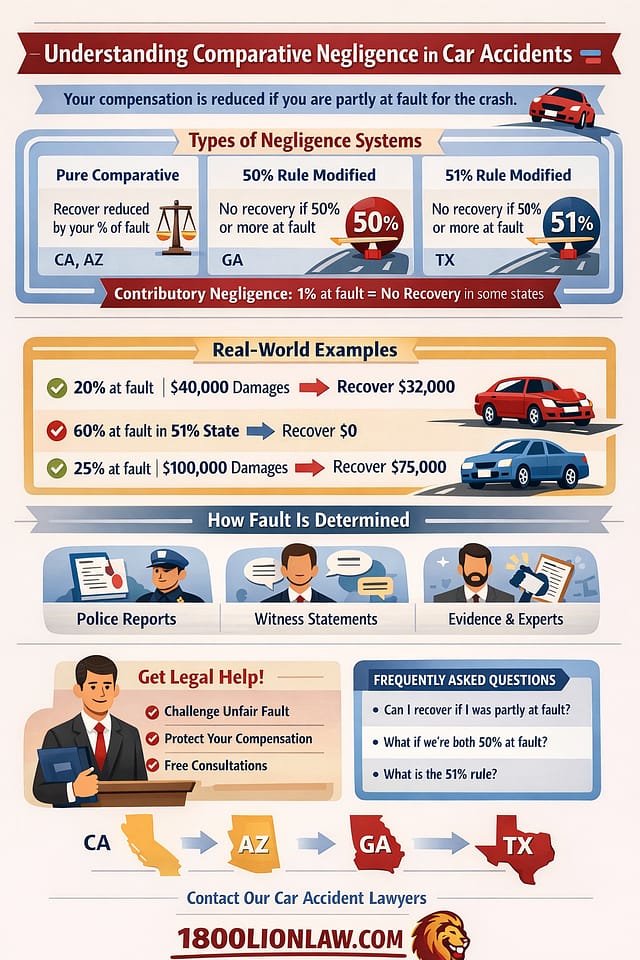
In a standard personal injury case, such as a car accident, Louisiana Civil Code Article 2323 requires the court to determine the percentage of fault of all persons contributing to the injury. If a plaintiff is 30% at fault, their $100,000 award is reduced to $70,000.
However, the Louisiana Supreme Court and various appellate courts have consistently held that the workers' compensation statutes are a separate body of law that overrides the general civil code regarding fault. In the workers' compensation arena, the "all or nothing" approach to negligence is replaced by a "guaranteed but capped" approach.
The following table highlights the fundamental differences between defenses in a traditional Louisiana tort (negligence) case and a Louisiana workers' compensation claim:
| Feature | Traditional Tort/Personal Injury | Workers' Compensation (LA) |
|---|---|---|
| Primary Legal Standard | Fault-based (Negligence) | No-Fault (Statutory) |
| Comparative Fault | Applicable (Reduces damages) | Not Applicable |
| Medical Benefit Limit | Limited only by proven damages | Unlimited (if reasonable/necessary) |
| Pain and Suffering | Recoverable | Not Recoverable |
| Intoxication Defense | May reduce recovery | Can result in total forfeiture |
| Employee Negligence | Partial defense | Generally ignored |
Statutory Affirmative Defenses: The Exceptions to No-Fault
While an employer cannot use "comparative fault" (general negligence) as a defense, the Louisiana Workers' Compensation Act does provide specific affirmative defenses under La. R.S. 23:1081. These are narrow exceptions where the employee’s conduct is so egregious that it forfeits their right to benefits entirely.
It is important to note that these are not "comparative" defenses—they do not reduce benefits by a percentage; if proven, they usually eliminate benefits altogether.
1. The Intoxication Defense
This is the most frequently litigated defense. If an employer can prove that the injury was caused by the employee’s intoxication (alcohol or non-prescribed controlled substances), no compensation is due.
- The Presumption: In 2026, Louisiana law maintains that if an employer provides a drug test immediately after an accident and it returns positive, there is a "rebuttable presumption" that the intoxication caused the accident.
- The Burden: The employee must then prove that the intoxication was not a contributing cause of the accident, which is a high legal hurdle.
2. Willful Intention to Injure
Benefits are denied if the injury was caused by the employee's willful intention to injure themselves or others. This typically applies to cases of self-harm or unprovoked physical aggression (starting a fight). If a worker initiates a physical altercation and gets injured by the person defending themselves, the aggressor is generally barred from recovery.
3. The "Horseplay" Defense
While minor "horseplay" is often considered a natural part of the workplace environment and may still be covered, excessive or extreme horseplay that deviates significantly from employment duties can be a defense. The courts look at whether the conduct was a substantial departure from the work task.
4. Failure to Use a Safety Guard
Under La. R.S. 23:1081(1)(c), if an employee deliberately fails to use an adequate guard or protection against accident provided for them, and they were properly instructed on its use, the employer may deny benefits.
- High Threshold: This is significantly harder to prove than comparative fault. The employer must show the failure was deliberate, not just a result of forgetfulness or haste. Simply forgetting to put on safety goggles is usually seen as negligence (covered), whereas intentionally removing a bolted-on machine guard to work faster might trigger this defense.
The Role of Comparative Fault in Third-Party Claims
There is one specific scenario where comparative fault becomes highly relevant to a workers' compensation case: Third-party liability claims.
If a worker is injured on the job by someone other than their employer or a co-worker (for example, a delivery driver from another company or a manufacturer of a defective tool), the worker can file a personal injury lawsuit against that third party.
In this third-party lawsuit:
- Comparative Fault Applies: The defendant (the third party) can argue that the worker was partially at fault for the accident to reduce the damages they owe.
- Employer Intervention: The workers' compensation insurance carrier typically "intervenes" in this lawsuit to get paid back (subrogation) for the medical and indemnity benefits they paid to the worker.
- The Impact of Fault: If the worker is found 50% at fault in the third-party suit, the total recovery from that third party is reduced by 50%. This reduction affects how much the workers' comp insurer can recover and how much "excess" money the worker takes home.
However, even if the worker is found 90% at fault in a third-party lawsuit, their workers' compensation benefits paid by their employer remain untouched. The comparative fault only limits the "extra" money they get from the lawsuit, not their baseline weekly checks or medical coverage.
Why Employers and Insurers Still Investigate Fault
Even though comparative fault isn't a legal defense, insurance adjusters and employers in 2026 still investigate the "fault" of an accident for several strategic reasons:
- Identifying Affirmative Defenses: They are looking for evidence of intoxication or willful intent that could kill the claim entirely.
- Determining Course and Scope: If a worker was acting so recklessly that they were no longer performing their job duties, the employer might argue the accident didn't "arise out of" employment.
- Subrogation Potential: If the employer's investigation shows a third party was at fault, they will prepare to sue that third party to recoup the costs of the claim.
- Safety Improvements: From a human resources and OSHA perspective, identifying "fault" helps prevent future accidents, even if it doesn't change the liability for the current one.
Practical Guidance for Employers and Employees
For Employers:
If you believe an employee’s own actions caused their injury, do not simply deny the claim based on "negligence." You must categorize the behavior into one of the specific statutory defenses (intoxication, intentional act, or safety device refusal). Documenting the provision of safety equipment and the training provided to the employee is essential if you intend to use the "safety guard" defense.
For Employees:
Do not be intimidated if an employer or adjuster tells you that "you shouldn't have been standing there" or "you were being careless." Under Louisiana law, those statements are admissions that an accident occurred during work. Unless you were intoxicated or intentionally trying to hurt someone, your right to medical care and lost wage replacement is protected regardless of your own errors.
Frequently Asked Questions
Can my boss reduce my workers' comp check if I didn't follow a safety rule?
No. Louisiana does not allow for a "penalty" reduction of benefits based on simple negligence or failure to follow safety protocols. You either qualify for 100% of the statutory benefits (typically two-thirds of your average weekly wage, subject to a state cap) or you qualify for 0% if a specific affirmative defense like intoxication is proven.
What if I was injured while doing something I wasn't supposed to do?
This falls under the "Course and Scope" analysis. If you were doing your job but doing it the "wrong" way or in a forbidden way, you are usually still covered. If you were doing something completely unrelated to your job (e.g., working on your personal car during work hours), the claim may be denied because it didn't "arise out of" employment.
Does comparative fault apply if I sue a manufacturer for a machine injury at work?
Yes. Because that is a products liability lawsuit against a third party (not your employer), the rules of comparative fault apply. Your total award from the manufacturer will be reduced by your percentage of negligence, but your workers' compensation benefits from your employer remain no-fault.
How does the intoxication defense work in 2026?
The employer must prove the presence of the substance and that the substance was a cause of the accident. If the drug test is positive, the law presumes the drug caused the accident. You would then have to provide evidence—such as witness testimony that you were acting normally or that a mechanical failure caused the crash—to "rebut" that presumption.
Can I be fired for an accident that was my fault?
Louisiana is an at-will employment state. While an employer cannot legally fire you solely in retaliation for filing a workers' compensation claim, they can fire you for violating safety policies or for the conduct that led to the accident, even if they still have to pay your workers' comp benefits.
Summary and Next Steps
The absence of comparative fault in Louisiana workers' compensation is a cornerstone of the system's stability. It ensures that injured workers receive prompt medical attention and financial support without the need to litigate the nuances of human error. However, the system is not a "free pass" for gross misconduct; the affirmative defenses of intoxication and intentional injury remain powerful tools for employers to prevent fraud and abuse.
If you are involved in a dispute where an employer is attempting to use your own negligence to deny benefits, your next step should be to:
- Secure the Incident Report: Ensure the facts of the accident are recorded accurately.
- Request the Medical Records: Especially any toxicology or drug screens performed immediately after the injury.
- Consult Legal Counsel: Because the distinction between "negligence" (covered) and "willful intent" (not covered) can be legally thin, a qualified workers' compensation attorney can help clarify the application of La. R.S. 23:1081 to your specific case.
Image Gallery