The Comprehensive Guide to Global Dental Implant Academy Training and Certification
The Global Dental Implant Academy (GDIA) is a premier international organization dedicated to providing clinical education, mentorship, and certification for dental professionals seeking to master implant dentistry. In 2026, the academ...
The Global Dental Implant Academy (GDIA) is a premier international organization dedicated to providing clinical education, mentorship, and certification for dental professionals seeking to master implant dentistry. In 2026, the academy remains a central hub for transitioning general practitioners into confident implant surgeons through a combination of evidence-based lectures and intensive, live-patient surgical training.
Contents
The Evolution and Mission of the Global Dental Implant Academy
The Global Dental Implant Academy was established to bridge the significant gap between theoretical knowledge and clinical proficiency in implantology. While many dental schools provide a foundational understanding of prosthodontics, the surgical nuances of dental implants often require postgraduate specialization. GDIA addresses this by offering a structured pathway that moves from basic biological principles to complex surgical interventions.
By 2026, the academy has expanded its global footprint, maintaining its primary administrative and educational hubs in the United States while operating extensive clinical residency programs in international locations such as South Korea and Mexico. The mission remains rooted in the "mentorship model," where experienced clinicians provide one-on-one guidance to students, ensuring that patient safety and surgical precision are prioritized over mere speed.
The organization operates on the philosophy that true mastery is achieved only through the tactile experience of surgery. Consequently, their curriculum is heavily weighted toward clinical hours. This approach helps clinicians overcome the "surgical anxiety" often associated with their first few implant placements, providing a controlled environment where mistakes are corrected in real-time by expert faculty.
Core Educational Pathways and Clinical Residencies
GDIA programs are categorized by clinical complexity, allowing practitioners to enter the curriculum at a level that matches their current experience. The 2026 curriculum is designed to be cumulative, ensuring that the biological foundations of osseointegration are fully understood before a student attempts advanced bone grafting or sinus augmentation.
Foundational Implantology (Phase I)
For the general dentist with little to no experience in surgery, the foundational courses focus on diagnosis, treatment planning, and the placement of single-unit implants in sites with abundant bone. Students learn to use Cone Beam Computed Tomography (CBCT) data to plan surgeries digitally, a standard requirement in 2026 dental practice. The focus here is on primary stability—the mechanical grip of the implant in the bone—and understanding the surgical kit components.
Advanced Surgical Techniques (Phase II)
The intermediate level transitions into more complex scenarios, including multi-unit bridges and "esthetic zone" placements where the gum line's appearance is critical. This phase introduces basic hard and soft tissue grafting. Students learn how to manage minor bone deficiencies and use membrane barriers to guide bone regeneration. This level is often where practitioners begin their first live-patient interactions under the academy’s supervision.
Mastership and Full-Arch Reconstruction (Phase III)
The highest tier of GDIA training involves full-arch rehabilitation, such as "All-on-X" protocols. These programs are often conducted as international clinical residencies. In these intensive sessions, students perform several surgeries over a few days, handling complications like ridge splits, sinus floor elevations, and immediate load prosthetics. By 2026, these courses also integrate advanced digital workflows, including 3D-printed surgical guides and intraoral scanning for immediate provisionalization.
The Live-Patient Training Model
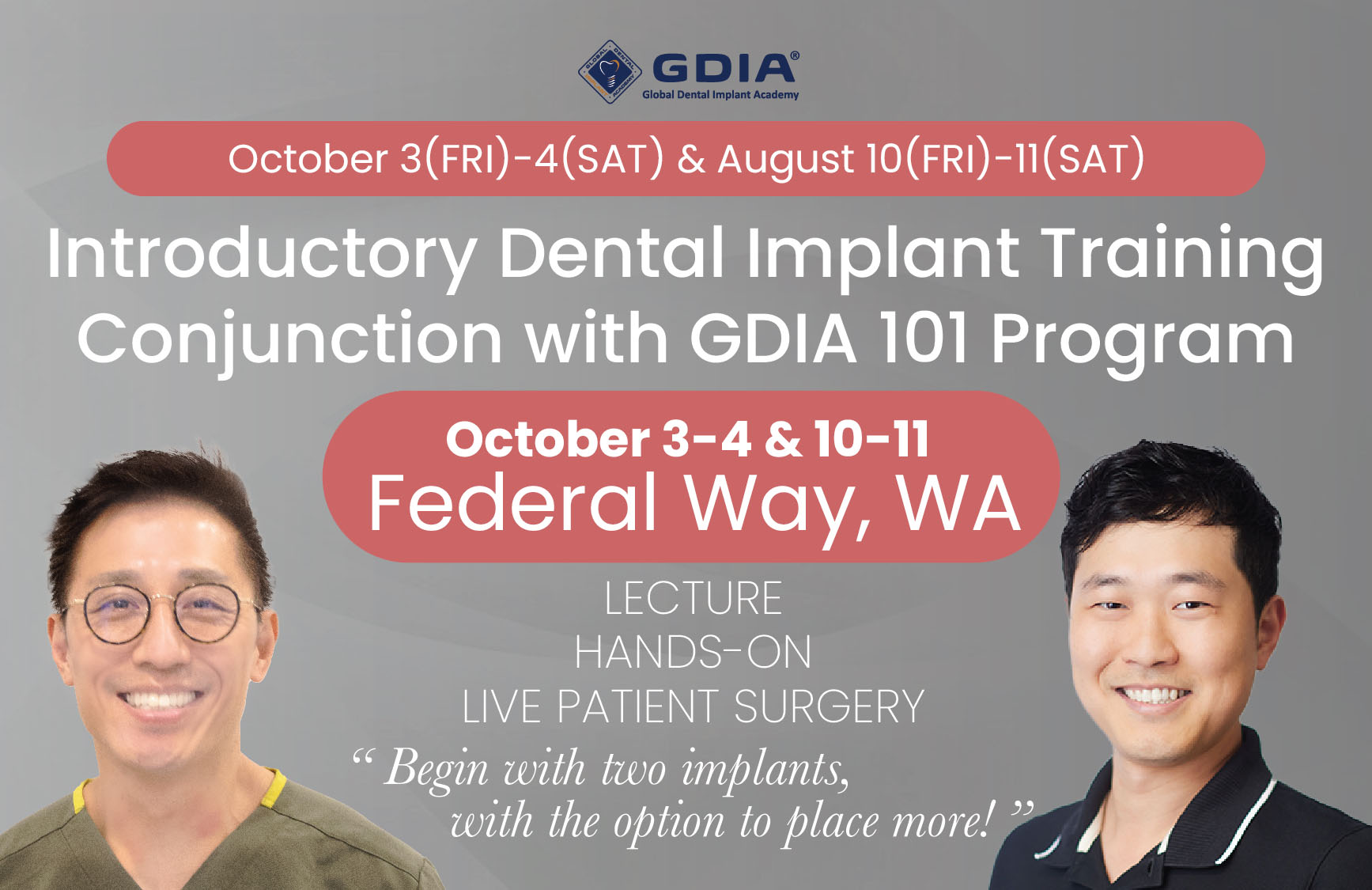
The hallmark of the Global Dental Implant Academy is its live-patient surgical programs. Unlike traditional Continuing Education (CE) that relies on plastic models or cadavers, GDIA facilitates environments where licensed dentists perform actual surgeries on patients who require dental care but lack the means to afford it in private settings.
Ethical Standards and Supervision
GDIA maintains strict ethical protocols for these programs. Patients are pre-screened to ensure their cases are appropriate for a teaching environment. Every student surgeon is paired with a faculty mentor—usually a board-certified periodontist or oral surgeon—who supervises every step, from the initial incision to the final suture. This high instructor-to-student ratio is what distinguishes the academy from larger, more commercialized seminars.
International Clinical Residencies
Because of regulatory variations, GDIA often hosts its most intensive live-patient sessions in international clinics. These residencies are not "dental vacations"; they are rigorous 10-to-12-hour surgical days. Participants often report that a single week of a GDIA residency provides more surgical experience than two years of sporadic weekend courses. In 2026, these programs are highly sought after, often requiring registration six to twelve months in advance.
Accreditation and Continuing Education (CE) Credits
For dental professionals, the acquisition of CE credits is a regulatory necessity for license renewal. GDIA is a recognized provider of AGD PACE (Academy of General Dentistry Program Approval for Continuing Education) credits. This accreditation ensures that the educational content meets high standards of scientific integrity and clinical relevance.
Certification Levels
Upon completion of specific modules, participants can earn various levels of recognition:
- Fellowship: Granted after completing core foundational modules and documenting a set number of successful clinical cases.
- Mastership: Requires advanced training, a significant number of documented complex cases (including grafting), and passing a peer-review examination.
- Diplomate Status: The highest honor, typically involving a combination of GDIA's advanced curriculum and involvement in mentorship or research within the academy.
| Program Feature | Traditional Lecture CE | GDIA Clinical Residency |
|---|---|---|
| Primary Format | Classroom/Webinar | Live-Patient Surgical Operatory |
| Mentorship Ratio | 1 Instructor to 50+ Students | 1 Instructor to 2-3 Students |
| Clinical Experience | Observation or Plastic Models | Actual Surgical Placement/Grafting |
| Tech Integration | Theoretical discussion of CBCT | Hands-on use of CBCT & Guided Surgery |
| Complexity Level | Basic to Intermediate | Intermediate to Complex/Full-Arch |
| CE Credits | Variable (often 6-12 hours) | High (typically 30-50 hours per week) |
Integrating Digital Dentistry and AI in 2026
By the year 2026, the Global Dental Implant Academy has fully integrated Artificial Intelligence (AI) and digital workflows into its teaching modules. The transition from free-hand surgery to guided surgery is a major focus of the current curriculum.
Students are taught to use AI-driven diagnostic software that identifies bone density patterns and suggests optimal implant positions to avoid anatomical structures like the mandibular nerve or the maxillary sinus. The academy emphasizes that while the computer provides a plan, the surgeon must possess the manual skill to execute it and the clinical judgment to deviate from the plan if intraoperative conditions change.
Furthermore, the 2026 curriculum includes training on 3D-printed biomaterials. Students learn how to use in-office printers to create surgical guides and custom healing abutments, which significantly reduces the cost of surgery and improves the patient's healing timeline.
Investment, Costs, and Return on Investment (ROI)
Training at the Global Dental Implant Academy represents a significant financial and time investment. Foundational weekend courses may cost between $3,000 and $5,000, while intensive international clinical residencies can range from $12,000 to $20,000, depending on the number of implants placed and the location.
However, the ROI for a dental practice is often realized quickly. In 2026, the average cost of a single implant procedure (including the crown) ranges from $3,500 to $6,000. By bringing these services in-house rather than referring them out to specialists, a general dentist can recoup the cost of a GDIA residency within the first five to ten cases. More importantly, the academy teaches "complication management," which saves the practitioner from the significant financial and reputational costs associated with failed implants or surgical errors.
Frequently Asked Questions
Is GDIA training only for US-based dentists?
While GDIA is headquartered in California, it is a truly global organization. Its programs attract dentists from Europe, Asia, and Latin America. The 2026 programs are taught in English, but many international residencies provide translation services or have bilingual faculty members to accommodate a diverse student body.
Do I need to bring my own surgical instruments?
For most foundational courses held in the US, GDIA provides the necessary surgical kits and motor units. However, for international residencies, clinicians are often encouraged to bring their preferred surgical loupes and headlamps. The academy provides all implants, biologics (bone and membranes), and heavy surgical equipment.
How does GDIA assist with case mentoring after the course?
One of the most valuable aspects of GDIA is the "alumni network." Graduates often have access to a secure portal where they can upload their own patient CBCT scans and treatment plans to receive feedback from faculty members. This ongoing support helps bridge the gap between the classroom and the clinician’s own practice.
What are the prerequisites for the advanced live-patient residency?
Participants must typically show proof of completion of a foundational implant course (either through GDIA or another recognized institution) and have a basic understanding of surgical flap design and suturing. A valid dental license in the practitioner's home jurisdiction is mandatory for all hands-on portions.
Can I earn credits toward a university degree through GDIA?
GDIA focuses on clinical certification rather than academic degrees (like a Master of Science). However, some of their advanced credits may be transferable to specific university-affiliated programs through various partnership agreements. It is best to check the current 2026 partnership list on the official GDIA website.
Practical Recommendations for Prospective Students
For dental professionals considering the Global Dental Implant Academy, the most effective approach is to start with a "Phase I" foundational course, even if they have some previous experience. This ensures alignment with the academy's specific surgical protocols and terminology.
Prospective students should also focus on their diagnostic equipment before attending; having a CBCT unit in your office is highly recommended to immediately implement the techniques learned during the training. Finally, clinicians should plan to book international residencies at least nine months in advance, as these high-intensity programs are the cornerstone of the GDIA experience and frequently reach capacity.
Image Gallery