Finance Degree or Management Degree: Choosing the Right Career Path in 2026
Choosing between a finance degree and a management degree depends on whether you prefer quantitative analysis or organizational leadership. A finance degree focuses on asset valuation, financial markets, and capital allocation, leading...
Choosing between a finance degree and a management degree depends on whether you prefer quantitative analysis or organizational leadership. A finance degree focuses on asset valuation, financial markets, and capital allocation, leading to technical roles in banking and investment. A management degree emphasizes operational strategy, human resources, and team coordination, preparing you for generalist leadership or administrative positions.
Contents
Defining the Academic Scope of Business Education
The decision between finance and management is rarely about which degree is "better" in a vacuum, but rather which aligns with an individual’s cognitive strengths and long-term professional aspirations. As we move through 2026, the business landscape has become increasingly specialized, making the distinction between these two tracks more pronounced than in previous decades.
A degree in finance is fundamentally the study of money and how it is moved, managed, and multiplied. It is a discipline rooted in mathematics and economics, requiring students to look at a business through the lens of its balance sheet and cash flow statements. Conversely, a management degree—often referred to as Business Management or Business Administration—is the study of people and processes. It views a business as a living ecosystem where the primary goal is to optimize efficiency, productivity, and organizational culture.
While both degrees are housed within business schools and share a common foundation in microeconomics, accounting, and business law, their upper-level trajectories diverge significantly. Finance students spend their final years mastering valuation models and risk assessments, while management students focus on organizational behavior and strategic implementation.
The Finance Track: Quantitative Rigor and Capital Markets
A finance degree is designed for those who find clarity in numbers and logic. In 2026, the curriculum for finance majors has evolved to include a heavy emphasis on financial technology (FinTech) and data analytics, reflecting the industry's shift toward algorithmic decision-making.
Core Finance Subjects
The academic journey for a finance major is sequential. It begins with the principles of accounting and moves rapidly into specialized domains.
- Corporate Finance: This is the bedrock of the degree, teaching how corporations make investment and financing decisions. Students learn about the weighted average cost of capital (WACC), net present value (NPV), and capital structure optimization.
- Investments and Portfolio Management: This subject covers the mechanics of the stock market, bond valuation, and the modern portfolio theory. In 2026, this increasingly includes the study of decentralized finance (DeFi) and digital assets.
- Financial Modeling: Students spend hundreds of hours in spreadsheets and specialized software, building predictive models to forecast company performance or simulate market volatility.
- Derivatives and Risk Management: A highly technical area focusing on options, futures, and swaps. It requires a strong grasp of statistics to understand how to hedge against financial loss.
Technical Competencies Required
To succeed in a finance degree, students must be comfortable with high-level mathematics. Beyond simple arithmetic, finance requires an understanding of algebra, statistics, and increasingly, programming languages like Python or SQL. These tools are now essential for processing the massive datasets used in modern financial analysis.
Employers in 2026 look for candidates who can not only calculate a return on investment but also explain the statistical probability of that return under various market conditions. This requires a "hard skill" mindset where accuracy is prioritized above all else.
The Management Track: Leadership and Operational Strategy
A management degree is built for the "big picture" thinker. It is less about the technical execution of a single task and more about how various departments—marketing, finance, operations, and HR—work together to achieve a corporate goal.
Core Management Subjects
The management curriculum is broad, providing a 360-degree view of how an organization functions.
- Organizational Behavior: This explores the psychology of the workplace. Students study how individual behavior and group dynamics influence the effectiveness of an organization.
- Operations and Supply Chain Management: This focuses on the "how" of business. It covers logistics, quality control, and the integration of AI-driven automation in manufacturing and service delivery.
- Human Resource Management: Students learn the legal and strategic aspects of hiring, training, and retaining talent. In the 2026 labor market, this includes managing hybrid teams and navigating global labor regulations.
- Strategic Management: Usually a capstone course, this teaches students how to analyze competitive landscapes and develop long-term plans for growth and sustainability.
Soft Skills and Organizational Influence
The "management" label can be misleading; it is not just about being a boss. It is about influence. Management majors must excel in communication, negotiation, and emotional intelligence. While a finance major might present a report on why a project is too expensive, a management major is responsible for convincing the team to pivot to a more efficient strategy without losing morale.
In 2026, management degrees also place a heavy emphasis on "Agile" and "Scrum" methodologies, which are frameworks for managing complex projects in rapidly changing environments.
Career Trajectories and Industry Demand
The choice of degree dictates the entry point into the professional world. While there is some overlap, the daily responsibilities of a finance graduate versus a management graduate are distinct.
Finance Professional Outcomes
Finance graduates typically enter the "Financial Services" sector. According to the U.S. Bureau of Labor Statistics, the demand for financial analysts remains robust, particularly in areas involving risk management and data-driven investment.
- Investment Banking: High-stakes roles involving mergers, acquisitions, and initial public offerings (IPOs).
- Equity Research: Analyzing stocks to provide "buy" or "sell" recommendations to investors.
- Corporate Treasury: Managing a company's liquidity, ensuring they have enough cash to meet obligations while investing the surplus.
- Financial Planning and Analysis (FP&A): Working within a company to budget and forecast future financial health.
Management Professional Outcomes
Management graduates are found in every industry, from tech startups to healthcare systems. Their roles are often defined by the "Manager" suffix, though they often start as coordinators or associates.
- Project Management: Overseeing specific initiatives from inception to completion, ensuring they stay on schedule and under budget.
- Operations Manager: Ensuring the day-to-day activities of a business run smoothly.
- Business Development: Identifying new market opportunities and forming strategic partnerships.
- Management Consultant: Working for firms like McKinsey or BCG to solve specific organizational problems for external clients.
Comparative Overview: Finance vs. Management
| Feature | Finance Degree | Management Degree |
|---|---|---|
| Primary Focus | Quantitative Analysis & Capital | People, Strategy & Operations |
| Key Math Level | Advanced (Calculus, Statistics) | Moderate (Business Math, Stats) |
| Primary Tools | Excel, Python, Bloomberg Terminal | CRM Software, Agile Tools, Slack/Teams |
| Work Environment | Banks, Hedge Funds, Corporate HQ | Offices, Remote Teams, Field Operations |
| Common Entry Role | Financial Analyst | Project Coordinator / Management Trainee |
| Professional Certs | CFA, CPA, CFP | PMP, SHRM-CP, MBA |
| Core Competency | Data Accuracy & Valuation | Strategic Vision & Team Leadership |
Salary Expectations and Return on Investment in 2026
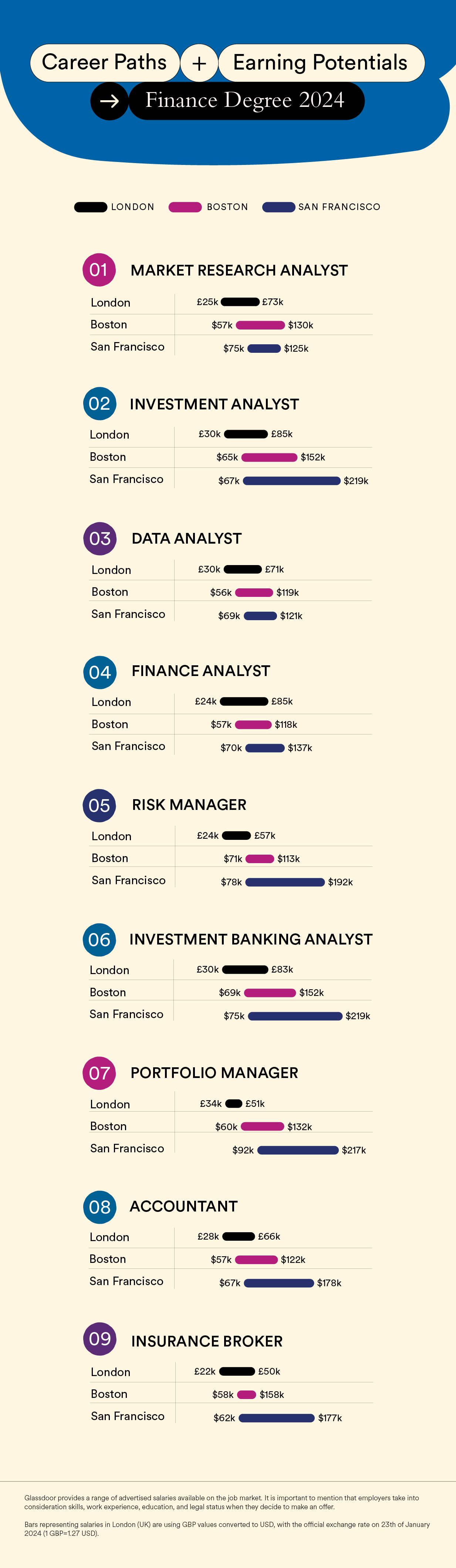
When evaluating the return on investment (ROI), finance degrees often show a higher starting salary "floor." Because the skills are highly technical and directly tied to the generation or preservation of wealth, companies are willing to pay a premium for entry-level talent.
As of 2026, an entry-level financial analyst in a major metropolitan area can expect a starting salary ranging from $75,000 to $95,000, excluding bonuses. In sectors like investment banking, total compensation can exceed $120,000 in the first year.
Management degrees have a wider variance. A management trainee at a retail corporation might start at $55,000, while a junior consultant at a top-tier firm could start at $90,000. However, the "ceiling" for management is arguably higher for those who reach executive leadership. CEOs and COOs often come from management backgrounds because their role requires a breadth of knowledge across all departments rather than a deep dive into just the financial aspects.
It is also important to consider the cost of continuing education. Many finance professionals find that a CFA (Chartered Financial Analyst) designation is as valuable as a Master's degree. Management professionals, however, often hit a "glass ceiling" that requires an MBA (Master of Business Administration) to break through.
Choosing the Right Path Based on Your Profile
The decision between finance and management should be an honest assessment of your personality and interests.
Choose Finance if:
- You enjoy puzzles and finding patterns in data.
- You prefer working with objective facts and figures over subjective opinions.
- You are comfortable with a high-pressure environment where accuracy is paramount.
- You have a strong interest in the global economy and how markets function.
Choose Management if:
- You enjoy leading groups and organizing complex tasks.
- You are interested in psychology and what motivates people to work effectively.
- You prefer a variety of tasks over deep-diving into a single spreadsheet for hours.
- You want a versatile degree that allows you to switch industries easily.
Frequently Asked Questions
Is finance harder than management?
Generally, yes, in terms of quantitative difficulty. Finance requires higher-level mathematics and a rigorous understanding of economic theory. Management is often considered "softer" academically but requires a high level of social intelligence and the ability to manage ambiguity, which can be just as challenging in a professional setting.
Can I get a management job with a finance degree?
Yes. It is often easier for a finance major to move into management than the other way around. Employers value the analytical mindset of finance graduates. Many finance professionals eventually move into "General Management" roles as they rise in seniority.
Which degree is better for starting a business?
A management degree provides a more comprehensive toolkit for entrepreneurship. It covers marketing, HR, and operations—all of which are vital for a founder. However, a finance degree is invaluable for understanding how to raise venture capital and manage a startup's "burn rate."
Do I need an MBA if I have a management degree?
While not strictly required, an MBA is the gold standard for management professionals looking to reach the C-suite (CEO, COO, etc.). For management majors, the MBA acts as a specialized credential that differentiates them from the large pool of general business graduates.
How has AI changed these degrees in 2026?
AI has automated many of the entry-level "data entry" tasks in finance, meaning finance degrees now focus more on AI oversight and strategy. In management, AI is used for predictive scheduling and performance tracking, so management degrees now include training on how to lead in an "AI-augmented" workplace.
Recommendation for Prospective Students
If you are currently undecided, the most strategic move is to look at the job descriptions of roles you admire. If those descriptions mention "quantitative analysis," "financial modeling," or "valuation," pursue Finance. If they mention "cross-functional leadership," "project lifecycle," or "strategic implementation," pursue Management.
For those who want the best of both worlds, consider a Double Major or a Major in Finance with a Minor in Management. This combination is highly attractive to employers in 2026, as it proves you have both the technical "hard skills" to do the work and the "soft skills" to eventually lead the people doing it. Regardless of the path, ensure your chosen institution is accredited by organizations like the AACSB, which ensures the curriculum meets global business standards.
Image Gallery