Exploring the Path to a PhD in Finance: Requirements, Career Paths, and Academic Rigor
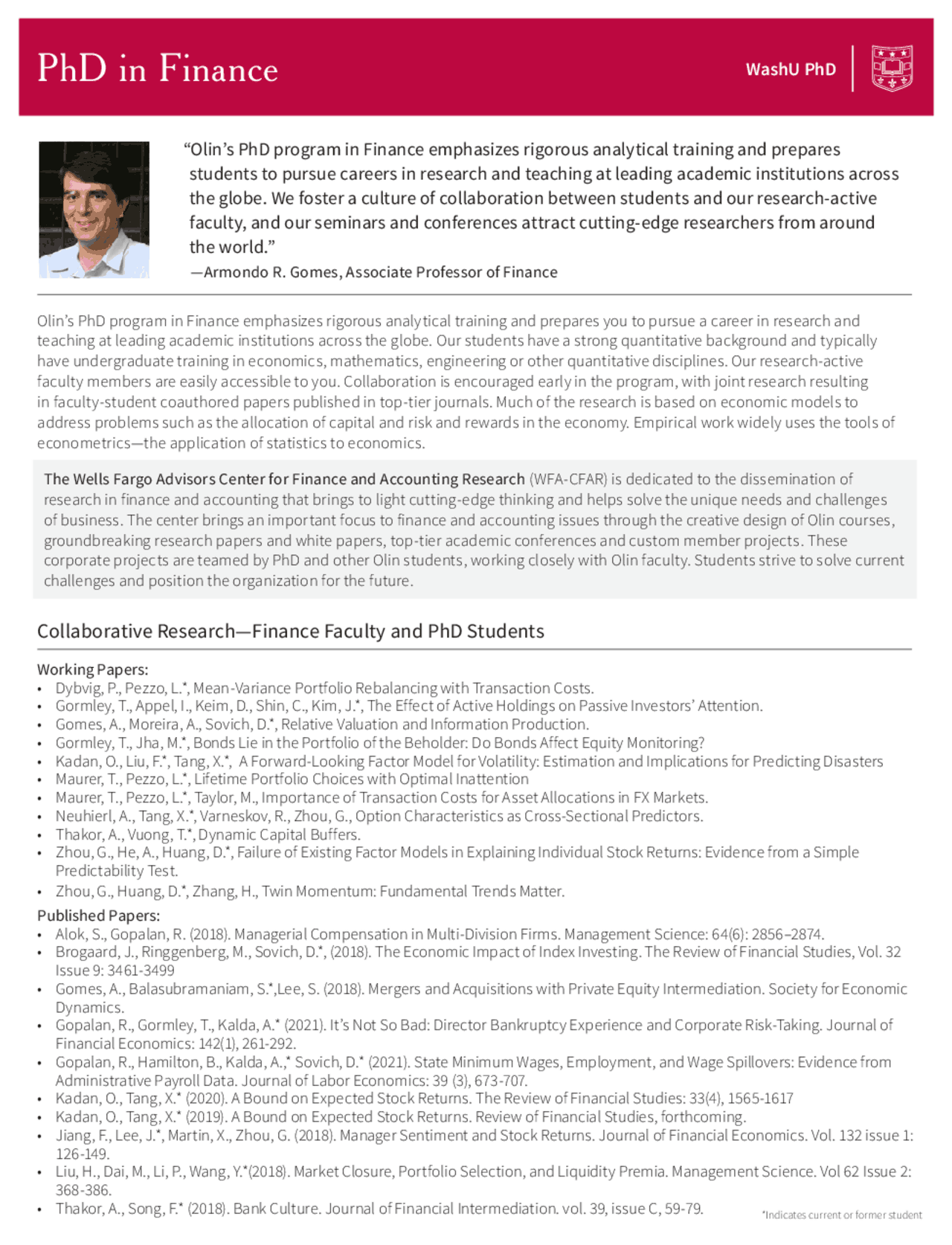
You can earn a PhD in Finance to pursue a career in high-level academic research, university teaching, or specialized quantitative roles in the private sector. This terminal degree focuses on original research, advanced economic theory...
You can earn a PhD in Finance to pursue a career in high-level academic research, university teaching, or specialized quantitative roles in the private sector. This terminal degree focuses on original research, advanced economic theory, and sophisticated statistical modeling, preparing candidates to contribute new knowledge to the global understanding of financial markets and corporate behavior.
Contents
The decision to pursue a Doctorate of Philosophy (PhD) in Finance is a commitment to mastering the mechanics of capital, risk, and value. Unlike professional degrees like the MBA, which focus on practical management and leadership, a PhD is a research-intensive journey. In 2026, the landscape of financial research has expanded to include not only traditional asset pricing and corporate finance but also the integration of machine learning, climate risk modeling, and decentralized finance (DeFi) architectures.
Defining the PhD in Finance: Research vs. Application
A PhD in Finance is the highest academic qualification one can achieve in the field. It is fundamentally different from a Doctor of Business Administration (DBA). While a DBA is often a "professional doctorate" aimed at experienced executives who want to apply research to specific business problems, a PhD is designed to train scholars.
Students in these programs spend the majority of their time developing and testing theories. They ask questions such as: How does asymmetric information affect market liquidity? Can behavioral biases be systematically predicted in retail trading? What is the impact of carbon taxes on corporate capital structure? The goal is to produce a dissertation that provides a significant, original contribution to the field, often culminating in articles published in top-tier journals like the Journal of Finance or the Review of Financial Studies.
Eligibility and Prerequisites for Admission
Admission to top-tier finance PhD programs is notoriously competitive, often with acceptance rates below 5%. Admissions committees look for a specific profile that demonstrates both the intellectual capacity for abstract thought and the technical skills to execute rigorous empirical analysis.
Mathematical Proficiency
Modern finance is heavily mathematical. Applicants are generally expected to have completed coursework in:
- Multivariable Calculus: Essential for optimization problems in economic theory.
- Linear Algebra: The backbone of econometric modeling and portfolio theory.
- Real Analysis: Many top programs view a course in Real Analysis as a "litmus test" for a student's ability to handle the formal proofs required in doctoral-level microeconomics.
- Probability and Statistics: Mastery of frequentist and Bayesian statistics is non-negotiable.
Academic Background
While a Master’s degree in Finance or Economics can be beneficial, it is not always a strict requirement. Many students enter directly from undergraduate programs in Mathematics, Physics, or Engineering because of their strong quantitative foundations. Conversely, an MBA is often seen as less relevant for a PhD program unless it was accompanied by significant research experience or high-level quantitative electives.
Standardized Testing and Recommendations
As of 2026, the GRE (Graduate Record Examinations) remains the preferred standardized test for most finance doctoral programs, though some still accept the GMAT. A high quantitative score (typically in the 90th percentile or higher) is a baseline requirement. Furthermore, letters of recommendation from faculty members who can attest to the applicant's research potential are more valuable than letters from corporate supervisors.
The Structure of a Finance Doctoral Program
A typical PhD in Finance takes five to six years to complete. The journey is divided into several distinct phases that transition the student from a consumer of knowledge to a producer of it.
Phase 1: Core Coursework (Years 1 and 2)
The first two years are spent in the classroom. Students take rigorous courses in:
- Microeconomic Theory: Studying the behavior of individual agents and firms.
- Econometrics: Advanced statistical methods for testing economic hypotheses.
- Asset Pricing: Theoretical and empirical study of how stocks, bonds, and derivatives are valued.
- Corporate Finance: Analysis of firm investment decisions, capital structure, and governance.
Phase 2: Comprehensive and Qualifying Exams
At the end of the second year, students must pass "comprehensive exams" or "field exams." These are high-stakes assessments designed to ensure the student has mastered the core literature. Failing these exams often results in dismissal from the program, sometimes with a terminal Master's degree as a consolation.
Phase 3: The Dissertation (Years 3 to 6)
The final and longest phase is the dissertation. Under the guidance of a faculty advisor and a committee, the candidate identifies a research gap, develops a hypothesis, and performs extensive data analysis or theoretical proofing. The "Job Market Paper" is the centerpiece of this phase—it is the single best piece of research the student produces, used to secure employment in the final year.
Comparing Doctoral and Professional Finance Credentials
Choosing between a PhD and other high-level credentials depends on your ultimate career goal. The following table highlights the differences between the most common paths as of 2026.
| Feature | PhD in Finance | DBA (Doctor of Bus. Admin) | CFA (Chartered Financial Analyst) |
|---|---|---|---|
| Primary Goal | Academic Research/Teaching | Executive Leadership/Consulting | Investment Management/Analysis |
| Duration | 5–6 Years | 3–4 Years | 2–4 Years (Self-study) |
| Cost | Usually Fully Funded (Stipend) | High Tuition Fees | Exam & Membership Fees |
| Final Product | Original Research Dissertation | Applied Business Project | Three Levels of Exams |
| Math Intensity | Very High | Moderate | Moderate/Applied |
| Career Outcome | Professor, Central Bank Researcher | CEO, Senior Consultant | Portfolio Manager, Equity Analyst |
Funding and Financial Considerations
One of the most significant advantages of a PhD in Finance at a reputable institution is that it is typically fully funded. Most universities provide a tuition waiver and a living stipend in exchange for the student working as a Research Assistant (RA) or Teaching Assistant (TA).
In 2026, stipends at top-tier U.S. and European business schools generally range from $35,000 to $50,000 per year. While this is modest compared to the salaries of finance professionals in the private sector, the primary "cost" of a PhD is the opportunity cost. A student spends five years earning a stipend while their peers in investment banking or private equity may be earning significantly more. However, the long-term earning potential of a finance professor or a senior "quant" at a hedge fund can eventually close this gap.
Career Outcomes: Academia vs. Industry
Historically, the primary path for a PhD in Finance was the tenure-track professorship. While this remains a prestigious and popular choice, the "non-academic" market has expanded significantly.
The Academic Market
Finance professors at AACSB-accredited business schools are among the highest-paid academics in the world. Newly minted PhDs from top programs can command starting salaries exceeding $200,000 in 2026, with significant opportunities for summer research support and consulting fees. The lifestyle offers immense intellectual freedom, though the pressure to publish in "A-list" journals to secure tenure is intense.
The Private Sector and Policy Roles
Financial institutions increasingly rely on PhDs to build complex models. Potential roles include:
- Quantitative Researchers (Quants): Working for hedge funds or high-frequency trading firms to develop algorithmic strategies.
- Central Banking: The Federal Reserve, European Central Bank, and International Monetary Fund (IMF) employ hundreds of finance PhDs to analyze systemic risk and monetary policy.
- Economic Consulting: Firms like Cornerstone Research or Analysis Group hire PhDs to provide expert testimony in high-stakes financial litigation.
Key Research Areas in 2026
As you consider a PhD, it is helpful to understand the current "hot topics" in the field. Research in 2026 has moved toward interdisciplinary questions:
- Climate Finance: Quantifying the impact of physical and transition risks related to climate change on asset prices and insurance markets.
- Machine Learning in Finance: Using natural language processing (NLP) to analyze central bank communications or corporate filings to predict market movements.
- Behavioral Finance: Utilizing large-scale datasets from fintech apps to study how individual investors deviate from rational behavior.
- FinTech and Digital Assets: Examining the efficiency, security, and systemic implications of Central Bank Digital Currencies (CBDCs) and blockchain-based settlement.
Common Mistakes to Avoid
Many students fail to gain admission or struggle during the program because of a few common misconceptions:
- Treating it like an "MBA Plus": A PhD is not a way to get a better job in corporate management. If you don't enjoy data cleaning, mathematical proofs, and spending months on a single problem, you will likely find the program frustrating.
- Neglecting Math: Even if you are interested in "soft" topics like corporate governance, the tools you will use to study them are deeply mathematical. Underestimating the level of quant skill required is a frequent cause of early dropout.
- Choosing the School Based Only on Rank: While prestige matters, the "fit" with your faculty advisor is more important. If you want to study behavioral finance, but the school only has experts in empirical asset pricing, you will struggle to find a mentor for your dissertation.
Frequently Asked Questions
Is a PhD in Finance worth it if I don't want to be a professor?
Yes, but only for specific roles. If you want to be a quantitative researcher, a data scientist at a major bank, or work in high-level policy at a central bank, the PhD is often a requirement. However, for most traditional roles in investment banking, corporate finance, or wealth management, an MBA or CFA is a more efficient use of time and money.
Can I do a PhD in Finance online?
As of 2026, highly respected, research-focused PhD programs in finance are almost exclusively in-person and full-time. The apprenticeship model of doctoral education—where you work closely with a faculty mentor—is difficult to replicate online. There are online DBAs available, but these are professional degrees and do not carry the same weight in the academic job market.
How much math do I really need?
You need a high level of comfort with abstract mathematics. Most programs expect you to have taken at least Calculus I-III and Linear Algebra. Many successful applicants also have Differential Equations and Real Analysis on their transcripts. You will be expected to read and understand papers in the American Finance Association journals, which are technically demanding.
What is the difference between a PhD in Economics and a PhD in Finance?
The two are closely related, and many finance professors actually hold PhDs in Economics. However, a Finance PhD is more specialized, focusing specifically on capital markets and firm behavior, whereas an Economics PhD is broader, covering everything from labor markets to international trade. Finance PhDs often command higher starting salaries in business schools than Economics PhDs.
Can I work while doing a PhD in Finance?
Generally, no. Most top-tier programs prohibit outside employment because the workload is so intense. Your funding package (stipend) is intended to cover your living expenses so that you can focus 100% of your time on research and teaching assistant duties.
Practical Recommendation for Aspiring Candidates
If you are considering a PhD in Finance, your first step should be to engage with actual research. Visit the Social Science Research Network (SSRN) and browse the most downloaded recent papers in the "Finance" category. If you find the methodologies and questions fascinating rather than daunting, you are a good candidate.
Begin strengthening your mathematical foundation immediately. Enroll in a graduate-level statistics or analysis course at a local university to prove your quantitative ability. Finally, reach out to current PhD students at institutions you are interested in; they can provide the most accurate "on-the-ground" perspective of the program's culture and the rigor of the current job market.
Image Gallery