Best Software for Nonprofits: 2026 Evaluation of Top CRM, Accounting, and Fundraising Tools
Selecting the best software for nonprofits requires matching your organization’s administrative scale, donor management needs, and financial tracking requirements with specialized platforms. Top solutions include Bloomerang and Neon CR...
Selecting the best software for nonprofits requires matching your organization’s administrative scale, donor management needs, and financial tracking requirements with specialized platforms. Top solutions include Bloomerang and Neon CRM for donor retention, Salesforce Nonprofit Cloud for scalable operations, QuickBooks Online (via TechSoup) for basic fund tracking, and Sage Intacct for complex multi-entity accounting.
Contents
The Nonprofit Software Landscape
Nonprofit organizations operate under distinct financial, operational, and reporting requirements that general commercial software rarely supports out of the box. From tracking donor relationships and managing volunteer pipelines to producing restricted fund accounting reports that satisfy Financial Accounting Standards Board (FASB) guidelines, mission-driven organizations require purpose-built tools.
Software tailored for mission-driven teams generally falls into four main functional categories:
- Donor Management & CRM Systems: Centralize donor profiles, communication logs, gift histories, and engagement metrics to drive donor retention.
- Fund Accounting Systems: Track restricted, temporarily restricted, and unrestricted revenue streams while facilitating grant management and audit compliance.
- Fundraising & Event Platforms: Power online donation forms, peer-to-peer campaigns, mobile bidding, and ticket sales.
- Operational & Volunteer Tools: Manage project workflows, grant application schedules, and volunteer hours.
While some platforms promise all-in-one capability, many growing nonprofits implement a integrated stack, connecting a dedicated constituent relationship management (CRM) tool to specialized financial accounting software.
Top Nonprofit CRM and Donor Management Software
A Constituent Relationship Management (CRM) system acts as the central repository for an organization’s relationships. Unlike business CRMs focused purely on sales pipelines, nonprofit CRMs emphasize donor lifetime value, stewardship tasks, campaign attribution, and recurring gift management.
1. Bloomerang: Best for Small to Mid-Sized Donor Programs
Bloomerang is engineered specifically around donor retention. Its intuitive user dashboard highlights key metrics, such as donor retention rates, recent activity, and constituent engagement scores, helping staff prioritize stewardship efforts.
- Key Features: Automated donor retention scoring, integrated email marketing templates, smart donation forms, and address verification via the United States Postal Service (USPS) database to reduce returned mail costs.
- Best Suited For: Small to mid-sized nonprofits seeking an easy-to-learn platform that focuses heavily on donor engagement and reducing churn without requiring extensive administrative overhead.
- Considerations: Custom reporting and workflow automation can feel restrictive for complex, multi-chapter enterprises.
2. Salesforce Nonprofit Cloud: Best for Enterprise Scale and Custom Workflows
Built on top of the Salesforce platform, Salesforce Nonprofit Cloud provides enterprise-level flexibility for organizations managing complex programs, multi-tier donor networks, grants management, and heavy data volumes. Eligible non-profit entities can access software licensing discounts through the Salesforce Power of Us Program.
- Key Features: Highly customizable data architecture, AI-driven predictive insights (Einstein), extensive third-party integration via the Salesforce AppExchange, and robust advocacy tools.
- Best Suited For: Mid-sized to enterprise-level organizations with dedicated IT staff, database administrators, or implementation partners capable of configuring custom objects and automated workflows.
- Considerations: Implementation requires technical expertise. Custom configuration and third-party apps can significantly increase total cost of ownership beyond basic discounted licensing.
3. Neon CRM: Best All-in-One Solution for Community and Membership Management
Neon CRM delivers a comprehensive operational hub that combines donor tracking, membership management, event management, and web form creation into a single ecosystem.
- Key Features: Native membership tier management, customizable online store interfaces, event ticketing with automated check-in, and built-in peer-to-peer fundraising tools.
- Best Suited For: Nonprofits that manage paid memberships, historical associations, arts and culture organizations, and teams seeking to consolidate multiple software subscriptions into one system.
- Considerations: User interface elements can feel dense due to the vast array of built-in modules.
4. Little Green Light: Best Budget-Friendly CRM for Emerging Nonprofits
Little Green Light (LGL) provides a robust, entry-level CRM platform designed for small teams needing reliable record-keeping, pledge tracking, and direct mail integration without a high monthly commitment.
- Key Features: Mail merge integration, form creation via LGL Forms, custom task management, and seamless syncing with external accounting software like QuickBooks.
- Best Suited For: Grassroots groups, local community foundations, and small non-profits moving off spreadsheets for the first time.
- Considerations: Lacks advanced built-in email marketing automation or sophisticated enterprise data modeling.
Top Nonprofit Accounting and Fund Accounting Software
Standard commercial accounting software tracks profit and loss. Nonprofit accounting, however, must track revenue sources, grant restrictions, program expenditures, and overhead ratios to ensure compliance with financial accounting standards (such as FASB Statement No. 116/117 guidelines for contributions and financial statements).
- Traditional Commercial Accounting
- Track Revenue vs. Expenses
- Target: Net Profit Margin
- Accounts: Single Ledger (General Accounts Payable/Rec)
- Nonprofit Fund Accounting
- Track Revenue by Restrictions
- Target: Stewardship & Audit
- Accounts: Multi-Dimensional (Grants, Programs, Funds)
1. QuickBooks Online for Nonprofits: Best Entry-Level Accounting
QuickBooks Online (QBO) remains the standard entry-level tool for non-profit bookkeepers. When configured properly using class and location tracking, QBO allows users to separate revenue and expenses by program, project, or grant. Nonprofits can secure heavily discounted access to QuickBooks products through TechSoup.
- Key Features: Standard chart of accounts customization for non-profits, donor receipt generation, bank feed automation, and widespread support among external CPAs and bookkeepers.
- Best Suited For: Small to mid-sized nonprofits with straightforward financial structures and standard reporting requirements.
- Considerations: QBO is not a true, native fund accounting platform. Managing complex, multi-year restricted grants with strict indirect cost allocations often requires manual spreadsheet workarounds.
2. Sage Intacct for Nonprofits: Best True Fund Accounting Platform
Sage Intacct is a cloud-based ERP solution built for non-profits requiring advanced multi-dimensional ledger capabilities, automated audit trails, and complex grant tracking.
- Key Features: Multi-dimensional chart of accounts, real-time FASB compliance reporting (Statement of Financial Position, Statement of Activities), automated grant tracking across fiscal years, and multi-entity consolidation.
- Best Suited For: Larger non-profits, international NGOs, healthcare providers, and organizations managing complex government grants with strict compliance oversight.
- Considerations: Requires substantial financial investment and formal setup by an enterprise deployment partner.
Leading Online Fundraising and Peer-to-Peer Platforms
While CRMs store long-term donor data, dedicated digital fundraising software focuses on modern donor acquisition, transaction processing efficiency, and viral peer-to-peer mobilization.
1. Givebutter: Best Transparent and Zero-Fee Platform
Givebutter offers an all-in-one suite covering online donation forms, peer-to-peer campaigns, and event ticketing with an optional donor tip model that enables qualifying groups to process transactions with zero software fees.
- Key Features: Mobile wallet integration (Apple Pay, Google Pay, Venmo), team fundraising leaderboards, custom auction management, and built-in SMS broadcast capability.
- Best Suited For: Mid-sized and growing nonprofits seeking modern digital payment options without paying high upfront platform fees.
- Considerations: Tipping models may not appeal to all major gift prospects; tip options can be disabled in favor of standard SaaS pricing tiers.
2. Classy: Best Enterprise Peer-to-Peer and Campaign Engine
Classy (a GoFundMe company) provides high-volume digital fundraising infrastructure for regional and global brands. Its strength lies in customizable online giving experiences, peer-to-peer campaign hubs, and branded donor portals.
- Key Features: Advanced custom branding controls, scalable event and recurring donation infrastructure, high-volume capacity for major awareness days (such as GivingTuesday), and deep native integrations with Salesforce.
- Best Suited For: Large regional, national, or international nonprofits running nationwide campaigns, athletic peer-to-peer events, or scalable recurring gift programs.
- Considerations: Enterprise pricing structure makes it cost-prohibitive for smaller community organizations.
Software Comparison Matrix
The following table summarizes the primary platform categories, organizational suitability, and deployment profiles across leading nonprofit software solutions:
| Software Platform | Primary Functional Category | Target Organization Size | Scalability Level | Key Strength / Differentiator |
|---|---|---|---|---|
| Bloomerang | Donor CRM | Small to Mid-Sized | Moderate | Focus on donor retention metrics & stewardship |
| Salesforce Nonprofit Cloud | Enterprise CRM / Operations | Mid-Sized to Large | Enterprise | Unlimited customization & deep ecosystem apps |
| Neon CRM | All-in-One CRM & Membership | Small to Mid-Sized | Moderate-High | Native integration of events, stores & memberships |
| Little Green Light | Entry-Level CRM | Grassroots to Small | Entry to Moderate | Highly cost-effective with clear pricing models |
| QuickBooks Online | Basic Accounting | Small to Mid-Sized | Moderate | Widespread CPA familiarity & TechSoup discounts |
| Sage Intacct | True Fund Accounting / ERP | Mid-Sized to Enterprise | Enterprise | Native FASB compliance & multi-fund ledgers |
| Givebutter | Digital Fundraising & Events | All Sizes | Moderate-High | Transparent donor-tip model & modern wallet support |
| Classy | Enterprise Digital Campaigns | Mid-Sized to Large | Enterprise | Enterprise peer-to-peer features & custom branding |
Critical Factors When Choosing Nonprofit Software
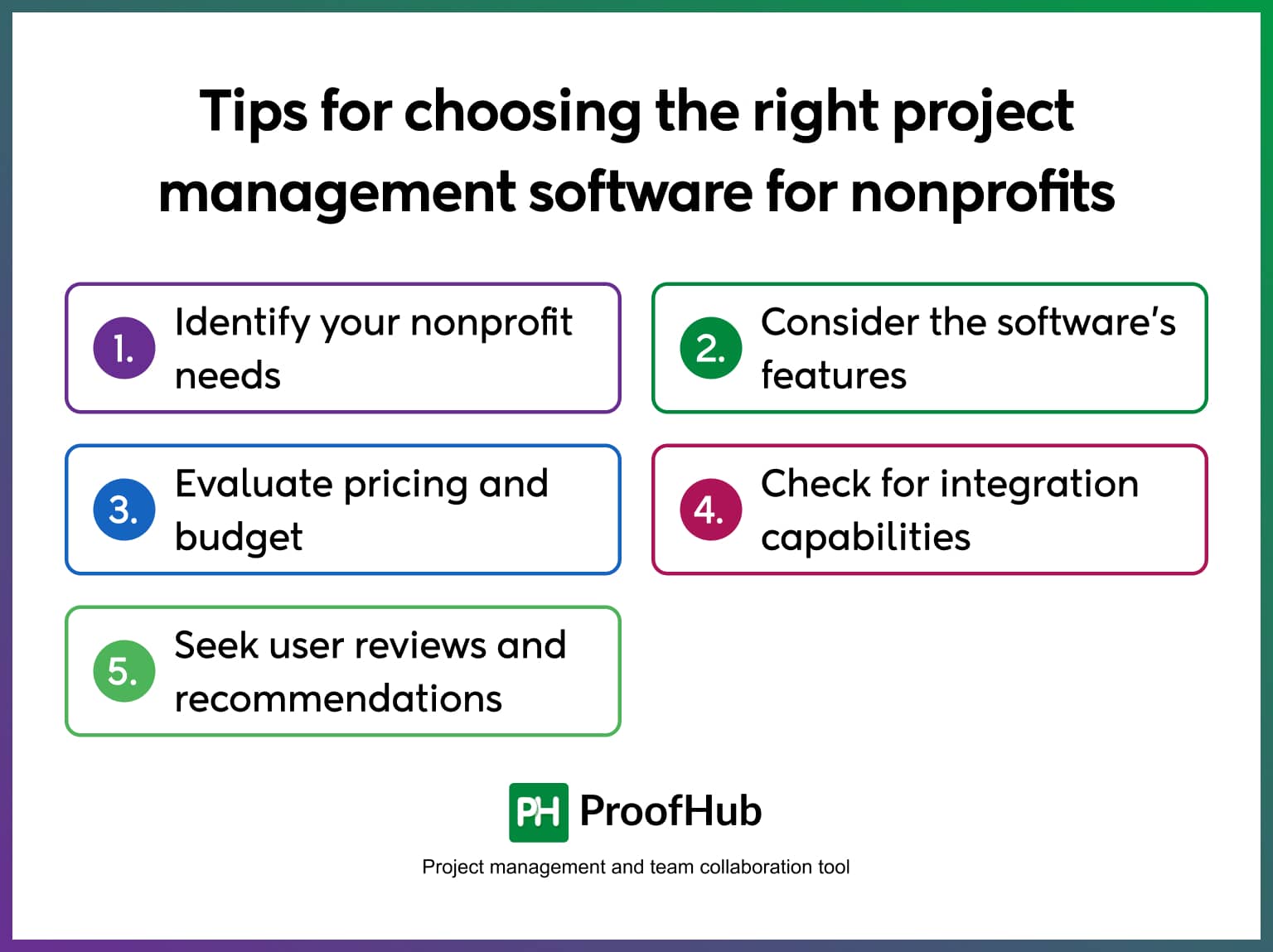
Selecting software for a mission-driven organization requires evaluating operational requirements beyond surface features. Key criteria to prioritize during vendor evaluations include:
Fund Accounting vs. Commercial Ledger Support
Using general business accounting tools for complex grant tracking often introduces compliance risks. Verify whether the tool supports multi-dimensional tracking, allowing transactions to be tagged simultaneously by account, program, project, and funding source (restricted vs. unrestricted) without duplicating chart of account lines.
Integration Capabilities and API Access
Data silos reduce team efficiency. Ensure prospective tools offer open APIs or pre-built integrations with your primary systems. For instance, your digital fundraising tool (e.g., Givebutter or Classy) must seamlessly sync transaction data into your central CRM (e.g., Bloomerang or Salesforce), which in turn should reconcile with your accounting ledger (e.g., QuickBooks or Sage Intacct).
Donor Data Security and Compliance
Nonprofit databases handle sensitive personally identifiable information (PII) and payment card data. Look for solutions compliant with standard security frameworks:
- PCI-DSS Compliance: Required for processing credit card donations securely.
- SOC 1 / SOC 2 Attestation: Verifies internal security controls, availability, and data confidentiality.
- Data Protection Regulations: Ensure systems support compliance with data security frameworks such as the California Consumer Privacy Act (CCPA) or international frameworks like GDPR where applicable.
Non-Profit Discounts and Technology Grants
Before paying retail pricing, verify eligibility for technology grant programs. Organizations like TechSoup facilitate donated software licenses for vetted 501(c)(3) entities. Platforms like Salesforce, Microsoft, and Google offer substantial software donations and operational grants directly to qualifying organizations.
Frequently Asked Questions
What is the difference between donor software and fund accounting software?
Donor software (CRM) focuses on Constituent Relationship Management, tracking donor touchpoints, giving histories, communication preferences, and retention strategies. Fund accounting software tracks financial operations, managing chart of accounts, restricted allocations, payroll, AP/AR, and formal financial statements compliant with FASB standards.
Can a small nonprofit rely solely on accounting software without a CRM?
Small grassroots organizations often begin by tracking donations inside accounting tools like QuickBooks. However, accounting systems do not track soft credit allocations, donor relationship histories, campaign responses, or communication task workflows. Adopting an entry-level CRM alongside accounting software ensures donor details are preserved as the organization grows.
How do non-profits access software discounts?
Eligible 501(c)(3) organizations (or international equivalents) can register with tech donation facilitators such as TechSoup. Additionally, many software providers offer direct non-profit programs that provide discounted or free software tiers upon submission of an official IRS determination letter.
What is true fund accounting, and why is it necessary?
True fund accounting separates financial assets into distinct categories based on donor-imposed or legal restrictions. Unlike commercial accounting, which evaluates profitability, fund accounting tracks accountability and stewardship—ensuring that restricted funds awarded for a specific purpose are spent solely on that purpose.
Next Steps for Technology Evaluation
To select and implement the right software for your organization:
- Conduct a Software Audit: Map your current software systems, identify data silos, and detail recurring pain points across donor tracking, event management, and financial reporting.
- Define System Requirements: Document mandatory technical needs, such as donor retention tracking, FASB-compliant reports, or specific payment gateway integrations.
- Confirm Eligibility: Register your organization with software donation portals like TechSoup to verify eligibility for non-profit licensing rates before requesting pricing quotes.
- Schedule Tailored Demonstrations: Request software demos from short-listed vendors using your organization's specific operational workflows and real-world donor scenarios.
Image Gallery