Understanding the Tax Implications of Cashing in a Life Insurance Policy During Your Lifetime
When you cash in a life insurance policy during your lifetime, you are generally taxed only on the portion of the cash value that exceeds your "cost basis." The cost basis is essentially the total amount of premiums you have paid into...
When you cash in a life insurance policy during your lifetime, you are generally taxed only on the portion of the cash value that exceeds your "cost basis." The cost basis is essentially the total amount of premiums you have paid into the policy, minus any dividends received or previous tax-free withdrawals. Any amount received above this basis is treated as ordinary income and taxed at your marginal tax rate in the year of the distribution.
Contents
Accessing the cash value of a permanent life insurance policy—such as whole life, universal life, or variable life—is a common strategy for supplementing retirement income, paying for education, or handling emergencies. However, the internal revenue code (IRC) has strict rules regarding how this money is treated. Unlike the death benefit, which is typically received tax-free by beneficiaries under IRC Section 101(a), "living benefits" are subject to specific "gain" calculations. Navigating these rules requires an understanding of cost basis, the sequence of withdrawals, and the specific classification of the policy itself.
Defining the "Cost Basis" in Life Insurance
The foundation of understanding your tax liability begins with the cost basis. In the context of life insurance, the cost basis represents your "after-tax" investment in the contract. Because you paid your premiums with dollars that had already been taxed as income, the IRS allows you to recover that specific amount without taxing it again.
To calculate your current cost basis in 2026, you must follow a specific formula:
- Total Premiums Paid: The sum of all scheduled and unscheduled premium payments made since the policy's inception.
- Minus Dividends Received in Cash: If your policy is "participating" and pays dividends, any dividends you took in cash or used to reduce premiums are subtracted from your basis. (Dividends used to purchase "paid-up additions" generally do not reduce the basis in the same way).
- Minus Prior Tax-Free Withdrawals: Any previous partial surrenders that were not taxed reduce your remaining "skin in the game."
If the amount you receive upon cashing in the policy is less than this basis, you have no taxable gain. It is important to note, however, that the IRS generally does not allow you to claim a tax loss if you surrender a policy for less than the premiums paid, as the difference is often attributed to the cost of the insurance protection you received over the years.
The Taxation of Full Policy Surrender
A full surrender occurs when you voluntarily terminate the insurance contract in exchange for its net cash surrender value. At this point, the insurance company calculates the "surrender value" by taking the total account value and subtracting any outstanding policy loans and surrender charges.
The tax calculation for a full surrender is straightforward: Taxable Gain = (Net Cash Received + Outstanding Loans) - Cost Basis
If you have an outstanding loan when you surrender the policy, that loan is considered "boot" or a constructive distribution. Many policyholders are surprised to find that even if they receive very little physical cash upon surrender, they may still owe significant taxes because the IRS treats the forgiven loan balance as income. This gain is taxed as ordinary income, not as a long-term capital gain. This is a critical distinction in 2026, as ordinary income tax brackets can be significantly higher than the preferential rates offered to capital gains.
Partial Withdrawals and the FIFO Rule
Most permanent life insurance policies are governed by the FIFO (First-In, First-Out) accounting method. Under FIFO, the first dollars you withdraw from a policy are considered to be a return of your premiums (your cost basis). As long as your total withdrawals do not exceed your cost basis, the money is received tax-free.
Once your withdrawals exceed the cost basis, every subsequent dollar is considered part of the policy's earnings (interest, dividends, or investment gains) and is fully taxable as ordinary income.
There is one major exception to this rule: if the withdrawal occurs within the first 15 years of the policy and results in a reduction of the death benefit. In such cases, the IRS may treat a portion of the withdrawal as "income-first" (LIFO) under IRC Section 7702(f)(7). This is a complex calculation usually handled by the insurance carrier's back office, but it is a necessary consideration for those looking to cash out significant portions of a newer policy.
The Role of Policy Loans
Taking a loan against your life insurance policy is often the most tax-efficient way to "cash in" during your life. Because a loan is a contractual obligation to repay the insurer (using the cash value as collateral), it is not considered a distribution of earnings.
- Tax Neutrality: You can generally borrow up to the full cash value of the policy without triggering an immediate tax bill, even if the loan amount exceeds your cost basis.
- The Lapsing Trap: The danger of policy loans arises if the policy "lapses" or is surrendered while the loan is still outstanding. If the interest on the loan compounds to the point where it exhausts the remaining cash value, the policy will terminate. At that moment, the IRS considers the entire loan balance to have been "distributed" to you. If the loan balance exceeds your cost basis, you will face a massive tax bill on "phantom income"—money you already spent years ago but are only now being taxed on.
Modified Endowment Contracts (MEC) – The LIFO Exception
In the 1980s, life insurance was often used as a tax-sheltered investment vehicle where people would dump large sums of cash into a policy to avoid taxes on the growth. To curb this, the IRS created the Modified Endowment Contract (MEC) classification.
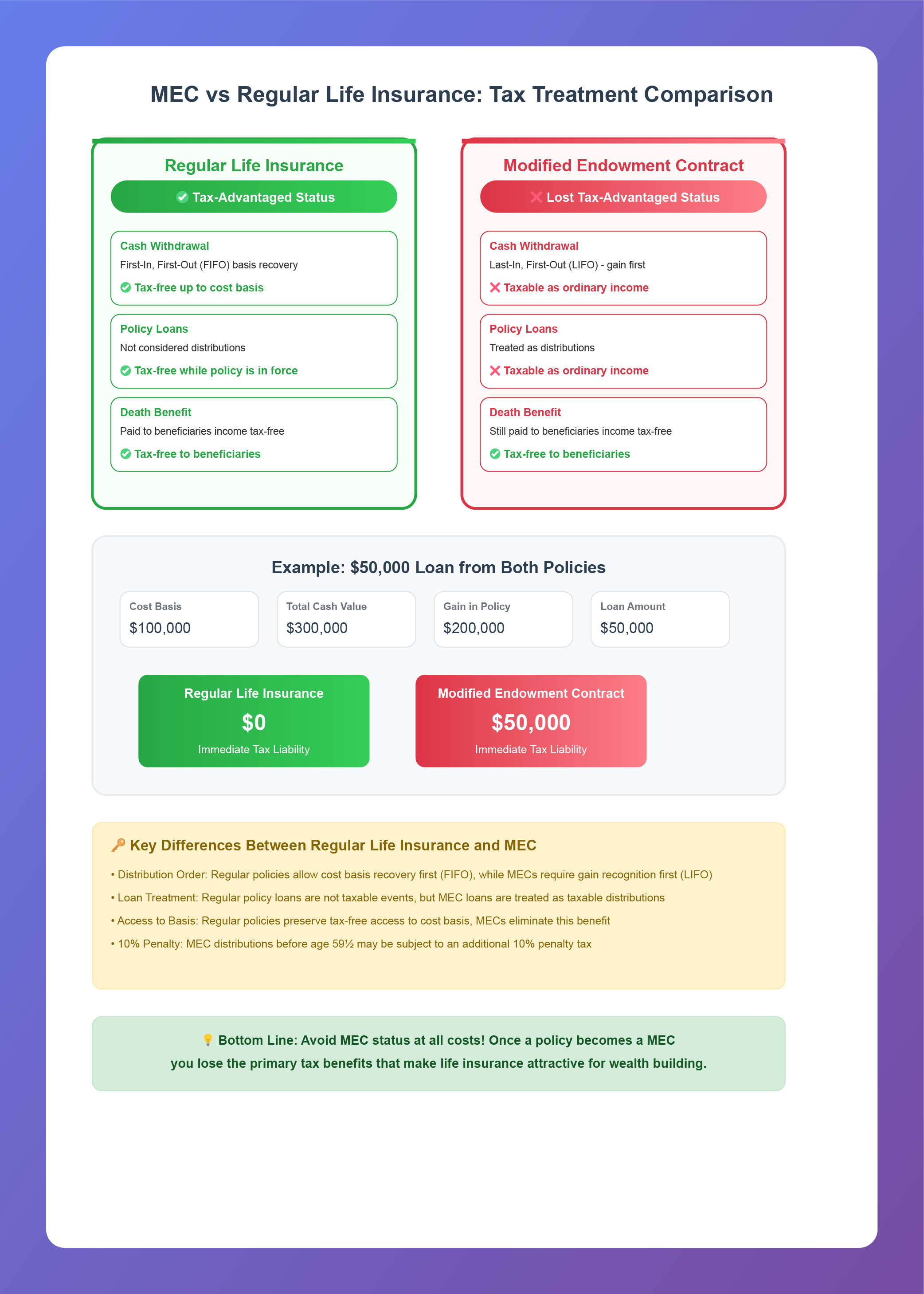
A policy becomes a MEC if the total premiums paid during the first seven years exceed the amount necessary to provide a fully paid-up policy (known as the "7-pay test"). Once a policy is classified as a MEC, it stays a MEC forever, and its tax treatment changes drastically:
- LIFO Taxation: Withdrawals and loans are taxed on a "Last-In, First-Out" basis. This means the earnings (the gains) are considered to come out first and are fully taxable.
- 10% Penalty: If you take money out of a MEC before reaching age 59.5, you may be subject to an additional 10% federal tax penalty on the taxable portion, similar to an early withdrawal from an IRA.
If you are "cashing in" a policy, always check with the insurer to see if the contract has been classified as a MEC, as this will determine whether your withdrawals are tax-free or immediately taxable.
Comparing Access Strategies
The following table summarizes the tax treatment for various methods of accessing cash value in a standard (non-MEC) life insurance policy as of 2026.
| Method | Tax Treatment | Impact on Basis | 10% Penalty Apply? |
|---|---|---|---|
| Full Surrender | Taxed on gains over basis | Basis is eliminated | No |
| Partial Withdrawal | Tax-free up to basis (FIFO) | Reduces basis dollar-for-dollar | No |
| Policy Loan | Tax-free (unless policy lapses) | Does not reduce basis | No |
| MEC Withdrawal | Taxed on gains first (LIFO) | Does not reduce basis until gains are gone | Yes (if under 59.5) |
| Dividend (Cash) | Tax-free up to basis | Reduces basis | No |
Life Settlements: Selling Your Policy to a Third Party
In 2026, many seniors opt for a "life settlement" rather than surrendering the policy back to the insurance company. This involves selling the policy to a third-party investor for an amount greater than the surrender value but less than the death benefit. The taxation of a life settlement is more complex and involves three tiers:
- Amount up to Basis: Received tax-free.
- Amount from Basis to Surrender Value: Taxed as ordinary income (this represents the internal build-up of the policy).
- Amount exceeding Surrender Value: Taxed as a capital gain (this represents the "market value" of the policy).
This "three-tier" tax treatment was solidified in the Tax Cuts and Jobs Act and remains the standard for settlements. It often provides a higher net-after-tax result than a simple surrender, but it requires a licensed life settlement broker to navigate correctly.
Practical Steps for Cashing In
Before you move forward with cashing in a policy, follow these steps to minimize tax liability:
- Request a "Cost Basis Letter": Call your insurance company and ask for a formal statement of your cost basis and the current taxable gain if the policy were surrendered today.
- Verify MEC Status: Ask specifically if the policy is a Modified Endowment Contract.
- Evaluate a 1035 Exchange: If you no longer need the life insurance but want to avoid the tax on the gains, you may be able to perform a Section 1035 Exchange. This allows you to transfer the cash value into a tax-deferred annuity without paying taxes on the current gain.
- Analyze the Loan Option: If you only need a portion of the money, taking a loan may be better than a withdrawal, provided you monitor the policy to ensure it does not lapse.
Frequently Asked Questions
1. Are life insurance dividends taxable when they are paid out? Dividends are generally considered a "return of premium" and are not taxable as long as they do not exceed the total premiums you have paid into the policy. However, if the dividends are left with the insurer to accumulate interest, the interest earned on those dividends is taxable in the year it is credited to your account.
2. Can I claim a tax loss if I surrender a policy for less than I paid? No. The IRS and the courts have historically ruled that the difference between the premiums paid and the cash value received represents the "cost of insurance protection" provided to you while the policy was in force. Since this was a personal expense, it is not deductible as a capital loss.
3. What happens if I cash in a policy that I inherited? If you inherit a policy and then cash it in, your basis is generally the same as the original owner's basis (carryover basis). However, most people receive the death benefit when they "inherit" a policy, which is tax-free. If the policy was transferred to you for value (purchased), different "transfer-for-value" rules apply, and much of the proceeds could be taxable.
4. Will the insurance company withhold taxes when I cash out? Insurance companies are generally required to offer you the option of federal income tax withholding. If you do not elect to have taxes withheld, you are responsible for paying the tax when you file your return. If the gain is substantial, you may need to make an estimated tax payment to avoid underpayment penalties.
5. How is a variable life insurance policy taxed differently? The tax mechanics are the same (FIFO for non-MECs, LIFO for MECs). However, because variable policies are invested in sub-accounts (like mutual funds), the potential for significant gains above the cost basis is higher. These gains are still taxed as ordinary income, not as capital gains from the underlying funds.
Final Recommendation: Before surrendering or withdrawing funds from a permanent life insurance policy, consult with a tax professional or a fee-only financial planner. A "forced" surrender due to an outstanding loan can create a significant tax liability with no cash on hand to pay the bill. Always explore a 1035 exchange or a life settlement as potential alternatives to a direct surrender.
Note: This information is for educational purposes and does not constitute legal or tax advice. Tax laws are subject to change, and jurisdictional variations may apply.
Image Gallery