The Mikelle Biggs Case in Context: Analyzing the Media, Evidence, and Legacy of a Cold Case
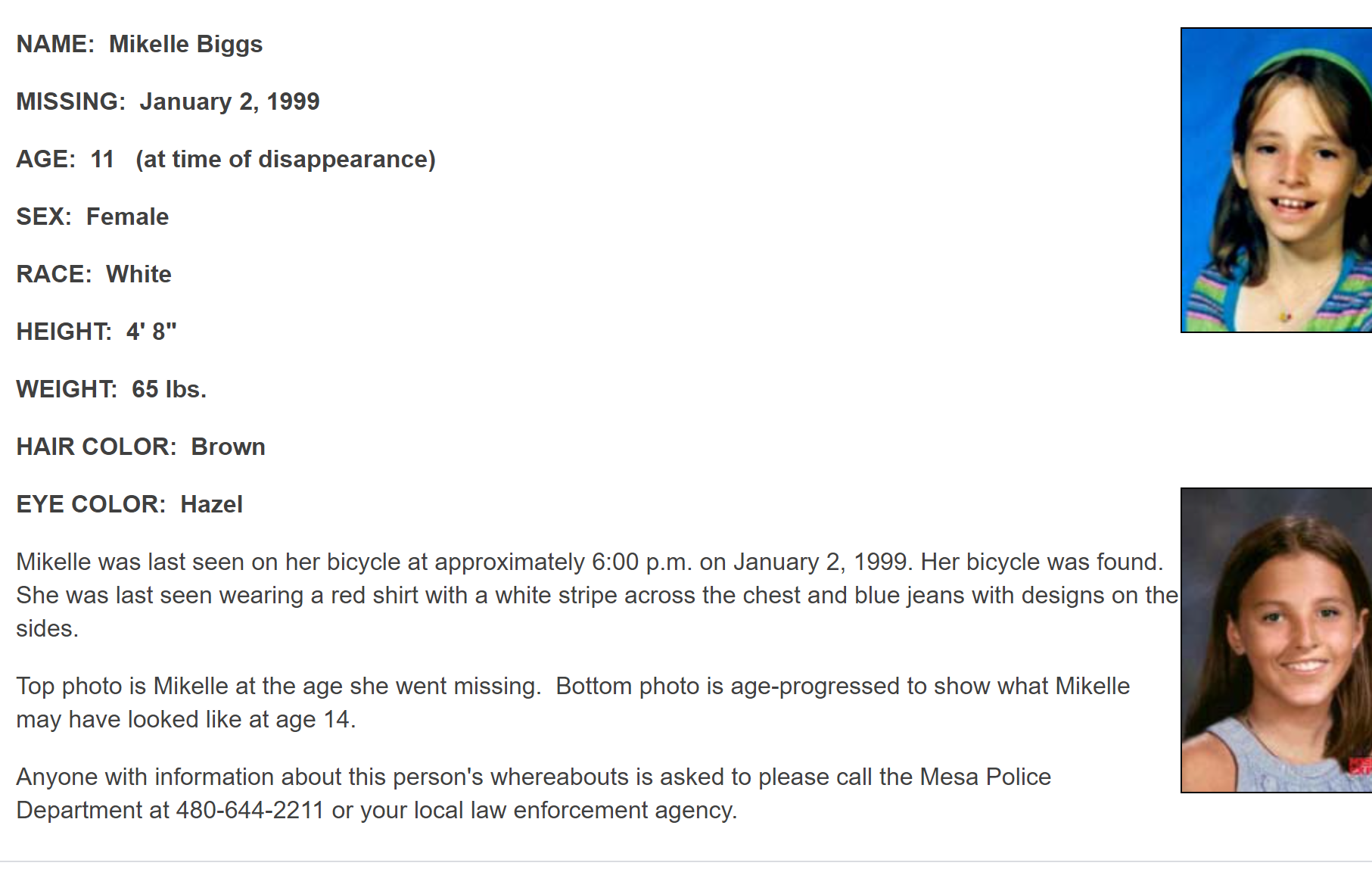
On January 2, 1999, 11-year-old Mikelle Biggs vanished from her suburban street in Mesa, Arizona, while waiting for an ice cream truck. In a window of under two minutes, she disappeared, leaving behind only her bicycle with its wheel s...
On January 2, 1999, 11-year-old Mikelle Biggs vanished from her suburban street in Mesa, Arizona, while waiting for an ice cream truck. In a window of under two minutes, she disappeared, leaving behind only her bicycle with its wheel still spinning and two quarters lying on the asphalt. Decades later, documentary coverage, investigative television specials, and true crime media continue to examine her case to understand how a child could vanish so quickly in a populated neighborhood and why the investigation remains one of the Southwest’s most haunting cold cases.
Contents
Understanding documentary and media coverage of the Mikelle Biggs disappearance requires looking beyond basic true crime tropes. Documentaries contextualize her story through multiple lenses: the evolution of law enforcement protocols for missing children, the psychological toll on families surviving decades of ambiguity, the limitations of late-1990s forensic technology, and the influence of media exposure on cold case investigations.
The Disappearance: What Happened on January 2, 1999?
To evaluate the media narratives surrounding the case, one must first understand the timeline established by the Mesa Police Department. On the late afternoon of January 2, 1999, Mikelle Biggs and her younger sister, Kimber, were outside listening for the music of a local ice cream truck in their Mesa neighborhood near Southern Avenue and Val Vista Drive.
As dusk approached, the temperature dropped, and Kimber went inside their home to retrieve a jacket. Mikelle stayed behind on her bicycle, holding quarters to buy a treat. When Kimber returned less than two minutes later, Mikelle was gone. Her bicycle was lying on its side in the road, the front wheel still spinning, with her helmet hanging from the handlebars and the quarters scattered on the pavement.
- 4:00 PM - 5:15 PM: Children playing outside in residential Mesa neighborhood
- 5:25 PM: Kimber Biggs goes inside briefly for a sweater
- 5:27 PM: Kimber returns; Mikelle is missing, bicycle left on street
- 5:30 PM: Family searches immediate area; police dispatched shortly after
The immediate response from the Mesa Police Department was swift. Officers conducted door-to-door canvas efforts, interviewed hundreds of residents, and deployed search-and-rescue teams. Despite the rapid police response and widespread community participation, no eye witnesses saw Mikelle being pulled into a vehicle, and no physical struggle was recorded by neighbors.
Media Representation and Documentary Coverage
Over the years, the disappearance of Mikelle Biggs has been featured across numerous national and international television programs, including Investigation Discovery’s Disappeared, specialized cold-case news segments on NBC’s Dateline and CBS’s 48 Hours, as well as regional investigative documentaries produced in Arizona.
When analyzing how filmmakers and investigative journalists frame the Mikelle Biggs case, three primary investigative themes emerge:
1. The Shock of Suburban Vulnerability
Documentaries frequently emphasize the setting of the abduction. Mesa, Arizona, in 1999 was a classic suburban community where parents generally felt comfortable allowing children to play outdoors unsupervised for short periods. Media coverage uses the case to illustrate how quickly public safety perceptions shifted at the turn of the 21st century. The narrative highlights how an abduction can occur within seconds in plain sight, challenging the conventional belief that physical safety is guaranteed within familiar neighborhoods.
2. The Evolution of Family Advocacy
Documentary narratives heavily feature Kimber Biggs, who was nine years old when her sister vanished. As an adult, Kimber became a prominent public advocate, using media platforms to keep Mikelle’s name active in public consciousness. Media analysis often centers on how surviving family members navigate trauma while serving as the primary drivers of cold-case public relations. Through interviews, documentary projects demonstrate the shifts in how families interact with law enforcement—transitioning from passive reliance on police updates to active media management.
3. Forensic Limitations of the Pre-Digital Era
Retrospective media reports highlight the technology gap present in 1999. In the late 1990s, residential security cameras, smart doorbells, personal mobile GPS tracking, and modern digital surveillance were virtually non-existent in typical suburban neighborhoods. Documentaries illustrate how investigators relied heavily on traditional canvassing, tire tread analysis, and physical witness statements. Modern true crime coverage contextualizes the investigation by contrasting 1999 physical evidence gathering against modern digital forensic standards.
Key Suspects, Physical Clues, and Unverified Leads
Documentaries and investigative reporting on Mikelle Biggs focus significantly on the primary leads pursued by the Mesa Police Department over more than two decades.
Dee Blalock: The Prime Suspect
The individual most frequently linked by law enforcement and documentary investigations to Mikelle's disappearance is Dee Wayne Blalock. At the time of Mikelle's abduction, Blalock was a convicted sex offender living just streets away from the Biggs family home.
In 1999, shortly after Mikelle vanished, Blalock was arrested and subsequently convicted for a violent assault on another woman residing in the same neighborhood. Mesa police investigators have repeatedly named Blalock as a primary person of interest. Law enforcement officers noted that Blalock had direct knowledge of the neighborhood layout, lacked a solid alibi for the exact window of the abduction, and possessed a history of predatory behavior. However, despite extensive searches, forensic sweeps of his property, and repeated interrogations, prosecutors have never accumulated sufficient physical evidence to formally charge Blalock with Mikelle's kidnapping or homicide.
The 2009 Dollar Bill Mystery
In March 2009, a sensational development renewed national media interest in the case. A dollar bill was discovered in Neah Bay, Washington, bearing a handwritten message written in pencil along the border:
"My name is Mikel Biggs kidnapped From Mesa AZ I'm Alive"
The discovery triggered widespread media coverage and prompted investigation by both Washington state authorities and Mesa police detectives. Detectives analyzed the handwriting, noted the misspelling of Mikelle's first name ("Mikel"), and submitted the currency for latent fingerprint and DNA testing.
- Currency Lead Analysis (2009 Dollar Bill)
- Location Found: Neah Bay, Clallam County, Washington
- Note Inscription: "My name is Mikel Biggs kidnapped From Mesa AZ I'm Alive"
- Forensic Testing: DNA and fingerprint analysis conducted by federal/state labs
- Police Conclusion: High probability of a hoax; unverified link to actual victim
Ultimately, law enforcement officials concluded that the dollar bill was highly likely a cruel hoax. The handwriting did not match known samples from Mikelle's childhood, no actionable DNA profile was recovered, and the physical path of the bill through circulation could not be traced back to 1999 Arizona. Documentary retrospectives frequently use this incident to examine how unverified leads and hoaxes complicate cold case investigations and inflict emotional distress on victims' families.
Documentaries vs. Official Investigation: Comparative Overview
The table below contrasts the main focus areas of major documentary retrospectives with the official law enforcement findings recorded by the Mesa Police Department and partner agencies.
| Feature / Aspect | Media & Documentary Focus | Official Police Record & Facts |
|---|---|---|
| Primary Theme | Emotional impact on family, suburban security, public advocacy | Methodical timeline reconstruction, suspect elimination, evidence management |
| Prime Person of Interest | Focus on Dee Wayne Blalock's violent criminal history and proximity | Blalock remains prime suspect; lack of physical evidence prevents formal charges |
| 2009 Washington Dollar Bill | Presented as a dramatic narrative twist and potential clue | Categorized as an unverified lead / probable hoax after forensic testing |
| Investigative Scope | Highlight of systemic cold-case challenges and media power | Over 10,000 leads evaluated, hundreds of interviews conducted since 1999 |
| Child Safety Impact | Connection to missing child awareness and community vigilance | Catalyzed internal protocol improvements for rapid deployment in missing child cases |
Systemic Impact: How the Case Changed Law Enforcement Protocols
The disappearance of Mikelle Biggs occurred during a transitional era for missing children investigations in the United States. Although the national AMBER Alert system was initially created in 1996 following the abduction of Amber Hagerman in Texas, public alert infrastructure was not yet fully standardized or instantly automated across every municipality in 1999.
Mikelle’s case served as a major catalyst within Arizona for refining regional emergency responses to child disappearances. Key operational changes influenced by cases during this period include:
- Rapid Abduction Response Teams: Law enforcement agencies instituted immediate deployment protocols for missing minors, reducing delay between the initial report and regional perimeter containment.
- Sex Offender Registration Integration: The proximity of a registered offender (such as Blalock) highlighted the necessity for integrated, searchable databases accessible instantly to field officers during active searches.
- Inter-Agency Data Sharing: The cross-state investigation of leads—such as the Washington currency discovery—demonstrated the need for standardized national communication channels between municipal police departments and federal agencies like the FBI National Center for the Analysis of Violent Crime.
Documentary Ethics and the Cold Case Industry
As true crime documentaries have surged in popularity across streaming platforms, media ethicists and legal analysts frequently evaluate how cold cases like Mikelle Biggs' are presented.
When documentaries cover active cold cases, they must balance narrative engagement with journalistic responsibility. Responsible documentary filmmaking provides tangible public value by:
- Generating New Leads: High-profile streaming documentaries reach global audiences, occasionally prompting individuals with historic knowledge to contact law enforcement tip lines.
- Preserving Historical Record: Documentaries preserve primary-source interviews from aging witnesses, retired detectives, and family members whose memories are vital to the evidentiary record.
- Holding Public Institutions Accountable: Investigative journalism examines whether initial investigations suffered from procedural errors, departmental oversights, or missed forensic opportunities.
Conversely, sensationalized media coverage risks spreading unverified rumors, falsely accusing individuals who have been cleared by law enforcement, and misrepresenting legal standards of evidence. In the Mikelle Biggs narrative, high-quality documentary projects differentiate themselves by sticking strictly to corroborated police files, verified court documents, and direct statements from the primary investigative team.
Frequently Asked Questions
Has Mikelle Biggs ever been found?
No. As of 2026, Mikelle Biggs remains missing, and no physical remains have ever been located. The Mesa Police Department continues to maintain an open cold case file and periodically reviews tips.
Who is the main suspect in the disappearance of Mikelle Biggs?
Dee Wayne Blalock, a convicted sex offender who lived in Mikelle's neighborhood at the time of her disappearance, remains the primary person of interest for law enforcement. Blalock was imprisoned for an unrelated brutal assault committed shortly after Mikelle vanished. However, no physical evidence directly tying him to Mikelle has been found, and he has never been charged in her case.
Was the dollar bill found in Washington state proven to be real?
No. Forensic handwriting analysis, DNA testing, and fingerprint evaluations conducted by law enforcement led investigators to conclude that the 2009 dollar bill was almost certainly a hoax rather than a genuine message from Mikelle.
How did Mikelle Biggs' case impact child safety protocols in Arizona?
Mikelle’s disappearance highlighted the extreme speed with which child abductions can take place and spurred regional improvements in police response protocols, rapid multi-agency coordination, and localized emergency alert systems for missing children across the Southwest.
Where can individuals submit tips regarding the Mikelle Biggs case?
Anyone with verified information regarding the disappearance of Mikelle Biggs is encouraged to contact the Mesa Police Department cold case unit directly or submit an anonymous tip through Silent Witness or the National Center for Missing & Exploited Children.
Practical Action: How Public Engagement Helps Cold Cases
The legacy of media coverage around the Mikelle Biggs case demonstrates that public awareness remains a vital tool in resolving historical missing persons cases. For citizens, true crime enthusiasts, and researchers engaging with cold case content, the most constructive actions include:
- Focusing on Official Channels: When reviewing documentary coverage, verify claims against official press releases from the Mesa Police Department or the National Center for Missing & Exploited Children (NCMEC).
- Reporting Credible Information: If you possess historical information regarding individuals who lived in the Mesa, Arizona area in January 1999, submit tips directly to official law enforcement channels rather than posting unverified theories on online forums.
- Supporting Advocacy Organizations: Support non-profit organizations that assist families of missing children, provide resources for search operations, and advocate for updated forensic technologies in law enforcement departments nationwide.
Image Gallery