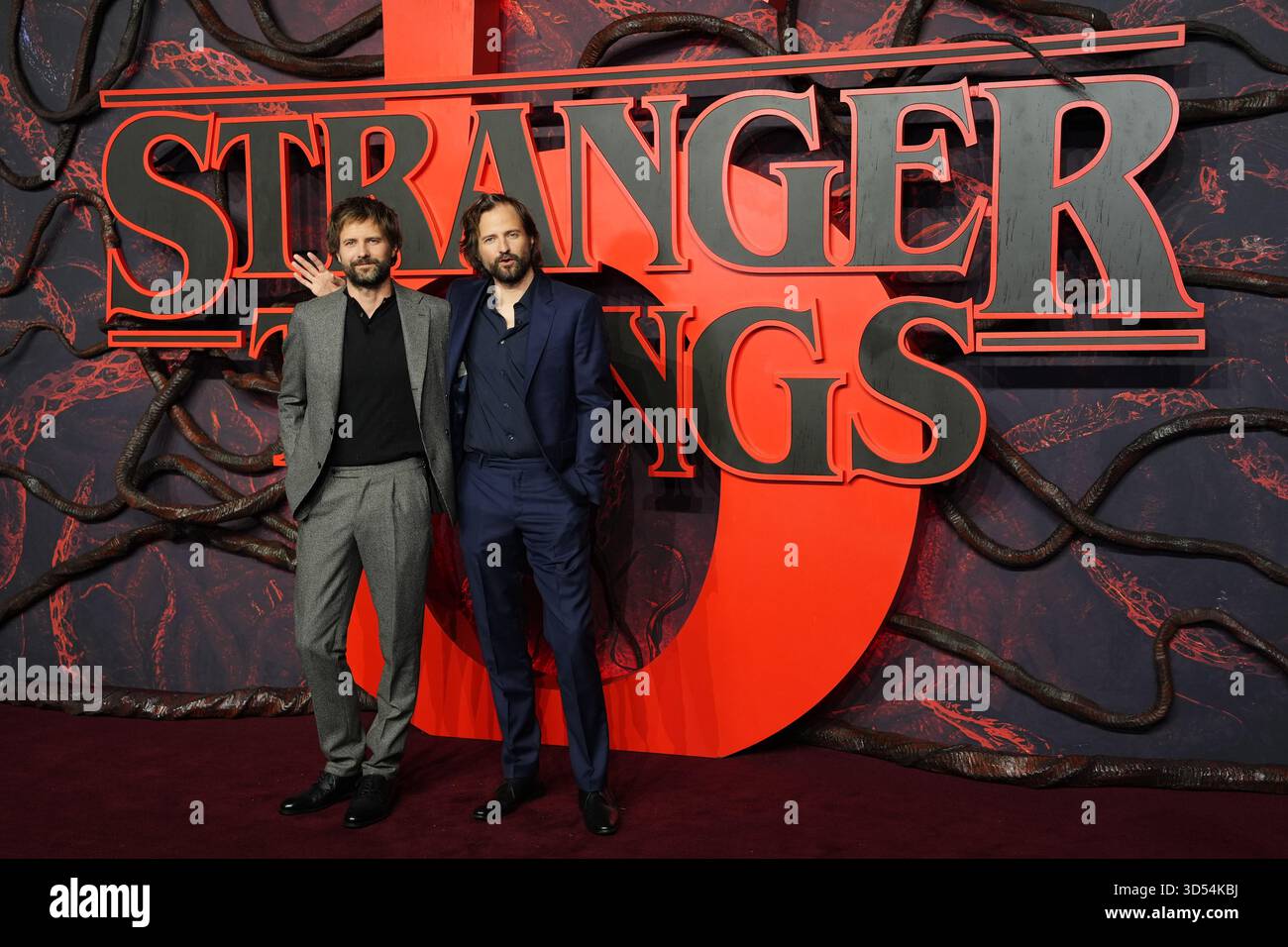
Ross Duffer Brothers and the Ethics of Tech Innovation
Ross and Matt Duffer, collectively known as the Duffer Brothers, have utilized their cinematic platform to explore the profound ethical dilemmas inherent in technological and scientific innovation. Through their work—most notably Stran...
Ross and Matt Duffer, collectively known as the Duffer Brothers, have utilized their cinematic platform to explore the profound ethical dilemmas inherent in technological and scientific innovation. Through their work—most notably Stranger Things—they examine the consequences of unchecked experimentation, the dehumanization of subjects in the pursuit of progress, and the catastrophic "rifts" created when institutional ambition outpaces moral oversight.
Contents
The Duffer Brothers as Cultural Commentators on Science
By 2026, the legacy of the Duffer Brothers extends beyond mere nostalgia-driven entertainment. Their narrative architecture serves as a sophisticated critique of how humanity interacts with the "unknown" through the lens of technology and science. While their stories are set in the 1980s, the themes resonate deeply with modern debates surrounding artificial intelligence, bio-engineering, and surveillance states.
The Duffer Brothers position innovation not as an inherent good, but as a dual-edged sword. In their storytelling, the "innovation" is often a breakthrough in physics or psychic potential funded by clandestine government branches. The ethical failure explored by the Duffers is rarely the technology itself, but rather the lack of transparency and the abandonment of the precautionary principle. This principle suggests that if an action or policy has a suspected risk of causing harm to the public or the environment, the burden of proof that it is not harmful falls on those taking the action. In the world of the Duffer Brothers, this burden is consistently ignored in favor of strategic advantage.
The Hawkins Laboratory: A Case Study in Institutional Ethics
The central setting of the Hawkins National Laboratory acts as a surrogate for any modern "Big Tech" or "Big Science" entity operating without public accountability. Ross Duffer has often noted in interviews that the horror of their work stems from the reality that those in power often believe the ends justify the means.
The Erosion of Informed Consent
One of the primary ethical breaches highlighted is the total erosion of informed consent. The character of Eleven (Jane Ives) represents the ultimate "subject"—a human being treated as a biological asset. In the pursuit of expanding the boundaries of human perception and domestic espionage, the innovators (led by Dr. Martin Brenner) strip away the subject's autonomy.
This mirrors contemporary concerns in 2026 regarding data privacy and the use of personal information to train large-scale models. Just as Brenner viewed Eleven’s mind as a resource to be harvested, modern tech ethics debates often center on whether individuals are being treated as participants in innovation or merely as raw material for it.
The Dangers of Dual-Use Technology
The Duffer Brothers frequently explore the concept of dual-use technology—innovations intended for one purpose (e.g., communication or exploration) that are co-opted for destructive or surveillance-oriented ends. In Stranger Things, the attempt to reach into another dimension is motivated by Cold War pressures. The ethics of innovation here are compromised by the "innovation race," where the fear of a competitor (the Soviet Union) achieving a breakthrough first leads to the cutting of ethical corners.
The "Upside Down" as a Metaphor for Unintended Consequences
The Upside Down is perhaps the most potent metaphor for the "black swan" events associated with technological overreach. In the Duffer Brothers' narrative, the scientists did not intend to create a portal to a decaying, predatory dimension; they intended to observe. However, the act of observation itself—facilitated by high-level technological intervention—altered the environment irreparably.
The "Rift" in Modern Context
In 2026, the "Rift" created in Hawkins serves as a cautionary tale for several real-world technological frontiers:
- Climate Engineering: The potential for unforeseen feedback loops when attempting to "innovate" our way out of ecological crises.
- Artificial General Intelligence (AGI): The risk of creating a system whose goals align poorly with human survival, leading to a metaphorical "leakage" of harmful outcomes into the real world.
- Biological Synthesis: The ethical implications of "editing" life without a full understanding of the long-term genomic consequences.
The Duffer Brothers emphasize that once a technological "door" is opened, it is rarely possible to close it completely. The "cleanup" of these innovations often falls not on the innovators themselves, but on the local community (the residents of Hawkins), highlighting a significant social justice disparity in tech ethics.
Historical Foundations: MKUltra and the Ethics of the Past
The Duffer Brothers grounded their fictional innovations in the very real history of Project MKUltra, a series of experiments conducted by the CIA which rose to public prominence in the 1970s. By anchoring their "sci-fi" innovation in historical fact, Ross and Matt Duffer remind the audience that the ethics of innovation are not hypothetical.
| Innovation Aspect | Duffer Brothers Depiction | Real-World Ethical Parallel (2026) |
|---|---|---|
| Participant Status | Human subjects as "numbered" assets. | User data commodification and "shadow profiling." |
| Funding Source | Clandestine military/government grants. | Military-industrial complex influence on AI and robotics. |
| Risk Assessment | Negligence of environmental "leakage." | Unforeseen societal impacts of social media algorithms. |
| Accountability | Total institutional denial and cover-ups. | Lack of clear regulatory frameworks for emerging tech. |
| Goal Alignment | Nationalistic superiority over safety. | Corporate profit-maximization over safety/alignment. |
This comparison highlights that the Duffers are not just writing about monsters; they are writing about the methodology of innovation. The ethical failure is systemic, where the institutional structure prioritizes the "breakthrough" over the human cost.
Upside Down Pictures and the Future of the Narrative
In 2022, the Duffer Brothers formed Upside Down Pictures, a production company aimed at telling stories that "take place at that beautiful intersection where the ordinary meets the extraordinary." By 2026, this company has become a vehicle for further exploring the intersection of human morality and technological progress.
Their involvement in projects like the stage play Stranger Things: The First Shadow and the live-action Death Note adaptation continues this trend. In Death Note, for instance, the "innovation" is a supernatural object, but the ethical dilemma is purely human: How does an individual handle absolute power and the ability to enact "justice" through a technological-like interface? Ross Duffer has noted that their interest lies in how technology (or supernatural tools) acts as a mirror, reflecting the user's inherent ethical strengths or failures.
Ethical Frameworks Proposed by the Duffers' Work
While the Duffer Brothers are storytellers rather than ethicists, their work suggests a specific framework for considering new innovations:
- Human-Centricity: Technology must serve human flourishing, not merely institutional power. If an innovation requires the dehumanization of its subjects, it is inherently unethical.
- Radical Transparency: The "lab" must not be a silo. The Duffer Brothers show that when science is conducted in total secrecy, the lack of external peer review and public oversight leads to catastrophic "drifts" in moral standards.
- The Responsibility of the Creator: Unlike Dr. Brenner, who views his creations as tools, an ethical innovator must take full responsibility for the "monsters" their technology may inadvertently release. This includes the duty to warn and the duty to mitigate harm.
Addressing the "Move Fast and Break Things" Mentality
The Duffer Brothers' narrative is a direct antithesis to the "move fast and break things" mantra of early 21st-century Silicon Valley. In the Duffer-verse, when you "break things," you break the fabric of reality, and the people who pay the price are usually the most vulnerable members of society.
Their work advocates for a more contemplative and cautious approach to innovation. They suggest that the "extraordinary" should be approached with humility rather than hubris. As we navigate the complex technological landscape of 2026, the cautionary tales of Ross and Matt Duffer remind us that the most important part of any innovation is not the power it grants, but the ethics of the hands that hold it.
Frequently Asked Questions
Did the Duffer Brothers base Hawkins Lab on a real place?
While Hawkins Lab is fictional, it is heavily inspired by Camp Hero in Montauk, New York, and the rumors surrounding the "Montauk Project." These stories, along with the documented history of Project MKUltra, provide the ethical backdrop for the Duffer Brothers' critique of government-funded scientific experimentation. The brothers used these real-world anxieties to ground their supernatural elements in a recognizable ethical framework.
How does the character of Eleven illustrate tech ethics?
Eleven illustrates the ethical concept of "personhood vs. property." In the context of innovation, she is treated as a piece of hardware—a tool for remote viewing and telekinetic defense. Her journey toward autonomy and her eventual reclamation of her name (Jane) represents the triumph of human ethics over dehumanizing technological exploitation.
What is the significance of the year 1983 in their exploration of tech?
The early 1980s represented a pivot point in modern technology, with the rise of personal computing and the intensification of the Cold War arms race. The Duffer Brothers chose this era to highlight a time when humanity was first grappling with the rapid acceleration of "invisible" technologies—things like satellite surveillance and early networking—that would eventually lead to the hyper-connected, surveillance-heavy world of 2026.
Are the Duffer Brothers' themes relevant to modern AI?
Yes, the themes are highly relevant. The "Upside Down" can be seen as an allegory for the "latent space" of AI—a vast, poorly understood territory that we are reaching into without fully knowing what we might pull out. The ethical concerns regarding "alignment"—ensuring AI goals match human values—mirror the struggle in Stranger Things to control a force that was never meant to be unleashed.
What is the "Precautionary Principle" in the context of their work?
The Precautionary Principle is the idea that if an innovation has a potential for great harm, even if the probability is low, we should proceed with extreme caution or not at all. In the Duffer Brothers' stories, the characters who ignore this principle (the scientists) cause the conflict, while the characters who respect the unknown (the children) are the ones who must find a way to contain it.
Next Steps for Understanding Media and Tech Ethics
For those interested in the intersection of narrative media and the ethics of innovation, the following actions are recommended:
- Study the history of Project MKUltra: Understanding the real-world ethical breaches of the mid-20th century provides essential context for the Duffer Brothers' work.
- Explore the "Ethics of Emerging Technologies" guidelines: Organizations like the IEEE and various AI safety institutes provide frameworks that mirror the concerns raised in Stranger Things.
- Analyze the concept of "Technological Hubris": Read works by philosophers of technology (such as Jacques Ellul or Langdon Winner) to see how the Duffers' themes of "unintended consequences" are supported by academic theory.
Image Gallery