Can You Go to Urgent Care with TRICARE Prime?
Yes, most TRICARE Prime enrollees can visit a network urgent care clinic without a referral or prior authorization. However, Active Duty Service Members (ADSMs) must obtain an official referral from their Primary Care Manager or contac...
Yes, most TRICARE Prime enrollees can visit a network urgent care clinic without a referral or prior authorization. However, Active Duty Service Members (ADSMs) must obtain an official referral from their Primary Care Manager or contact the Military Health System Nurse Advice Line first to avoid paying out-of-pocket expenses under point-of-service charges.
Contents
Understanding how TRICARE Prime handles urgent care is critical to receiving fast, high-quality medical evaluation without triggering unexpected medical debt. Urgent medical issues—such as sprains, high fevers, minor lacerations requiring stitches, or severe sore throats—frequently occur outside standard military treatment facility (MTF) business hours. Navigating the program guidelines correctly ensures that coverage remains seamless and out-of-pocket expenses are minimized.
Urgent Care Rules by TRICARE Prime Beneficiary Category
TRICARE Prime operates similarly to a civilian Health Maintenance Organization (HMO). While routine specialty care strictly mandates a referral from your assigned Primary Care Manager (PCM), urgent care access depends fundamentally on your beneficiary status.
Active Duty Service Members (ADSMs)
Active duty personnel face the strictest restrictions under military readiness directives. If you are an active duty soldier, sailor, airman, marine, guardian, or Coast Guardsman enrolled in TRICARE Prime or TRICARE Prime Remote:
- Referral Mandate: You must have an approved referral from your PCM before seeking non-emergency care at a civilian urgent care center.
- After-Hours Protocol: If your assigned military clinic is closed and you need prompt care, you must call the Military Health System (MHS) Nurse Advice Line (NAL). If the triage registered nurse determines urgent care is appropriate, they will submit an electronic urgent care pre-authorization.
- Failure to Comply: Seeking unauthorized civilian care can lead to claims denial, leaving the service member personally liable for the full commercial bill, as point-of-service options do not cover active duty members.
Active Duty Family Members (ADFMs)
Family members enrolled in TRICARE Prime enjoy substantial flexibility under policy adjustments designed to alleviate military clinic capacity constraints:
- No Referral Required: Spouses and dependent children do not need a referral or prior authorization to visit a TRICARE-authorized urgent care center.
- Network Requirement: To avoid cost penalties, dependents must select an in-network provider. If an out-of-network clinic is used without an explicit referral from a PCM, claims are processed under the expensive Point-of-Service (POS) option.
Retirees, Family Members of Retirees, and Other Non-Active Beneficiaries
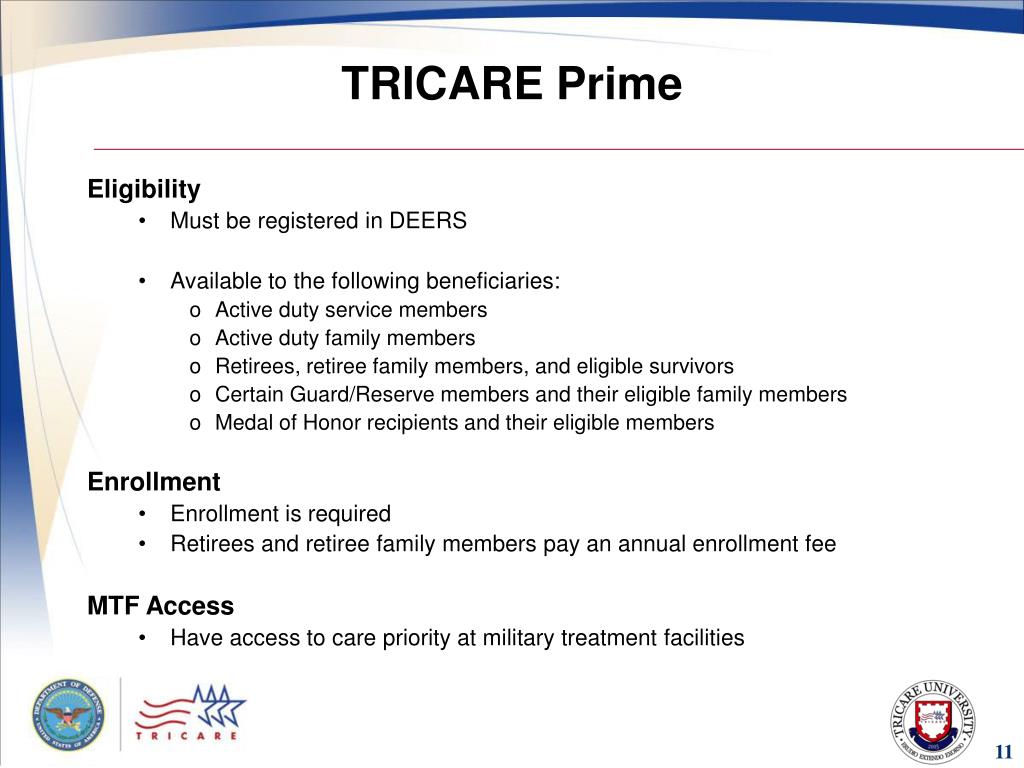
Military retirees, their dependents, and transitional survivors enrolled in TRICARE Prime follow identical procedural pathways to active duty family members:
- Direct Access: No referral or pre-authorization is required when utilizing an urgent care center within your regional contractor’s network (Humana Military for the East Region, Health Net Federal Services for the West Region).
- Copayments Apply: Unlike active duty dependents (who generally pay zero dollars at network urgent care clinics), retirees and their families are subject to modest network copayments based on their group tier (Group A vs. Group B).
Verifying Network Status: Urgent Care Center Types
Not all walk-in clinics are classified as standard urgent care facilities under TRICARE contracts. Seeking care at the wrong facility type can alter your cost-share obligations.
Standalone Urgent Care Centers
These are independent medical clinics staffed by physician assistants, nurse practitioners, and board-certified physicians equipped to handle non-life-threatening illnesses and injuries. To verify network participation, beneficiaries should search the regional contractor directory online or telephone the facility directly to ask: "Are you a contracted, in-network urgent care provider for TRICARE Prime?"
Convenience Clinics (Retail Health Clinics)
Retail clinics (such as MinuteClinic inside CVS, or Healthcare Clinic inside Walgreens) provide limited walk-in care for routine complaints like seasonal allergies, uncomplicated ear infections, or basic immunizations. TRICARE Prime classifies these clinics similarly to urgent care centers, meaning ADFMs and retirees do not require a referral, provided the retail chain is contracted in-network.
Hospital-Affiliated Urgent Care Centers
Caution is required when an urgent care center operates inside, adjacent to, or under the licensure of an acute care hospital. If the clinic bills services under hospital outpatient facility codes rather than standard urgent care billing taxonomy (CMS Form 1500 / Place of Service 20), TRICARE may classify the visit as an outpatient hospital encounter, triggering referral disputes or higher institutional copays.
TRICARE Prime Urgent Care Costs and Copayment Structure
The out-of-pocket financial liability for urgent care visits under TRICARE Prime depends on beneficiary group classification:
- Group A: Beneficiary or sponsor initial military enlistment or appointment occurred before January 1, 2018.
- Group B: Beneficiary or sponsor initial military enlistment or appointment occurred on or after January 1, 2018.
| Beneficiary Category | In-Network Urgent Care Referral Needed? | In-Network Out-of-Pocket Copay | Out-of-Network Cost Without Referral (POS Option) |
|---|---|---|---|
| Active Duty Service Member (ADSM) | Yes (Strictly required via PCM or NAL) | $0 (Covered in full) | Not authorized (100% member liability) |
| Active Duty Family Member (ADFM) | No | $0 copayment | Point-of-Service deductible + 50% cost-share |
| Retirees & Dependents (Group A) | No | $39 copayment per visit | Point-of-Service deductible + 50% cost-share |
| Retirees & Dependents (Group B) | No | $40 copayment per visit | Point-of-Service deductible + 50% cost-share |
Important Point-of-Service (POS) Warning If a non-active duty TRICARE Prime enrollee visits an out-of-network urgent care clinic without an active referral from their Primary Care Manager, the claim falls under the Point-of-Service option. Under POS rules, the enrollee must satisfy an annual POS outpatient deductible ($300 individual / $600 family) and pay a 50% cost-share on allowable charges. These POS expenses do not apply to the annual catastrophic cap.
How to Go to Urgent Care with TRICARE Prime: Step-by-Step Guide
Executing an urgent care visit smoothly requires adhering to regional TRICARE administrative protocols.
1. Assess the Medical Severity
Determine whether the medical situation is an emergency or an urgent issue.
- Go to the nearest Emergency Room (or call 911): Chest pain, sudden paralysis, severe respiratory distress, uncontrolled hemorrhage, head trauma involving loss of consciousness, or sudden speech loss. No referral is ever needed for genuine emergency care.
- Go to Urgent Care: Sprains, small puncture wounds, earaches, urinary tract infections, simple cuts, moderate dehydration, or minor burns.
2. Contact the MHS Nurse Advice Line (Required for ADSMs, Recommended for Others)
Before leaving your home, dial the Military Health System Nurse Advice Line at 1-800-TRICARE (1-800-874-2273), Option 1.
Registered nurses provide clinical triage 24 hours a day, 7 days a week. For active duty personnel, the nurse coordinates necessary authorization codes and notifies your local military treatment facility. For dependents and retirees, the triage nurse documents the encounter in the central MHS record and guides you to the nearest open in-network facility.
3. Locate an In-Network Clinic
Check your regional contractor’s provider directory:
- East Region: Humana Military provider directory portal.
- West Region: Health Net Federal Services provider portal.
Filter specifically for "Urgent Care" and ensure the facility holds an active contract. If searching remotely, verify the clinic's physical address directly against the directory to ensure it is not a standalone emergency department billing at catastrophic trauma rates.
4. Present Credentialing at Check-In
When arriving at the urgent care desk:
- Present your valid Department of Defense Common Access Card (CAC) or Uniformed Services Identification Card (USID).
- Provide the clinic with your DoD Benefits Number (DBN), found on the back of the USID card.
- Explicitly state: "My coverage is TRICARE Prime through [Humana Military / Health Net Federal Services]. I am here for urgent walk-in care."
- Active duty members must provide the authorization reference number supplied by their PCM or the Nurse Advice Line.
5. Review Billing Paperwork
Review any paperwork prior to signature. If the front desk claims they do not take TRICARE or demands payment upfront in full, pause and verify their participation status. Do not sign fee guarantees accepting full commercial non-network liability unless you intend to trigger Point-of-Service cost-shares.
Common TRICARE Prime Urgent Care Mistakes to Avoid
Managing military healthcare access involves specific compliance boundaries. Avoiding several operational mistakes ensures zero claims rejections:
Using Free-Standing Emergency Rooms by Mistake
In many suburban areas, free-standing emergency departments look almost identical to walk-in urgent care centers. However, free-standing emergency rooms bill as Level 4 or Level 5 emergency facilities. If you present with non-emergency conditions at an off-base free-standing ER without an emergency clinical presentation, claims may face intensive utilization reviews, resulting in unexpected high-deductible liabilities.
Forgetting to Update DEERS Before Visiting
All TRICARE eligibility is derived directly from the Defense Enrollment Eligibility Reporting System (DEERS). If a sponsor recently transitioned duty stations, changed rank, got married, or had an identification card expire, the clinic's electronic real-time eligibility check may return an "Ineligible" status. Maintain your physical and demographic data inside the MilConnect portal to keep coverage uninterrupted.
Failing to Follow Up with Your Primary Care Manager (PCM)
Urgent care clinics provide episodic, acute stabilization; they do not manage longitudinal chronic conditions. After being treated for an urgent medical issue:
- Request a complete copy of the clinical notes, discharge instructions, and diagnostic lab or radiology reports.
- Contact your assigned military treatment facility or civilian PCM within 72 business hours to log the civilian encounter into your permanent electronic health record (MHS GENESIS).
- Any recommended follow-up diagnostic imaging (such as an MRI) or referrals to specialists (such as orthopedic surgery) cannot be ordered directly by the urgent care doctor. Your assigned PCM must originate all subsequent downstream specialty referrals.
Frequently Asked Questions
Can an active duty service member ever go to urgent care without calling first?
No. Active duty service members must always receive authorization before receiving non-emergency civilian medical care. If an active duty service member receives care without PCM approval or Nurse Advice Line triage routing, TRICARE will not cover the medical claims, leaving the service member personally responsible for the entire billed charge.
Does a TRICARE Prime urgent care visit count against my catastrophic cap?
Yes. Allowable copayments paid by retirees and dependents at network urgent care clinics accrue directly toward your annual TRICARE catastrophic cap. However, if you choose an out-of-network clinic and incur Point-of-Service fees and the additional 50% cost-share, those specific penalty charges do not apply toward the catastrophic cap.
Can I get prescription medications filled at the urgent care clinic?
Urgent care clinics occasionally dispense starter medication packs (e.g., initial doses of an antibiotic) directly on-site. However, routine take-home prescriptions written by an urgent care physician must be taken to an in-network TRICARE retail pharmacy (such as Walgreens or other military network pharmacies) or filled through the military treatment facility pharmacy to ensure full prescription coverage.
What should I do if an urgent care clinic bills me directly?
Contracted in-network TRICARE providers are legally barred under federal acquisition regulations from balance-billing patients for amounts above the TRICARE-allowable charge. If you receive a bill, verify your Explanation of Benefits (EOB) via your regional contractor's online portal. If the provider billed incorrectly, call your regional contractor’s customer service department to initiate provider billing mediation.
Protect Your Benefits and Avoid Unnecessary Out-of-Pocket Costs
Accessing urgent care through TRICARE Prime is straightforward once you apply the correct protocol for your beneficiary category. Active duty personnel must secure immediate telephone approval through the MHS Nurse Advice Line, while military dependents and retirees have the freedom to access network urgent care centers without prior authorization. Always confirm the facility's active network status, verify your identification in DEERS, and deliver all discharge documentation back to your Primary Care Manager to keep your official military health record accurate.
Image Gallery