What Happened to Justin Tucker? Inside the Kick-Accuracy Dip and Career Trajectory
Justin Tucker, long considered the most accurate placekicker in NFL history, experienced an unprecedented statistical slump during the 2024 NFL season. Driven primarily by a sharp drop in field goal accuracy from 50-plus yards and mino...
Justin Tucker, long considered the most accurate placekicker in NFL history, experienced an unprecedented statistical slump during the 2024 NFL season. Driven primarily by a sharp drop in field goal accuracy from 50-plus yards and minor operational timing issues, Tucker faced intense scrutiny after multiple multi-miss games, temporarily yielding his position as the all-time leader in kick accuracy percentage.
Contents
The Unprecedented Slump: Analyzing the Numbers
For over a decade after joining the Baltimore Ravens as an undrafted free agent in 2012, Justin Tucker defined absolute reliability at the kicker position. Entering the mid-2020s, Tucker boasted a career field goal conversion rate consistently above 90%, five First-team All-Pro selections, and the NFL record for the longest field goal in league history (66 yards set against the Detroit Lions in 2021).
However, during the 2024 campaign, Tucker’s operational consistency hit a rare roadblock. Across the first 12 weeks of that season, Tucker missed more field goal attempts than he had in entire prior seasons. By late 2024, he had missed five field goal attempts from beyond 50 yards as well as critical mid-range attempts under 50 yards—including two missed kicks in a high-stakes divisional matchup against the Pittsburgh Steelers and two crucial misses against the Philadelphia Eagles.
Historical vs. 2024 Performance Split
| Metric / Parameter | Historical Average (2012–2023) | 2024 Regular Season Trend | Career Baseline Benchmark |
|---|---|---|---|
| Overall Field Goal % | ~90.2% | ~73.0% – 78.0% | >85.0% (NFL Elite Standard) |
| 50+ Yard Field Goal % | ~70.0% – 75.0% | Below 50.0% | ~65.0% (NFL Average) |
| Extra Point (PAT) % | 98.8% | 98.0%+ | >97.0% |
| NFL All-Time FG % Rank | 1st (All-Time) | Hovered between 1st and 3rd | Top 5 All-Time |
| Primary Operational Timing | 1.25 – 1.28 seconds | Slight variance (1.30+ sec) | <1.30 seconds |
This sudden decline led fans and analysts alike to question whether the baseline of kicking excellence in Baltimore was breaking down due to physical decline, operational changes, or mechanical errors.
Key Factors Behind Justin Tucker’s Struggles
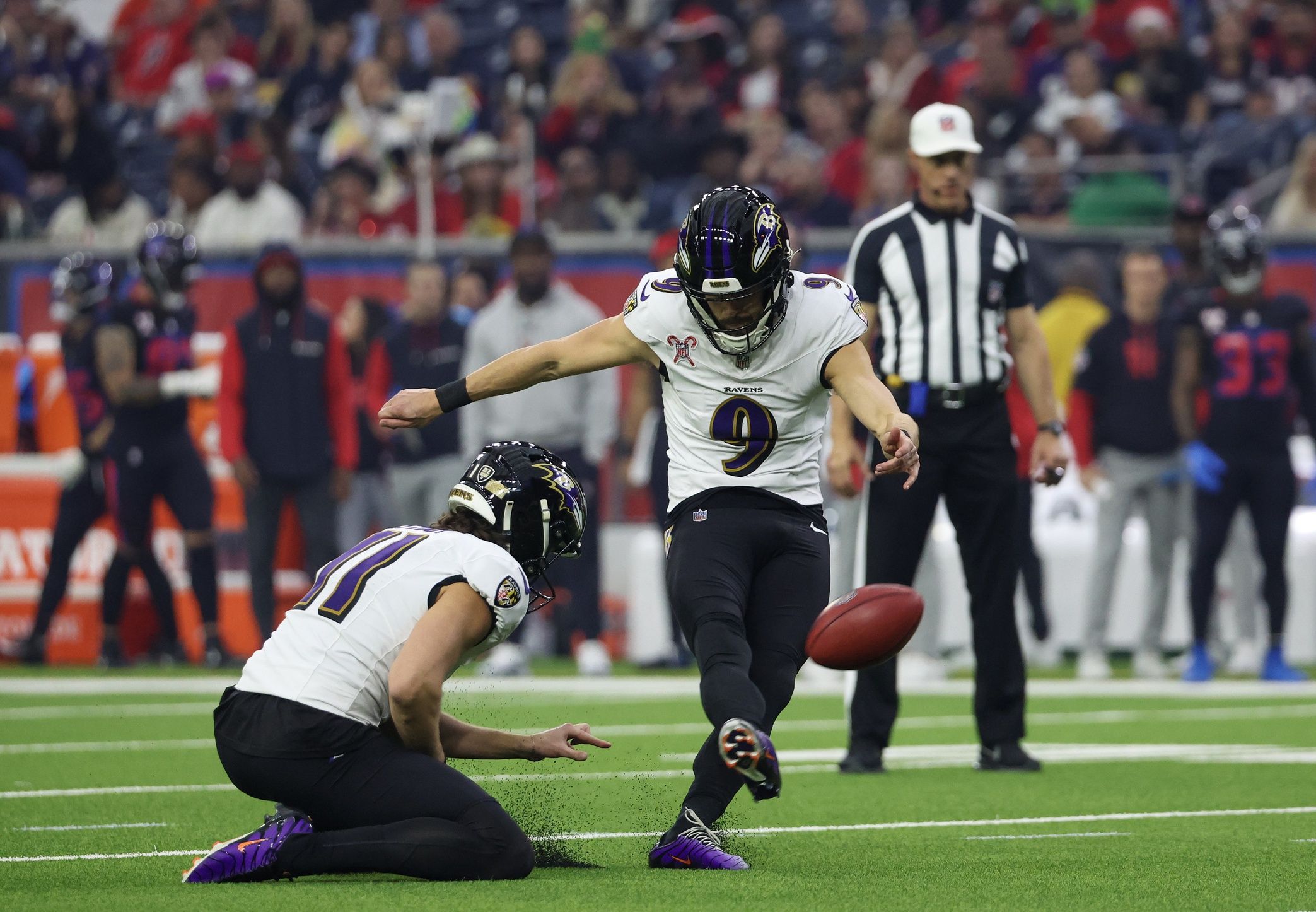
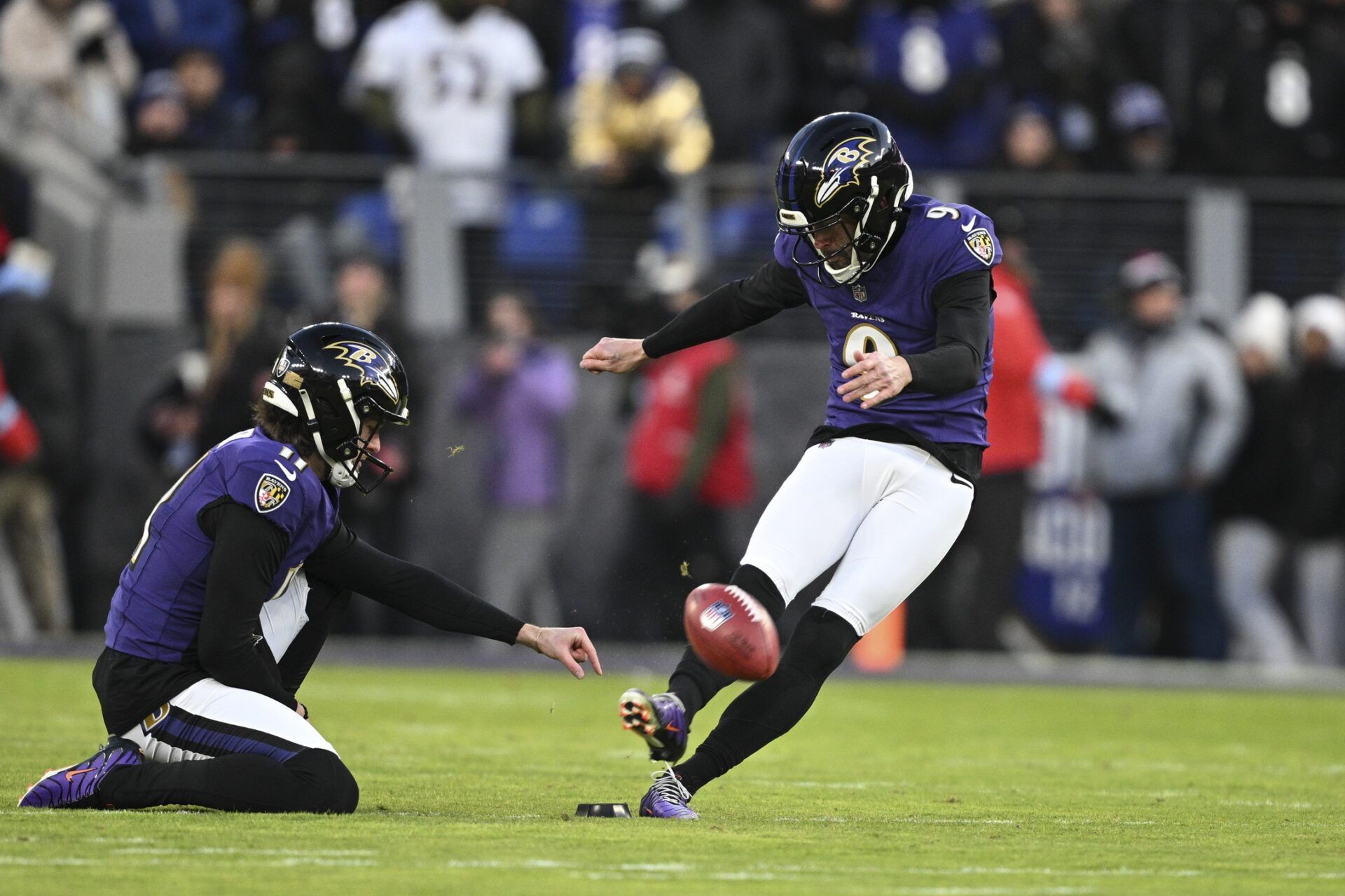
Kicking an NFL football under extreme pressure is a delicate chain reaction involving three distinct moving parts: the long snapper, the holder, and the kicker. When a kicker of Tucker's caliber experiences a sudden dip in accuracy, technical analysts examine both individual mechanics and unit execution.
- Long Snapper
- Holder (Placement/Laces)
- Kicker (Plant Foot & Swing)
- Snap-to-Kick Timing (<1.3s)
1. Long-Range Accuracy and Leg Speed
The primary area where Tucker struggled was on kicks measuring 50 yards or longer. Historically, Tucker was one of the most lethal deep-range kickers in league history. However, as kickers enter their mid-30s, natural ball velocity and leg speed can shift slightly.
To compensate for maximum distance on 55-plus yard attempts, kickers often adjust their strike angle, driving harder into the ball. This micro-adjustment can alter the plant foot location by an inch or two, causing the ball to hook left or push right. On several of Tucker's 50-plus yard misses, the ball started on a strong trajectory before drifting left outside the uprights, a classic sign of over-compensating for distance.
2. Operational Mechanics: Snap, Hold, and Rotation
Field goal operations require absolute synchronization. The entire process—from the snap hitting the holder's hands to the kicker making contact—must occur within roughly 1.25 to 1.30 seconds.
Following the retirement of long-time Ravens punter and holder Sam Koch, Baltimore transitioned to punter Jordan Stout handling holding duties alongside long snapper Nick Moore. While Stout is an accomplished punter, minor variations in lace placement, tilt angle, or spot timing can disorient a kicker’s established rythm. Even a quarter-turn deviation in how the football's laces face the uprights affects aerodynamic flight, particularly in wind-heavy venues like Baltimore's M&T Bank Stadium.
3. Plant Foot Positioning and Body Mechanics
Film breakdown by special teams analysts highlighted subtle inconsistencies in Tucker's plant foot placement during his 2024 slump. On several missed attempts, Tucker's left plant foot landed slightly behind or wide of the football.
When a kicker plants too far back, the kicking leg elevates prematurely, striking the lower half of the ball with an open clubface. This results in low trajectories or wide-right pushes. Conversely, planting too close forces the body to wrap around, causing hooks to the left.
Baltimore Ravens’ Response and Coaching Adjustments
Despite public debate regarding Tucker's status, the Baltimore Ravens organization maintained firm support for their star kicker. Head Coach John Harbaugh—himself a former special teams coordinator—publicly addressed the issue, rejecting any notion of replacing Tucker.
- Ravens Special Teams Diagnostic Plan
- Unit Synchronization
- Audit snap-to-hold timing
- Standardize laces rotation
- Practice under varied wind angles
- Biomechanical Audit
- Adjust plant-foot depth
- Refine contact follow-through
- Optimize leg speed efficiency
- Unit Synchronization
To resolve the issue, the Ravens implemented targeted operational refinements:
- Timing Audits: The coaching staff conducted micro-timing evaluations on snaps and holds during midweek practices to ensure Stout and Moore delivered the ball within Tucker's preferred rhythm window.
- Targeting Adjustments: Special teams coordinator Chris Horton worked with Tucker to adjust his aim points inside stadium corridors, adjusting for local crosswinds rather than relying solely on leg power to cut through the air.
- Volume Management: Recognizing the strain of mid-season rep load on a 35-year-old veteran, the coaching staff streamlined Tucker’s mid-week kick counts to preserve leg fatigue while emphasizing high-leverage scenario reps.
Impact on All-Time Records and Historical Standing
Justin Tucker's mid-career slump shifted the historical leaderboards for NFL kicking efficiency. For years, Tucker held a commanding lead in all-time field goal percentage over competitors like Eddy Piñeiro, Younghoe Koo, and Harrison Butker.
Due to the mathematical nature of career percentage metrics, a cluster of missed kicks late in a kicker's career impacts the cumulative percentage faster than early-career misses. When Tucker's career mark briefly dipped below 89.5%, he temporarily traded the #1 spot on the all-time field goal accuracy list with Atlanta Falcons kicker Younghoe Koo and Carolina Panthers kicker Eddy Piñeiro.
All-Time Field Goal Accuracy Leaders (Contextual Landscape)
| Player | Field Goal Accuracy |
|---|---|
| 1. Eddy Piñeiro | ~89.3% - 89.9% |
| 2. Justin Tucker | ~89.1% - 89.7% |
| 3. Harrison Butker | ~88.8% - 89.3% |
| 4. Younghoe Koo | ~88.0% - 88.5% |
| 5. Mike Vanderjagt | 86.5% (Retired Baseline) |
Despite the slight drop in cumulative percentage, sports historians and NFL analysts continue to recognize Tucker's baseline as one of the most impressive in league history. Unlike kickers who played predominantly in indoor domes, Tucker compiled his record while playing outdoors in harsh late-season AFC North weather conditions.
What Lies Ahead for Justin Tucker?
As Justin Tucker continues his professional career, both his personal trajectory and the Ravens' special teams philosophy reflect strategic adaptations designed for long-term consistency.
Contract and Roster Security
Tucker signed a lucrative four-year extension with the Ravens that runs through the 2025 season, making him one of the highest-paid kickers in the league. Given his historical leverage, high dead-cap hit, and elite standard performance, the Ravens retained full confidence in his role as their primary placekicker rather than pursuing mid-season replacement candidates.
Game-Management Strategy
To assist Tucker while he fine-tunes his deep-range mechanics, the Ravens' coaching staff adjusted their fourth-down decision-making matrix. On 4th-and-short situations near the opponent's 38-to-40-yard line (which translate to 55+ yard field goals), Baltimore became more inclined to keep quarterback Lamar Jackson and the offense on the field, reserving Tucker's field goal attempts for distances inside 52 yards where his operational success rate remains elite.
Frequently Asked Questions
Did Justin Tucker get injured during his 2024 accuracy slump?
Neither Justin Tucker nor the Baltimore Ravens reported any structural injuries, such as hip flexor strains or knee tears, during his 2024 slump. However, natural physical wear and tear associated with over a decade of high-volume NFL kicking can introduce subtle fatigue that affects mechanics.
Who holds the record for the longest field goal in NFL history?
Justin Tucker holds the record for the longest field goal in NFL history with a 66-yard conversion. He set the record on September 26, 2021, as time expired to give the Baltimore Ravens a 19-17 victory over the Detroit Lions at Ford Field.
Is Justin Tucker still the most accurate kicker in NFL history?
While Tucker held the official #1 spot in field goal accuracy percentage (over 300 attempts minimum) for nearly a decade, his mid-2024 slump caused his career conversion rate to slip slightly below 90%. This brought him into a tight, week-to-week battle for the top spot with active kickers Eddy Piñeiro and Harrison Butker.
Why did Justin Tucker miss so many kicks from 50+ yards in 2024?
The primary reasons for Tucker's long-range misses involved a combination of minor plant-foot placement errors, altered swing trajectories to generate max power, and subtle operational timing variations between long-snapper Nick Moore and holder Jordan Stout.
Practical Recommendation for Fantasy Managers and Analysts
When evaluating Justin Tucker for fantasy football rosters or analyzing Baltimore Ravens game strategies:
- Monitor Range Expectations: Treat Tucker as an elite, tier-one option for kicks under 50 yards, but account for potential variance on 53+ yard attempts in high-wind outdoor stadiums.
- Evaluate Stadium Conditions: Track weather reports for home games at M&T Bank Stadium and divisional road trips to Pittsburgh and Cleveland. Crosswinds above 15 mph significantly increase kicking variance for long-range attempts.
- Track Operational Stability: Pay attention to special teams health. When holder Jordan Stout and snapper Nick Moore operate seamlessly, Tucker's conversion rates inside 48 yards remain among the most reliable in football.
Image Gallery