Alastair Graham and the Shifting Landscape of Fintech Regulation
The evolving landscape of fintech regulation centers on automated compliance, robust digital identity verification, and real-time oversight. Industry leaders like Alastair Graham have championed regulatory technology (RegTech) solution...
The evolving landscape of fintech regulation centers on automated compliance, robust digital identity verification, and real-time oversight. Industry leaders like Alastair Graham have championed regulatory technology (RegTech) solutions that streamline Know Your Customer (KYC) and Anti-Money Laundering (AML) processes. Modern financial firms must navigate complex cross-border frameworks to maintain regulatory compliance while offering frictionless digital experiences.
Contents
Disclaimer: Regulatory requirements vary significantly across jurisdictions, financial product types, and institutional scales. The following analysis provides operational insight into regulatory technology trends but does not constitute formal legal or compliance counsel.
The Transformation of Financial Regulation and Regulatory Technology
Over the past decade, financial technology regulation has transitioned from reactive, post-hoc auditing to proactive, architecture-embedded compliance. In the early years of modern fintech, regulatory frameworks struggled to keep pace with rapid innovations in peer-to-peer lending, digital wallets, decentralized finance, and open banking APIs. Regulators initially applied legacy banking rules to digital-first models, creating operational bottlenecks and regulatory uncertainty for emerging fintech firms.
This dynamic created the need for specialized regulatory technology (RegTech). Industry leaders, including Alastair Graham—known for advocating privacy-centric digital identity verification and compliance infrastructure—helped shape how financial institutions approach regulatory obligations. Rather than viewing compliance as a static legal checklist, modern financial architecture incorporates compliance directly into the software stack.
Today, real-time transaction monitoring, automated identity verification, and algorithmic risk profiling form the foundation of global financial compliance. Regulators around the world now demand programmatic compliance capabilities, expecting financial institutions to detect fraudulent activity, verify user identities, and enforce sanctions screening instantly upon customer onboarding and throughout the customer lifecycle.
Key Drivers Reshaping Fintech Compliance
The fintech regulatory landscape is defined by several converging legislative initiatives and regulatory standards. Operating across international borders requires a clear understanding of these distinct compliance vectors:
- Customer Onboarding
- Digital ID Verification
- AML / Sanctions Screening
- Real-Time Monitoring
- Automated Audit Reporting
1. Anti-Money Laundering and Counter-Terrorist Financing (AML/CTF)
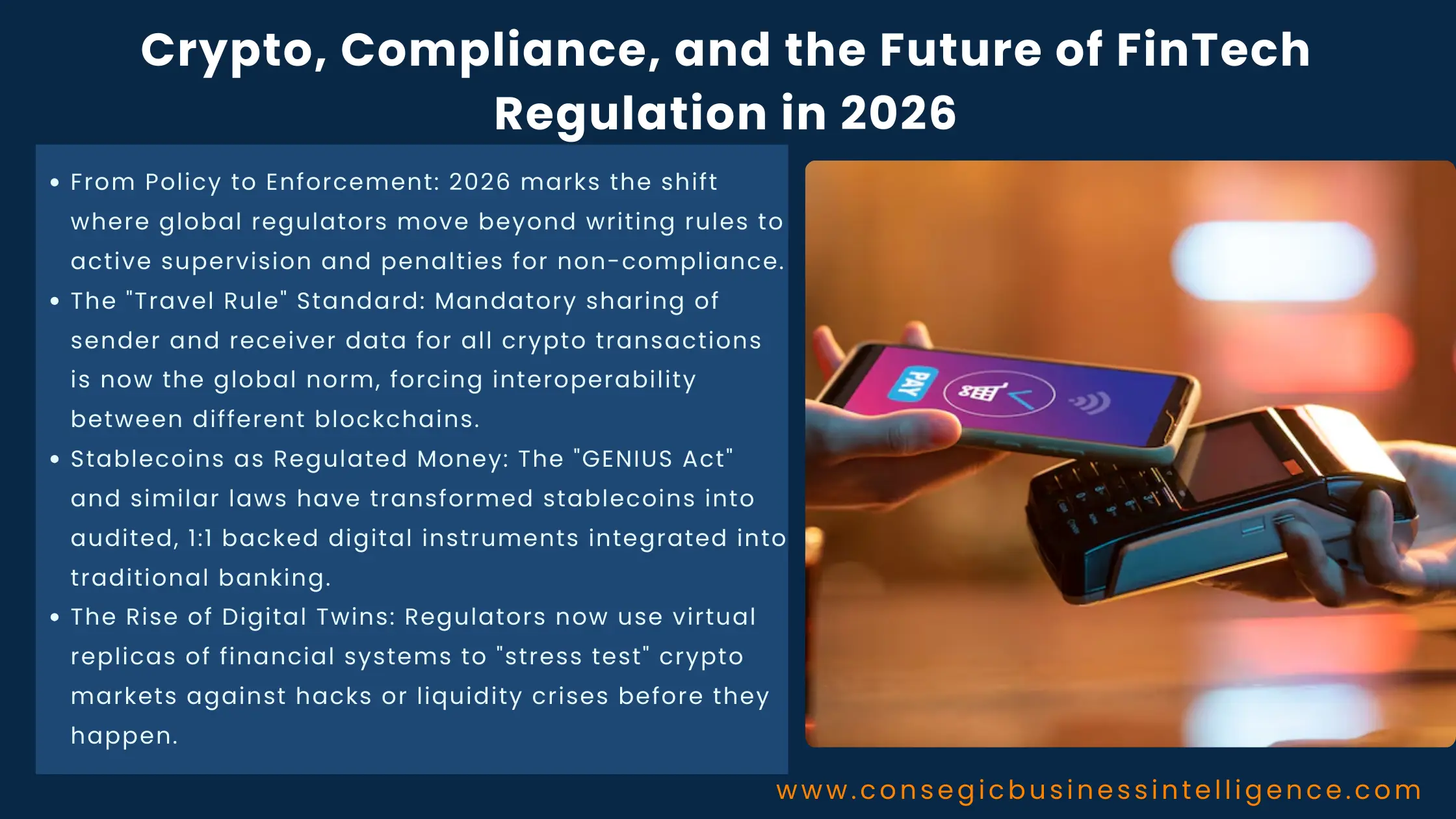
Global bodies such as the Financial Action Task Force (FATF) have continuously updated their guidance to address digital assets, cross-border payment rails, and synthetic identity fraud. Directives such as the European Union’s Sixth Anti-Money Laundering Directive (AMLD6) and updated FinCEN regulations in the United States hold corporate officers personally liable for systemic compliance failures. Furthermore, the implementation of the FATF "Travel Rule" across crypto-asset service providers (CASPs) requires fintech firms to pass originator and beneficiary information alongside transaction payloads.
2. Digital Identity and Privacy-Preserving Verification
Digital identity verification sits at the center of modern RegTech. Pioneer contributions in this space, such as those by Alastair Graham in age and identity verification tech, demonstrate how organizations can fulfill strict regulatory mandates without needlessly compromising consumer data privacy. Standardized frameworks like the European Union’s eIDAS 2.0 regulation (and its European Digital Identity Wallet provisions) alongside the UK Digital Identity and Attributes Trust Framework (DIATF) establish technical and legal standards for reusable digital identities.
3. Open Banking and Payment Services Evolution
The transition from Europe's Payment Services Directive 2 (PSD2) to PSD3 and the Payment Services Regulation (PSR) reflects an ongoing shift toward open finance. Regulatory bodies are strengthening Strong Customer Authentication (SCA) provisions, broadening access to payment systems for non-bank payment institutions, and mandating stricter API uptime and security protocols to protect consumer financial data from unauthorized access.
4. Data Protection and Consumer Duty Mandates
Frameworks like the General Data Protection Regulation (GDPR) and the UK Financial Conduct Authority’s (FCA) Consumer Duty mandate that fintech companies prioritize customer outcomes and data minimization. Regulators require financial entities to demonstrate that their algorithmic models—used for credit scoring, fraud detection, and insurance underwriting—are non-discriminatory, auditable, and transparent.
Alastair Graham’s Impact on Identity-Driven RegTech
In the broader context of regulatory technology, Alastair Graham has consistently advocated for identity frameworks that balance compliance mandates with user privacy and operational efficiency. Identity verification is frequently the primary friction point in digital financial onboarding. Excessive friction leads to customer drop-off, while insufficient verification exposes institutions to financial crime and severe regulatory fines.
Graham’s work within identity verification highlights several architectural principles that have become standard in modern fintech engineering:
- Data Minimization: Verifying attributes (such as age, residency, or accreditation status) without storing unnecessary personally identifiable information (PII). By relying on cryptographic proofs or tokenized verification responses, fintechs reduce their data liability under GDPR and CCPA.
- Interoperable Verification Standards: Building verification systems that align with global regulatory specifications, enabling a user verified in one jurisdiction to interact with services in another without repeating redundant verification checks.
- Zero-Knowledge Proofs (ZKPs): Implementing privacy-enhancing technologies that allow a fintech application to confirm a financial attribute (e.g., verifying that a user's account balance exceeds a required threshold) without disclosing exact underlying data.
By embedding these principles into regulatory compliance systems, financial institutions satisfy legal requirements while maintaining streamlined customer journeys.
Global Fintech Regulatory Landscape Matrix
The following table compares primary fintech regulatory regimes, key oversight bodies, core focus areas, and compliance obligations across major global financial jurisdictions:
| Jurisdiction | Primary Regulatory Bodies | Key Legislative Frameworks | Dominant Regulatory Focus | Core Technological Requirement |
|---|---|---|---|---|
| European Union | EBA, ESMA, ECB | AMLD6, eIDAS 2.0, PSD3/PSR, MiCA, DORA | Operational resilience, crypto assets, cross-border identity | ISO 20022 compliance, strong authentication, resilient cloud infrastructure |
| United Kingdom | FCA, PRA, ICO | UK GDPR, Consumer Duty, DIATF, FSMA | Fair customer outcomes, digital identity trust, open banking | Automated audit trails, risk-based KYC, API security protocols |
| United States | FinCEN, SEC, CFTC, CFPB | Corporate Transparency Act, Bank Secrecy Act (BSA), Dodd-Frank | Anti-money laundering, beneficial ownership disclosure, investor protection | Real-time transaction surveillance, SAR filing automation, identity validation |
| Singapore / APAC | MAS (Monetary Authority of Singapore) | Payment Services Act, Personal Data Protection Act (PDPA) | Cross-border retail payments, digital banking licensing, sandbox innovation | Singpass integration, API-driven regulatory reporting, real-time screening |
Operational Roadmap: Building a Modern Regulatory Architecture
For fintech executives, compliance officers, and system architects, navigating modern regulatory requirements demands a structured operational approach. Implementing a robust compliance engine involves clear procedural phases:
- Step 1: Gap & Risk Assessment
- Step 2: API & Infrastructure Selection
- Step 3: Policy Configuration & Rule Engines
- Step 4: Audit & Continuous Monitoring
- Step 3: Policy Configuration & Rule Engines
- Step 2: API & Infrastructure Selection
Step 1: Conduct Jurisdictional and Product Risk Assessments
Identify the specific regulatory authorities governing your product suite and target customer demographics. Determine whether your service acts as a primary balance-sheet holder, an intermediary payment processor, or a non-custodial software layer. Each classification triggers distinct licensing, capital reserve, and AML reporting requirements.
Step 2: Implement an API-First Identity and Verification Layer
Deploy specialized RegTech APIs for onboarding and ongoing customer monitoring. Rather than building proprietary verification logic from scratch, integrate established identity providers capable of performing:
- Document authenticity verification (OCR and biometric liveness detection).
- Politically Exposed Persons (PEP) and sanctions list screening.
- Adverse media monitoring integrated into automated workflow triggers.
Step 3: Configure Privacy-Preserving Data Architecture
Structure data repositories to isolate sensitive PII from operational databases. Ensure that customer records subject to data retention laws (such as 5-year AML record-keeping rules) are encrypted at rest and in transit using hardware security modules (HSMs). Apply data tokenization so that internal operational tools process references rather than raw identifiers.
Step 4: Establish Continuous Automated Transaction Monitoring
Static onboarding checks are no longer sufficient under modern regulatory guidelines. Implement real-time transaction monitoring engines that employ machine learning alongside rule-based systems to detect unusual velocity, geographic anomalies, or suspicious wallet interactions. Configure automated alerts that queue flagged events for human compliance analyst review.
Step 5: Maintain Audit-Ready Governance and Reporting Systems
Ensure that all system decisions—such as automated identity approvals, risk scoring outputs, and transaction blocks—generate immutable, time-stamped log files. Regulators expect financial institutions to demonstrate the precise logic behind automated compliance decisions during periodic audits or supervisory reviews.
Emerging Regulatory Challenges
As the financial ecosystem evolves, compliance teams face several emerging systemic challenges:
Artificial Intelligence Governance and Algorithmic Bias
The integration of generative AI and automated decisioning tools in credit underwriting, fraud prevention, and customer support has drawn increased regulatory scrutiny. Frameworks such as the EU AI Act classify AI systems used in credit scoring and risk assessment as high-risk, requiring continuous bias audits, human oversight mechanisms, and explicit model explainability.
Operational Resilience and Third-Party Risk Management
Regulators are shifting focus from purely financial stability to operational resilience. Under legislation like the EU’s Digital Operational Resilience Act (DORA), fintech firms and their critical ICT (Information and Communication Technology) providers must demonstrate robust cybersecurity posture, continuous vulnerability management, and tested business continuity plans to withstand systemic technical outages.
Decentralized Finance and Cross-Border Interoperability
Regulating non-custodial software protocols and cross-border digital asset transfers remains one of the most complex policy areas. Financial regulators are increasingly targeting the entry and exit ramps of decentralized finance, mandating that gateway providers enforce strict KYC and transaction tracing standards before interacting with public blockchain networks.
Frequently Asked Questions
How does digital identity verification impact fintech regulatory compliance?
Digital identity verification serves as the initial gatekeeper for financial compliance. By automating Know Your Customer (KYC) checks using document verification, liveness checks, and authoritative database matching, fintechs meet legal AML obligations while reducing customer drop-off during onboarding.
What role does RegTech play in meeting AML and KYC obligations?
RegTech automates manually intensive compliance workflows. It provides real-time sanctions screening, transaction monitoring, customer risk profiling, and regulatory reporting, allowing financial institutions to manage high transaction volumes efficiently while lowering risk of human error.
How do privacy laws like GDPR interact with AML data retention requirements?
Privacy laws like GDPR enforce data minimization and the "right to be forgotten," whereas AML regulations mandate retaining customer identity and transaction logs for specified periods (typically 5 to 10 years). In practice, statutory AML retention obligations supersede deletion requests for compliance-related records, but financial institutions must strictly isolate and protect that data from secondary commercial uses.
What is the significance of eIDAS 2.0 for European fintechs?
eIDAS 2.0 introduces standardized European Digital Identity Wallets, enabling citizens across EU member states to share verified identity credentials securely. For fintechs, this harmonizes customer onboarding across borders, reduces verification costs, and provides trusted, cryptographic proof of customer attributes.
How should early-stage fintechs structure their compliance management programs?
Early-stage fintechs should adopt a risk-based approach. Rather than attempting to build internal compliance technology from scratch, startups should leverage validated third-party RegTech APIs for KYC, AML, and transaction monitoring, while appointing dedicated compliance leadership to oversee policy configuration, regulatory relationships, and independent audits.
Strategic Recommendations for Industry Leaders
To succeed in an increasingly regulated market, fintech executives and technical leaders should take the following actions:
- Prioritize Privacy by Design: Follow identity architectures advocated by pioneers like Alastair Graham by minimizing PII storage and adopting privacy-preserving verification mechanisms.
- Unify Compliance and Product Development: Treat compliance as a core feature rather than a late-stage hurdle. Involve compliance officers and regulatory architects during the initial product design phases.
- Invest in Scalable RegTech Infrastructure: Replace fragmented manual review processes with API-driven RegTech solutions that support automated reporting, multi-jurisdictional rules, and continuous transaction surveillance.
- Prepare for Operational Resilience Audits: Review infrastructure dependencies, cloud vendor agreements, and incident response plans to ensure full compliance with operational resilience regulations like DORA and FCA standards.
Image Gallery