Understanding Workers' Comp Foot Injury Settlements: Valuation, Process, and Key Factors
A workers' compensation foot injury settlement provides financial compensation to an employee who suffers a foot injury on the job. The settlement covers permanent disability, past and future medical expenses, and lost wages. Final pay...
A workers' compensation foot injury settlement provides financial compensation to an employee who suffers a foot injury on the job. The settlement covers permanent disability, past and future medical expenses, and lost wages. Final payout values depend on injury severity, state statutory benefit schedules, maximum medical improvement (MMI) ratings, and long-term work restrictions.
Contents
The Nature of Workplace Foot Injuries and Medical Severity
Workplace foot injuries range from minor soft tissue strains to catastrophic crush injuries requiring amputation or joint fusion. The foot contains 26 bones, 33 joints, and over 100 muscles, tendons, and ligaments. Because the feet bear the full body weight during standing, walking, and lifting, even minor structural damage can result in permanent functional limitations.
Common work-related foot injuries include:
- Calcaneus Fractures: Fractures of the heel bone often occur due to falls from ladders, scaffolding, or heavy machinery. Calcaneus fractures frequently involve the subtalar joint, leading to chronic stiffness, permanent gait alteration, and secondary osteoarthritis.
- Lisfranc Injuries: Disruption of the midfoot ligaments and metatarsal joints often results from heavy objects falling on the foot or rotational twists. These injuries frequently require open reduction and internal fixation (ORIF) surgery or midfoot arthrodesis (fusion).
- Metatarsal Fractures: Fractures to the long bones of the foot can occur from direct impacts or repetitive stress. While simple fractures heal with casting, complex displaced fractures require surgical pins or plates.
- Crush Injuries: High-impact workplace accidents involving heavy equipment, forklifts, or industrial machinery can cause multi-tissue crushing, tissue necrosis, compartment syndrome, or traumatic amputation.
- Complex Regional Pain Syndrome (CRPS): A severe, chronic pain condition that sometimes develops after nerve injury or trauma to an extremity. CRPS causes burning pain, swelling, hypersensitivity, and thermal skin changes.
Understanding the specific medical diagnosis is the foundation of any workers' compensation claim. Insurance adjusters evaluate claims based on objective diagnostic imaging—such as X-rays, CT scans, and MRIs—as well as operative reports and functional capacity evaluations (FCE).
How Workers' Comp Foot Injury Settlements Are Calculated
Workers' compensation is a state-regulated system. Payout calculations vary significantly across jurisdictions, but most states utilize standardized formulas based on statutory schedules, average weekly wages, and impairment ratings.
Total Disability Value = (AMA Impairment Rating %) × (Statutory Schedule Weeks) × (Weekly Benefit Rate)
1. Scheduled vs. Unscheduled Injury Guidelines
Most state workers' compensation systems classify foot injuries as scheduled injuries. A statutory schedule assigns a maximum number of weeks of wage replacement benefits for the total loss—or loss of use—of a specific body part.
For example, a state statute might assign 150 to 250 weeks of benefits for the loss of a foot. If a physician determines an employee has suffered a 20% permanent loss of function in their foot, the employee receives 20% of the maximum statutory weeks assigned to the foot.
Some complex conditions, such as CRPS or injuries that extend into the ankle and knee, may be reclassified as unscheduled injuries or body-as-a-whole claims. Unscheduled claims evaluate loss of wage-earning capacity rather than strict anatomical loss, often yielding higher settlement values.
2. Average Weekly Wage (AWW)
The financial baseline for disability payments is the worker's Average Weekly Wage (AWW) calculated over a specific period before the injury (typically 52 weeks). Temporary Total Disability (TTD) and Permanent Partial Disability (PPD) benefits are generally calculated at two-thirds (66.67%) of the AWW, subject to state minimum and maximum statutory caps.
3. Maximum Medical Improvement (MMI) and Impairment Ratings
A settlement cannot be accurately calculated until an injured worker reaches Maximum Medical Improvement (MMI). MMI occurs when a treating physician determines that the worker's condition has stabilized and further medical treatment will not result in significant anatomical or functional recovery.
Upon reaching MMI, an evaluating physician assigns a permanent impairment rating using the American Medical Association (AMA) Guides to the Evaluation of Permanent Impairment (typically the 5th or 6th Edition, depending on the state). This percentage directly dictates the PPD payout.
Comparative Overview: Average Settlement Factors by Foot Injury Type
Settlement values vary based on the nature of the damage, required surgical interventions, and long-term functional loss. The following table highlights common injury scenarios and their key settlement considerations.
| Foot Injury Type | Typical AMA Impairment Rating Range | Standard Recovery Window | Primary Settlement Drivers |
|---|---|---|---|
| Simple Metatarsal Fracture | 0% – 8% Foot Impairment | 8 – 16 Weeks | Conservative care costs, temporary lost wages, minimal residual disability. |
| Lisfranc Dislocation / Midfoot ORIF | 10% – 25% Foot Impairment | 6 – 12 Months | Surgical expenses, hardware removal, early post-traumatic arthritis risk. |
| Calcaneus (Heel) Fracture | 15% – 40% Foot Impairment | 9 – 18 Months | Subtalar fusion requirements, permanent standing/walking restrictions, gait modification. |
| Severe Crush / Partial Amputation | 35% – 80% Foot Impairment | 12 – 24+ Months | Prosthetics, adaptive orthotics, job re-training, potential body-as-a-whole rating. |
| Complex Regional Pain Syndrome (CRPS) | 20% – 100% Whole Person | Indefinite / Chronic | Long-term pain management, spinal cord stimulators, loss of earning capacity. |
Types of Workers' Compensation Settlement Agreements
When closing a workers' compensation claim, parties generally select between two main settlement structures:
Compromise and Release (C&R)
A Compromise and Release is a full and final settlement in which the injured worker receives a single lump sum (or structured annuity) in exchange for closing the entire claim. This releases the employer and legal insurer from all future liability, including future medical bills and ongoing wage replacement.
- Advantage: Provides an immediate lump sum of capital and operational independence from the insurance carrier.
- Caution: The worker becomes personally responsible for paying all future medical treatment related to the foot.
Stipulated Findings and Award (Stipulation)
Under a Stipulated Award, the injured worker and insurer agree on the permanent disability rating and the weekly benefit payment amount. However, the insurer retains responsibility for paying reasonable and necessary future medical treatment related to the industrial foot injury.
- Advantage: Secures ongoing medical coverage for chronic pain management, future surgeries, or orthotics.
- Caution: Payouts are distributed over a weekly schedule rather than a single lump sum, and the insurance company remains involved in approving treatment decisions.
Key Factors That Increase or Decrease Settlement Values
Insurance adjusters evaluate several risk factors when proposing settlement figures. Claimants and legal advisors focus on these elements during negotiations:
Factor Analysis: High Impact: Future Surgery Needs + Permanent Work Restrictions + High Pre-Injury AWW Low Impact: Full Recovery without Hardware + Pre-Existing Conditions without Exacerbation
- Future Medical Expenses: If orthopedic experts testify that an injured worker will require secondary surgeries (such as subtalar joint fusion or hardware removal) or lifetime prescription management, the projected cost of care must be built into a lump-sum settlement.
- Permanent Work Restrictions: If an employee cannot return to work that requires standing, climbing, or heavy lifting, the insurer must account for vocational rehabilitation or permanent partial disability adjustments.
- Apportionment and Pre-Existing Conditions: Insurers often attempt to reduce payouts by asserting that residual pain or arthritis stems from pre-existing joint degeneration, previous sports injuries, or diabetes-related neuropathy. Clear medical evidence must prove the workplace accident was the primary cause or significant aggravator of the disability.
- Medicare Set-Aside (MSA) Requirements: If a claimant is currently enrolled in Medicare or has a reasonable expectation of enrolling within 30 months, federal regulations require a portion of the settlement to be allocated into a Medicare Set-Aside account to cover future injury-related medical expenses that Medicare would otherwise cover.
Step-by-Step Guide to Navigating a Foot Injury Settlement
Navigating a workers' compensation claim requires strategic medical and legal decisions to ensure fair valuation.
Step 1: Report & Seek Treatment ➔ Step 2: Complete Rehab & Reach MMI ➔ Step 3: Formal Impairment Rating ➔ Step 4: Calculate Future Costs ➔ Step 5: Finalize Settlement Structure
Step 1: File Formal Reports and Seek Care
Immediately report the incident to employer management in compliance with state reporting deadlines (often within 30 days). Obtain medical care from an authorized provider and detail every foot symptom, including heel pain, numbness, swelling, and inability to bear weight.
Step 2: Complete Treatment and Reach MMI
Follow all prescribed physical therapy regimens, wear recommended supportive orthotics or boots, and undergo surgery if recommended. Do not engage in premature settlement discussions while active healing is taking place. Settling before reaching MMI risks underestimating long-term medical costs.
Step 3: Obtain a Formal Impairment Rating
Once MMI is reached, undergo an independent evaluation by a physician trained in the AMA Guides. If the insurance company's chosen doctor assigns an unfairly low rating, the injured worker can request a panel evaluation or obtain a Qualified Medical Evaluator (QME) opinion, depending on state law.
Step 4: Calculate the Comprehensive Claim Value
Itemize all claim components:
- Unpaid past medical bills.
- Future medical needs (orthotics, injections, physical therapy, fusion surgery).
- Permanent Partial Disability benefit totals based on statutory week multipliers.
- Vocational rehabilitation vouchers or retraining stipends.
Step 5: Negotiate and Secure Administrative Approval
Submit the settlement demand to the insurance company. Negotiate the settlement structure (C&R vs. Stipulation). Once an agreement is reached, the settlement document must be reviewed and approved by a Workers' Compensation Administrative Law Judge to ensure statutory fairness.
Common Pitfalls in Foot Injury Claims
- Failing to Document Non-Foot Symptoms: Foot injuries frequently alter gait patterns, leading to secondary back, hip, or knee pain (referred to as kinetic chain issues). If these secondary conditions are not documented early, insurers may refuse to include them in the final valuation.
- Accepting the First Settlement Offer: Initial settlement offers from insurance carriers routinely omit projections for future orthotics, prescription management, or hardware removal procedures.
- Ignoring Medicare Guidelines: Closing a claim with a lump sum without considering Medicare rules can result in Medicare denying coverage for future foot care.
Frequently Asked Questions
How much is an average workers' comp settlement for a foot injury?
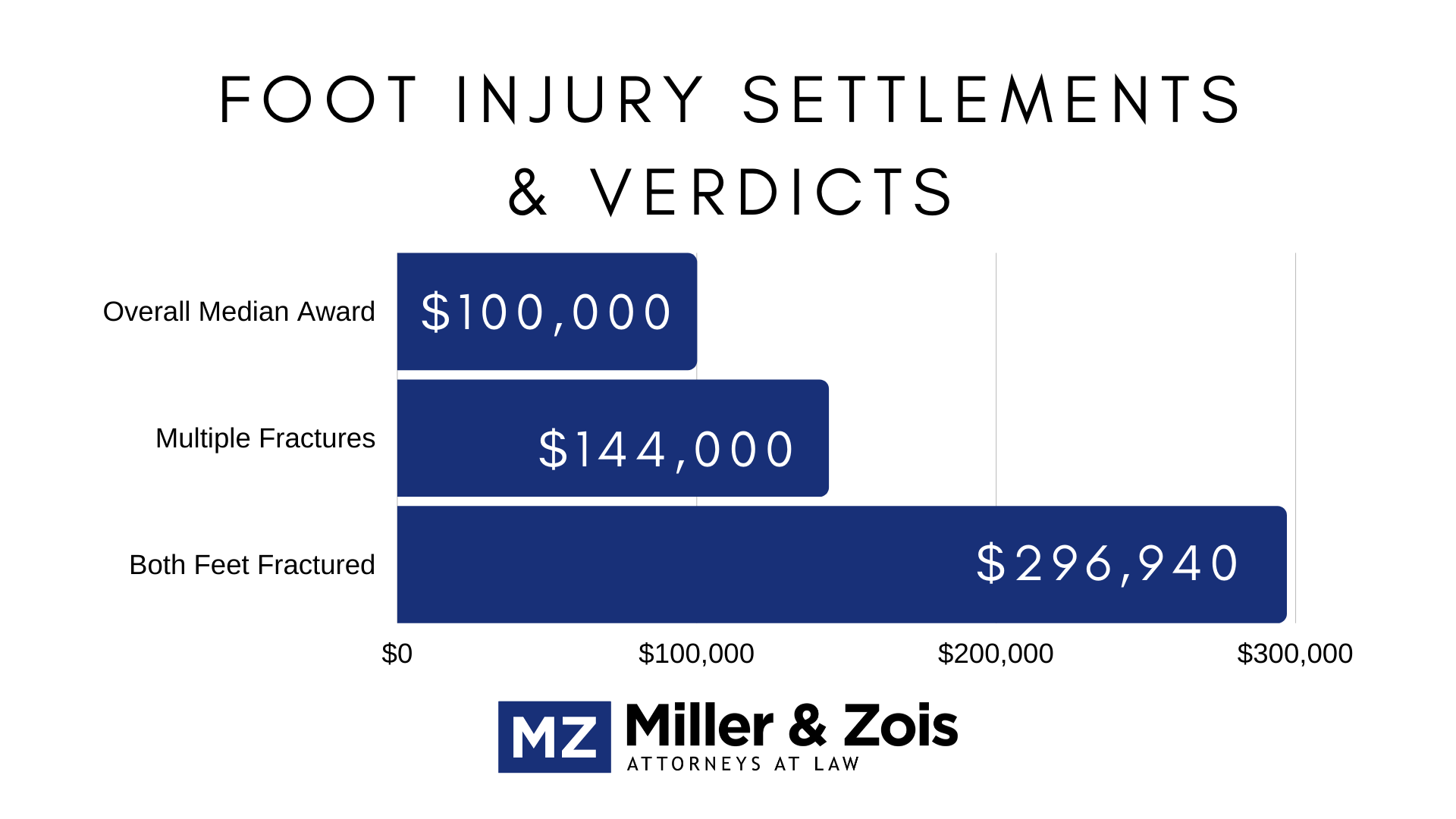
Settlement amounts vary widely based on jurisdiction, injury severity, and average weekly wage. Minor fractures with full recovery may settle between $5,000 and $15,000, whereas severe heel fractures, joint fusions, or crush injuries resulting in permanent work restrictions can range from $40,000 to over $150,000.
Can I collect a workers' comp settlement if I return to work?
Yes. Permanent Partial Disability (PPD) benefits compensate for permanent anatomical loss of function, regardless of whether you return to work. However, returning to your pre-injury job at full wage may impact entitlement to additional vocational loss-of-wage benefits.
What is the difference between a foot injury and an ankle injury in statutory schedules?
State statutes treat feet and ankles differently. Under most scheduled benefit tables, an ankle injury is classified as part of the leg, which typically carries a higher statutory maximum number of benefit weeks (e.g., 288 weeks for a leg versus 205 weeks for a foot). Correct legal classification of the joint boundary is critical during medical rating.
How long does it take to finalize a workers' compensation settlement?
Finalizing a settlement typically takes between 6 and 18 months. The primary delay factor is the time required for the worker to complete medical treatment, reach MMI, and obtain official impairment ratings.
Will a foot injury settlement cover future replacement of custom orthotics or braces?
Only if these costs are explicitly calculated and built into a Compromise and Release lump-sum agreement, or if you enter into a Stipulated Award that leaves medical benefits open. Custom foot orthotics require replacement every 1 to 3 years, so these long-term expenses should be factored into cash settlement proposals.
Actionable Next Steps for Claimants
If you are dealing with a workplace foot injury, prioritize your physical recovery by completing all doctor-recommended care until your condition stabilizes. Avoid settling your claim while actively undergoing therapy or considering surgical options. Request complete copies of your medical records and diagnostic scans, track all out-of-pocket medical expenses, and consider consulting a licensed workers' compensation attorney to review your state's specific statutory schedule before signing any settlement release.
Disclaimer: Workers' compensation statutes and regulations vary significantly by state and legal jurisdiction. This article is for informational purposes only and does not constitute formal legal or medical advice. Consult a qualified workers' compensation attorney or state labor board official regarding your specific claim.
Image Gallery