Optimizing Corporate Spend with Business Rewards Cards: A Strategic Selection Guide
Business rewards cards are commercial credit products designed for registered companies, small businesses, and sole proprietors to earn cash back, flexible points, or travel miles on everyday operational expenses. By aligning major cor...
Business rewards cards are commercial credit products designed for registered companies, small businesses, and sole proprietors to earn cash back, flexible points, or travel miles on everyday operational expenses. By aligning major corporate spending categories—such as digital advertising, client travel, office utilities, and recurring SaaS subscriptions—with optimized card reward structures, business owners can convert routine operating overhead into direct financial returns and valuable capital liquidity.
Contents
The Core Mechanics of Business Rewards Credit Cards
Business rewards cards operate similarly to consumer credit cards, but they feature credit limits, category multipliers, and administrative tools tailored specifically to commercial operations. When a business makes purchases using a rewards card, the issuing bank returns a percentage of the transaction value to the cardholder. This return is delivered as cash credit, proprietary bank points, or co-branded loyalty program miles.
Unlike consumer products, business card accounts allow primary account holders to issue multiple employee cards with customized spending limits, real-time transaction tracking, and merchant category restrictions. These administrative controls streamline expense management while aggregating points across the entire organization into a central business account.
How Reward Accumulation and Redemption Function
Earnings on business rewards cards are calculated based on earn rates. These rates are expressed either as a percentage of spend (e.g., 2% cash back) or as point multipliers per dollar spent (e.g., 3x points on travel expenses).
Total Reward Value = Total Category Spend × Category Multiplier × Point Redemption Value
The true value of any rewards card depends not only on how quickly points accumulate, but also on the baseline redemption value of those points:
- Cash Back: Represents the simplest structure, offering a fixed cash value (typically $0.01 per point or percentage point) that can be applied as a statement credit or deposited directly into a linked business checking account.
- Flexible Bank Points: Issued by major banking institutions, these points can be redeemed through issuer booking portals or transferred directly to partner airline and hotel loyalty programs. Point values often range from $0.01 to $0.02 depending on the redemption channel.
- Co-Branded Loyalty Miles: Earned directly within specific airline or hotel reward ecosystems. Value is dependent on the specific award chart and seat/room availability of the partner program.
Evaluating Primary Business Rewards Card Structures
Selecting the correct reward card structure depends heavily on a business's operational spending patterns, cash flow requirements, and financial management preferences.
- Analyze Primary Expense Categories
- Broad Spending Profile (Utilities, Rent, Misc)
- Flat-Rate Cash Back Card (e.g., 2% on all spend)
- Concentrated Spend (Travel, Ads, Telecom)
- Tiered Category Card (e.g., 3x-5x on specific zones)
- Broad Spending Profile (Utilities, Rent, Misc)
1. Flat-Rate Rewards Cards
Flat-rate cards offer a predictable reward percentage—typically between 1.5% and 2%—on every eligible transaction regardless of spending category.
- Best Suited For: Businesses with diverse operating expenses that do not concentrate heavily in standard bonus categories like travel or shipping.
- Key Advantage: Eliminates the complexity of tracking spending caps or shifting categories.
- Operational Trade-off: Yields lower maximum returns compared to targeted category cards on high-volume spending areas.
2. Tiered and Category-Specific Cards
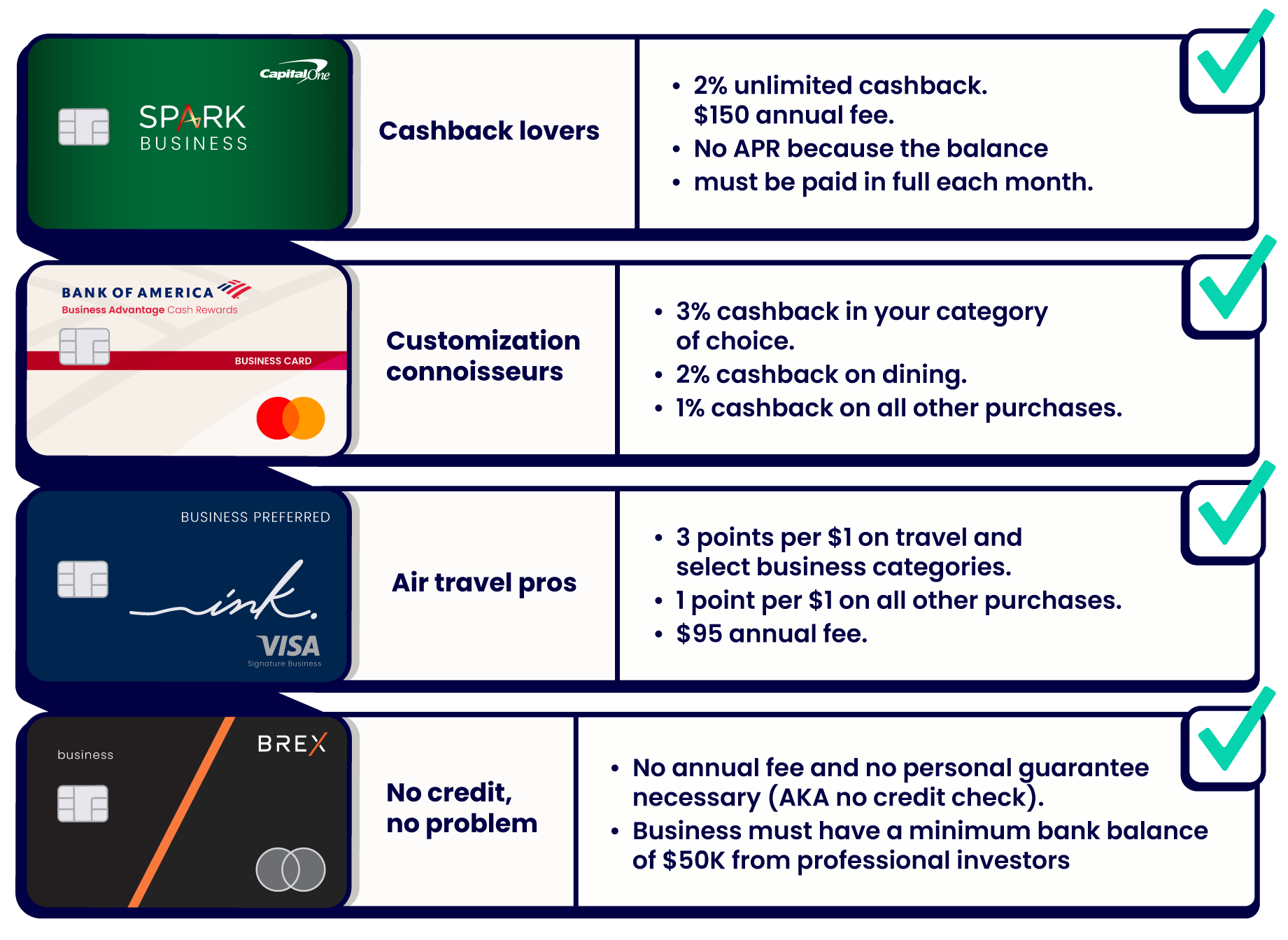
Category-based rewards cards deliver higher multipliers (ranging from 3x to 5x points or percent back) on designated business spending sectors while offering a baseline 1x return on all un-categorized purchases. Common elevated reward categories include:
- Digital advertising and social media marketing spending.
- Telecommunications, mobile service, and office supply providers.
- Gas stations, EV charging network fees, and logistics expenditures.
- Commercial software, cloud computing, and hardware acquisitions.
Category cards often impose annual spend caps (for example, 5x earnings on the first $150,000 spent per policy year), after which the earn rate drops to the baseline 1% or 1x rate.
3. Premium Travel and Transferable Points Cards
Designed for executives and enterprises with substantial business travel requirements, premium travel cards combine elevated point earnings on flights, hotels, and vehicle rentals with premium perks such as airport lounge access, travel insurance protections, and elite status upgrades.
The primary advantage of transferable points systems is their flexibility. Points earned through issuers like American Express, Chase, or Capital One can be transferred directly to secondary airline and hotel loyalty accounts. This maneuver frequently yields an effective value above $0.02 per point when redeemed for premium travel cabins or peak season accommodations.
Business Rewards Card Comparison Matrix
The table below outlines how different rewards card structures align with various organizational spending profiles, administrative requirements, and financial targets.
| Card Category | Average Earn Structure | Typical Annual Fee | Key Target Expenses | Primary Benefit / Value Driver |
|---|---|---|---|---|
| Flat-Rate Cash Back | 1.5% – 2.0% on all spend | $0 – $95 | General business overhead, inventory, client entertainment | Straightforward cash liquidity; no spending cap tracking |
| Category-Bonus | 3x – 5x on select tiers; 1x baseline | $0 – $295 | Search/social ads, telecommunications, office supplies | Maximizes returns on concentrated spending categories |
| Premium Travel | 2x – 5x on travel bookings; 1x baseline | $395 – $695 | Airfare, hotels, rental cars, client transportation | Global lounge access, point transferability, trip protection |
| No-Fee Utility | 1.5x – 3x on core utilities | $0 | Gas, electric, shipping, internet, phone services | Minimal overhead risk; reliable return on monthly fixed bills |
Qualification Requirements and Application Criteria
Applying for a business rewards card requires providing both business operational details and personal identity verification. Financial institutions evaluate both the credit profile of the primary applicant and the legal structure of the business entity.
Essential Documentation and Data Points
When submitting an application, business owners must present specific verifiable details:
- Legal Entity Information: Registered business name, Doing Business As (DBA) designation, Federal Tax ID or Employer Identification Number (EIN), business address, and legal structure (Sole Proprietorship, LLC, S-Corp, C-Corp). Sole proprietors may apply using their Social Security Number (SSN).
- Financial Metrics: Annual gross business revenue, estimated monthly spending volume on the card, and years of corporate operation.
- Owner Verification: Personal identity data, residential address, ownership percentage, and personal income of all key stakeholders owning 25% or more of the company.
Credit Evaluation and The Personal Guarantee
Most small-to-medium enterprise (SME) rewards cards require a Personal Guarantee (PG). A personal guarantee makes the individual applicant personally liable for any unpaid balances incurred by the company.
Because of the PG requirement, card issuers conduct a personal credit check on the primary applicant during evaluation. A personal credit score in the good-to-excellent range (typically 670+ for basic cards, 740+ for premium cards) is generally required for approval.
While personal credit secures the initial line of credit, activity on the account is usually reported to business credit bureaus such as Dun & Bradstreet, Experian Commercial, and Equifax Small Business. This helps the entity establish an independent corporate credit profile over time.
Tax Treatment and Accounting Management
Properly tracking and recording credit card rewards is crucial for tax compliance and accurate corporate financial reporting.
IRS Regulatory Position on Rewards
According to guidance established by the Internal Revenue Service (IRS)—notably detailed in historical precedents such as Revenue Ruling 76-96 and Announcement 2002-18—rewards earned through credit card purchases are generally categorized as purchase price adjustments or rebates, rather than gross income.
- Cash Back and Points Earned via Purchase Thresholds: Treated as non-taxable reductions in the cost of goods or services purchased. If a business spends $1,000 on office supplies and receives $20 in cash back, the net tax-deductible expense for those office supplies is adjusted downward to $980.
- Bank Bonuses Without Spend Thresholds: Direct welcome bonuses or referral credits awarded without requiring spend thresholds may be classified as taxable income and reported on IRS Form 1099-MISC or Form 1099-NEC.
Disclaimer: Tax laws vary by jurisdiction and business structure. Consult a certified public accountant (CPA) or qualified tax professional to ensure appropriate accounting treatment for your company.
Accounting Integration and Fee Deductibility
To maintain clear financial books, business credit cards should be directly connected to modern cloud accounting software like QuickBooks, Xero, or NetSuite. Automated bank feeds simplify real-time bank reconciliations and categorize transaction-level rewards data.
Annual card fees paid for maintaining a business credit card are generally considered tax-deductible ordinary business expenses under IRS guidelines, provided the account is used exclusively for legitimate corporate activities.
Common Pitfalls and Risk Mitigation Strategies
While business rewards cards provide measurable financial upside, mismanaging commercial lines of credit can erode profit margins and introduce fiscal risk.
1. Carrying High Interest Balances
Business rewards credit cards typically carry variable Annual Percentage Rates (APRs) that are significantly higher than traditional commercial term loans. Interest charges calculated on revolving balances will quickly exceed any 1.5% to 5% return earned through rewards points.
- Mitigation: Pay monthly statement balances in full during the designated grace period, or utilize dedicated zero-percent intro APR business cards specifically for financing capital equipment or inventory acquisitions.
2. Point Valuation Dilution and Expiration
Points issued by proprietary airline, hotel, or bank programs are subject to devaluation when program terms change. Unlike cash, rewards currencies do not yield interest and can lose purchasing power over time.
- Mitigation: Adopt a continuous redemption model rather than hoarding point balances long-term. Convert points into tangible value—such as statement credits, direct travel bookings, or gift cards—within 12 to 18 months of accumulation.
3. Employee Misuse and Weak Spend Visibility
Distributing employee cards without strict administrative oversight increases the risk of unauthorized spending, fraudulent charges, or out-of-policy purchases.
- Mitigation: Utilize issuer control platforms to set individual card spending limits, disable cash advances, block specific merchant category codes (MCCs), and enforce instant mobile transaction alerts for management.
Frequently Asked Questions
Can a sole proprietor or freelancer apply for a business rewards card?
Yes. Sole proprietors, freelancers, gig workers, and independent contractors can apply for business rewards cards. Applications can be submitted using a Social Security Number (SSN) instead of an Employer Identification Number (EIN), entering personal legal names as the business name.
Will applying for a business rewards card hurt my personal credit score?
The initial application typically results in a hard inquiry on your personal credit report, which may cause a temporary drop of a few points. However, most major issuers do not report ongoing account balances or monthly activity to personal credit bureaus unless the account becomes severely delinquent, keeping your personal debt-to-income ratio clear.
How do corporate cards differ from small business rewards cards?
Small business rewards cards rely on the owner's personal credit score and personal guarantee. Corporate cards (typically designed for mid-to-large-scale companies with millions in annual revenue) evaluate the business's balance sheet, audited financials, and cash reserves without requiring a personal guarantee from an individual owner.
What is the difference between a cash back card and a flexible points card?
Cash back cards yield a direct financial return (e.g., statement credit or bank deposit) with a fixed, transparent value. Flexible points cards award point currencies that can be redeemed for travel, merchandise, or transferred to secondary partner programs, often unlocking higher potential redemption value at the cost of added redemption complexity.
Are sign-up bonuses on business credit cards taxable?
Sign-up bonuses that require you to meet a minimum spending threshold (e.g., spend $5,000 in three months to earn 50,000 points) are treated as price rebates by the IRS and are generally not taxable. However, bonuses awarded instantly upon account opening without spending requirements may be considered taxable income and reported via Form 1099.
Action Plan for Selecting the Right Card
To maximize rewards while keeping administrative costs low, take these steps to choose your next business rewards card:
- Audit Your Expense History: Review the past 12 months of operational spend across your business accounts. Identify your top three recurring expense categories (e.g., travel, software, digital advertising, utilities).
- Calculate Your Net Reward Yield: Subtract the card's annual fee from your estimated annual rewards earnings for each candidate card. Choose the option that provides the highest net return after accounting for fees.
- Verify Administrative Compatibility: Ensure the issuing bank offers employee card controls, custom limit settings, and seamless accounting integration with your primary bookkeeping software.
- Confirm Eligibility and Financial Controls: Check the personal credit requirements, review the personal guarantee terms, and establish an internal corporate policy governing employee card use before submitting your application.
Image Gallery