Comprehensive Guide to the IEC 60601-1-3 Standard for Medical Electrical Equipment
IEC 60601-1-3 is a critical collateral standard specifying radiation protection requirements for diagnostic X-ray equipment. It ensures that medical electrical systems provide high-quality diagnostic images while minimizing ionizing ra...
IEC 60601-1-3 is a critical collateral standard specifying radiation protection requirements for diagnostic X-ray equipment. It ensures that medical electrical systems provide high-quality diagnostic images while minimizing ionizing radiation exposure to patients, operators, and the surrounding environment through rigorous design, testing, and documentation protocols required for global market access.
Contents
Understanding the Scope and Purpose of IEC 60601-1-3
In the realm of medical device manufacturing, the IEC 60601 family serves as the international benchmark for the safety and essential performance of medical electrical equipment. Within this framework, IEC 60601-1-3 functions as a "collateral standard." This means it applies to a specific sub-set of risks—in this case, radiation protection—across a broad range of diagnostic X-ray systems.
As of 2026, the standard remains the primary regulatory reference for any device that generates X-rays for medical diagnosis, including radiography, fluoroscopy, computed tomography (CT), and mammography systems. Its primary objective is to balance the clinical necessity of radiation with the imperative of safety. By establishing strict limits on stray radiation and mandates for beam filtration, the standard helps manufacturers adhere to the ALARA (As Low As Reasonably Achievable) principle. This principle dictates that every reasonable effort must be made to maintain radiation exposures as far below dose limits as practical, consistent with the purpose for which the device is used.
It is important to distinguish this standard from those governing radiotherapy. While IEC 60601-1-3 focuses on diagnostic imaging, equipment intended for therapeutic radiation (treating cancer, for instance) is governed by separate particular standards, such as the IEC 60601-2-1 series.
The Hierarchy of Standards: General, Collateral, and Particular
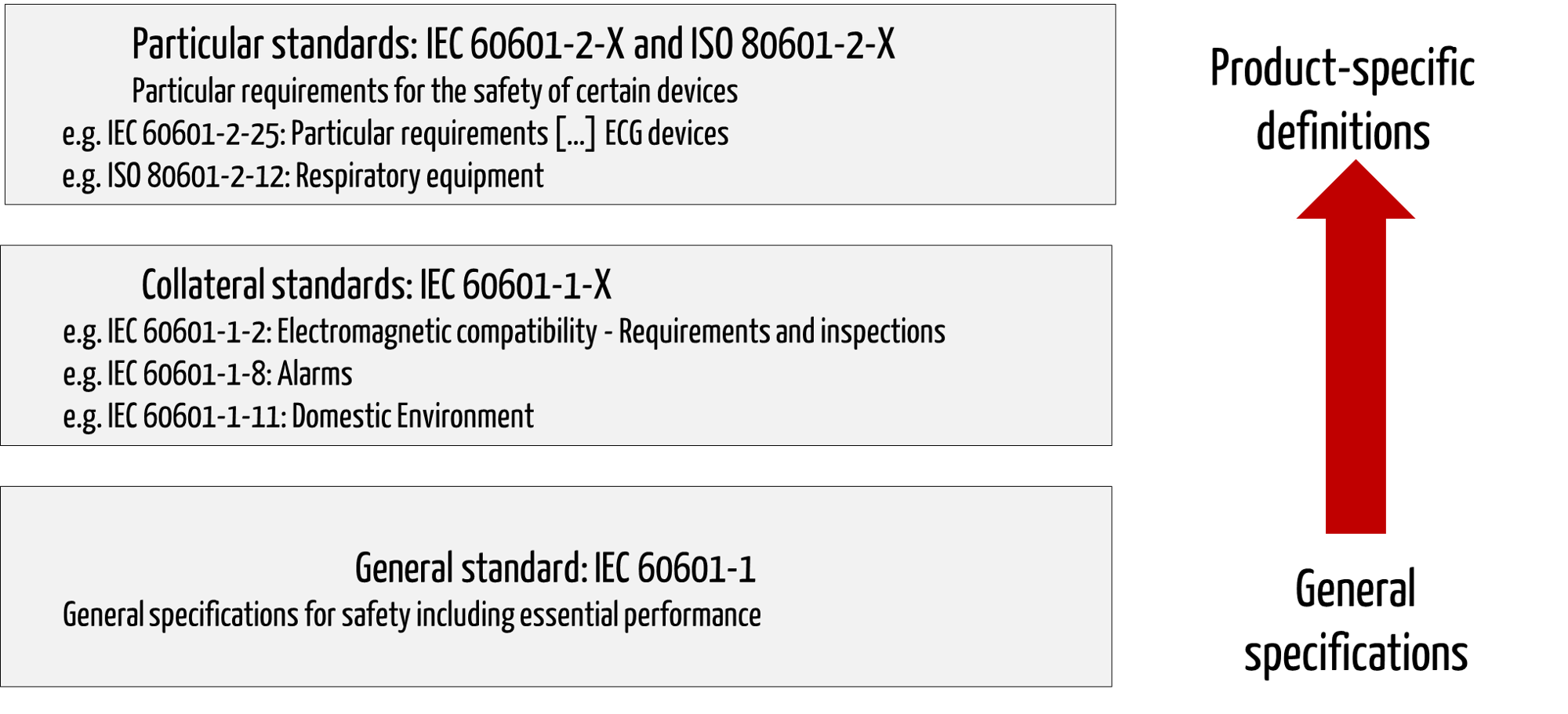
To achieve compliance, manufacturers must understand how IEC 60601-1-3 fits into the larger regulatory puzzle. The IEC 60601 series is organized in a hierarchical structure:
- IEC 60601-1 (The General Standard): This covers general requirements for basic safety and essential performance for all medical electrical equipment.
- IEC 60601-1-X (Collateral Standards): These address specific cross-cutting issues. IEC 60601-1-3 is the third collateral standard, focusing specifically on radiation protection in diagnostic X-ray equipment.
- IEC 60601-2-X (Particular Standards): These are vertical standards that apply to specific types of devices (e.g., IEC 60601-2-44 for CT scanners).
When a particular standard exists for a specific device, its requirements often take precedence over or supplement the general and collateral standards. For example, if a particular standard for mammography has more stringent filtration requirements than IEC 60601-1-3, the manufacturer must follow the more specific mammography rule. However, IEC 60601-1-3 remains the foundational "floor" for radiation safety that all diagnostic X-ray systems must meet.
Core Technical Requirements for Radiation Protection
The technical specifications within IEC 60601-1-3 are designed to control the quality and direction of the X-ray beam. These requirements are divided into several critical categories that influence the hardware design of the X-ray tube and housing.
Radiation Quality and Filtration
One of the most vital aspects of the standard is the requirement for beam filtration. X-ray tubes naturally produce a spectrum of radiation, including low-energy "soft" X-rays. These low-energy photons are problematic because they are absorbed by the patient’s skin and do not contribute to the final image quality. IEC 60601-1-3 mandates a minimum level of total filtration (typically expressed in millimeters of aluminum equivalent) to "harden" the beam, ensuring only the useful high-energy photons reach the detector.
Beam Limitation and Collimation
The standard requires that the X-ray beam be strictly confined to the area of clinical interest. This is achieved through collimation systems. Manufacturers must ensure that the X-ray field does not exceed the size of the image receptor by more than specific percentage thresholds. Modern digital systems often utilize automatic collimation, but the standard requires manual overrides and visual indicators to ensure the operator is always aware of the radiation field's extent.
Stray Radiation and Leakage
Even when the primary beam is perfectly aimed, "stray radiation" can occur due to X-rays escaping the tube housing or scattering off the patient. IEC 60601-1-3 sets strict limits on leakage radiation from the X-ray source assembly. Typically, leakage must not exceed 1 mGy per hour at a distance of one meter from the focal spot when the tube is operated at its maximum rated continuous power.
Risk Management and Documentation Requirements
Compliance with IEC 60601-1-3 is not merely a matter of hardware testing; it requires extensive documentation within the Risk Management File, adhering to ISO 14971. Manufacturers must perform a formal risk analysis to identify potential hazards related to ionizing radiation.
The Role of the Accompanying Documents
The standard places a heavy emphasis on the information provided to the user. The instructions for use (IFU) must include:
- Technical Specifications: Detailed data on focal spot size, filtration, and X-ray tube ratings.
- Dosimetric Information: Guidance on how the equipment calculates or displays the radiation dose delivered to the patient (e.g., Dose Area Product or CT Dose Index).
- Safety Instructions: Clear warnings regarding the risks of radiation and the necessary protective measures for staff, such as the use of lead aprons or thyroid shields.
Quality Assurance and Maintenance
To remain compliant throughout the device's lifecycle in 2026, the standard outlines requirements for periodic testing. Manufacturers must provide healthcare facilities with a schedule and methodology for quality control tests. These tests ensure that factors like kilovoltage (kV) accuracy, timer consistency, and dose reproducibility remain within the calibrated tolerances over years of clinical use.
Comparison of Safety Thresholds in IEC 60601-1-3
The following table summarizes some of the primary technical benchmarks required by the standard to protect different stakeholders.
| Feature | Requirement / Parameter | Primary Benefit |
|---|---|---|
| Total Filtration | Typically ≥ 2.5 mm Al equivalent for general use | Reduces patient skin dose by removing low-energy X-rays. |
| Leakage Radiation | < 1.0 mGy/h at 1 meter from the source | Protects operators and bystanders from unintended exposure. |
| Beam Collimation | Misalignment usually limited to < 2% of the SID | Ensures radiation is only applied to the diagnostic area. |
| Focal Spot Marking | Visual indicator on the tube housing | Allows for accurate measurement and positioning. |
| User Instructions | Mandated "Accompanying Documents" | Empowers the operator to use the device safely and effectively. |
Testing and Verification Protocols
Verifying compliance with IEC 60601-1-3 requires specialized laboratory equipment, including calibrated dosimeters, kVp meters, and phantom objects that simulate human tissue. The testing process generally follows three stages:
- Visual Inspection: Checking for the presence of required labels, warning signs (the ionizing radiation symbol), and the physical integrity of the tube housing.
- Functional Testing: Testing the interlocking systems. For instance, if a door to a high-radiation area is opened, the standard often requires the X-ray emission to terminate immediately.
- Parametric Measurement: Measuring the Half-Value Layer (HVL) to verify filtration and using ion chambers to quantify stray radiation levels.
For manufacturers targeting the 2026 market, these tests must be conducted by accredited laboratories (such as those with ISO/IEC 17025 accreditation) to be accepted by regulatory bodies like the FDA in the United States or Notified Bodies in the European Union.
Common Compliance Challenges
Manufacturers frequently encounter obstacles when aligning their products with IEC 60601-1-3. One common issue is the integration of legacy components. If a company uses an older X-ray tube design in a new system, they must re-verify that the tube housing meets current leakage and filtration standards, which may have become more stringent since the component was originally designed.
Another challenge is the software-hardware interface. In modern digital radiography, the software controls the timing and intensity of the pulse. Under IEC 60601-1-3, the software must be validated to ensure it cannot accidentally trigger an exposure that exceeds the rated capacity of the tube, which could lead to hardware failure or excessive radiation.
Frequently Asked Questions
Does IEC 60601-1-3 apply to dental X-ray equipment?
Yes, IEC 60601-1-3 applies to dental diagnostic X-ray equipment. While dental units have their own particular standard (IEC 60601-2-65), the foundational radiation protection principles regarding filtration and stray radiation outlined in -1-3 remain applicable to ensure dental staff and patients are protected.
What is the latest version of the IEC 60601-1-3 standard?
As of 2026, the industry continues to operate under the consolidated version known as IEC 60601-1-3:2008+AMD1:2013+AMD2:2021. The 2021 amendment (Amendment 2) introduced critical updates regarding dosimetric indications and clarified requirements for "stray radiation" to align with more modern testing methodologies.
Is compliance with IEC 60601-1-3 mandatory for FDA approval?
While the FDA does not "require" any specific standard in a strictly legal sense, it recognizes IEC 60601-1-3 as a consensus standard. This means that demonstrating compliance with this standard is the most straightforward path to proving your device is "substantially equivalent" to a legally marketed predicate device during the 510(k) submission process.
How does this standard address patient dose reporting?
IEC 60601-1-3 requires that the equipment provide information that allows the user to estimate the radiation dose. For high-dose procedures like fluoroscopy or CT, the standard (often in conjunction with specific -2-XX standards) mandates real-time dose displays and the recording of dose data in the image metadata (DICOM tags).
Can a manufacturer perform their own testing?
While a manufacturer can perform internal testing for development purposes, regulatory bodies usually require "Type Testing" reports from an independent, third-party test house. This ensures that the measurements of stray radiation and beam quality are unbiased and performed with calibrated, traceable instruments.
Practical Recommendations for Manufacturers
To ensure a smooth path to certification, companies should incorporate IEC 60601-1-3 requirements into the earliest stages of the design process. Retrofitting a finished X-ray system to meet filtration or leakage requirements is significantly more expensive than designing the tube housing correctly from the start.
Furthermore, maintain a robust Traceability Matrix. This document should link every requirement in the IEC 60601-1-3 standard to a specific design feature or a specific test result in your laboratory report. When a regulatory auditor reviews your technical file in 2026, a clear traceability matrix is the best evidence that your device is safe for clinical use.
Professional Advice Limitation: This article provides technical guidance on international standards and is intended for informational purposes only. It does not constitute legal or regulatory advice. Manufacturers should consult with a certified regulatory consultant or legal counsel to ensure compliance with the specific laws of their target jurisdictions, such as the EU Medical Device Regulation (MDR) or US FDA 21 CFR.
Image Gallery