Understanding the Legal Definition of Petty Theft and Its Consequences
Petty theft, often referred to legally as petit larceny, is a criminal offense involving the unlawful taking or stealing of another person's property where the value of the stolen items falls below a specific monetary threshold set by...
Petty theft, often referred to legally as petit larceny, is a criminal offense involving the unlawful taking or stealing of another person's property where the value of the stolen items falls below a specific monetary threshold set by state law. Typically classified as a misdemeanor, it requires the prosecution to prove that the individual intended to permanently deprive the rightful owner of their property.
Contents
While the term might sound minor, a conviction for petty theft in 2026 carries significant weight, potentially resulting in jail time, substantial fines, and a permanent criminal record that can affect employment and housing opportunities. Understanding the specific legal elements and jurisdictional variations is essential for anyone navigating the legal system or seeking to understand criminal statutes.
The Fundamental Elements of Petty Theft
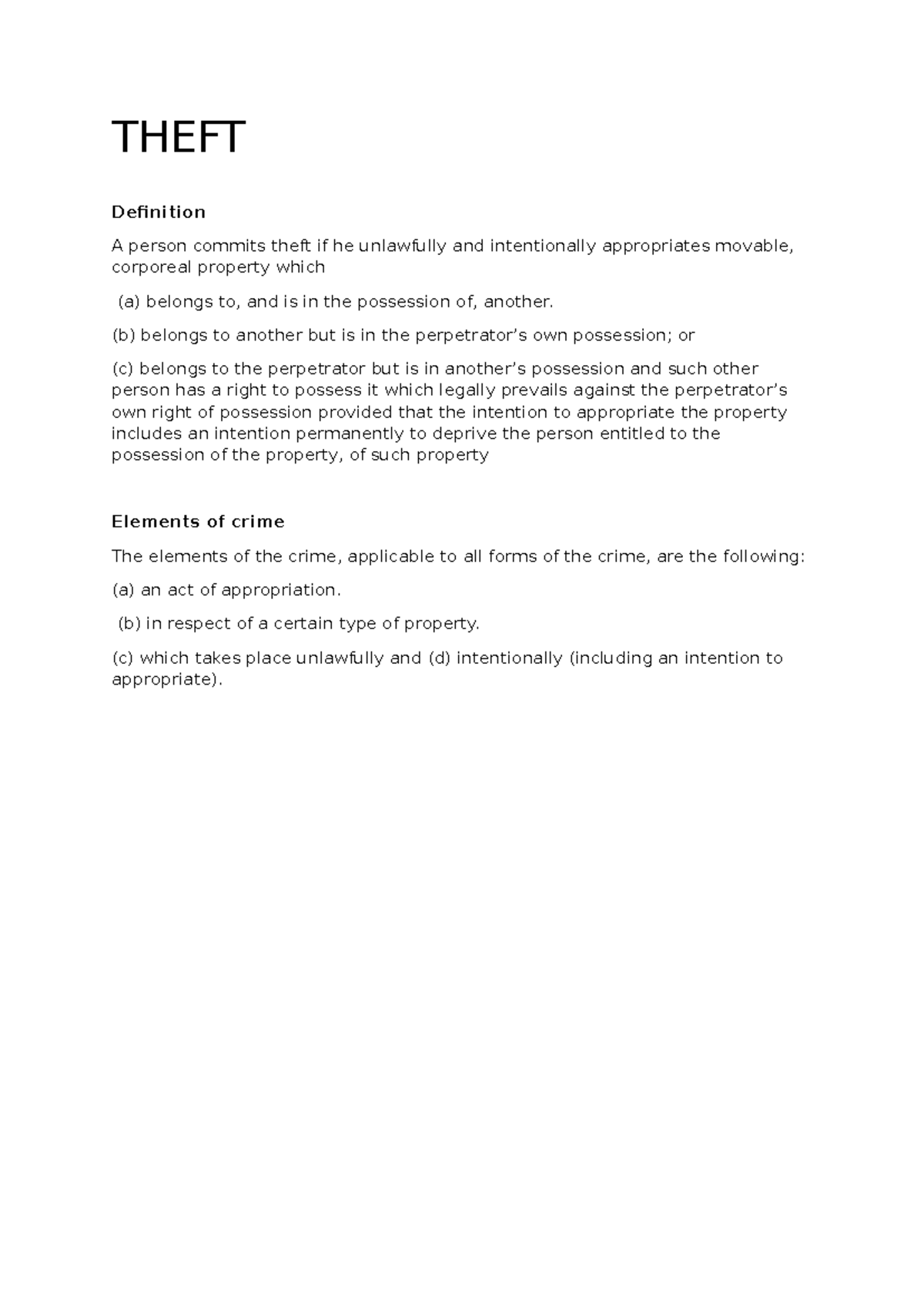
To secure a conviction for petty theft, the prosecution must generally prove five distinct elements beyond a reasonable doubt. These elements are derived from common law larceny and have been codified into modern penal codes across the United States.
1. The Taking of Property
The "taking" occurs when the defendant gains physical control over property that does not belong to them. In the context of shoplifting—a common form of petty theft—this occurs the moment an item is concealed or moved with the intent to steal, even if the individual has not yet left the premises. Legal systems in 2026 continue to emphasize that the property must be tangible or represent a specific value, such as physical goods, cash, or even digital assets stored on physical devices.
2. Asportation (Carrying Away)
Asportation is a technical legal term referring to the movement of the property. For a theft to be completed, the property must be moved, even if only a slight distance. In modern case law, the "carrying away" requirement is satisfied as soon as the defendant moves the item from its original position. For example, moving a laptop from a desk into a backpack constitutes asportation, even if the thief is caught before exiting the room.
3. Property of Another
The item taken must belong to someone else. This element seems straightforward but can become complex in cases involving joint ownership or disputed debts. Petty theft statutes do not apply if the individual has a good-faith "claim of right" to the property, meaning they honestly believe the item belongs to them. However, taking property to satisfy a debt without a court order is still generally considered theft.
4. Lack of Consent
The taking must occur without the owner’s permission. If an owner voluntarily hands over property for a specific purpose and the recipient keeps it, the crime might instead be classified as "theft by trick" or "embezzlement," depending on how the initial possession was obtained. For petty theft, the focus is on the unauthorized nature of the initial acquisition.
5. Specific Intent to Deprive
The most critical element is the defendant's mental state. The prosecution must prove that the individual intended to permanently deprive the owner of the property. Taking an item with the intent to "borrow" it and return it shortly—such as taking a neighbor's lawnmower with the intent to return it after two hours—is generally not considered larceny, though it could be charged under "unauthorized use" statutes.
Statutory Thresholds: How Value Defines the Crime
The primary factor distinguishing petty theft from grand theft is the fair market value of the property at the time and place of the theft. Each state sets its own "ceiling" for petty theft. In recent years, many states have adjusted these thresholds to account for inflation and to prioritize prison space for violent offenders.
In 2026, the thresholds remain a point of significant legislative debate. For example, in California, under the remnants of Proposition 47, the threshold for petty theft is $950. If the value of the property is $950 or less, the crime is a misdemeanor. If it exceeds that amount, it can be charged as grand theft, which is a "wobbler" (can be a misdemeanor or a felony).
| Jurisdiction | Petty Theft Threshold (Approx. 2026) | Classification |
|---|---|---|
| California | $950 or less | Misdemeanor |
| Texas | Less than $2,500 | Class B or C Misdemeanor |
| Florida | Less than $750 | 1st or 2nd Degree Petit Theft |
| New York | $1,000 or less | Class A Misdemeanor |
| Illinois | $500 or less | Class A Misdemeanor |
Valuation is typically determined by the "fair market value," which is the price a willing buyer would pay a willing seller in an open market. For retailers, this is usually the sticker price. If the item is used, the value is depreciated from its original cost. Cornell Law School's Legal Information Institute provides a deeper look at how these larceny-based definitions evolved from common law.
Distinguishing Petty Theft from Related Offenses
It is common to confuse petty theft with other crimes such as robbery, burglary, or shoplifting. While they all involve the loss of property, the legal distinctions are vital for sentencing.
- Shoplifting: Many states have specific shoplifting statutes that overlap with petty theft. Shoplifting specifically involves taking goods from a commercial establishment during business hours. While a petty theft charge can apply to stealing a bicycle from a neighbor’s yard, shoplifting is limited to retail environments.
- Robbery: Robbery is a violent crime. It is defined as taking property from the immediate presence of another through the use of force or fear. Even if the item stolen is worth only $5, the use of a weapon or physical force elevates the crime from petty theft to a high-level felony.
- Burglary: Burglary involves entering a structure (like a home or business) with the intent to commit a crime inside (usually theft). You can be charged with burglary even if you don't actually manage to steal anything, whereas petty theft requires the successful taking of property.
Common Penalties and Long-Term Legal Implications
While categorized as a misdemeanor, the consequences of a petty theft conviction in 2026 extend beyond the courtroom. Judges typically have discretion in sentencing, influenced by the defendant's prior criminal history and the specific circumstances of the case.
Immediate Criminal Penalties
For a first-time offender, penalties often include:
- Jail Time: Up to six months or one year in county jail, though probation is more common for first offenses.
- Fines: Fines can range from $500 to $2,500, plus court costs and "victim restitution," which requires the defendant to pay the owner for the value of the item if it was not recovered.
- Probation: A period of 1 to 3 years where the individual must stay out of trouble and potentially meet with a probation officer.
- Community Service: Courts frequently mandate a specific number of hours of labor for a non-profit or government agency.
The "Crime of Moral Turpitude"
In the legal world, petty theft is often classified as a crime of moral turpitude. This designation is particularly damaging because it suggests a lack of honesty or integrity. This classification has severe collateral consequences:
- Employment: Many employers in sectors like finance, healthcare, and education are barred from hiring individuals with theft convictions.
- Professional Licensing: Boards governing nurses, attorneys, and real estate agents may deny or revoke licenses based on a petty theft conviction.
- Immigration: For non-citizens, a conviction for a crime of moral turpitude can lead to deportation or the denial of a visa or green card application.
Legal Defenses and Mitigating Factors
Defending against a petty theft charge often focuses on the "intent" element. Since the prosecution must prove a specific mental state, the defense may argue that the element was never met.
- Mistake of Fact: If you genuinely believed the item was yours, or that you had permission to take it, the intent to steal is missing. An example would be picking up a black umbrella that looks identical to yours while leaving a restaurant.
- Return of Property: While returning an item does not technically "undo" the crime, doing so quickly can be used to argue there was no intent to permanently deprive the owner, or it can be used as a mitigating factor to reduce the sentence.
- Intoxication: In some jurisdictions, if a defendant was so intoxicated that they could not form the "specific intent" to steal, it may serve as a partial defense, though this is difficult to prove and often unpopular with juries.
- Duress: If an individual was forced to steal under threat of immediate physical harm, they may have a defense, although the requirements for proving duress are extremely stringent.
Impact of Prior Convictions: "Petty Theft with a Prior"
Many states employ "recidivist" statutes. If an individual has a prior conviction for theft, robbery, or burglary, a subsequent petty theft—even for a very low-value item—can sometimes be charged as a felony. This is known as "Petty Theft with a Prior." In 2026, while many states have moved toward rehabilitation, these "enhancement" laws remain on the books in various forms to deter repeat offenders.
Frequently Asked Questions
Can petty theft be expunged from my record?
In many jurisdictions, misdemeanor petty theft convictions are eligible for expungement or sealing after the successful completion of probation. This process typically hides the conviction from public view and private employers, though it may still be visible to law enforcement and certain government agencies. Requirements usually include paying all fines and not having any new criminal charges.
Is shoplifting the same as petty theft?
Legally, shoplifting is a subset of petty theft. While some states have a specific "shoplifting" statute (like California Penal Code 459.5), the core elements of taking property without consent and with the intent to deprive are identical. Shoplifting specifically occurs in a commercial establishment during business hours for items valued under the petty theft threshold.
Will I go to jail for a first-time petty theft offense?
For a first-time offense involving a low dollar amount, active jail time is uncommon but legally possible. Courts prefer "diversion programs" for first-timers, which allow the defendant to perform community service or attend theft-deterrence classes in exchange for a dismissal of the charges. However, if the theft involved a breach of trust (like stealing from an employer), the likelihood of jail time increases.
What happens if I accidentally walk out of a store with an item?
Accidental taking lacks the "intent to permanently deprive," which is a requirement for a theft conviction. However, proving it was an accident can be difficult. Security footage showing a person looking around nervously or concealing the item usually contradicts a claim of an accident. Honest mistakes, such as an item left in the bottom of a shopping cart, are frequently resolved without charges if the individual offers to pay immediately.
Does the value of the property include sales tax?
Most jurisdictions calculate the value of stolen goods based on the pre-tax retail price. However, some courts have ruled that if the victim (the store) would have collected tax on the sale, that tax is part of the "loss" incurred. It is always safest to assume the total replacement cost, including tax, could be used to determine if the crime crosses the threshold into grand theft.
Practical Recommendations
If you are facing a charge of petty theft, the first step is to avoid making any incriminating statements to loss prevention officers or police. Anything said can be used as evidence of "intent." Seeking the counsel of a qualified criminal defense attorney is essential, as they can often negotiate for a "civil compromise" (where the store agrees to drop charges if the item is paid for) or a diversion program that keeps your criminal record clean.
For businesses, preventing petty theft in 2026 involves a combination of visible surveillance and employee training. Understanding that the legal definition of theft begins the moment an item is concealed allows staff to intervene legally within the bounds of "shopkeeper’s privilege" statutes, provided they act with reasonable cause and for a reasonable amount of time.
Image Gallery