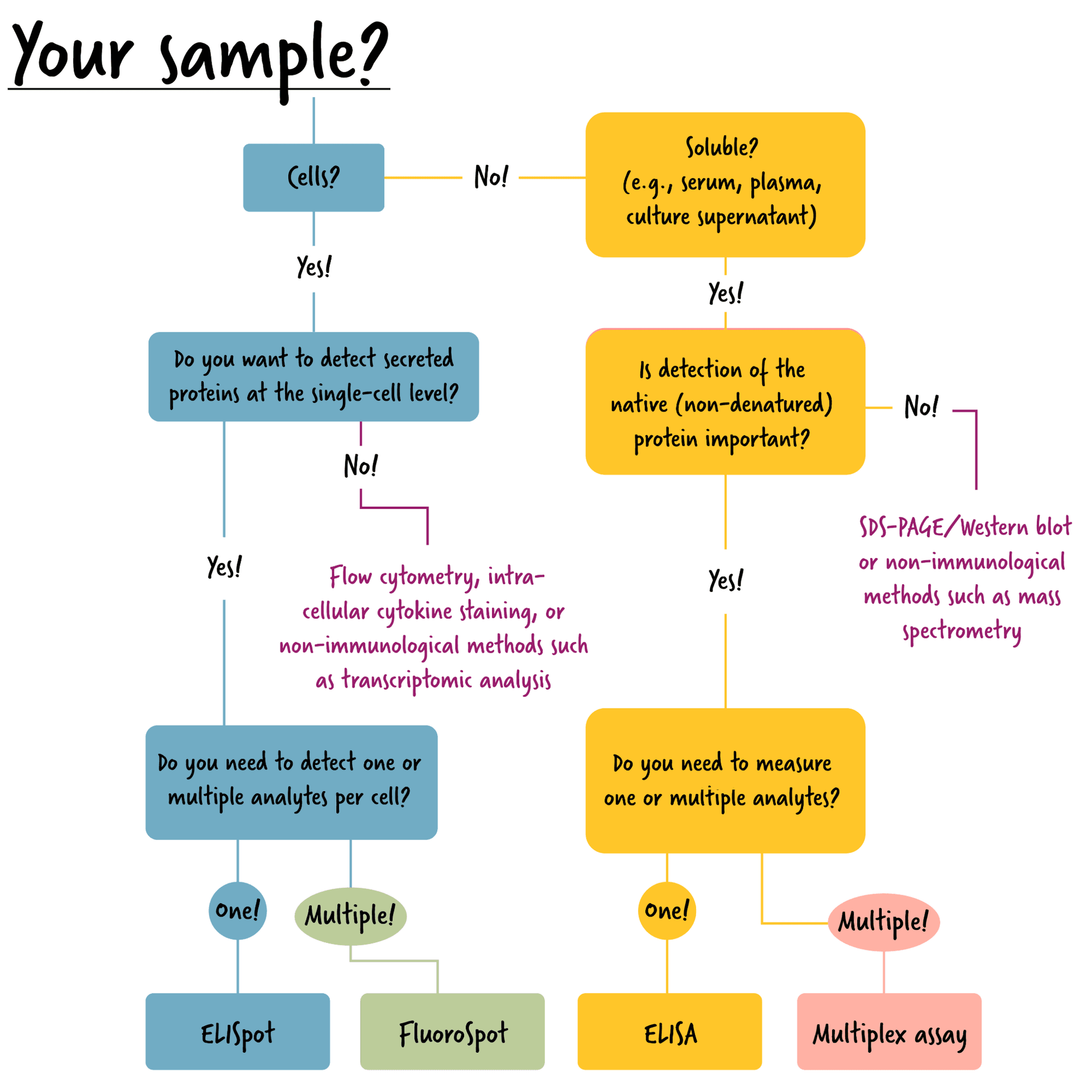
MSD vs. ELISA: Which Assay Fits Your Lab Needs?
Choosing between Meso Scale Discovery (MSD) and Enzyme-Linked Immunosorbent Assay (ELISA) depends on your requirements for sensitivity, dynamic range, and budget. While ELISA remains the cost-effective gold standard for simple protein...
Choosing between Meso Scale Discovery (MSD) and Enzyme-Linked Immunosorbent Assay (ELISA) depends on your requirements for sensitivity, dynamic range, and budget. While ELISA remains the cost-effective gold standard for simple protein detection, MSD’s electro-chemiluminescence technology offers superior sensitivity and multiplexing capabilities, making it ideal for complex biomarker discovery and limited sample volumes in 2026.
Contents
As laboratory workflows become increasingly automated and the demand for high-sensitivity biomarker detection grows, selecting the right immunoassay platform is a critical strategic decision. Both ELISA and MSD are foundational tools in drug development, clinical research, and diagnostics, yet they operate on distinct physical principles that dictate their performance limits and operational costs. Understanding these differences is essential for optimizing laboratory throughput and data quality.
The Enduring Legacy of ELISA: Stability and Accessibility
The Enzyme-Linked Immunosorbent Assay (ELISA) has been the bedrock of protein quantification for over five decades. In 2026, it remains the most widely used immunoassay format due to its simplicity and the massive ecosystem of commercially available kits.
How ELISA Works
ELISA typically employs a "sandwich" format where a capture antibody is immobilized on a plastic microplate. After the sample is added, a detection antibody conjugated to an enzyme (often Horseradish Peroxidase or Alkaline Phosphatase) binds to the target protein. A substrate is then added, which the enzyme converts into a measurable signal—most commonly a color change (colorimetric), but sometimes light (chemiluminescent) or fluorescence.
Advantages of the ELISA Platform
- Low Barrier to Entry: Most labs already possess the necessary equipment: a standard microplate reader and a washer.
- Cost-Effectiveness: For single-analyte detection where extreme sensitivity is not required, ELISA reagents are significantly less expensive than specialized alternatives.
- Methodological Maturity: Because it is the "gold standard," regulatory bodies like the FDA and EMA have extensive documentation and precedents for ELISA-based bioanalytical method validation.
- Vast Target Library: Thousands of pre-validated kits exist for almost any protein, cytokine, or hormone imaginable.
Limitations of ELISA
The primary drawback of ELISA is its dynamic range. Most ELISA assays only remain linear over 1 to 1.5 logs of concentration. This frequently requires researchers to perform multiple sample dilutions to ensure the concentration falls within the standard curve, which increases labor and pipetting errors. Furthermore, ELISA is prone to the "hook effect" and matrix interference from complex biofluids like serum or plasma, which can mask low-abundance targets.
The MSD Revolution: Electro-Chemiluminescence (ECL)
Meso Scale Discovery (MSD) platforms utilize Electro-Chemiluminescence (ECL) to detect analytes. This technology has largely superseded traditional ELISA in pharmaceutical research and high-stakes clinical trials where data precision and sample conservation are paramount.
The Physics of ECL
Unlike ELISA, where the signal is generated throughout the bulk solution, MSD signals are generated only at the electrode surface. The plates contain carbon electrodes at the bottom of each well. The detection antibodies are labeled with SULFO-TAG (ruthenium-based) markers. When electricity is applied to the plate electrodes, a redox reaction occurs involving the SULFO-TAG and a co-reactant (TPA), emitting light at 620 nm.
Why MSD Outperforms in Sensitivity
Because the light emission is triggered by electricity and occurs only at the surface, the "background noise" from the rest of the sample is virtually eliminated. This leads to a high signal-to-noise ratio, allowing for the detection of proteins at sub-picogram per milliliter (pg/mL) levels. In 2026, this sensitivity is vital for detecting early-stage disease biomarkers that exist at concentrations below the detection limits of standard ELISA.
Multiplexing Capabilities
One of MSD's most significant advantages is its ability to perform multiplexing within a single well. MSD plates can be manufactured with up to 10 distinct "spots," each coated with a different capture antibody. This allows a researcher to measure 10 different cytokines from a single 25µL sample, providing a comprehensive profile of a biological response without the need for additional volume or plates.
Direct Performance Comparison
When deciding which assay fits your lab, you must weigh technical specifications against operational realities. The following sections break down the specific metrics used by lab managers to justify the switch from ELISA to MSD or vice versa.
Dynamic Range and Dilution Logistics
As mentioned, ELISA usually offers a 1.5-log range. In contrast, MSD typically provides a 3 to 4-log dynamic range.
- Impact: In a study measuring inflammatory cytokines (where levels can spike 1,000-fold during a "cytokine storm"), an ELISA would require three different dilutions to capture every sample's data. MSD can often capture the entire range of concentrations on a single plate with a single dilution. This reduces the number of plates used and minimizes human error.
Sample Volume Conservation
In 2026, longitudinal studies involving mouse models or pediatric patients are common. These studies provide very limited sample volumes.
- ELISA: Measuring five analytes requires five separate wells (approx. 50–100µL per well), totaling 250–500µL.
- MSD: Using a V-PLEX multiplex kit, those same five analytes can be measured in a single 25µL sample.
Matrix Effects and Interference
Biological matrices (serum, CSF, cell lysates) often contain proteins that interfere with antibody binding or enzyme activity. Because MSD's signal is localized at the electrode and uses a different chemical pathway than enzyme-substrate reactions, it is generally more resistant to these "matrix effects" than ELISA. This results in higher accuracy when working with "dirty" or complex samples.
Operational and Financial Considerations
The choice is not purely scientific; it is also a matter of laboratory infrastructure and long-term budget planning.
Instrumentation Costs
- ELISA Readers: High-quality absorbance readers are available for $5,000 to $15,000.
- MSD Readers: Systems like the MESO QuickPlex SQ 120 or the high-throughput MESO SECTOR S 600 require a significant capital investment, often ranging from $50,000 to over $150,000 depending on the configuration and automation features.
Reagent and Consumable Pricing
On a per-well basis, MSD plates are more expensive than ELISA plates. However, the calculation changes when you factor in:
- Labor costs: Fewer dilutions and fewer plates to wash/read.
- Multiplexing: If you are measuring 10 analytes, one MSD plate replaces 10 ELISA plates. In this scenario, MSD is often significantly cheaper on a "per-data-point" basis.
- Repeat rates: The higher reproducibility of MSD reduces the need to re-run assays that failed due to samples being out of range.
Regulatory Compliance
Both platforms are compatible with 21 CFR Part 11 compliance for data integrity. MSD’s Methodical software provides robust audit trails, which is a prerequisite for GLP (Good Laboratory Practice) and GMP (Good Manufacturing Practice) environments in 2026.
Comparison Summary Table
| Feature | ELISA (Standard Colorimetric) | Meso Scale Discovery (MSD) |
|---|---|---|
| Detection Method | Enzyme-Substrate (Optical) | Electro-Chemiluminescence (ECL) |
| Sensitivity | Low pg/mL range | Sub-pg/mL range |
| Dynamic Range | 1 – 1.5 Logs | 3 – 4 Logs |
| Multiplexing | Generally 1 analyte per well | Up to 10 analytes per well |
| Sample Volume | 50 – 100 µL per analyte | ~25 µL for up to 10 analytes |
| Initial Tooling Cost | Low ($) | High ($$$) |
| Consumable Cost | Low per plate | High per plate (Low per data point) |
| Workflow Complexity | Moderate (Multiple wash/incubation) | Simplified (Often faster read times) |
Common Troubleshooting and Implementation Hurdles
While MSD offers superior performance, transitioning from ELISA is not without challenges. Labs moving to MSD must consider:
- Plate Specificity: MSD requires proprietary plates. You cannot run an MSD assay on a standard 96-well plate.
- Training: Although the workflow is similar to ELISA, the software and instrument maintenance require specific training to ensure data consistency.
- Cross-Reactivity in Multiplexes: When multiplexing on MSD, one must ensure that the antibodies for Target A do not cross-react with Target B. While MSD validates their V-PLEX kits for this, custom "U-PLEX" assays require careful validation by the user.
Frequently Asked Questions
Can I convert my existing ELISA protocol to an MSD assay?
Yes, it is possible to "home-brew" an MSD assay using your existing antibodies. By using MSD’s Gold Sulfo-Tag NHS-Ester, you can label your own detection antibodies. However, you will need to re-optimize the concentrations and incubation times, as the ECL environment differs significantly from colorimetric buffers.
Is MSD always more reproducible than ELISA?
In general, yes. MSD’s automation-friendly plates and more stable signal generation lead to lower Coefficients of Variation (CVs) between replicates. However, poor pipetting technique or improper plate washing (if done manually) will degrade the precision of any immunoassay, regardless of the platform.
When is ELISA the better choice?
ELISA is the better choice for routine, high-volume testing of a single, high-abundance analyte (like albumin or specific IgGs) where extreme sensitivity isn't required. It is also preferred in academic settings with limited capital equipment budgets or in field clinics where expensive MSD readers cannot be maintained.
Does MSD handle the "hook effect" better than ELISA?
The hook effect (where extremely high concentrations of analyte cause a paradoxically low signal) is a risk for any sandwich immunoassay. Because of its wider dynamic range, MSD is less likely to be "surprised" by the hook effect within a standard experimental range, but it is not immune to it. Dilution linearity studies are still required during validation.
What is the difference between V-PLEX and U-PLEX in MSD?
V-PLEX are fully validated kits from Meso Scale Discovery, where every antibody combination has been tested for cross-reactivity and matrix interference. U-PLEX allows the researcher more flexibility to pick and choose their own analytes using a proprietary linker system, offering a "build-your-own" multiplex approach.
Final Recommendation: Which Should You Choose?
If your lab is focused on standard diagnostic assays or high-abundance protein quantification where cost per plate is the primary driver, ELISA remains a reliable and logical choice. The accessibility of reagents and low instrument costs make it the standard for a reason.
However, if your research involves biomarker discovery, oncology, immunology, or neurology where samples are scarce (e.g., mouse serum, CSF) and sensitivity is paramount, MSD is the superior investment for 2026. The ability to multiplex 10 analytes in a single well with a 4-log dynamic range drastically improves data quality and operational efficiency, ultimately accelerating the timeline from discovery to clinical validation.
For further reading on assay validation and standards, refer to the FDA Bioanalytical Method Validation Guidance or the technical resources provided by Meso Scale Discovery.
Image Gallery