What the Crocs Net Worth Reveals About the Brand: A 2026 Financial Analysis
As of 2026, the "net worth" of Crocs, Inc.—more accurately defined by its market capitalization and total shareholders' equity—reveals a brand that has successfully transitioned from a polarizing fad into a permanent, high-margin pilla...
As of 2026, the "net worth" of Crocs, Inc.—more accurately defined by its market capitalization and total shareholders' equity—reveals a brand that has successfully transitioned from a polarizing fad into a permanent, high-margin pillar of the global footwear industry. With a market valuation consistently hovering between $8 billion and $11 billion and annual revenues surpassing the $4.5 billion mark, the company's financial health signals a dominant market position driven by operational efficiency, strategic acquisitions, and an unparalleled ability to monetize brand polarization.
Contents
Defining the "Net Worth" of Crocs, Inc.
When discussing the net worth of a multi-billion dollar public corporation like Crocs, Inc. (NASDAQ: CROX), it is essential to distinguish between two financial metrics: Market Capitalization and Shareholders' Equity (Book Value).
Market Capitalization
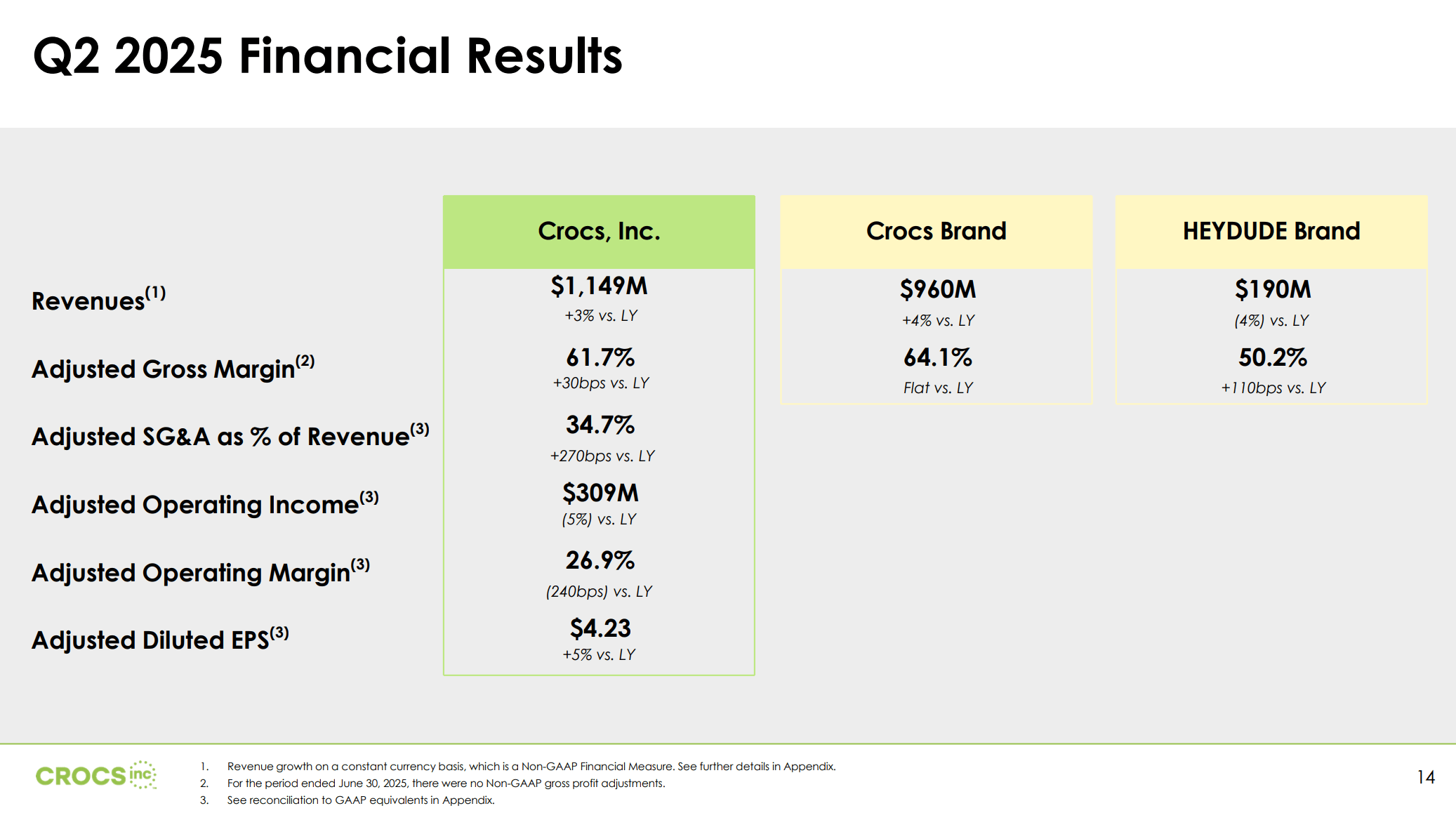
In 2026, Crocs' market capitalization serves as the most accurate "real-time" valuation of the brand. This figure is calculated by multiplying the current stock price by the total number of outstanding shares. A high market cap relative to the company's physical assets indicates that investors place a high value on the brand's future earnings potential, intellectual property, and consumer loyalty. In the mid-2020s, the market has rewarded Crocs for its industry-leading gross margins, which often exceed 55%, a figure rarely seen in mass-market footwear.
Shareholders' Equity
This represents the company's total assets minus its total liabilities. While the market cap reflects future expectations, the shareholders' equity reflects the historical performance and the tangible value remaining if the company were to liquidate. For Crocs, this figure has been significantly influenced by the 2022 acquisition of HEYDUDE, which added substantial intangible assets (goodwill) and long-term debt to the balance sheet. By 2026, the steady deleveraging of this debt has fortified the company’s book value, signaling a more conservative and stable investment profile compared to the volatile growth years of the early 2020s.
What the Financial Strength Reveals About Brand Identity
The financial trajectory of Crocs provides a roadmap of how the company evolved from a single-product "ugly shoe" manufacturer into a diversified powerhouse. The valuation reveals several key truths about the brand's current status:
- Resilience Against Trend Cycles: For two decades, critics predicted the "death of the clog." However, the 2026 valuation proves that Crocs has achieved "staple" status. The consistent cash flow suggests that the product is no longer tied to fashion cycles but is treated as a functional necessity in healthcare, hospitality, and casual lifestyle sectors.
- Pricing Power and Brand Authority: Despite inflationary pressures throughout 2024 and 2025, Crocs maintained its profit margins. This reveals a high level of "brand elasticity"—the ability to raise prices without significantly losing customer volume. Consumers are not just buying molded foam; they are buying the Crocs brand.
- Efficiency of the "Croslite" Moat: Most footwear brands struggle with complex supply chains involving leather, textiles, and intricate stitching. Crocs' valuation is bolstered by the simplicity of its primary material, Croslite. This closed-cell resin is inexpensive to produce and easy to mold, allowing for massive scalability with minimal manufacturing overhead.
The HEYDUDE Integration: A Strategic Valuation Shift
A significant portion of what the Crocs net worth reveals today stems from the $2.5 billion acquisition of HEYDUDE. Initially met with skepticism by Wall Street, the integration of this brand by 2026 has provided Crocs with a "two-pillar" growth strategy.
While the Crocs brand dominates the molded footwear space, HEYDUDE captures the casual, fabric-based loafer market. This diversification has lowered the company's overall risk profile. If consumer interest in clogs were to wane, the HEYDUDE segment provides a financial safety net. The 2026 earnings reports show that HEYDUDE has successfully expanded into international markets using Crocs’ existing distribution infrastructure, effectively proving that the "net worth" of the parent company is greater than the sum of its parts.
Financial Benchmarks: Crocs vs. Industry Peers (2026 Projections)
The following table compares key financial metrics that define the "net worth" and operational health of Crocs relative to other major players in the footwear and apparel sector.
| Metric | Crocs, Inc. (2026 Est.) | Industry Average (Footwear) | Significance |
|---|---|---|---|
| Gross Margin | 56% - 58% | 40% - 45% | Indicates superior manufacturing efficiency. |
| Operating Margin | 26% - 28% | 12% - 15% | Reveals lean corporate management and high profitability. |
| Debt-to-Equity Ratio | 1.2 | 1.8 | Shows successful debt reduction post-HEYDUDE acquisition. |
| Inventory Turnover | 4.2x | 3.5x | Indicates high demand and efficient supply chain management. |
| International Revenue % | 42% | 50% | Highlights significant growth potential in Asian markets. |
Digital and Personalization as Valuation Drivers
Beyond the shoes themselves, the Crocs net worth is heavily supported by the Jibbitz ecosystem. Jibbitz—the small charms used to personalize Crocs—represent a masterclass in high-margin add-on sales.
Financially, Jibbitz function similarly to software or razor blades; they have negligible production costs but high emotional value to the consumer. In 2026, the data reveals that customers who purchase Jibbitz have a significantly higher "Lifetime Value" (LTV) than those who do not. The brand's ability to turn a $50 shoe into a $100 customized product through accessories is a primary reason why its valuation remains robust compared to competitors who rely solely on one-time footwear sales.
Global Expansion: The Asia Growth Lever
As of 2026, the brand's valuation is increasingly tied to its performance in China and Southeast Asia. Historically, Crocs was heavily reliant on the North American market. However, the "net worth" reveals a strategic pivot. By 2026, international revenue accounts for nearly 45% of total sales, up from roughly 35% in 2022.
The success in China, specifically, has been a major catalyst for stock price appreciation. By leveraging "localized" collaborations with regional celebrities and designers, Crocs has avoided the pitfalls of being seen as a "Western-only" brand. This global footprint makes the brand more resilient to regional economic downturns, further stabilizing its market capitalization.
Risk Factors Influencing the Brand's Valuation
Despite its strong financial standing, the 2026 valuation of Crocs is not without risks. Investors and analysts monitor several "threat vectors" that could impact the brand's net worth:
- Counterfeit Saturation: The simplicity of the Crocs design makes it a frequent target for IP infringement. While the brand has been aggressive in legal enforcement, the sheer volume of "foam clog" clones puts downward pressure on the brand’s premium pricing.
- Sustainability Regulations: As a company reliant on synthetic resins (plastics), Crocs faces increasing pressure from global ESG (Environmental, Social, and Governance) mandates. The brand's transition to "Bio-based Croslite" is not just a marketing move but a financial necessity to avoid carbon taxes and maintain institutional investor support in 2026.
- Dependency on the "Classic Clog": While HEYDUDE provides some diversification, the "Classic Clog" still accounts for a massive percentage of total revenue. Any sudden shift in cultural perception could lead to an inventory glut.
FAQ: Understanding Crocs' Financial Footprint
Is Crocs considered a "value" or "growth" stock in 2026?
By 2026, Crocs is increasingly viewed as a value-growth hybrid. It offers the high margins and cash flow of a mature "value" company but maintains "growth" characteristics through its expansion in the Asian market and the scaling of the HEYDUDE brand.
How does the Crocs net worth compare to Birkenstock?
While both brands occupy the "comfortable footwear" niche, Crocs generally maintains higher operating margins due to lower material costs (synthetic resin vs. leather and cork). However, Birkenstock often commands a higher "luxury" valuation multiple, whereas Crocs is valued based on high-volume efficiency and mass-market dominance.
What is the impact of celebrity collaborations on the company's value?
Collaborations are a "marketing-spend efficiency" tool for Crocs. Instead of traditional expensive TV advertising, the brand uses limited-edition drops (e.g., with musicians, luxury fashion houses, and anime franchises) to maintain cultural relevance. This strategy keeps "Customer Acquisition Costs" (CAC) low, which directly increases the net profit and overall valuation.
Does Crocs own its manufacturing facilities?
Crocs utilizes a mix of company-owned manufacturing and third-party contractors. This hybrid model allows the company to maintain high "net worth" by staying asset-light while still retaining enough control over production to ensure quality and respond quickly to demand surges.
How has debt affected the brand's valuation?
The debt taken on for the HEYDUDE acquisition initially suppressed the company's valuation in 2022-2023. However, by 2026, the aggressive repayment of this debt using strong free cash flow has led to a "rerating" of the stock, making the brand appear much healthier to conservative institutional investors.
Summary of Brand Status in 2026
The net worth of Crocs reveals a company that has mastered the art of the high-margin staple. It is no longer a niche player or a meme-driven success story. Instead, it is a sophisticated retail operation that uses data-driven personalization (Jibbitz), a simplified manufacturing process, and strategic brand acquisitions to maintain a valuation that far exceeds many of its legacy footwear competitors.
For observers, the financial data suggests that as long as the company can navigate the transition toward sustainable materials and continue its expansion in Asia, its "ugly shoe" legacy will continue to produce beautiful balance sheets.
Image Gallery