The Challenges of San Diego Medical Waste Management in 2026
Managing medical waste in San Diego requires navigating a complex intersection of California's stringent environmental laws, local enforcement by the Department of Environmental Health and Quality (DEHQ), and the logistical pressures o...
Managing medical waste in San Diego requires navigating a complex intersection of California's stringent environmental laws, local enforcement by the Department of Environmental Health and Quality (DEHQ), and the logistical pressures of a major metropolitan hub. Facilities must overcome hurdles in waste segregation, rising disposal costs, and rigorous staff training to maintain compliance and protect public health.
Contents
The healthcare landscape in San Diego County continues to expand, driven by world-class systems like UCSD Health, Scripps Health, and Sharp Healthcare, alongside a burgeoning biotech sector. However, this growth brings a proportionate increase in biohazardous materials. In 2026, the challenges of San Diego medical waste management are no longer just about disposal; they are about integrated compliance, environmental stewardship, and cost-containment in one of the most regulated environments in the United States.
The Regulatory Framework: Navigating the MWMA and DEHQ
The foundational challenge for any San Diego-based healthcare provider is the California Medical Waste Management Act (MWMA). Unlike many other states where federal EPA or OSHA guidelines provide the primary roadmap, California’s Department of Public Health (CDPH) sets a significantly higher bar. In San Diego, the Department of Environmental Health and Quality (DEHQ) acts as the Local Enforcement Agency (LEA), conducting inspections and issuing permits.
Large Quantity vs. Small Quantity Generators
The DEHQ classifies facilities based on the volume of waste produced. Large Quantity Generators (LQGs)—those producing 200 pounds or more of medical waste in any month—face the most rigorous oversight, including mandatory biennial inspections and detailed Medical Waste Management Plans. Small Quantity Generators (SQGs) have slightly fewer administrative burdens but must still adhere to strict storage and labeling protocols. The challenge lies in accurate tracking; a small clinic that experiences a temporary surge in patients could inadvertently cross into the LQG category, triggering new legal requirements and higher permit fees.
The Impact of the Hazardous Materials Division (HMD)
The HMD within San Diego County oversees the Unified Program, which includes medical waste. In 2026, the integration of digital reporting through the California Environmental Reporting System (CERS) remains a hurdle for smaller facilities. Ensuring that medical waste manifests are correctly uploaded and synchronized with hazardous waste disclosures is a common point of failure during inspections.
The Financial Burden of Rising Operational Costs
In 2026, San Diego remains one of the most expensive regions for business operations, and medical waste management is no exception. Several factors contribute to the escalating costs that facilities must manage:
- Logistical Constraints: San Diego’s geography, hemmed in by the ocean, the Mexican border, and the mountains, limits the available routes for waste transport. Heavy traffic on the I-5 and I-15 corridors complicates pickup schedules, often leading to surcharges from waste hauling companies.
- Limited Local Treatment Facilities: There are very few permitted medical waste treatment facilities within San Diego County. Much of the waste must be transported to the Inland Empire or even out of state for incineration or autoclaving. This long-haul transport increases fuel surcharges and environmental footprints.
- Specialized Disposal Needs: Pharmaceutical waste and trace chemotherapy waste require specialized treatment (often incineration), which is significantly more expensive than standard autoclave sterilization used for "red bag" biohazardous waste.
The Critical Importance of Waste Segregation
Perhaps the most persistent operational challenge is the effective segregation of waste streams. When different types of waste are commingled, the cost of disposal skyrockets, and legal risks increase.
Red Bag vs. Regular Trash
Placing non-hazardous items (like clean packaging or paper) into biohazard "red bags" is a common mistake that inflates costs. Red bag waste can cost up to ten times more per pound to process than standard municipal solid waste. Conversely, placing biohazardous material in the regular trash can lead to massive fines from the DEHQ and potential closure of the facility.
The Pharmaceutical Waste Conundrum
Distinguishing between RCRA hazardous pharmaceutical waste and non-RCRA pharmaceutical waste is a major technical challenge. Under California law, pharmaceutical waste must be managed carefully to prevent it from entering the water supply. In San Diego, facilities must often utilize "Blue Bins" for non-hazardous pharmaceuticals and "Black Bins" for RCRA-regulated hazardous drugs. Misidentifying a substance can result in a violation of the Resource Conservation and Recovery Act, a federal offense.
Technical Specifications for Waste Storage and Handling
To remain compliant in 2026, San Diego facilities must adhere to specific technical requirements for the storage of medical waste. Failure to follow these measurements and timelines is a frequent cause for administrative citations.
| Waste Category | Storage Container Requirement | Max Storage Time (San Diego) | Primary Treatment Method |
|---|---|---|---|
| Biohazardous (Red Bag) | Leak-proof, puncture-resistant, labeled containers | 7 days (if >20 lbs/month); 30 days (if <20 lbs) | Autoclave (Steam Sterilization) |
| Sharps Waste | Rigid, puncture-resistant, locking lids | Until full (or 30 days if biohazard-contaminated) | Autoclave or Incineration |
| Pathological Waste | Leak-proof, secondary containment, refrigerated | 7 days (must be kept at <32°F if needed) | Incineration Only |
| Chemotherapy Waste | Yellow containers, leak-proof | 7 days (if stored at room temp) | Incineration Only |
| Pharmaceuticals | Blue or White containers (Non-RCRA) | 90 days | Incineration or Encapsulation |
Staff Training and the Human Factor
Even with the most sophisticated waste management plan, the system relies on the frontline staff—nurses, dental assistants, and janitorial crews. High turnover rates in the San Diego healthcare sector create a perpetual need for retraining.
Training Requirements under the MWMA
The MWMA requires that all employees who handle medical waste receive initial training and annual refreshers. This training must cover:
- The facility's specific Medical Waste Management Plan.
- Procedures for segregation, labeling, and storage.
- Emergency response for spills or needle-stick injuries.
- Proper use of Personal Protective Equipment (PPE).
In 2026, the challenge is ensuring that this training is not just a "check-the-box" activity but a fundamental part of the culture. San Diego inspectors often interview staff during site visits to verify their knowledge; if a staff member cannot explain the difference between a red bag and a sharps container, the facility can be cited regardless of their written documentation.
Sustainability and the "Green" Healthcare Movement
In 2026, there is an increasing push within the San Diego community for sustainable waste practices. Hospitals are under pressure to reduce their carbon footprint while maintaining sterile environments.
The Shift Away from Incineration
While incineration is required for pathological and certain pharmaceutical wastes, it is the least environmentally friendly option due to air emissions. Many San Diego facilities are transitioning to high-efficiency autoclaves or microwave shredding technologies that render waste non-infectious without the heavy carbon output of traditional burning.
Reusable Sharps Containers
To reduce plastic waste, many San Diego clinics have moved toward reusable sharps containers. These are collected, industrially cleaned, and returned to the facility. While sustainable, this introduces a new logistical challenge: managing the pickup and delivery cycles and ensuring the vendor’s sterilization process meets DEHQ standards.
Choosing the Right Waste Management Partner
For most San Diego facilities, the solution to these challenges lies in partnering with a certified medical waste management company. However, selecting a vendor is itself a challenge. Facilities are "cradle-to-grave" liable for their waste. This means that if a hauler illegally dumps waste in the San Diego backcountry or a Mexico-bound shipment is intercepted, the original generator (the doctor’s office or hospital) is legally responsible.
When vetting a partner in 2026, San Diego facilities should verify:
- Permit Status: Ensure the company is registered with the CDPH and has a current San Diego County HMD permit.
- Insurance Coverage: Confirm they carry adequate environmental pollution liability insurance.
- Tracking Systems: Look for vendors providing digital manifests and real-time tracking of waste from pickup to final disposal.
- Compliance Support: The best vendors provide staff training modules and assist with DEHQ audit preparation.
Frequently Asked Questions
What constitutes "medical waste" in San Diego County?
Under the California Medical Waste Management Act, medical waste includes biohazardous waste (waste contaminated with fluid blood or infectious agents), sharps waste, pathological waste, and certain types of pharmaceutical waste. It does not include standard trash, hazardous chemical waste, or radioactive waste, which are governed by separate regulations.
How often does the DEHQ inspect San Diego medical facilities?
Large Quantity Generators (LQGs) are typically inspected every two years. Small Quantity Generators (SQGs) may be inspected less frequently, often on a three-to-five-year cycle, or in response to a complaint or a reported spill incident.
Can I dispose of medical waste in the regular trash if I treat it myself?
Generally, no. While some large hospitals have on-site autoclaves, they must be specifically permitted and monitored by the DEHQ. Home-based healthcare or very small clinics cannot simply "bleach" waste and throw it in the trash; it must be handled by a licensed hauler to ensure it reaches a permitted treatment facility.
What are the penalties for non-compliance in San Diego?
Fines can vary significantly based on the severity of the violation. Administrative civil penalties can reach up to $25,000 per violation per day. Beyond financial loss, non-compliance can lead to professional license reviews and significant reputational damage.
Does San Diego have specific rules for home-generated medical waste?
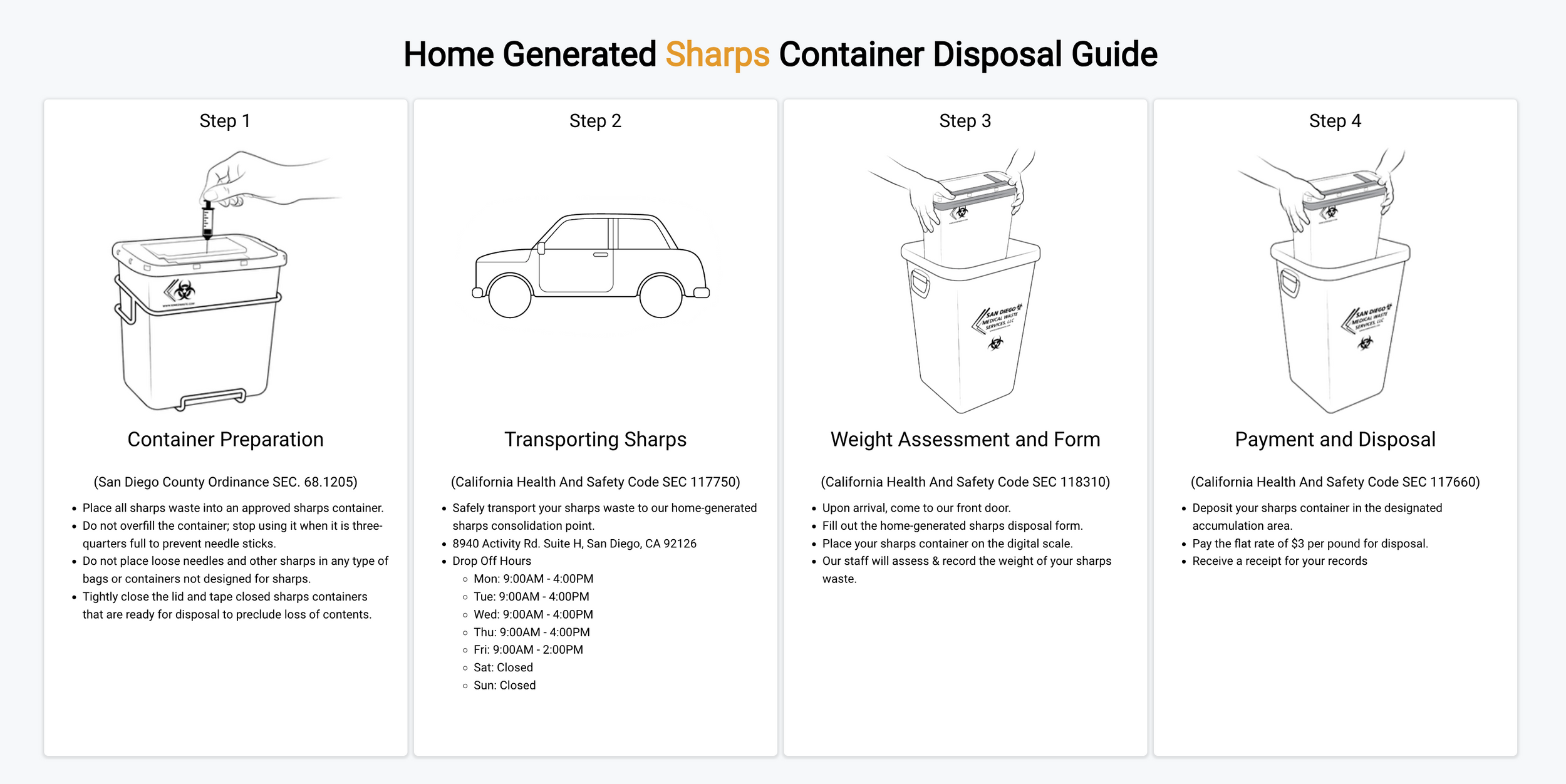
Yes. San Diego County residents are prohibited from placing sharps in the regular trash. Home-generated sharps must be placed in a puncture-resistant container and taken to designated collection centers, such as certain pharmacies or household hazardous waste (HHW) facilities.
Final Recommendation for San Diego Facilities
To navigate the challenges of medical waste management in 2026, San Diego healthcare providers should conduct a comprehensive waste stream audit. Start by quantifying exactly how much waste is being produced in each category. Often, facilities find they are over-paying for "red bag" disposal for items that could safely go into the municipal stream. Once the audit is complete, invest in robust, localized training for all staff members and secure a contract with a reputable, San Diego-permitted waste hauler that offers transparent tracking and compliance support.
For additional guidance on local permits and requirements, facilities should consult the San Diego County Department of Environmental Health and Quality (DEHQ).
Image Gallery