Do You Have to Report Marijuana Use on Life Insurance? Requirements and Impacts in 2026
Yes, you must report marijuana use when applying for life insurance. Failure to disclose use—whether recreational or medicinal—constitutes material misrepresentation. In 2026, while many insurers have modernized their guidelines, non-d...
Yes, you must report marijuana use when applying for life insurance. Failure to disclose use—whether recreational or medicinal—constitutes material misrepresentation. In 2026, while many insurers have modernized their guidelines, non-disclosure still risks a denial of the death benefit or policy cancellation during the contestability period.
Contents
The Legal and Contractual Obligation of Disclosure
When you apply for a life insurance policy, you enter into a legal contract based on the principle of "utmost good faith." This means both the applicant and the insurer must be completely transparent. For the applicant, this involves answering all questions on the application honestly, including those regarding lifestyle habits and substance use.
In 2026, marijuana use is viewed differently than it was a decade ago, but the requirement to report it remains absolute. Most insurance applications specifically ask if you have used marijuana, cannabis, or THC-containing products within a certain timeframe (usually the last 12 to 36 months). Even if the substance is legal in your state or used for a legitimate medical purpose, you are contractually obligated to disclose it.
The Consequences of Material Misrepresentation
If you choose not to report your marijuana use and the insurance company discovers it later, the consequences are severe. This is known as material misrepresentation—withholding information that would have affected the insurer's decision to issue the policy or the premium rate charged.
- Denial of Claims: If the insured passes away within the "contestability period" (typically the first two years of the policy), the insurer has the right to investigate the original application. If they find evidence of undisclosed marijuana use, they can legally deny the death benefit to the beneficiaries.
- Policy Rescission: If the insurer discovers the omission while you are still alive, they can cancel (rescind) the policy entirely. You may lose the coverage you’ve paid for, and obtaining a new policy will be significantly more expensive due to your history of misrepresentation.
- Premium Adjustments: In some cases, the insurer might not cancel the policy but instead "reform" it. This involves calculating the premiums you should have been paying based on your actual risk profile and deducting the difference from the eventual death benefit.
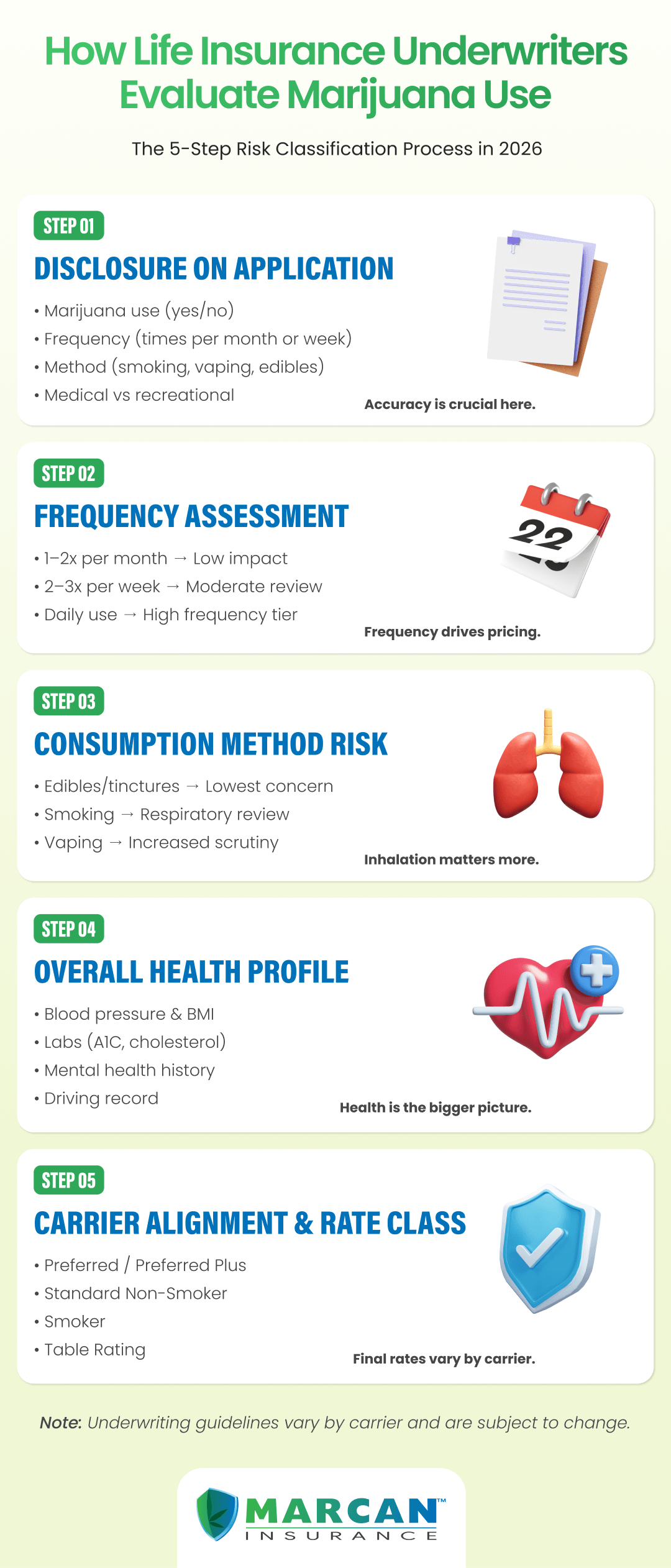
How Life Insurance Underwriters Evaluate Marijuana Use in 2026
Underwriting is the process by which an insurance company evaluates your risk level to determine your premium. In 2026, the industry has shifted toward more nuanced assessments of cannabis users. However, insurers still categorize users based on frequency, method of consumption, and the reason for use.
Recreational vs. Medicinal Use
Insurers distinguish between these two categories. If you use marijuana medicinally, the underwriter will focus more on the underlying health condition you are treating than the cannabis itself. For example, if you use medical marijuana for chronic pain, the insurer will evaluate the severity of the pain and any associated mobility issues. If you use it for a more serious condition like Crohn’s disease or cancer, the rating will depend on the prognosis of that specific illness.
Recreational use is evaluated based on lifestyle risk. Occasional use (e.g., once a month) may have no impact on your rates at many top-tier carriers, while daily use might trigger "Smoker" rates or even a decline if there are signs of dependency or heavy use of other substances.
The Impact of Consumption Methods
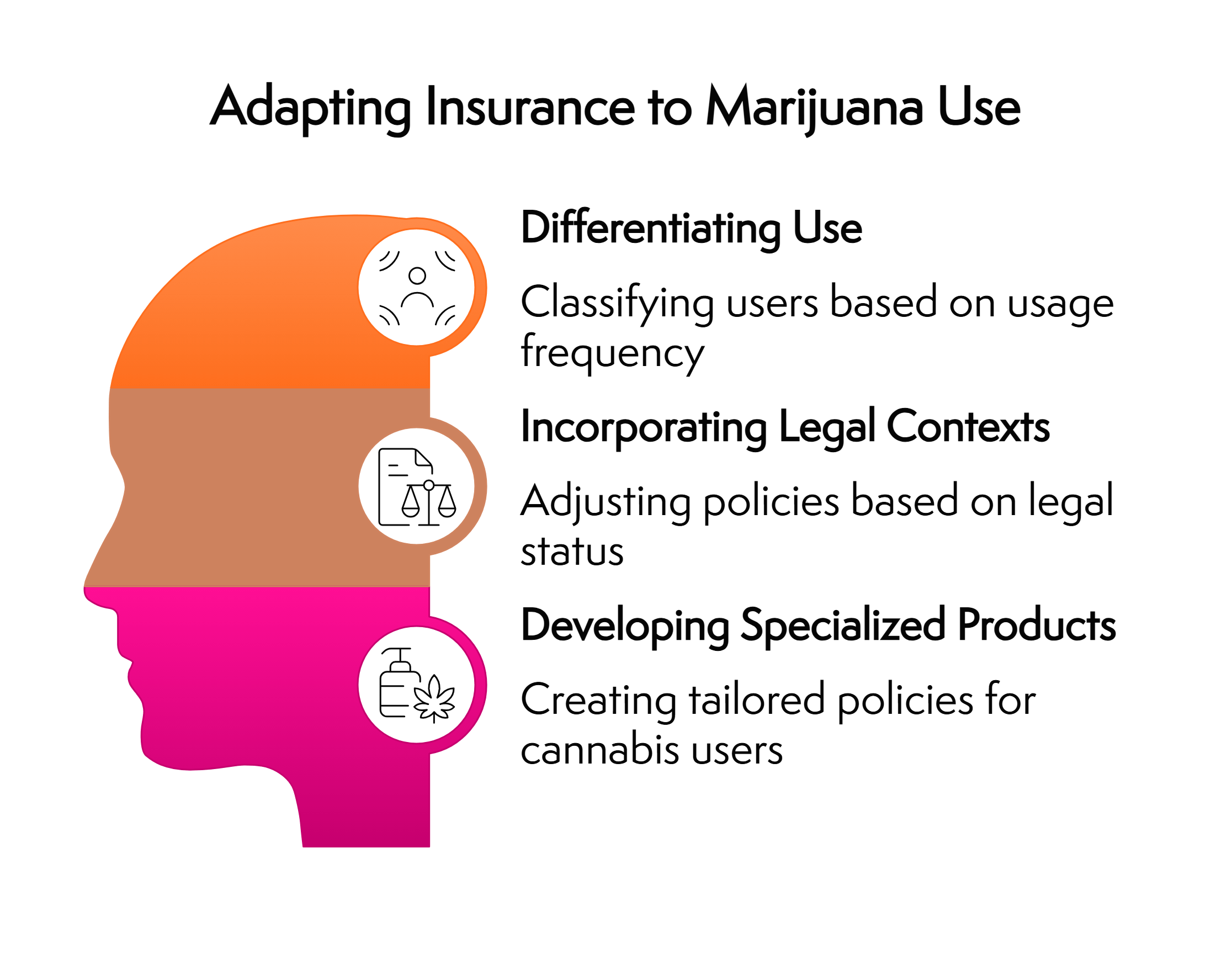
By 2026, many insurance carriers have moved away from a "one-size-fits-all" approach to marijuana. A key differentiator is how the substance is consumed:
- Smoking/Vaping: Many carriers still classify anyone who smokes or vapes marijuana as a "Smoker." This can lead to premiums that are two to three times higher than "Non-Smoker" rates.
- Edibles and Oils: Some forward-thinking insurers now allow "Non-Smoker" rates for individuals who exclusively use edibles, tinctures, or oils, provided the frequency of use is within their "Preferred" guidelines.
- CBD Products: Pure CBD use (with 0.3% THC or less) is generally ignored by underwriters unless it is being used to treat a significant medical condition that carries its own risks.
The Medical Exam and Detection Protocols
Even if you do not report your use, it is highly likely that the insurer will find out through the standard medical underwriting process. In 2026, the technology used in laboratory testing for insurance exams is highly sensitive.
Urinalysis and Blood Tests
Most traditional life insurance policies require a medical exam that includes a urine sample. These tests look for THC-COOH, a metabolite that remains in the body long after the psychoactive effects of marijuana have worn off. Depending on your body fat percentage and frequency of use, marijuana can be detected in urine for several days to several weeks.
The Medical Information Bureau (MIB)
Insurance companies share information through the MIB. If you applied for a policy with one company and disclosed marijuana use (or it was discovered via a medical exam), that information is recorded in your MIB file. When you apply for a policy with a different company later, they will check this file. Discrepancies between your MIB record and your current application are a major red flag for fraud.
Comparing Insurance Carrier Tiers for Marijuana Users
The following table illustrates how different frequencies of marijuana use generally impact life insurance ratings and premium costs across the industry in 2026.
| Usage Frequency | Typical Rating Class | Estimated Premium Impact | Consumption Method Note |
|---|---|---|---|
| Infrequent (1-2x per month) | Preferred Non-Smoker | Negligible / None | Often requires "No Smoking" |
| Occasional (1-2x per week) | Standard Non-Smoker | Low (10-20% increase) | Some carriers may trigger Smoker rates |
| Frequent (3+ times per week) | Standard Smoker | High (2x - 3x increase) | Generally treated as tobacco use |
| Daily / Heavy | Table Rated or Declined | Very High | Risk of "Substance Abuse" flag |
| Medicinal (Prescribed) | Based on condition | Variable | Dependent on the primary diagnosis |
Strategies for Marijuana Users Seeking Coverage
If you use marijuana, you can still find affordable life insurance coverage in 2026. The key is to be strategic about how and where you apply.
1. Work with an Independent Broker
Avoid applying directly to a single "big name" brand. Independent brokers have access to dozens of carriers and know which ones are "marijuana-friendly." Some companies are much more lenient than others; a broker can direct you to an insurer that offers non-smoker rates to edible users or occasional smokers.
2. Be Specific About Consumption
When disclosing your use, be precise. Instead of just saying "I use marijuana," specify "I use 5mg THC edibles twice a month for sleep." Providing context can help the underwriter move you into a more favorable rating class.
3. Consider No-Exam Policies
In 2026, "accelerated underwriting" or "no-exam" policies are more common than ever. These policies use data algorithms to assess risk instead of blood and urine samples. While you still must answer the marijuana question honestly, these policies may be less focused on your metabolite levels and more focused on your overall health record. However, be aware that these policies often have lower coverage limits and may still check your MIB records.
4. Wait Until You Can Qualify for Better Rates
If you have recently quit using marijuana, it may be beneficial to wait. Many carriers will allow you to qualify for "Preferred" rates if you have been clean for at least 12 to 24 months. If you apply immediately after quitting, you will still be rated based on your recent usage history.
Common Myths About Marijuana and Life Insurance
Myth 1: "Since it's legal in my state, the insurance company can't penalize me." State legality does not dictate insurance underwriting. Insurance is a private contract based on mortality risk. Just as insurers can charge more for high-risk hobbies like skydiving (which is legal), they can charge more for substance use that they deem a health risk.
Myth 2: "They only test for 'hard' drugs." Standard life insurance panels test for a wide range of substances, including THC, cocaine, opiates, and methamphetamines. THC is one of the most common substances detected during life insurance exams.
Myth 3: "I can just say I use CBD." Underwriters are trained to look at lab results. If your lab work shows high levels of THC metabolites, claiming you only use CBD will be viewed as a lie, potentially leading to an immediate decline for misrepresentation.
Frequently Asked Questions
Can I be denied life insurance for marijuana use?
Yes, you can be denied if your usage is deemed excessive (daily use) or if it is associated with other "red flag" behaviors, such as a history of drug abuse, a DUI, or if the marijuana is being used to treat a very high-risk medical condition. However, most casual users are not denied; they are simply charged higher premiums.
Does medical marijuana get a "pass" on smoker rates?
Not necessarily. Most insurers still view inhaled smoke as a respiratory risk, regardless of whether it is medicinal or recreational. If you smoke medical marijuana, you will likely still be classified as a smoker. However, you may have better luck with oils or pills if you can prove the medical necessity.
How long should I wait after using marijuana before taking the medical exam?
THC can stay in your system for a significant amount of time. For a casual user, it may clear in 3-7 days. For a regular user, it can take 30 days or longer. However, because you must disclose your use on the application, trying to "time" the test is often counterproductive. It is better to be honest about your usage and let the underwriter see a consistent, truthful profile.
If I start using marijuana after the policy is issued, do I have to tell them?
No. Once a life insurance policy is "in force" and as long as you pay your premiums, your health or lifestyle changes do not affect your coverage. You do not need to notify the insurer of new habits. However, if you let the policy lapse and have to re-apply or "reinstate" it, you will have to disclose the new usage at that time.
Will my marijuana use be reported to the police?
No. Insurance companies are bound by privacy laws (such as HIPAA in the United States). They use your medical information strictly for underwriting purposes. They do not report legal or illegal substance use to law enforcement.
Final Recommendation: Honesty is the Only Path
In 2026, the landscape for marijuana users in the life insurance market is more favorable than ever before, but it requires absolute transparency. The risk of losing a multi-million dollar death benefit for your family far outweighs the potential savings of "hiding" your usage to get a lower premium.
If you use marijuana, your best course of action is to consult with an independent agent who specializes in "high-risk" or "specialty" underwriting. They can help you identify carriers that distinguish between smoking and edibles, and those that offer non-smoker rates for occasional recreational use. Always prioritize the validity of your contract over the cost of the premium.
Image Gallery