Understanding the 5 Arcana in Tarot: A Comprehensive Guide to Deck Structure
To understand the 5 arcana in tarot, one must recognize the five structural pillars of a standard 78-card deck: the Major Arcana and the four suits of the Minor Arcana (Wands, Cups, Swords, and Pentacles). Together, these five categori...
To understand the 5 arcana in tarot, one must recognize the five structural pillars of a standard 78-card deck: the Major Arcana and the four suits of the Minor Arcana (Wands, Cups, Swords, and Pentacles). Together, these five categories represent the spiritual, creative, emotional, intellectual, and physical dimensions of human experience.
Contents
The Structural Anatomy of a Tarot Deck in 2026
As of 2026, the study of tarot has moved beyond simple fortune-telling into a sophisticated tool for psychological mapping and personal development. While traditional occultists often speak of the "Major" and "Minor" Arcana as a binary system, modern pedagogical approaches categorize the deck into five distinct "arcana" or groups to better reflect the elemental and archetypal forces at play.
The term "Arcana" itself is derived from the Latin arcanum, meaning "secret" or "mystery." Understanding these five mysteries is essential for any practitioner seeking to interpret the nuanced language of the cards. The Major Arcana represents the "Great Secrets"—macrocosmic life lessons and spiritual archetypes—while the four suits of the Minor Arcana represent the "Lesser Secrets"—microcosmic daily events, moods, and actions.
By treating the four suits as individual arcana alongside the Major Arcana, readers can more easily identify where energy is concentrated in a spread. For example, a reading dominated by the "Swords Arcana" suggests a mental or communicative focus, whereas a reading heavy in the "Major Arcana" indicates a significant life transition guided by fate or deep soul-work.
The First Arcana: The Major Arcana and the Path of Spirit
The Major Arcana consists of 22 cards, numbered from 0 (The Fool) to 21 (The World). This is the "Fifth Element" or the Spirit Arcana. In esoteric traditions, this group represents the collective unconscious and the universal stages of human development, often referred to as "The Fool’s Journey."
The Archetypal Journey
Each card in the Major Arcana serves as a milestone. The journey begins with the Fool, representing pure potential and the "leap of faith." As the sequence progresses through cards like The Magician (willpower), The High Priestess (intuition), and The Empress (abundance), the seeker encounters the fundamental building blocks of human society and psychology.
Midway through the Major Arcana, the themes become more challenging. Cards like Death, The Devil, and The Tower represent the necessary disruptions and ego-deaths required for spiritual evolution. These are not "bad" cards but rather represent the inevitable cycles of transformation. The sequence concludes with The World, signifying completion, integration, and the successful navigation of a life cycle.
Spiritual Significance
In a tarot reading, Major Arcana cards carry more "weight" than the Minor suits. They suggest that the situation at hand is not merely a passing whim but a significant event with long-term consequences. They often point to lessons that the soul needs to learn, rather than immediate actions that need to be taken. In 2026, professional readers often use the Major Arcana to identify "karmic" patterns that may be influencing a client’s current trajectory.
The Suit of Wands: The Arcana of Fire and Will
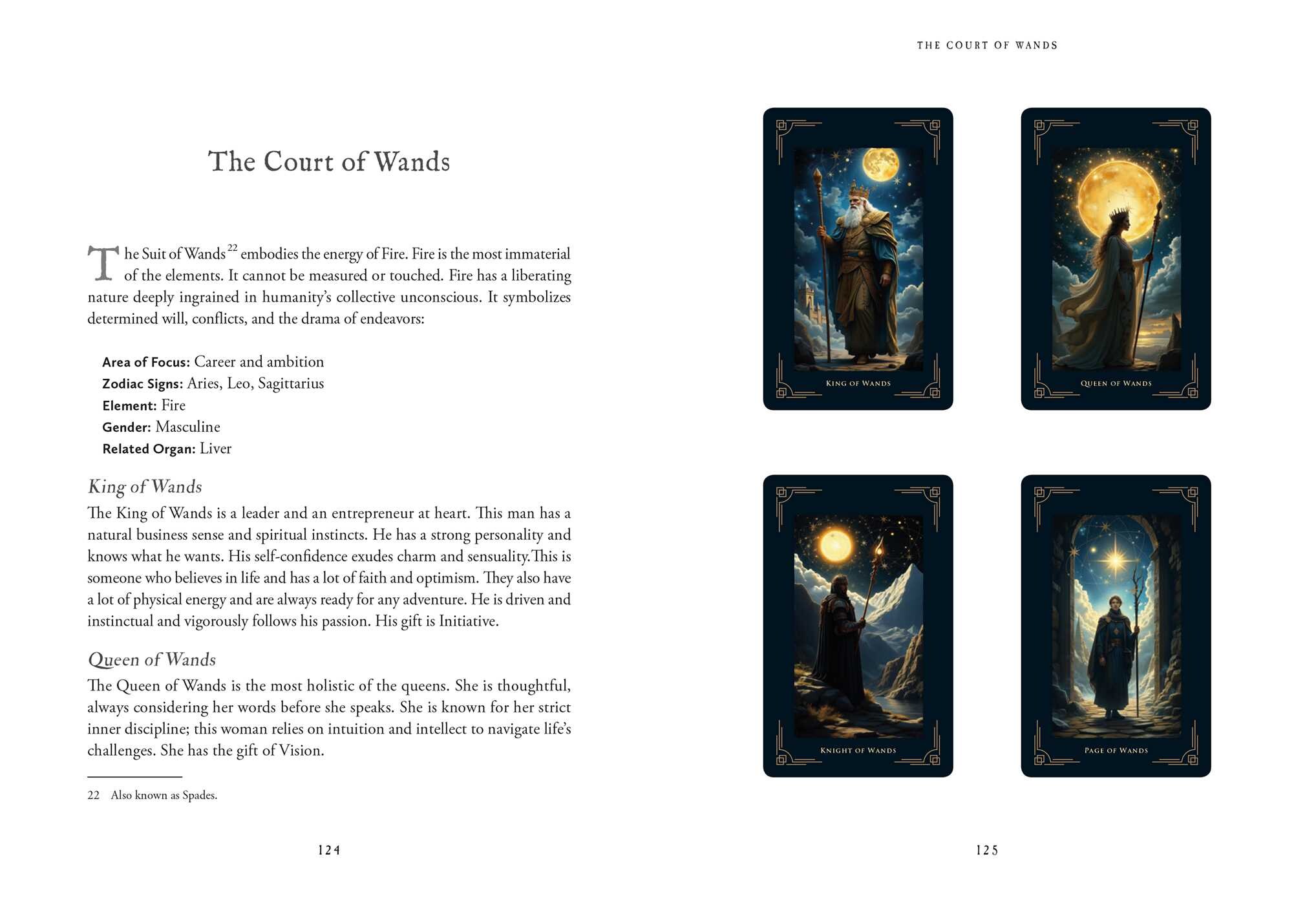
The Suit of Wands represents the Fire Arcana. This group of 14 cards governs the realms of inspiration, creativity, ambition, and primal energy. Wands are the spark of life—the initial impulse that drives a person to start a business, create art, or pursue a passion.
Elemental Attributes
Fire is transformative, unpredictable, and energetic. Consequently, the Wands Arcana is associated with movement and growth. When these cards appear, they often signal that the querent (the person asking the question) is in a phase of high activity. The Ace of Wands, for instance, is the quintessential "lightbulb moment," while the Eight of Wands suggests rapid communication or travel.
Practical Application
In a career context, Wands often relate to professional drive and the entrepreneurial spirit. However, the shadow side of Fire is burnout and aggression. The Ten of Wands warns of carrying too much responsibility, while the Five of Wands points to petty competition or internal friction. Understanding the Wands Arcana requires a balance between pursuing one’s "True Will" and ensuring that the fire of ambition does not consume the practitioner.
The Suit of Cups: The Arcana of Water and Emotion
The Suit of Cups represents the Water Arcana. This suit is the gateway to the heart, covering the spectrum of human emotion, relationships, intuition, and the subconscious mind. While Wands are about "doing," Cups are about "feeling" and "being."
The Fluidity of Emotion
Water takes the shape of its container, and the Cups Arcana reflects this adaptability. These cards deal with how we relate to others and ourselves. The Two of Cups represents a harmonious partnership, while the Five of Cups depicts the mourning of a loss. In 2026, as mental health and emotional intelligence have become central to the global discourse, the Cups Arcana is frequently used to explore shadow work and healing.
Intuition and Dreams
Because water is deep and often opaque, the Cups Arcana is also linked to psychic abilities and the dream world. The Page of Cups often brings intuitive messages, and the King of Cups represents a person who has mastered their emotional landscape. When reading the Cups, it is vital to look for the "ebb and flow" of the cards—are the emotions overflowing (as in the Ace of Cups) or are they being repressed (as in the Four of Cups)?
The Suit of Swords: The Arcana of Air and Mind
The Suit of Swords represents the Air Arcana. This is perhaps the most challenging group of cards, as it deals with the intellect, communication, logic, and conflict. Swords are double-edged; they can be used to cut through deception (clarity) or they can wound (harsh words and anxiety).
The Power of the Intellect
The Air element is associated with the mental plane. The Swords Arcana tracks the progression of thoughts and how they manifest in our reality. The Ace of Swords signifies a breakthrough in understanding or a "moment of truth." However, many cards in this suit—such as the Three of Swords (heartbreak/betrayal) or the Nine of Swords (insomnia/anxiety)—deal with the pain that our own minds can inflict upon us.
Conflict and Resolution
Swords are often present in readings concerning legal matters, debates, or difficult decisions. They represent the need for objective truth over subjective feeling. To understand the Swords Arcana, one must appreciate the necessity of "mental hygiene"—the practice of clearing away toxic thoughts and communicating with integrity. In the modern era, this suit often highlights the stresses of information overload and the digital landscape.
The Suit of Pentacles: The Arcana of Earth and Body
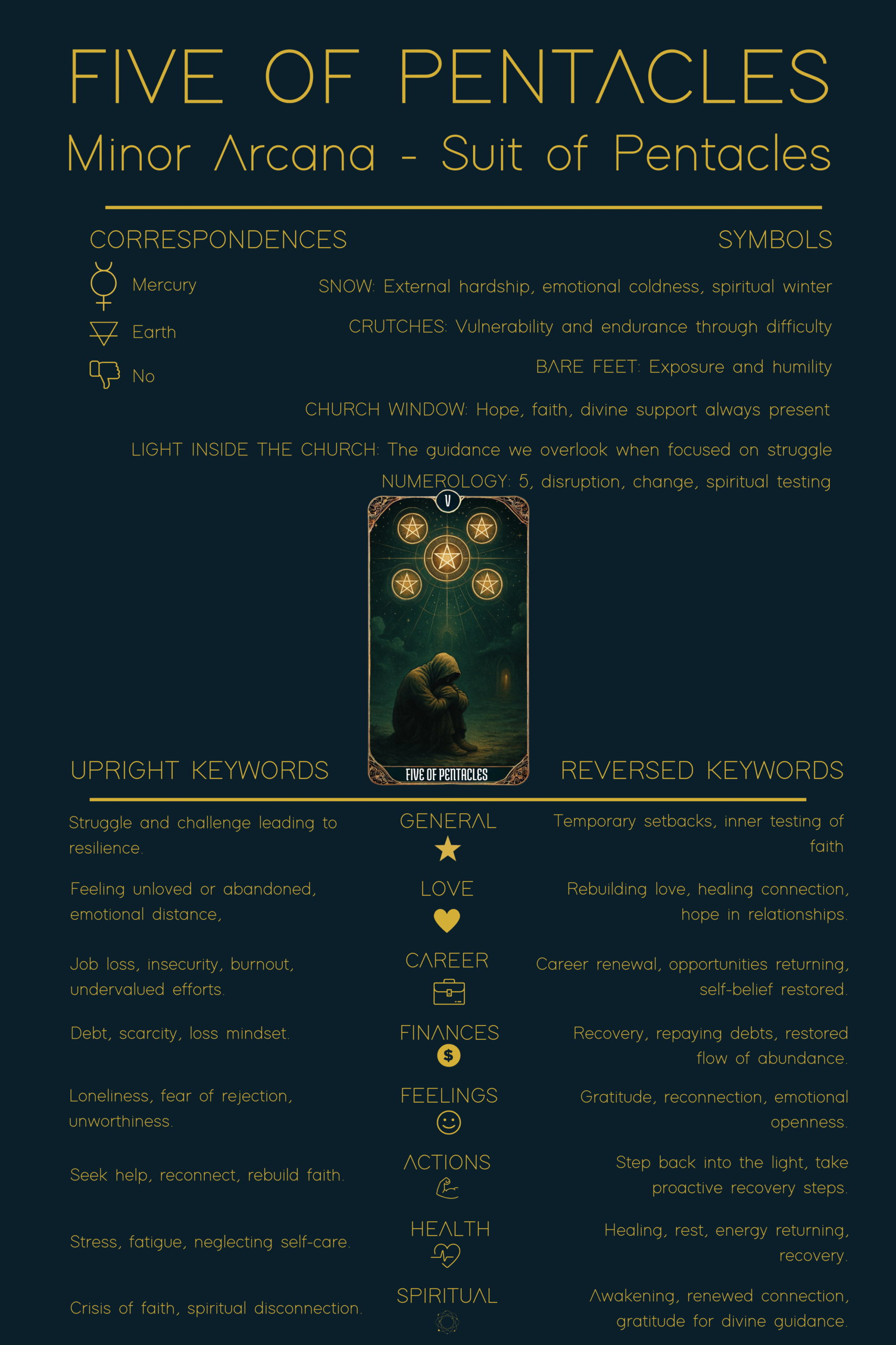
The Suit of Pentacles (sometimes called Coins or Disks) represents the Earth Arcana. This suit grounds the deck in the physical world. It governs finances, work, physical health, nature, and the home. It is the arcana of manifestation—turning ideas (Wands) into tangible reality.
Materiality and Value
The Earth element is stable, slow-moving, and fertile. The Pentacles Arcana reflects our relationship with the material plane and our sense of self-worth. The Ace of Pentacles represents a new financial opportunity or a seed planted for future growth. The Eight of Pentacles shows the value of craftsmanship and hard work, while the Ten of Pentacles represents long-term legacy and generational wealth.
The Physical Vessel
Beyond money, Pentacles represent the body. They remind the seeker that spiritual and mental health cannot flourish if the physical vessel is neglected. In 2026, this suit is heavily associated with sustainable living and ecological awareness. When Pentacles dominate a spread, it is a sign to "ground" oneself, look at the facts, and focus on practical steps rather than abstract theories.
Comparative Overview of the 5 Arcana
The following table summarizes the primary characteristics of the five arcana to assist in rapid identification during a reading.
| Arcana Group | Element | Primary Realm | Key Themes | Tarot Symbolism |
|---|---|---|---|---|
| Major Arcana | Spirit (Aether) | Macrocosm | Destiny, Soul Lessons, Life Cycles | The 22 Archetypes |
| Wands | Fire | Inspiration | Creativity, Ambition, Action, Passion | Staffs, Clubs, Fire |
| Cups | Water | Emotion | Relationships, Intuition, Love, Psyche | Chalices, Hearts, Water |
| Swords | Air | Intellect | Logic, Communication, Conflict, Clarity | Blades, Spades, Air |
| Pentacles | Earth | Material | Finance, Health, Property, Manifestation | Coins, Disks, Earth |
Integrating the 5 Arcana in Professional Practice
In 2026, an experienced tarot reader does not look at cards in isolation but observes how these five "arcana" interact. A "balanced" reading typically contains a mix of several groups, suggesting that the seeker's life is moving forward on multiple fronts.
Identifying Imbalances
If a reading is missing an entire arcana, it reveals a "void" in the seeker's current experience. For example, a spread with no Pentacles might suggest that the person has great ideas (Wands) and emotions (Cups) but lacks the grounding or resources to make them real. Conversely, a spread with no Cups might indicate a situation that is strategically sound (Swords) and profitable (Pentacles) but emotionally unfulfilling.
The Fifth Element Integration
The Major Arcana acts as the "overseer" of the four Minor suits. When a Major card lands next to a specific suit, it amplifies that suit’s importance. If The Lovers (Major) appears next to the Two of Cups (Minor), it suggests a relationship that is not just a passing romance but a significant soul-contract or life-altering union.
Technical Depth in Reading
To deepen your understanding, consider the "Golden Dawn" associations which link the 5 arcana to specific astrological placements. The Major Arcana often corresponds to planets or zodiac signs, while the Minor Arcana (numbered cards 2-10) correspond to decans of the zodiac. This layers a chronological and astronomical dimension onto the five categories, allowing for precise timing in predictions.
Frequently Asked Questions
Why do some people call them "5 Arcana" instead of just two?
While the traditional division is Major and Minor, many modern educational systems treat the four suits as individual arcana because they have distinct elemental signatures. This "5-pillar" approach helps students memorize the deck by categorizing cards into five manageable thematic blocks rather than two large, disparate groups.
Is there a "6th Arcana" in tarot?
Generally, no. The 78-card structure is fixed. However, some avant-garde decks in 2026 include a "Void" or "Shadow" suit, but these are non-standard. In traditional and modern hermeticism, the five categories (Spirit + 4 Elements) cover the entirety of human existence.
How do the Court Cards fit into the 5 Arcana?
The Court Cards (Pages, Knights, Queens, and Kings) are part of the four Minor Arcana suits. They represent personalities, maturity levels, or specific people in the seeker’s life. For example, the Queen of Swords is the "mature" expression of the Air/Intellect Arcana.
Can the "5 Arcana" be found in other systems?
Yes, this structure mirrors many other esoteric systems, such as the four elements of Western Astrology plus the "Prime Mover," or the four suits in a standard deck of playing cards (Hearts, Diamonds, Clubs, Spades) plus the Joker (the Fool).
Which arcana is the most important?
No single arcana is more important than the others. While the Major Arcana deals with "bigger" themes, you cannot live a functional life without the "Lesser" secrets of the Minor suits. You need the Earth (Pentacles) to eat, the Air (Swords) to think, the Water (Cups) to love, and the Fire (Wands) to create.
Final Recommendations for Mastery
To master the 5 arcana, begin by sorting your deck into these five piles. Spend a week meditating on one pile at a time. Observe how the "Fire" of the Wands manifests in your daily energy levels, or how the "Earth" of the Pentacles reflects your physical surroundings.
By the end of five weeks, you will have developed a "muscle memory" for the elemental and spiritual forces of the tarot. For those seeking professional certification in 2026, a deep-dive into the interaction between the Major Arcana and the four suits is usually a prerequisite for advanced clinical or psychological tarot practice.
Image Gallery