Money of Greece: Currency Guide, Payment Rules, and Local Financial Tips
The official currency of Greece is the Euro (currency code: EUR, symbol: €). Adopted on January 1, 2001, when Greece joined the Eurozone, physical Euro banknotes and coins officially replaced the historical Greek Drachma in national ci...
The official currency of Greece is the Euro (currency code: EUR, symbol: €). Adopted on January 1, 2001, when Greece joined the Eurozone, physical Euro banknotes and coins officially replaced the historical Greek Drachma in national circulation on January 1, 2002. Today, electronic payments via debit or credit cards and digital wallets are mandatory across nearly all commercial businesses in Greece, though carrying small amounts of cash remains recommended for remote locations and tipping.
Contents
The Official Currency of Greece: The Euro (EUR)
Greece operates as one of the member states of the Eurozone, utilizing the Euro for all monetary transactions, financial reporting, and commercial pricing. The policy and supply of the currency are managed jointly by the Bank of Greece—the nation’s central bank—and the European Central Bank (ECB).
Euro currency in Greece consists of eight coin denominations and six active banknote denominations:
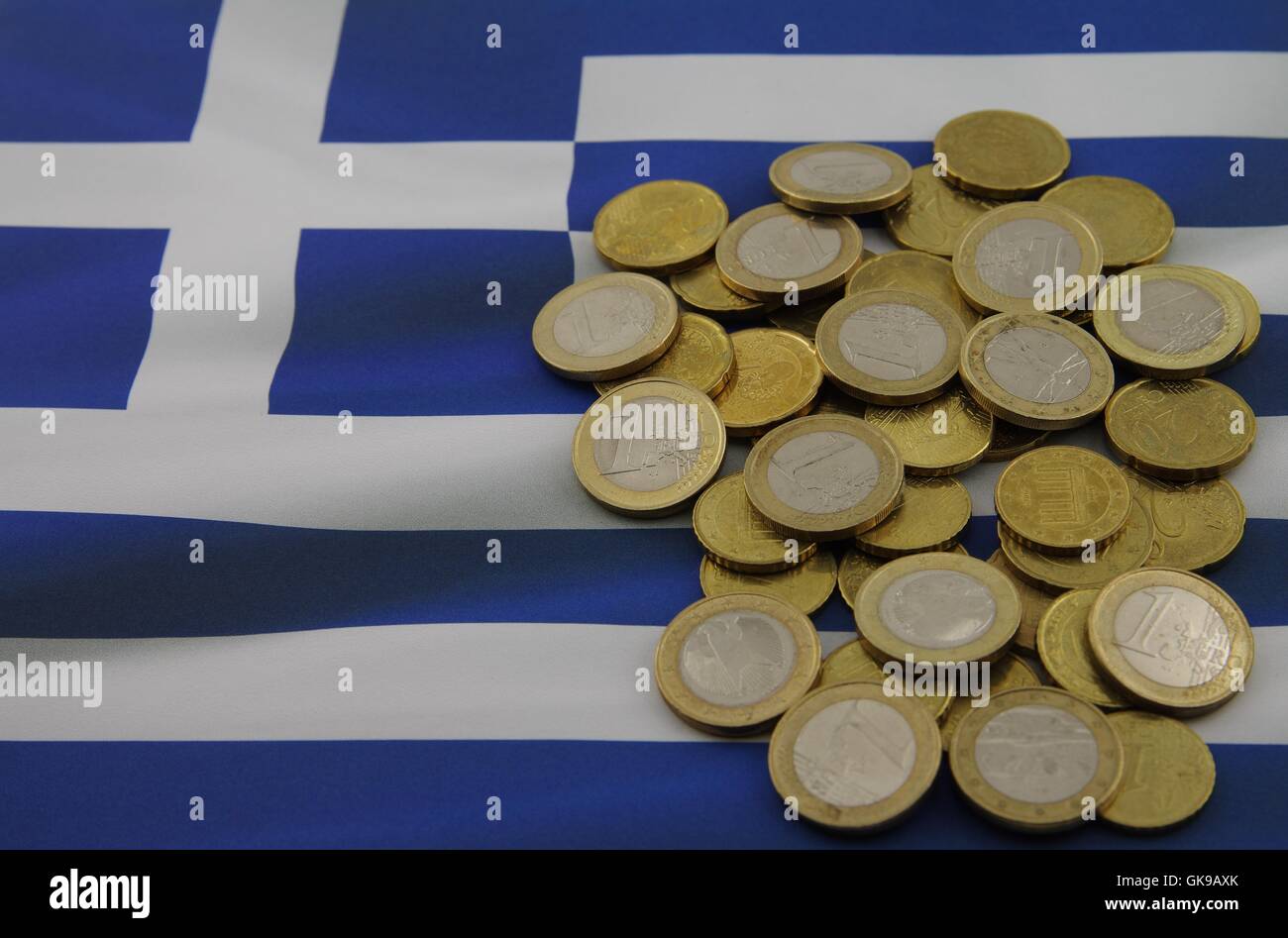
- Coins: 1 cent, 2 cents, 5 cents, 10 cents, 20 cents, and 50 cents, alongside €1 and €2 coins. Like all Eurozone coins, Greek Euro coins feature a standardized national side. The national reverse designs of Greek coins honor national heritage, featuring historic vessels on the smaller cent coins, notable modern Greek figures on the middle cent coins, an ancient Athenian tetradrachm on the €1 coin, and the mythological scene of Europa being abducted by Zeus on the €2 coin.
- Banknotes: €5, €10, €20, €50, €100, and €200. Banknotes feature identical designs across all Eurozone countries, portraying architectural styles from different epochs of European culture. The €500 note was permanently discontinued from production by the ECB in 2019 to curb illicit financial activity, though legacy €500 notes remain legal tender.
In daily life, prices are listed in Euros and cents using the comma (,) as a decimal separator and the period (.) as a thousands separator (for example, €1.250,50 represents one thousand two hundred fifty Euros and fifty cents).
Historical Context: From the Ancient Drachma to the Euro
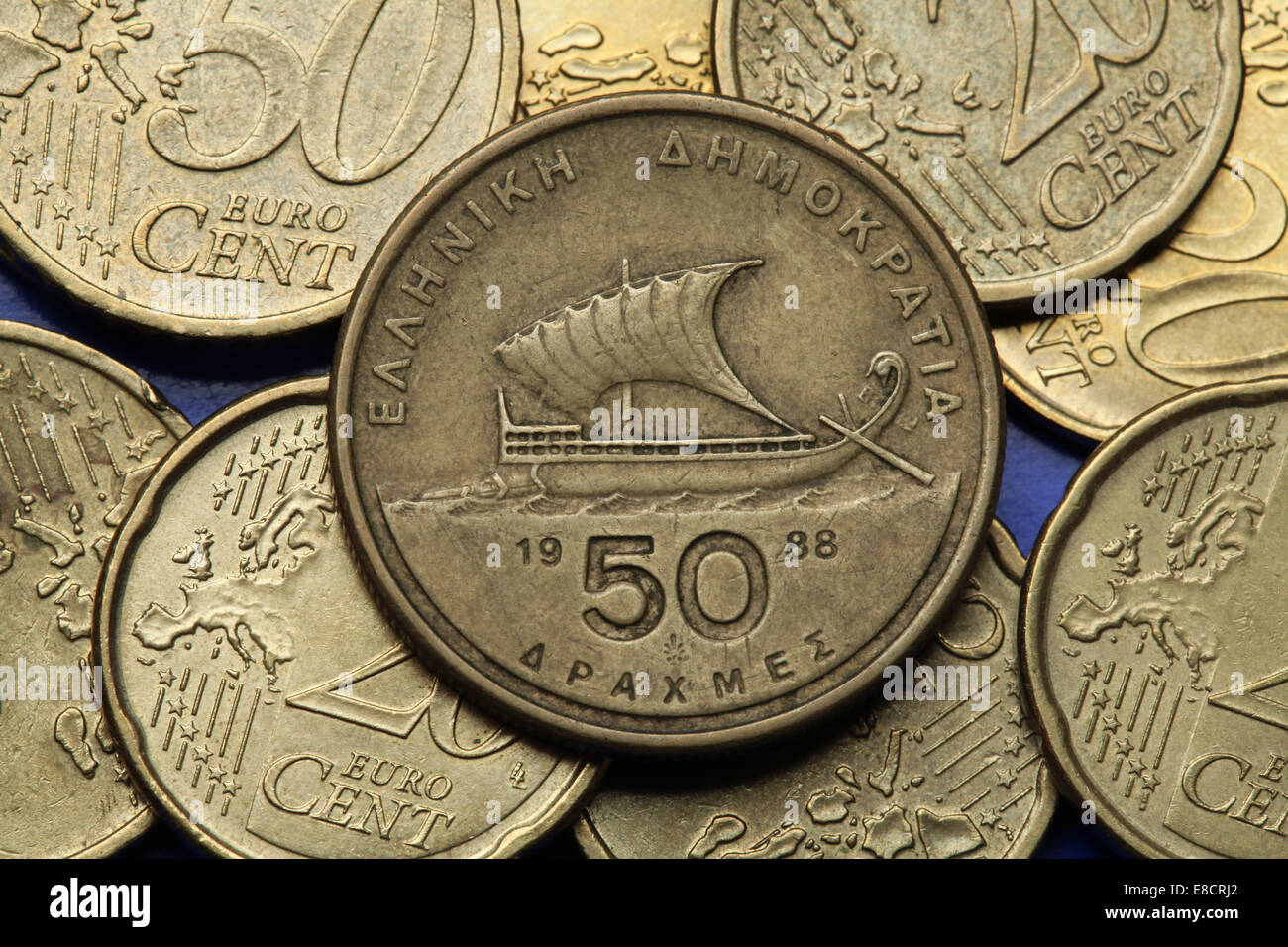
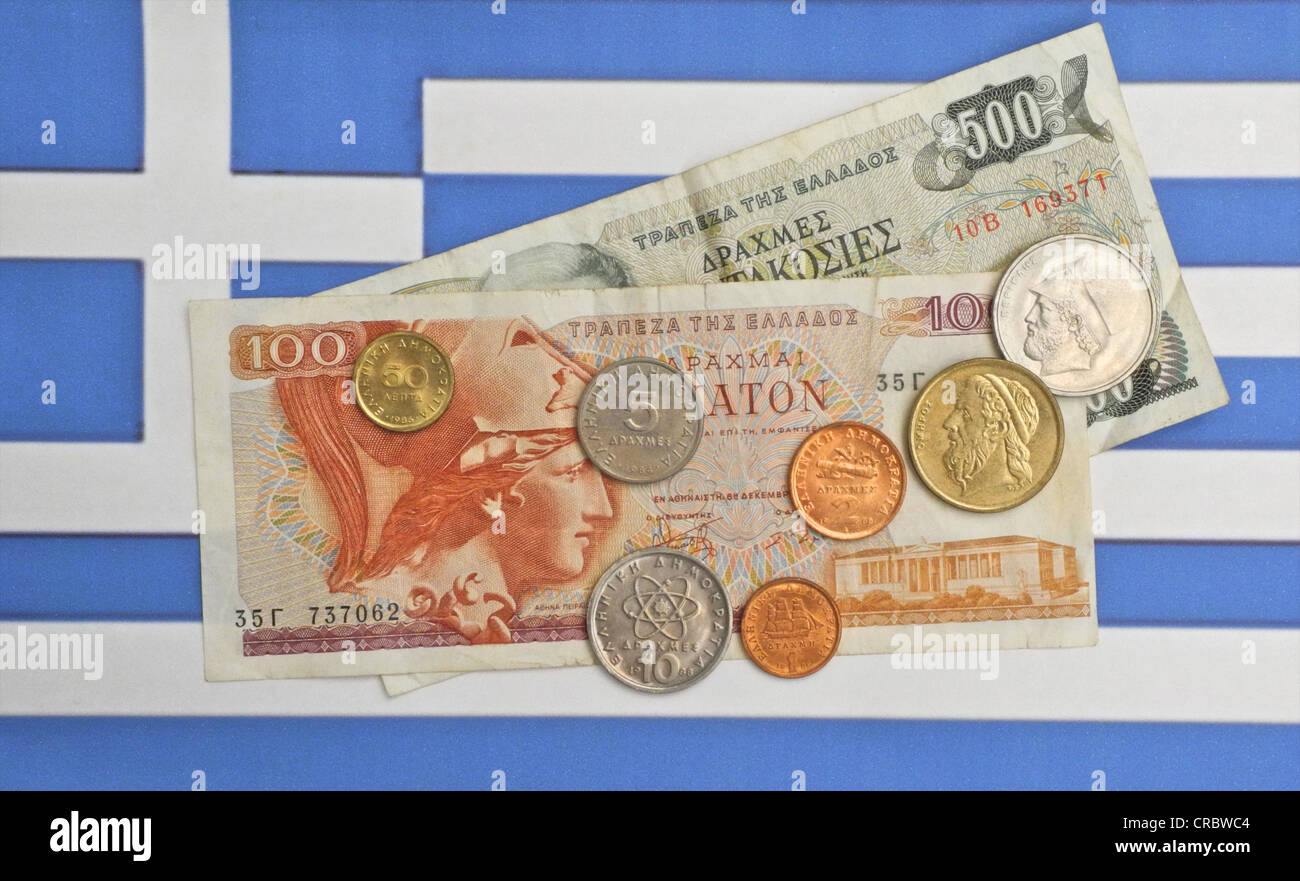
Before adopting the Euro, Greece used the Greek Drachma (GRD), a currency with deep historical roots dating back to ancient Greek city-states. The modern Drachma was re-introduced in 1832 following the establishment of the modern Greek state, replacing the short-lived Phoenix.
For nearly 170 years, the modern Drachma served as the monetary backbone of Greece through various economic cycles, revaluations, and hyperinflationary periods during World War II.
In preparation for European economic and monetary union, Greece aligned its fiscal and monetary targets with the Maastricht criteria during the late 1990s. Greece officially entered the Eurozone on January 1, 2001, fixing the exchange rate irrevocably at:
$$\text{1 EUR} = 340.750 \text{ GRD}$$
On January 1, 2002, Euro coins and banknotes entered physical circulation alongside the Drachma during a dual-currency period that concluded on February 28, 2002, after which the Euro became the sole legal tender. The central Bank of Greece accepted the exchange of old Drachma coins until 2004 and Drachma banknotes until 2012.
Paying for Things in Greece: Cards vs. Cash Requirements
Payment habits in Greece have undergone a major transformation due to strict regulatory updates enforced by the Hellenic Ministry of Economy and Finance and the Independent Authority for Public Revenue (AADE).
Legal Mandate for Card Acceptability
Under Greek tax regulations, virtually all commercial businesses, service providers, and independent professionals in Greece are legally required to accept electronic payments via Point-of-Sale (POS) terminals. This mandate covers:
- Restaurants, tavernas, cafes, and beach bars.
- Retail stores, supermarkets, and pharmacies.
- Taxis and private transit operators (which must display signage stating card acceptance).
- Open-air street markets (laiki agora) and kiosks (periptera).
- Independent medical practitioners, mechanics, and legal consultants.
Card transactions are primarily handled through networks like Visa and Mastercard. American Express and Discover are accepted at major hotel chains, luxury retailers, and high-end restaurants, but are frequently rejected by smaller independent merchants due to higher merchant processing fees. Contactless technology—including smartphone wallets like Apple Pay, Google Wallet, and wearable smart devices—is standard across almost all POS terminals.
When Cash is Still Necessary
Despite high card acceptance, carrying a modest cash reserve (€20 to €50 in low-denomination notes) is recommended for:
- Small Island Transport: Regional public buses (KTEL) on smaller Aegean or Ionian islands occasionally experience connectivity issues or prefer cash payments onboard.
- Small Island Kiosks & Rural Vendors: Remote mountain villages or secluded beaches may suffer from internet outages that temporarily disrupt card terminals.
- Tipping: Leaving cash directly on the table ensures the gratuity goes straight to service staff without delay or card processing deductions.
- Coin-Operated Facilities: Public restrooms, coin locks for supermarket carts, and street parking meters in regional towns frequently require physical coins.
High-denomination notes (€100, €200, and residual €500 notes) are often refused by small shop owners and taxi drivers due to limited cash float for change and concerns over counterfeit bills. Stick to €5, €10, and €20 notes for small purchases.
ATM Withdrawals, Currency Exchange, and the DCC Trap
When accessing cash in Greece, international travelers and residents should understand local ATM fees, banking networks, and foreign currency conversion mechanisms.
Main Bank Networks
Greece's banking sector is anchored by four major systemic retail banks:
- National Bank of Greece (NBG)
- Piraeus Bank
- Alpha Bank
- Eurobank
Withdrawing cash from ATMs operated by these four major retail banks is generally the safest and most reliable method. Domestic retail bank ATMs usually charge a direct access fee (typically €1.50 to €3.00 per transaction) for foreign-issued cards, in addition to any foreign transaction fees levied by your home bank.
Independent ATMs vs. Bank ATMs
Throughout high-traffic tourist areas, airports, and ferry ports, travelers will encounter standalone, non-bank ATMs operated by third-party financial service providers (such as Euronet). These independent machines often charge significantly higher fixed transaction fees (€4.00 to €6.00+) and aggressively push dynamic currency conversion defaults. Where possible, use an ATM physically attached to a branch of one of the major domestic banks.
The Dynamic Currency Conversion (DCC) Trap
When making a purchase or withdrawing cash with a foreign credit or debit card (for example, a card tied to USD, GBP, CAD, or AUD), the payment terminal or ATM will often present a prompt asking whether you wish to be charged in your home currency or in Euros (EUR). This service is called Dynamic Currency Conversion (DCC).
Always Choose Euros (EUR): If you select your home currency, the local ATM or payment terminal vendor performs the currency conversion on the spot, applying an exchange rate that includes markups of 6% to 18% above the standard interbank rate.
Decline Conversion: By choosing to be billed in Euros, the transaction is passed to your home card-issuing bank, which will perform the currency conversion using standard market exchange rates, which are virtually always far more favorable.
Payment Terminal Options
- Select Currency / Conversion Option:
- Pay in USD / Home Currency (DECLINE: Uses inflated DCC rate)
- Pay in EUR (Euros) (SELECT: Best exchange rate)
- Select Currency / Conversion Option:
Currency Exchange Offices
If traveling with physical foreign currency (such as US Dollars or British Pounds), cash can be exchanged at international airports, major bank branches, and licensed currency exchange bureaus (Exchange) located in commercial centers like Athens (Syntagma Square) or Thessaloniki. Airport exchange kiosks generally offer the least favorable exchange rates due to high overhead surcharges; exchange bureaus in central city areas or major bank branches typically offer better value.
Comparative Overview: Money Options and Fees in Greece
The following table summarizes the primary payment options available to visitors and residents in Greece:
| Payment Method | Acceptance Level | Typical Processing Fees | Recommended Use Cases | Operational Considerations |
|---|---|---|---|---|
| Visa / Mastercard (Credit/Debit) | Very High (>95% of businesses) | 0% to 3% (depending on home bank foreign transaction fees) | General dining, hotels, retail, supermarket, transport | Fully supported by contactless POS terminals; decline DCC when prompted. |
| Digital Wallets (Apple/Google Pay) | Very High | Identical to linked credit/debit card | Daily contactless purchases, cafes, transit, quick retail | Requires active smartphone battery/NFC; linked card dictates underlying fees. |
| Euros (Cash - Small Notes/Coins) | Universal (100%) | None | Small island buses, tips, rural kiosks, public toilets | Keep denominations to €5, €10, and €20; avoid carrying excess cash for safety. |
| Major Bank ATMs (NBG, Alpha, Piraeus) | High across towns & cities | €1.50 – €3.00 ATM fee + home bank out-of-network fees | Withdrawing physical Euros from foreign accounts | Locate ATMs attached to actual bank branches; decline DCC conversion prompts. |
| Independent ATMs (e.g., Euronet) | High in tourist hubs | €4.00 – €6.00+ ATM fee + heavy DCC conversion margins | Emergency cash access only | Avoid if domestic bank ATMs are nearby due to high surcharge fees. |
| Foreign Cash Exchange (USD, GBP, CAD) | Low (Not accepted directly for goods) | 5% to 15% hidden margin in exchange rates | Emergency backup option | Must be exchanged at bank branches or city exchange bureaus before spending. |
Tipping, Daily Budgeting, and Financial Etiquette in Greece
Understanding local financial practices and tax obligations helps avoid misunderstandings during your stay.
Tipping Etiquette
Tipping in Greece is appreciated, though not as strictly institutionalized as in North America. Service charges are legally required to be included in menu pricing, but leaving a gratuity for personal service is standard practice.
- Restaurants & Tavernas: Leaving a cash tip of 5% to 10% of the bill on the table is customary for satisfactory service. On smaller bills (e.g., a €15 meal), rounding up to the nearest couple of Euros is typical.
- Cafes & Bars: Rounding up the bill to the nearest Euro or leaving small coins (€0.50 to €2.00) is standard.
- Taxis: Tipping taxi drivers is not mandatory, but rounding up the fare to the nearest Euro (e.g., leaving €9.00 for an €8.20 fare) is common practice.
- Hotels: Tipping porter services €1.00 to €2.00 per bag and leaving €1.00 to €2.00 per day for housekeeping staff is appreciated.
Daily Spending Estimates
Budget requirements in Greece vary based on location (e.g., Athens vs. popular islands like Santorini or Mykonos vs. mainland regions like Epirus or Peloponnese):
- Budget Tier (€50 – €80 per day): Staying in hostels or budget rooms, eating street food like gyros and souvlaki (€3.50 – €5.00 each), utilizing public transit, and visiting free or reduced-admission historical sites.
- Mid-Range Tier (€120 – €250 per day): Staying in 3-star or 4-star hotels, sitting down for traditional meals at local tavernas (€20 – €40 per person), taking inter-island ferries, and buying standard museum admission tickets.
- Luxury Tier (€350+ per day): Staying in luxury boutique resorts, fine dining establishments (€80+ per person), renting private vehicles or booking domestic flights, and participating in private guided tours.
Value Added Tax (VAT / ΦΠΑ) and Receipts
Greece applies a standard Value Added Tax (VAT, locally known as ΦΠΑ - FPA) of 24% on most goods and services. A reduced rate of 13% applies to basic foodstuffs, restaurant meals (catering services), hotel accommodations, and energy, while a super-reduced rate of 6% applies to medicines, books, and theater tickets. Certain remote Aegean islands qualify for lower VAT rates to offset transport costs.
Mandatory Receipt Law: Under Greek law, customers are not legally required to pay for a service or product if the merchant fails to provide an official, itemized receipt (apodeixi) printed from a registered fiscal device or digital POS terminal. Hand-written slips or informal notes are not valid legal receipts.
International visitors residing outside the European Union can claim VAT refunds on non-perishable merchandise purchases exceeding €50 made at participating "Tax-Free Shopping" retailers. The tax refund form must be validated by Greek Customs at your final port of departure from the European Union.
Local Banking and Digital Money Systems: The IRIS Payment Platform
For residents, digital nomads, and expats living in Greece, the local banking ecosystem relies on specific digital frameworks.
The IRIS Payment Platform
Managed through DIAS (the national payment system operator under Hellenic Bank Association guidelines), IRIS Payments is Greece’s native real-time account-to-account transfer network. IRIS enables individuals and small businesses to transfer funds instantly using only a mobile phone number or Tax Identification Number (AFM - Arithmos Forologikou Mitroou), bypassing standard interbank settlement delays.
- Greek Digital Payments Ecosystem Structure
- Payment Channels:
- POS Terminals (Cards/Wallets)
- IRIS Payments (Instant P2P / Account Transfers)
- Settlement Framework: Bank of Greece / SEPA Settlement Framework
- Payment Channels:
Under domestic financial regulations, self-employed professionals and small business owners must link their professional accounts to the IRIS platform to allow consumers to make fee-free instant payments directly from their mobile banking applications.
SEPA Integration
As part of the European Single Euro Payments Area (SEPA), domestic and cross-border bank transfers in Euros between Greek bank accounts and accounts within other SEPA member nations (such as Germany, France, or Ireland) are processed under standardized execution timelines and low or zero cross-border transfer fees.
Frequently Asked Questions About Money in Greece
Can I use US Dollars, British Pounds, or other foreign currencies in Greece?
No. Foreign cash currencies like US Dollars, British Pounds, or Canadian Dollars are not accepted for direct transactions in shops, restaurants, or transport in Greece. You must use Euros or pay electronically via a card that automatically converts your home currency to Euros.
Are taxis in Greece required to accept card payments?
Yes. By law, all taxi drivers in Greece are required to accept credit, debit, and contactless mobile card payments. Taxis must display an official sticker on the rear passenger window indicating card acceptance in both Greek and English. If a driver claims their POS terminal is out of order, they are legally obligated to inform you before starting the journey.
What should I do if an ATM or terminal asks to bill me in my home currency?
Always decline the conversion and choose to be charged in Euros (EUR). Choosing your home currency triggers Dynamic Currency Conversion (DCC), which allows the machine operator to charge an inflated exchange rate with high hidden markups. Selecting EUR ensures your home bank handles the conversion at a standard, competitive rate.
How much cash should I carry when visiting Greek islands?
While major tourist islands like Crete, Rhodes, Corfu, Santorini, and Mykonos have extensive card acceptance and bank ATM networks, carrying €30 to €100 in physical cash (in small denominations like €5, €10, and €20) is advisable when visiting smaller or less-developed islands. This covers small expenses, local bus fares, or situations where internet disruptions disable POS terminals.
How do I claim a VAT refund when leaving Greece?
If you reside outside the EU and spend more than €50 at a participating tax-free shop, request a Tax-Free Form at the cash register. Before checking your luggage or departing the EU at a Greek airport or port, present your unused goods, receipts, passport, and tax-free form to Greek Customs officers to receive an official validation stamp. Once stamped, you can claim your cash or card refund at an airport tax-refund desk.
Practical Recommendations for Managing Money in Greece
To ensure smooth financial transactions when traveling or living in Greece:
- Notify Your Financial Institutions: Alert your home bank of your travel dates to Greece so your credit or debit cards are not flagged for suspicious international activity.
- Opt for Euros at POS Terminals: Select "Pay in EUR" every time you use a card terminal or ATM to avoid Dynamic Currency Conversion fees.
- Carry a Backup Card and Cash Reserve: Carry two payment cards from different banking networks (e.g., one Visa and one Mastercard) alongside €30–€50 in small banknotes.
- Rely on Major Retail Bank ATMs: Use ATMs attached directly to physical branches of National Bank of Greece, Piraeus Bank, Alpha Bank, or Eurobank to minimize withdrawal surcharges and avoid independent high-fee tourist ATMs.
- Always Keep Receipts: Verify that you receive an official, printed fiscal receipt for every purchase, as required under Greek consumer protection and tax law.
Disclaimer: This guide is provided for general informational purposes only and does not constitute legal, tax, or formal financial advice. Foreign exchange policies, banking fees, and local merchant regulations are subject to statutory updates by official regulatory bodies in Greece and the European Union.
Image Gallery