How to Write a Formal Letter to Change Life Insurance Details
A formal letter for a life insurance change must include the policyholder’s full name, the specific policy number, a detailed description of the requested modification, and a dated signature. Using a standardized professional business...
A formal letter for a life insurance change must include the policyholder’s full name, the specific policy number, a detailed description of the requested modification, and a dated signature. Using a standardized professional business format ensures the insurance provider can verify your identity and process the update without administrative delays or legal ambiguity.
Contents
Updating a life insurance policy is a critical financial task that often follows significant life milestones. While many providers in 2026 offer digital portals for minor updates, formal written correspondence remains the gold standard for substantive changes, such as modifying beneficiaries, adjusting coverage limits, or correcting legal names. A well-structured letter serves as a permanent record of your intent, providing a crucial paper trail should any disputes arise regarding the policy’s execution.
The Importance of Formal Documentation in 2026
Even in an era dominated by instant digital updates, the formal letter continues to hold significant weight in the insurance industry. Life insurance is a legally binding contract; therefore, any amendment to that contract requires clear, unambiguous communication. A formal letter eliminates the risks associated with technical glitches in web portals and ensures that complex instructions—such as specific percentage allocations for multiple beneficiaries—are recorded exactly as intended.
Furthermore, certain changes require "wet signatures" or notarization, which are best handled through physical or high-resolution scanned correspondence. When you submit a formal letter, you are providing a document that can be archived in the insurer’s permanent files, which is vital for claims processing decades down the line.
Core Components of the Formal Letter Format
To ensure your request is processed efficiently, your letter must follow a standard professional layout. Missing even a minor detail, such as a middle initial or a policy suffix, can lead to the rejection of your request.
1. The Header and Contact Information
Your letter should begin with your full legal name, current mailing address, phone number, and email address. Below your information, include the date of writing. Following the date, provide the recipient’s details, typically addressed to the "Policy Administration Department" or a specific claims representative if one has been assigned to you.
2. The Subject Line
The subject line is perhaps the most critical part of the letter for administrative sorting. It should be bolded and include the primary purpose of the letter alongside your policy number. For example: RE: Request for Beneficiary Change – Policy #123456789.
3. The Formal Salutation
Use a professional greeting such as "Dear Policy Administration Team" or "To the Underwriting Department." Avoid overly casual greetings, as this is a legal request regarding a financial asset.
4. The Opening Paragraph
State clearly and immediately that you are requesting a change to your policy. Identify yourself as the policyholder and reference the policy type (e.g., Term Life, Whole Life, or Universal Life).
5. The Body: Detailing the Change
This section should be specific. If you are changing a beneficiary, provide the new individual's full legal name, Social Security number (if required by the carrier), relationship to you, and the percentage of the benefit they are to receive. If you are changing coverage amounts, specify the current amount and the new desired limit.
6. The Closing and Signature
End the letter with a professional closing like "Sincerely" or "Respectfully." Leave space for a physical signature above your typed name. If the policy is owned by someone other than the insured, the owner must be the one to sign the letter.
Comparison of Common Life Insurance Changes
The following table outlines the typical requirements and documentation needed for various types of policy modifications as of 2026.
| Change Type | Required Information | Supporting Documentation | Processing Time |
|---|---|---|---|
| Beneficiary Update | Full Name, DOB, SSN, Relationship | None (Usually) | 3–5 Business Days |
| Name Change | New Legal Name, Reason for Change | Marriage Cert/Court Order | 7–10 Business Days |
| Coverage Increase | Desired Amount, Reason | Medical Exam/Financial Statement | 2–4 Weeks |
| Coverage Decrease | Desired Amount | Signed Surrender Form (if applicable) | 5–7 Business Days |
| Address/Contact | New Address, Phone, Email | Proof of Residency (occasionally) | 2–3 Business Days |
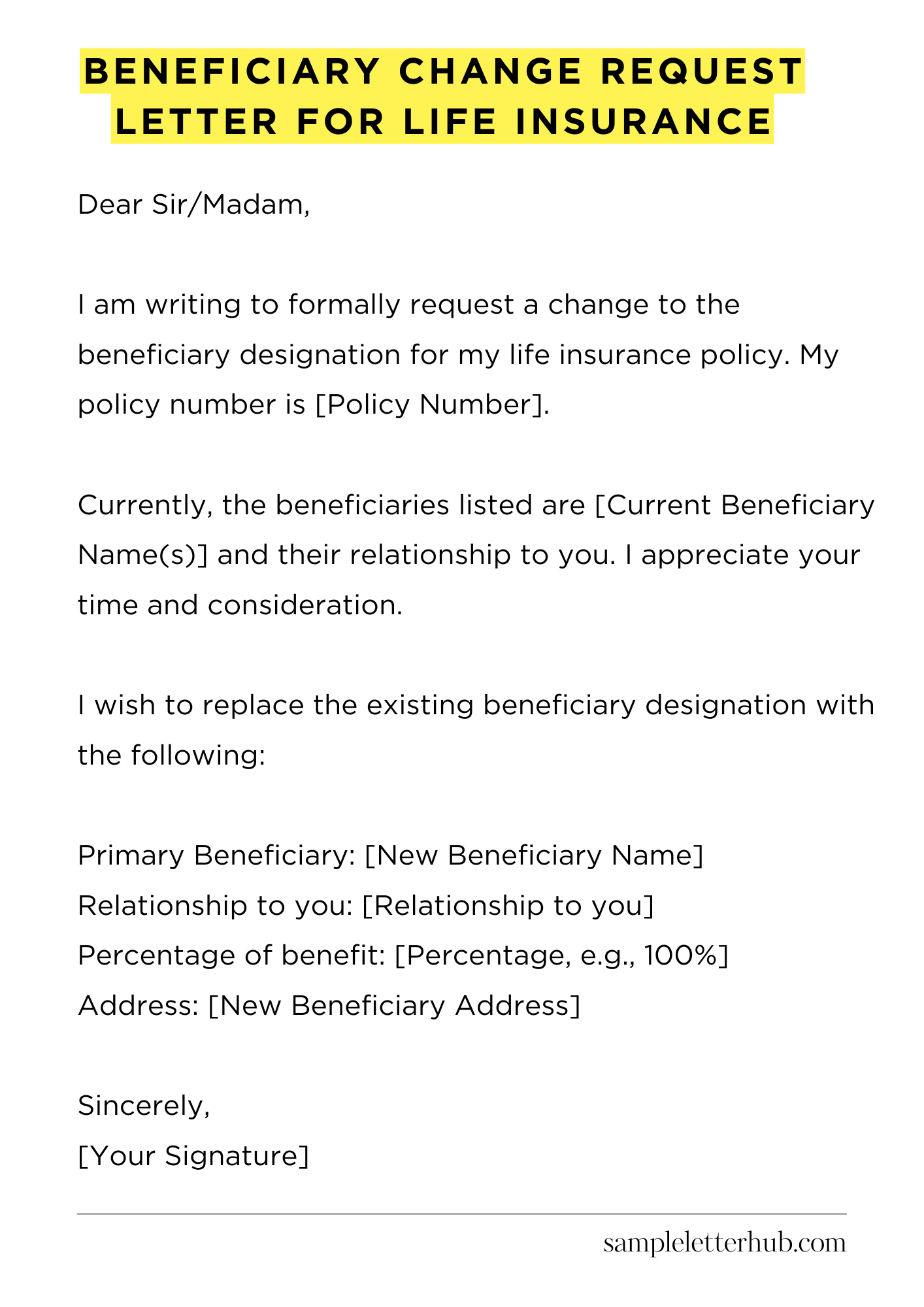
Sample Letter Template: Change of Beneficiary
This template can be adapted for most standard life insurance providers. Ensure all bracketed information is replaced with your specific details.
[Your Full Legal Name][Your Street Address][City, State, Zip Code][Your Phone Number][Your Email Address]
[Date: March 15, 2026]
[Insurance Company Name][Policy Administration Department][Company Street Address][City, State, Zip Code]
RE: Formal Request to Change Beneficiary – Policy #[Your Policy Number]
To the Policy Administration Department,
I am writing to formally request a change to the beneficiary designations for my life insurance policy, number [Your Policy Number]. I am the current policyholder and the insured party under this contract.
Effective immediately, please remove all previous primary and contingent beneficiaries and replace them with the following:
Primary Beneficiary:
- Name: [Full Legal Name]
- Relationship: [e.g., Spouse]
- Date of Birth: [MM/DD/YYYY]
- Social Security Number: [XXX-XX-XXXX]
- Benefit Percentage: 100%
Contingent Beneficiary:
- Name: [Full Legal Name]
- Relationship: [e.g., Child]
- Date of Birth: [MM/DD/YYYY]
- Social Security Number: [XXX-XX-XXXX]
- Benefit Percentage: 100%
Please update your records to reflect these changes. I request a written confirmation of this update sent to my address on file or via email at [Your Email Address] once the process is complete.
If there are additional forms required or if further verification is necessary, please contact me at your earliest convenience.
Sincerely,
[Your Signature]
[Your Typed Name]
Guidance for Specific Change Scenarios
Increasing or Decreasing Coverage
When requesting a change in the face value of your policy, the formal letter format remains the same, but the body paragraph must address financial or medical justifications. For an increase, be prepared for the insurer to request a "Statement of Insurability" or a new medical underwriting process. If you are decreasing coverage to lower premiums, clearly state the new total amount you wish to maintain.
Changing the Premium Payment Mode
If you wish to switch from monthly installments to an annual payment (or vice versa), the letter should specify the date you wish the new billing cycle to begin. Annual payments often come with a small discount in 2026, so it is beneficial to ask the insurer to calculate the new premium rate in your letter.
Legal Name Changes
For name changes due to marriage, divorce, or legal petition, the formal letter must be accompanied by a certified copy of the legal document. Mention in your letter: "Attached is a certified copy of [Document Name] as evidence of this legal change."
Best Practices for Submission and Verification
To ensure your formal letter is effective, follow these professional standards:
- Use Certified Mail: When sending physical letters, use certified mail with a return receipt requested. This provides legal proof that the insurance company received your request.
- Keep a Digital Copy: Scan the signed letter and any attachments. Store them in a secure digital vault or a cloud-based filing system.
- Verify After 10 Days: If you have not received a confirmation notice within ten business days, call the customer service department. Reference the date you sent the letter and the tracking number if applicable.
- Check for Consistency: Ensure the name and address on your letter match exactly what the insurance company currently has on file. If you have moved, it is often best to update your address first before requesting a beneficiary change.
Common Mistakes to Avoid
Incomplete or incorrect letters are the primary cause of delays in policy administration. Avoid these frequent errors:
- Vague Beneficiary Designations: Never use phrases like "my children" or "my spouse." Always use full legal names and Social Security numbers to prevent confusion during the claims process.
- Missing Policy Numbers: Large insurers manage millions of policies. Without a policy number, your letter may be filed incorrectly or ignored.
- Unsigned Documents: A letter requesting a change to a financial contract is not valid without a signature.
- Failure to Designate Percentages: If you name multiple primary beneficiaries, you must specify the percentage of the death benefit each is to receive (e.g., 50/50 or 70/30). If you do not, the insurer may reject the request or default to equal distribution, which may not align with your estate plan.
Frequently Asked Questions
Can I change my life insurance beneficiary through an email instead of a formal letter?
While some companies allow email requests, most will respond by sending you a PDF form to sign or will require a formal letter as an attachment. A plain-text email is rarely sufficient for a permanent change to a legal contract because it lacks a verified signature.
How often should I review my life insurance details?
Financial experts in 2026 recommend reviewing your policy details annually or after any major life event, such as marriage, divorce, the birth of a child, or the death of a named beneficiary.
Do I need a lawyer to write a change of life insurance letter?
No, a lawyer is not required. As long as the letter is clear, includes your policy number, and is signed by the policy owner, the insurance company is legally obligated to process the request or provide a valid reason why they cannot.
What happens if I send a letter but die before the change is processed?
This is a complex legal area. Generally, if the insurer received the request before the policyholder's death and the request was in good order, the change may be honored. However, if the letter was never received, the original beneficiaries will likely receive the payout. This is why using certified mail is vital.
Can I change the "Insured" person on the policy via a formal letter?
No. You cannot change the person whose life is covered by the policy. You can change the owner or the beneficiaries, but a life insurance policy is intrinsically tied to the specific individual named at the time of underwriting.
Final Recommendation
When preparing your formal letter, clarity is your highest priority. Use a clean, 12-point font, avoid emotional language, and stick strictly to the facts of the request. Once you have mailed the letter, set a reminder on your calendar for 14 days later to confirm that the changes have been reflected in your account. Keeping your life insurance details updated is an essential part of responsible estate management and ensures your loved ones are protected according to your current wishes.
Image Gallery