Understanding the Central Time Acronym in Daily Schedules: CST, CDT, and CT Explained
Understanding the Central Time acronym in daily schedules requires recognizing three distinct labels: CT (Central Time), CST (Central Standard Time), and CDT (Central Daylight Time). In daily scheduling, CST refers to UTC-6 (observed f...
Understanding the Central Time acronym in daily schedules requires recognizing three distinct labels: CT (Central Time), CST (Central Standard Time), and CDT (Central Daylight Time). In daily scheduling, CST refers to UTC-6 (observed from November to March), CDT refers to UTC-5 (observed from March to November), and CT is a generic term encompassing both phases.
Contents
Decoding the Central Time Acronyms: CT, CST, and CDT
Navigating time zone designators in event invites, flight itineraries, and project deadlines can be confusing when acronyms are used interchangeably or incorrectly. While many professionals write "CST" for any event occurring in the central portion of North America, using the correct designation prevents costly miscommunications, missed meetings, and automated calendar conversion errors.
- Central Time (CT): Generic identifier for the North American zone
- Central Standard Time (CST): UTC-6 (Nov – Mar in US/CA)
- Central Daylight Time (CDT): UTC-5 (Mar – Nov in US/CA)
Central Standard Time (CST) Defined
Central Standard Time (CST) is the standard time offset used in the Central Time Zone when Daylight Saving Time (DST) is not active. Expressed as an offset from Coordinated Universal Time, CST is UTC-6.
In the United States and Canada, CST is observed during the winter months—specifically from the first Sunday in November until the second Sunday in March. When a schedule specifies 2:00 PM CST, it explicitly denotes an event anchored to UTC-6. If that event takes place in July, labeling it "CST" is technically inaccurate, even though recipient calendar clients often attempt to correct the error automatically.
Central Daylight Time (CDT) Defined
Central Daylight Time (CDT) represents the daylight saving period for the Central Time Zone. During this period, clocks are advanced by one hour, shifting the zone's offset to UTC-5.
In most regions of North America that observe daylight saving, CDT begins on the second Sunday in March and ends on the first Sunday in November. Marking an event as 2:00 PM CDT indicates that local clocks in Chicago, Dallas, or Winnipeg read 2:00 PM under the UTC-5 offset.
Central Time (CT) as a Universal Identifier
The acronym CT stands for Central Time. Unlike CST or CDT, CT does not specify whether standard or daylight saving time is currently in effect. Instead, it serves as a umbrella term that automatically points to whichever phase local clocks are observing on a given date.
For general daily scheduling, using CT is often the safest choice. If you create a recurring meeting that spans the entire year, designating it as "10:00 AM CT" allows calendar platforms like Google Calendar, Microsoft Outlook, and Apple Calendar to resolve the exact UTC offset dynamically as seasonal daylight changes occur.
Geographic Scope and Regional Variations of Central Time
The Central Time Zone stretches across North America, spanning parts of Canada, the United States, Mexico, and Central America. However, not all locations within this geographic meridian transition between standard and daylight saving time on the same schedule, nor do all regions observe daylight saving time at all.
United States and Canada
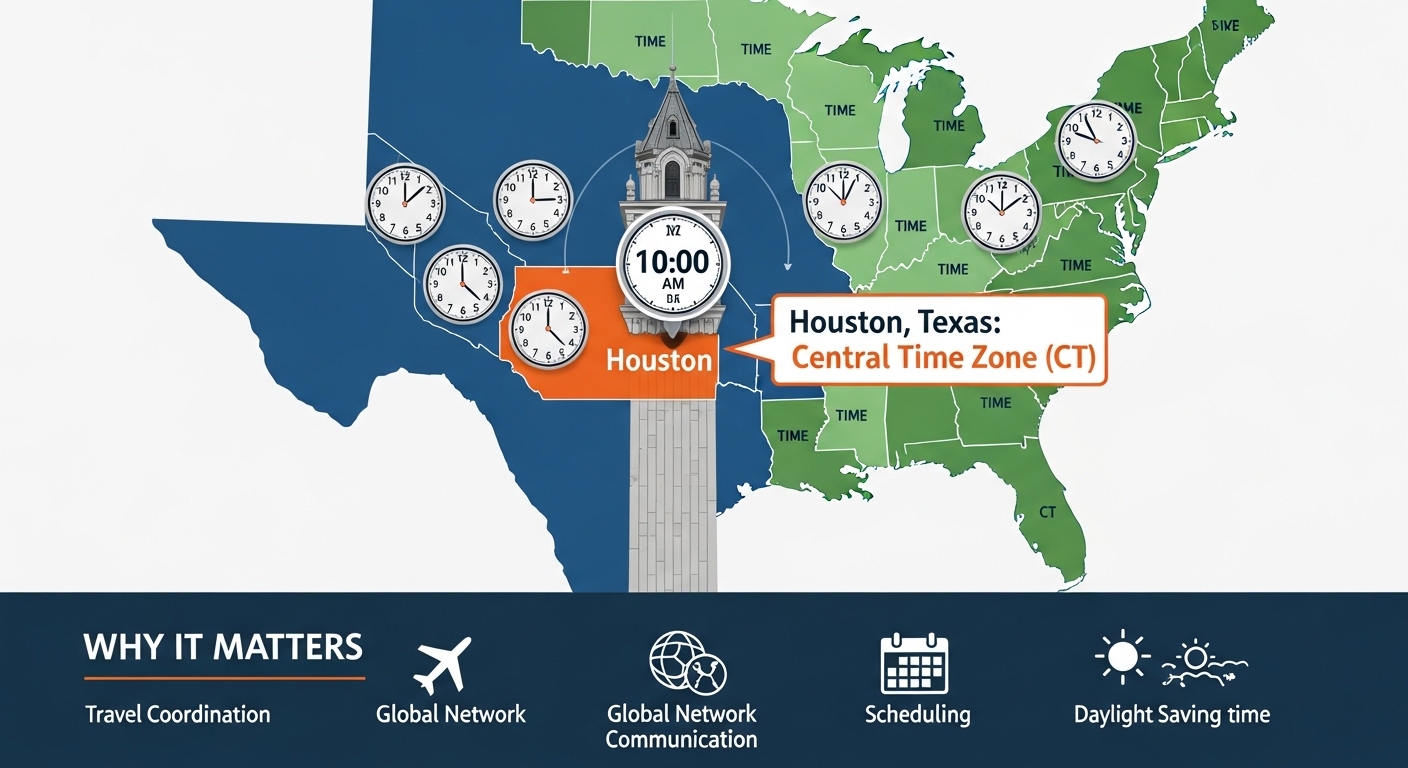
In the United States, Central Time encompasses 20 states in whole or in part, including major commerce centers such as Chicago, Houston, Dallas, Minneapolis, St. Louis, and New Orleans. In Canada, it includes the entire province of Manitoba, most of Saskatchewan, parts of northwestern Ontario, and eastern Nunavut.
While most of these jurisdictions transition simultaneously between CST (UTC-6) and CDT (UTC-5), notable exceptions exist:
- Saskatchewan (Canada): Most of Saskatchewan remains on CST (UTC-6) year-round and does not observe Daylight Saving Time. As a result, during the summer months, Saskatchewan's local clocks match Mountain Daylight Time (MDT), while during the winter, they align with Central Standard Time (CST).
- Divided States: States like Indiana, Kentucky, Tennessee, Florida, Michigan, Kansas, Nebraska, and the Dakotas sit on time zone borders. Municipalities on opposite sides of a county line within the same state may operate on different base time zones (Central versus Eastern or Mountain).
Mexico and Central America
Mexico previously aligned most of its central territory with North American Daylight Saving Time rules. However, following national legal reform in late 2022, Mexico abolished daylight saving time for the majority of the country.
Most interior Mexican states now remain on standard time (CST / UTC-6) year-round. Certain border municipalities (such as Ciudad Juárez, Reynosa, and Matamoros) maintain seasonal time changes to stay synchronized with adjacent U.S. commercial hubs.
Further south, Central American nations—including Belize, Guatemala, Honduras, El Salvador, Nicaragua, and Costa Rica—geographically operate at UTC-6. These countries typically do not observe daylight saving time, maintaining a constant UTC-6 offset throughout the calendar year.
Transition Dates and Time Changes
For regions that follow North American Daylight Saving Time rules, the transition dates follow a set annual schedule established by legislation, such as the U.S. Energy Policy Act of 2005.
- Spring Transition (Clocks Move Forward 1 Hour)
- Second Sunday in March at 2:00 AM Local Time
- CST (UTC-6) to CDT (UTC-5)
- (1:59 AM CST becomes 3:00 AM CDT)
- Fall Transition (Clocks Move Back 1 Hour)
- First Sunday in November at 2:00 AM Local Time
- CDT (UTC-5) to CST (UTC-6)
- (1:59 AM CDT becomes 1:00 AM CST)
During the spring transition, the hour between 2:00 AM and 3:00 AM is omitted. Daily routines, digital cron jobs, and overnight shift schedules scheduled during that missing hour require explicit handling to avoid execution delays or duplicate runs.
During the fall transition, the hour between 1:00 AM and 2:00 AM is repeated. Software platforms usually distinguish these repeated hours using explicit UTC offset tags (e.g., 01:30-05:00 versus 01:30-06:00).
Common Scheduling Pitfalls and How to Avoid Them
Misinterpreting or improperly specifying Central Time acronyms in daily business schedules leads to missed appointments, flight confusion, and operational friction.
- Static Acronym Mislabeling: Writing "CST" in July forces user software to resolve conflicting data.
- Cross-Boundary Coordination: Inviting participants across CST/MDT or EST lines without dynamic links.
- International Desynchrony: Forgetting that Europe/Mexico switch DST on different dates.
1. Hardcoding "CST" Year-Round
A frequent mistake in emails and public meeting notices is writing "CST" when the meeting takes place in the summer (when CDT is active).
- The Problem: If a scheduling system or calendar app parses "CST" strictly as UTC-6 in July, an event meant for 1:00 PM CDT (UTC-5) might be calculated as 2:00 PM Eastern instead of 2:00 PM EDT, shifting the time for non-Central participants by an hour.
- The Solution: Use CT for general scheduling, or let software convert times based on the exact calendar date. If writing manual timestamps, verify whether the date falls under standard or daylight time.
2. Assuming Uniform International Daylight Saving Dates
Different regions change clocks on different dates. For example, Europe typically transitions to Summer Time on the last Sunday in March and back on the last Sunday in October.
For approximately two to three weeks every spring and autumn, the offset between Central Time and European time zones (such as CET or GMT) shifts by an extra hour. Assuming fixed relative offsets year-round causes meeting overlaps during these transition windows.
3. Misinterpreting Border Locations
Cross-border transit, remote teams, and multi-state distribution routes regularly cross time zone borders. For instance, traveling from Pensacola, Florida (Central Time) to Tallahassee, Florida (Eastern Time) moves your local clock forward by one hour within the same state. Always confirm local municipal time rather than relying solely on state boundaries.
Time Zone Comparison and Offset Reference
To simplify daily coordination, the following reference table maps Central Time to major North American time zones and Coordinated Universal Time (UTC) across both phases of the year.
| Time Zone Name | Standard Abbreviation | Daylight Abbreviation | UTC Offset (Standard) | UTC Offset (Daylight) | Equivalent to 9:00 AM CT (Local Time) |
|---|---|---|---|---|---|
| Coordinated Universal Time | UTC | UTC | UTC+0 | UTC+0 | 3:00 PM UTC (Standard) / 2:00 PM UTC (Daylight) |
| Eastern Time | EST | EDT | UTC-5 | UTC-4 | 10:00 AM Local |
| Central Time | CST | CDT | UTC-6 | UTC-5 | 9:00 AM Local |
| Mountain Time | MST | MDT | UTC-7 | UTC-6 | 8:00 AM Local |
| Pacific Time | PST | PDT | UTC-8 | UTC-7 | 7:00 AM Local |
| Alaska Time | AKST | AKDT | UTC-9 | UTC-8 | 6:00 AM Local |
| Hawaii-Aleutian Time | HAST | HADT | UTC-10 | UTC-9 | 5:00 AM Local (Hawaii stays UTC-10 year-round) |
Note: Regions like Arizona (except the Navajo Nation), Hawaii, and Saskatchewan do not observe Daylight Saving Time, remaining on their standard offsets year-round.
Practical Guidelines for Managing Central Time in Digital Calendars
Modern calendar applications handle time zone conversions automatically if events are configured correctly. Following standard practices keeps daily work schedules synchronized across remote teams and international stakeholders.
Setting Up Primary and Secondary Calendars
If you regularly coordinate with individuals in the Central Time Zone while residing elsewhere (or vice versa), enable a secondary time zone in your digital calendar application:
- Google Calendar: Go to Settings > General > World clock or Time zone. Enable Display secondary time zone, select (GMT-06:00) Central Time, and set a label (e.g., "CT").
- Microsoft Outlook: Go to File > Options > Calendar. Under Time zones, check Show a second time zone, choose (UTC-06:00) Central Time (US & Canada), and assign a short label like "CT".
This view shows your local hours alongside Central Time, making it easy to spot reasonable meeting slots without manual calculation.
Best Practices for Writing Invites and Meeting Notes
When circulating meeting requests, publication launch times, or webinar invites, adopt these communication standards:
- Use Universal Identifiers for Written Text: Write "9:00 AM CT" instead of guessing between CST and CDT.
- Include Reference Cities: Pair time zone acronyms with recognizable cities (e.g., "9:00 AM CT / Chicago time" or "9:00 AM CT (UTC-5)").
- Attach Digital Calendar Links: When sending invites via email or chat apps, embed standard
.icscalendar files or web links (e.g., Google Calendar invite links). Digital files anchor events to an exact UTC timestamp, allowing recipient calendar software to translate the start time into local time automatically regardless of acronym labels. - Specify UTC Offsets in Software Systems: For server logs, automated workflows, and database entries, avoid standard three-letter acronyms like "CST" altogether. Instead, store timestamps using standard ISO 8601 formatting (e.g.,
2026-03-15T09:00:00-05:00for CDT or2026-11-15T09:00:00-06:00for CST).
Frequently Asked Questions
What does CT stand for in a schedule?
CT stands for Central Time. It refers to the North American Central Time Zone and covers both Central Standard Time (CST) and Central Daylight Time (CDT). Using CT in a schedule indicates that the event observes local time in cities like Chicago or Dallas, shifting automatically with daylight saving transitions.
Is CST the same as CDT?
No. While both represent time in the Central Time Zone, CST (Central Standard Time) has an offset of UTC-6 and is observed during autumn and winter. CDT (Central Daylight Time) has an offset of UTC-5 and is observed from spring to early autumn during Daylight Saving Time.
Why is writing "CST" in the summer considered incorrect?
During summer, the Central Time Zone operates on Daylight Saving Time (CDT / UTC-5). Writing "CST" (UTC-6) during summer technically indicates a time that is one hour behind local clocks. While human readers usually infer what is meant, automated calendar software or global participants may interpret the label literally, leading to scheduling discrepancies.
How many hours behind UTC is Central Time?
Central Time is 6 hours behind UTC during standard time (CST = UTC-6) and 5 hours behind UTC during daylight saving time (CDT = UTC-5).
Does Saskatchewan follow CST or CDT?
Most of Saskatchewan stays on Central Standard Time (CST / UTC-6) year-round. It does not observe Daylight Saving Time. Consequently, during the summer months, Saskatchewan shares the same local time as Mountain Daylight Time (MDT / UTC-6).
What major cities operate on Central Time?
Major cities in the Central Time Zone include Chicago, Illinois; Houston and Dallas, Texas; Minneapolis, Minnesota; St. Louis, Missouri; Nashville, Tennessee; Winnipeg, Manitoba; and (during standard time) Mexico City, Mexico.
Actionable Next Steps for Accurate Scheduling
To eliminate scheduling errors and streamline time management across time zones, put these core habits into practice:
- Audit Existing Invitations: Review recurring calendar entries and public event pages. Update static labels like "CST" or "CDT" to the neutral CT designation.
- Leverage ISO Standard Offsets for Systems: If you manage automated communications, web apps, or server schedules, configure timestamps using explicit offset strings (such as
-06:00or-05:00) or standard zone database keys (likeAmerica/Chicago) rather than brief three-letter acronyms. - Double-Check Transition Windows: Take extra care when scheduling international calls during the spring (March) and autumn (October/November) transition windows when daylight saving rules diverge between North America, Europe, and other regions.
Image Gallery