Charlemagne as the Father of Europe: The Architect of Western Civilization
Charlemagne is recognized as the "Father of Europe" (Pater Europae) because he unified Western and Central Europe for the first time since the Roman Empire's collapse. His reign established the common administrative, educational, and r...
Charlemagne is recognized as the "Father of Europe" (Pater Europae) because he unified Western and Central Europe for the first time since the Roman Empire's collapse. His reign established the common administrative, educational, and religious foundations that evolved into the modern nations of France, Germany, and the Low Countries.
Contents
The title "Pater Europae" was not a modern invention of 20th-century historians or European Union bureaucrats. It first appeared in the writings of a contemporary poet in the late 8th century, celebrating the Frankish king's ability to consolidate a fractured continent. By the year 2026, over 1,200 years since his death in 814 AD, the legacy of Charles the Great (Charlemagne) remains the primary historical reference point for European integration. His influence spans beyond mere territorial conquest; it encompasses a radical restructuring of the social, intellectual, and legal framework of the Western world.
The Historical Genesis of the Carolingian Empire
To understand Charlemagne’s ascent, one must analyze the vacuum left by the Western Roman Empire's disintegration. By the mid-8th century, Western Europe was a patchwork of tribal kingdoms, often at war and lacking a centralized cultural or political identity. The Merovingian dynasty, which preceded Charlemagne’s Carolingian line, had become "do-nothing kings" (rois fainéants), leaving actual power in the hands of the Mayors of the Palace.
When Charlemagne assumed the throne in 768 AD, initially sharing power with his brother Carloman I, the Frankish Kingdom was already a significant power. However, it was Charlemagne’s relentless military campaigns—numbering over 50 during his 46-year reign—that transformed a regional kingdom into a continental empire. His expansion into Saxony, Lombardy, and Bavaria was not merely an exercise in power but a systematic effort to bring these disparate regions under a single Christian and Frankish banner.
Military Unification: Redrawing the Map of the West
Charlemagne’s military success was the prerequisite for his title as the Father of Europe. He was a master of logistics and siege warfare, often leading his troops personally across the Alps or into the dense forests of Germania.
- The Conquest of the Lombards (773–774): By defeating the Lombards in Northern Italy, Charlemagne became the first Frankish king to adopt the title "King of the Lombards." This secured the papacy’s protection and tied the destiny of the Frankish crown to the city of Rome.
- The Saxon Wars (772–804): These were the most protracted and brutal of his campaigns. The forced conversion of the Saxons to Christianity and their integration into the Frankish administrative system expanded the borders of "Europe" eastward, incorporating regions that had never been fully Romanized.
- The Spanish March: While the campaign in Spain is best known for the legendary defeat at Roncesvalles (immortalized in The Song of Roland), it succeeded in creating a "buffer zone" (the Hispanic March) between the Islamic Umayyad Caliphate and the Frankish heartland.
By 800 AD, Charlemagne’s realm encompassed roughly the territories of modern-day France, Belgium, the Netherlands, Luxembourg, Germany, Switzerland, Austria, and northern Italy. This geographical footprint remains the core of the European project today.
The Coronation of 800 AD and the Holy Roman Empire
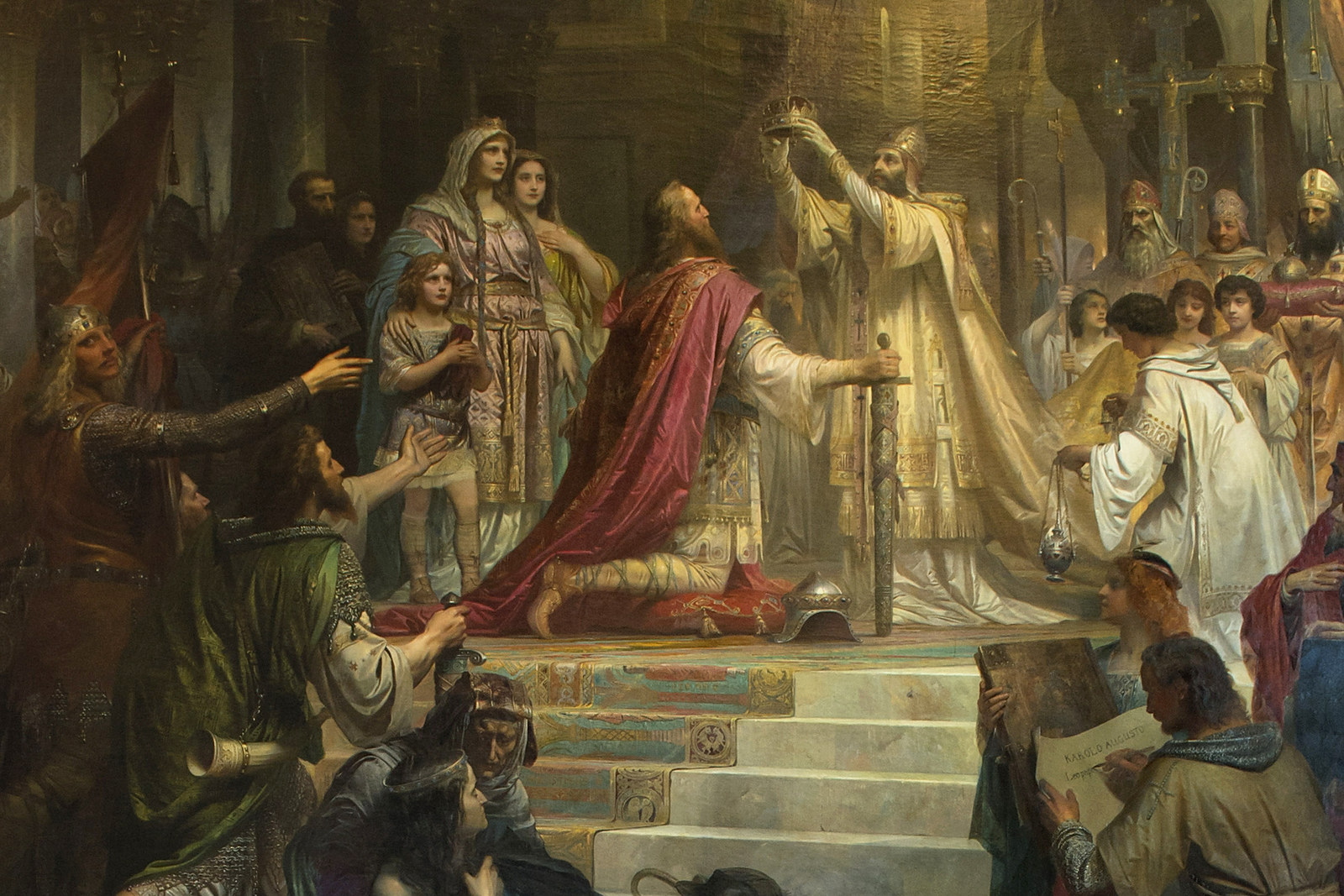
The definitive moment in Charlemagne’s career occurred on Christmas Day, 800 AD, in Old St. Peter's Basilica. Pope Leo III crowned Charlemagne "Emperor of the Romans" (Imperator Romanorum). This event was a geopolitical earthquake with three major consequences:
- Legitimacy: It provided a legal and religious framework for Charlemagne’s rule, framing him as the successor to Constantine and Augustus.
- The Great Schism Precursor: It challenged the authority of the Byzantine Empire in Constantinople, which still viewed itself as the sole legitimate Roman successor. This deepened the divide between the Latin West and the Greek East.
- The Church-State Alliance: It solidified the concept of "Christendom"—a unified European society where political power and religious authority were inextricably linked.
This "translation of empire" (translatio imperii) shifted the center of European gravity from the Mediterranean to the Rhine and the Meuse, centering Western civilization in Northern Europe for the first time.
The Carolingian Renaissance: Intellectual Foundations
Charlemagne recognized that a vast empire could not be held together by the sword alone. He initiated the Carolingian Renaissance, a period of cultural and intellectual revival that sought to restore the learning of antiquity.
The Role of Alcuin of York
Charlemagne recruited the greatest minds of his time to his court in Aachen, most notably the English scholar Alcuin of York. Under Alcuin’s guidance, the Palace School became a center for the "liberal arts"—the trivium (grammar, logic, rhetoric) and the quadrivium (arithmetic, geometry, music, astronomy).
Carolingian Minuscule
One of the most enduring legacies of this era was the development of Carolingian minuscule. Before this, Latin scripts were often localized and difficult to read across different regions. Minuscule introduced a clear, uniform script with lowercase letters and spaces between words. This standardization was essential for administrative communication and the preservation of texts. In fact, most of the classical Latin literature we possess today survived because Carolingian monks painstakingly copied them into this new, legible script.
Educational Reform
Through the Admonitio Generalis (789), Charlemagne mandated that every monastery and cathedral establish a school to teach children—not just the clergy—the basics of reading, writing, and arithmetic. This was the first attempt at a systemic educational policy in post-Roman Europe.
Administrative Innovation: The Mechanics of a Unified State
Charlemagne’s ability to govern such a massive territory was rooted in his administrative genius. He moved away from purely tribal loyalties and toward an organized state structure.
The Missi Dominici
To ensure his decrees were followed in distant provinces, Charlemagne utilized the Missi Dominici (Envoys of the Lord). These were pairs of inspectors—usually one bishop and one count—who traveled the empire to investigate corruption, ensure justice was being served, and confirm that the king's laws (capitularies) were being enforced.
The Feudal Precursor
While full-blown feudalism developed later, Charlemagne laid the groundwork by granting land (benefices) to his vassals in exchange for military service and loyalty. This hierarchical structure provided the stability necessary to manage a continent without a modern professional civil service.
Economic and Monetary Reform
Charlemagne abolished the gold standard, which was increasingly difficult to maintain due to trade disruptions in the Mediterranean. He introduced the Livre Carolingienne (a silver pound), which was divided into 20 solidi (shillings) and 240 denarii (pence). This currency system was so robust that it remained the basis for British currency until decimalization in 1971.
| Feature | Pre-Carolingian Europe | Carolingian Empire (Charlemagne) | Modern Legacy |
|---|---|---|---|
| Political Structure | Fragmented tribal kingdoms | Centralized Imperial Administration | Model for European Integration |
| Primary Script | Merovingian / Local Uncials | Carolingian Minuscule | Basis for modern Roman typefaces |
| Monetary System | Depleted gold coinage | Silver-based denarius (Penny) | Foundations of European banking |
| Legal Basis | Oral tribal customs | Written Capitularies | Standardization of European Law |
| Cultural Identity | Local / Tribal | Unified Christian Europe (Christendom) | Concept of a shared European values |
The Long-Term Legacy: From the Treaty of Verdun to the EU
Charlemagne's empire did not survive intact long after his death. His son, Louis the Pious, struggled to maintain control, and in 843 AD, the Treaty of Verdun divided the empire among Charlemagne’s three grandsons. This division roughly outlined the borders of West Francia (France), East Francia (Germany), and Middle Francia (the disputed "Lotharingia" or Low Countries).
Despite this fragmentation, the idea of a unified Europe persisted. The Holy Roman Empire, which lasted until 1806, claimed direct descent from Charlemagne. In the 20th and 21st centuries, the founders of the European Union—such as Robert Schuman and Konrad Adenauer—frequently invoked Charlemagne as a symbol of transnational cooperation.
Every year, the city of Aachen (Charlemagne’s favorite residence) awards the International Charlemagne Prize to individuals who have done the most to further the cause of European unity. Winners have included Winston Churchill, Pope John Paul II, and Volodymyr Zelenskyy. This award underscores that even in 2026, the Frankish king remains the ultimate symbol of a continent that seeks strength through commonality.
Frequently Asked Questions
Why is Charlemagne specifically called the "Father of Europe"?
The term was coined by a contemporary poet (the "Paderborn Epic") who referred to him as Rex, Pater Europae (King, Father of Europe). This was in recognition of his unique achievement in uniting the Germanic, Roman, and Christian elements of the continent into a single, cohesive political entity.
Did Charlemagne speak French or German?
Charlemagne spoke an early form of Old High German (specifically a Franconian dialect). While he understood Latin and some Greek, the modern French and German languages were only beginning to diverge from their Latin and Germanic roots during his time. He is claimed by both France and Germany as a founding father.
Was the Carolingian Renaissance actually a "Renaissance"?
Yes, in the sense that it was a "rebirth" of classical knowledge. While it did not reach the artistic heights of the 15th-century Italian Renaissance, it was a crucial intellectual stabilization that prevented the complete loss of Greek and Roman philosophy, law, and literature.
How did Charlemagne influence modern law?
He issued capitularies, which were legislative acts divided into chapters. These were the first attempts since the Romans to create a standardized written code of law that applied to multiple ethnicities and regions, moving Europe toward the rule of law rather than the rule of tribal custom.
What is the significance of Aachen in Charlemagne’s empire?
Aachen (Aix-la-Chapelle) was the heart of his empire. He built a magnificent Palatine Chapel there, which still stands. Choosing Aachen—located in the northern borderlands of modern Germany and Belgium—symbolized the shift of European power away from the Mediterranean and into the northern heartlands.
Summary and Next Steps
To truly appreciate Charlemagne’s role as the Father of Europe, one must view him not just as a conqueror, but as a reformer who understood the necessity of shared culture and administration. His synthesis of Roman tradition, Christian faith, and Germanic warrior ethics created the blueprint for Western civilization.
For those interested in exploring his legacy further, a visit to the Aachen Cathedral, a UNESCO World Heritage site, provides a tangible link to the Carolingian era. Scholars may also research the Monumenta Germaniae Historica, which contains the primary source capitularies that detail his legal and social reforms. Understanding Charlemagne is essential for anyone seeking to understand the historical soul of the European continent and its ongoing quest for unity.
Image Gallery