How the Florida Department of Workers’ Compensation Operates
The Florida Division of Workers' Compensation, a component of the Department of Financial Services (DFS), operates as a regulatory agency that monitors the state’s "self-executing" workers' compensation system. It ensures that employer...
The Florida Division of Workers' Compensation, a component of the Department of Financial Services (DFS), operates as a regulatory agency that monitors the state’s "self-executing" workers' compensation system. It ensures that employers maintain required coverage, insurance carriers process claims accurately and timely, and injured workers receive the medical and indemnity benefits mandated by Florida law.
Contents
As of 2026, the Florida workers' compensation landscape continues to be governed primarily by Chapter 440 of the Florida Statutes. While the Division of Workers' Compensation (DWC) does not provide insurance or pay benefits directly to workers—those are the responsibilities of private insurance carriers or self-insured employers—it acts as the administrative backbone of the system. Its mission is to ensure that the legislative intent of a quick, efficient, and non-adversarial delivery of benefits is met through strict oversight and enforcement.
The Administrative Structure of the Florida DWC
To understand how the Florida Department of Workers’ Compensation operates, one must first recognize its placement within the broader state government. The DWC is led by a Division Director who reports to the Florida Chief Financial Officer. The division is divided into several specialized bureaus, each tasked with a specific portion of the regulatory process.
Bureau of Compliance
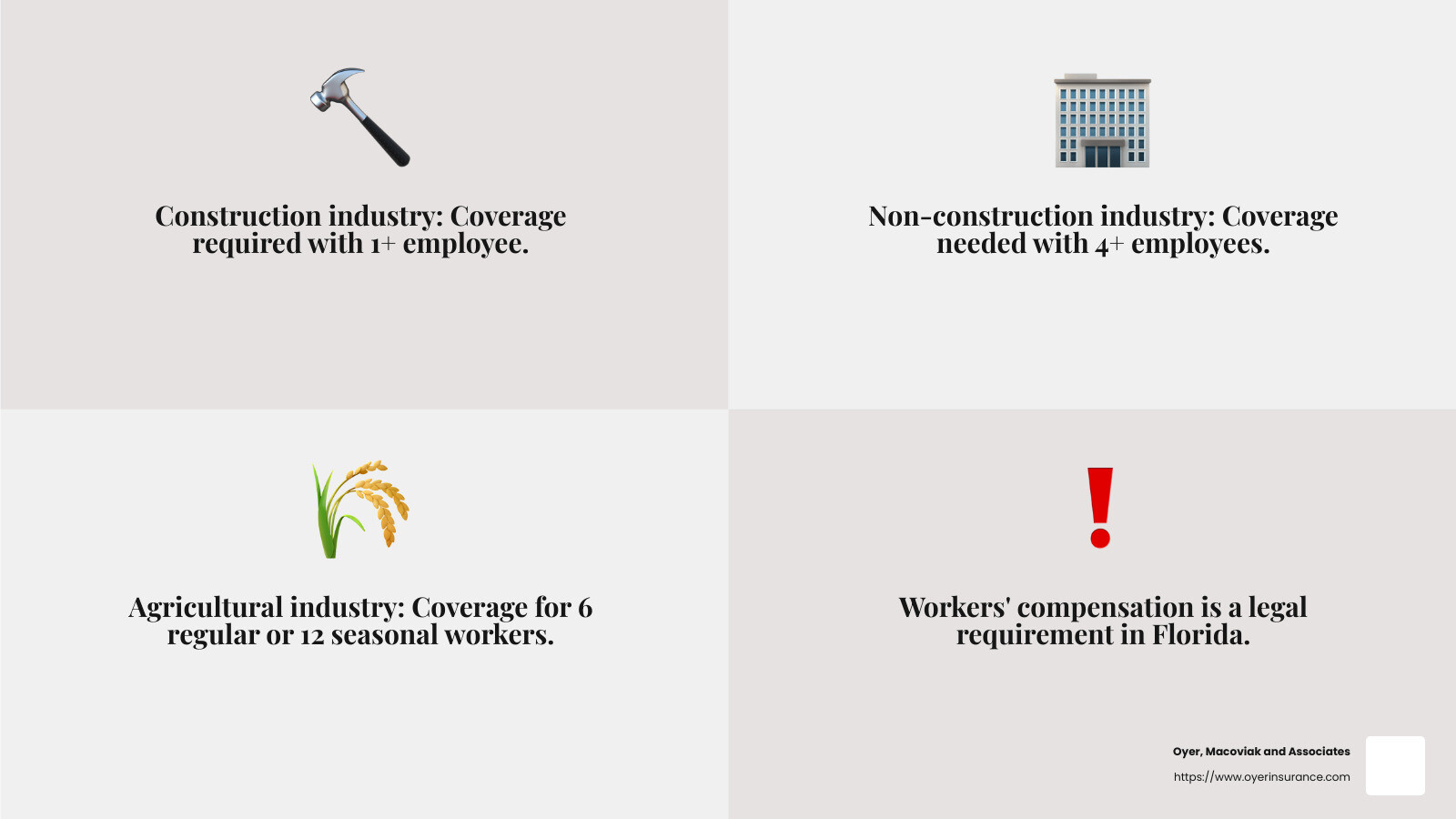
The Bureau of Compliance is essentially the enforcement arm of the DWC. Its primary function is to ensure that all Florida employers who are legally required to carry workers' compensation insurance actually do so. In 2026, the thresholds remain consistent: most non-construction employers with four or more employees (full-time or part-time) must carry coverage, while all construction-related businesses with at least one employee are mandated to have insurance.
When the Bureau identifies an employer without proper coverage, it has the authority to issue a Stop-Work Order (SWO). This order requires the business to cease all operations immediately until they secure insurance and pay a penalty, which is typically calculated as 1.5 to 2 times the amount the employer would have paid in premiums over the preceding three years.
Bureau of Monitoring and Audit
While Compliance focuses on employers, the Bureau of Monitoring and Audit focuses on the insurance carriers and third-party administrators (TPAs). This bureau performs detailed audits to ensure that carriers are paying the correct amount of benefits and doing so within the statutory timeframes. If a carrier consistently fails to file forms on time or underpays benefits, this bureau can levy administrative fines. This oversight is vital for maintaining the "self-executing" nature of the system, where benefits should theoretically flow to the worker without the need for constant litigation.
The Role of the Bureau of Employee Assistance and Ombudsman (BEAO)
One of the most critical resources for an injured worker is the Bureau of Employee Assistance and Ombudsman, often referred to as the BEAO. This bureau serves as a neutral party that provides information and assistance to employees, employers, and medical providers.
The BEAO operates a toll-free helpline designed to resolve disputes before they escalate into formal legal battles. If a worker is not receiving their checks or is having trouble getting a medical appointment authorized, the BEAO can contact the insurance adjuster to facilitate a resolution.
Under Florida Statute 440.191, the BEAO is also responsible for the "Petition for Benefits" (PFB) intake process. If a dispute cannot be resolved informally, the worker must file a PFB. The BEAO reviews these petitions for legal sufficiency before they are forwarded to the Office of the Judges of Compensation Claims (OJCC).
Data Collection and the "Proof of Coverage" Database
A major component of the DWC’s daily operation is the management of the Proof of Coverage (POC) database. Every insurance policy written in the state of Florida must be reported to the DWC. This database is accessible to the public and allows employees to verify that their employer has active coverage.
This data integration allows the DWC to:
- Cross-reference payroll data with insurance records.
- Identify "at-risk" industries with high injury rates.
- Monitor the financial health of the workers' compensation market in Florida.
- Provide statistical reports to the legislature to guide future policy changes.
How the DWC Interacts with the Legal System
It is a common misconception that the Florida Department of Workers’ Compensation employs the judges who hear workers' compensation cases. In reality, the Office of the Judges of Compensation Claims (OJCC) is housed under the Division of Administrative Hearings (DOAH), not the DWC.
However, the DWC and the OJCC are inextricably linked. The DWC manages the administrative rules that govern how medical bills are paid and how disability ratings are calculated, while the OJCC adjudicates disputes when the parties cannot agree on how those rules apply to a specific claim. In 2026, the OJCC maintains an electronic filing system that integrates with DWC data to ensure that case files are accurate and up-to-date.
| Entity | Primary Responsibility | Regulatory Oversight |
|---|---|---|
| Employer | Securing insurance coverage for all required employees. | Monitored by the Bureau of Compliance. |
| Insurance Carrier | Paying medical bills and indemnity (lost wage) benefits. | Audited by the Bureau of Monitoring and Audit. |
| DWC (The Division) | Oversight, enforcement of Chapter 440, and data management. | Reports to the Florida CFO and DFS. |
| BEAO | Dispute resolution and ombudsman services for workers. | Part of the DWC administrative structure. |
| OJCC | Hearing formal legal disputes and issuing binding orders. | Under the Division of Administrative Hearings. |
Financial Operations and Specialized Funds
The DWC also manages the financial machinery that keeps the system solvent. This includes the Workers' Compensation Administration Trust Fund (WCATF). The WCATF is funded by assessments on insurance premiums paid by employers. These funds pay for the operation of the DWC and the OJCC, ensuring that the burden of administration does not fall on general taxpayers.
Furthermore, the Division oversees the Special Disability Trust Fund (SDTF). While the SDTF is no longer accepting new claims for reimbursement for injuries occurring after 2003, the DWC still manages the runoff of older claims where an employer/carrier is entitled to reimbursement for hiring a worker with a pre-existing permanent physical impairment.
Medical Services and Policy Oversight
The DWC's Bureau of Medical Services is responsible for establishing the reimbursement schedules for doctors, hospitals, and pharmacies that treat injured workers. These schedules, often referred to as "Maximum Reimbursement Allowances" (MRAs), prevent overcharging and help control the overall cost of the system.
They also oversee the "Expert Medical Advisor" (EMA) program. In cases where two different doctors have conflicting opinions on a worker's medical condition or treatment plan, a Judge of Compensation Claims may appoint an EMA. The DWC maintains the list of certified EMAs and ensures they meet the high standards of expertise required by Florida law.
Common Operational Limitations and Procedural Safeguards
Despite its broad powers, the Florida DWC operates under several strict limitations:
- No Direct Payments: The Division cannot order a carrier to pay a specific claim without an order from a Judge of Compensation Claims.
- Neutrality: The BEAO provides information but cannot provide legal advice or act as a worker's attorney.
- Statutory Bounds: The DWC cannot change the law; it can only implement the rules as passed by the Florida Legislature in Chapter 440.
To protect the rights of all parties, the DWC maintains a transparent rulemaking process. When changes are proposed to medical reimbursement schedules or administrative forms, the Division holds public hearings where stakeholders—including labor groups, business associations, and insurance carriers—can provide input.
Frequently Asked Questions
Does the Florida DWC pay me if my employer doesn't have insurance?
No. If an employer is uninsured, the DWC does not have a "uninsured employers fund" to pay benefits. Instead, the Division will penalize the employer through the Bureau of Compliance. In such cases, the injured worker often gains the right to sue the employer in civil court, where the employer is stripped of certain legal defenses, or the worker can pursue the employer directly for workers' compensation benefits.
How do I report an employer who doesn't have workers' comp insurance?
You can report non-compliance through the DWC’s Bureau of Compliance. Reports can be made anonymously via their online portal or toll-free tip line. The Division will then investigate and, if necessary, send an investigator to the worksite to conduct an on-site inspection of records and personnel.
Can the DWC help me get my surgery authorized?
The BEAO can contact your insurance carrier to inquire about the status of a medical authorization and remind them of their statutory obligations. However, the DWC cannot legally compel the carrier to authorize a surgery. If the carrier refuses, you must file a Petition for Benefits to have a Judge of Compensation Claims rule on the necessity of the procedure.
What is the 2026 maximum weekly compensation rate in Florida?
The maximum weekly compensation rate is adjusted annually based on the Florida unemployment compensation law's average weekly wage. For 2026, the DWC calculates this rate based on data from the Florida Department of Commerce. This cap applies to all disability benefits (Temporary Total, Temporary Partial, and Permanent Total Disability).
How long does the DWC keep records of a workplace injury?
The Division maintains an Electronic Data Interchange (EDI) system that archives claim information for decades. While the specific "open" status of a claim may expire due to the Statute of Limitations (generally two years from the date of injury or one year from the last payment/medical treatment), the record of the filing remains part of the DWC's historical database.
Practical Recommendations for Navigating the System
If you are an injured worker or an employer in 2026, the most effective way to interact with the Florida Department of Workers’ Compensation is through their digital resources. Employers should use the Coverage Verification Search to ensure their sub-contractors are properly insured, as Florida law can hold a general contractor liable for the injuries of a sub-contractor’s employees.
For workers, if you encounter any delay in benefits, your first step should be to contact the Bureau of Employee Assistance and Ombudsman at 1-800-342-1741. Documenting your interactions with this bureau can be helpful if your case eventually moves to a formal hearing. Always keep copies of the "First Report of Injury" (Form DWC-1) and any "Notice of Action / Change" (Form DWC-12) you receive, as these are the primary documents the DWC uses to track your claim's progress.
Image Gallery