Understanding How Indexed Universal Life Insurance Interest Rates Work
Indexed Universal Life (IUL) insurance interest rates are not direct investment returns but rather performance credits determined by the movement of external market indices, such as the S&P 500, subject to specific contractual caps, fl...
Indexed Universal Life (IUL) insurance interest rates are not direct investment returns but rather performance credits determined by the movement of external market indices, such as the S&P 500, subject to specific contractual caps, floors, and participation rates. These rates define how much interest is credited to the policy’s cash value account each term, directly impacting the policy’s ability to cover costs of insurance and accumulate long-term tax-deferred cash value.
Contents
The Mechanics of Crediting Interest
To understand how interest is credited to an IUL policy, you must first distinguish between the policy's cash value account and a traditional brokerage investment. When you pay premiums into an IUL, the insurer deducts administrative costs and insurance charges. The remaining balance is credited with interest based on the performance of a chosen index or a fixed-interest bucket.
Unlike a stock portfolio, you do not own the underlying shares of the companies in the index. Instead, the insurance company uses the performance of that index to calculate a "crediting rate." This rate is constrained by three primary levers: the participation rate, the cap, and the floor. These mechanisms serve to mitigate the extreme volatility of the stock market, protecting the policyholder from major losses while limiting the upside potential during bull markets.
Defining Key Crediting Levers
The complexity of IUL performance lies in the interaction between the following three contractual features:
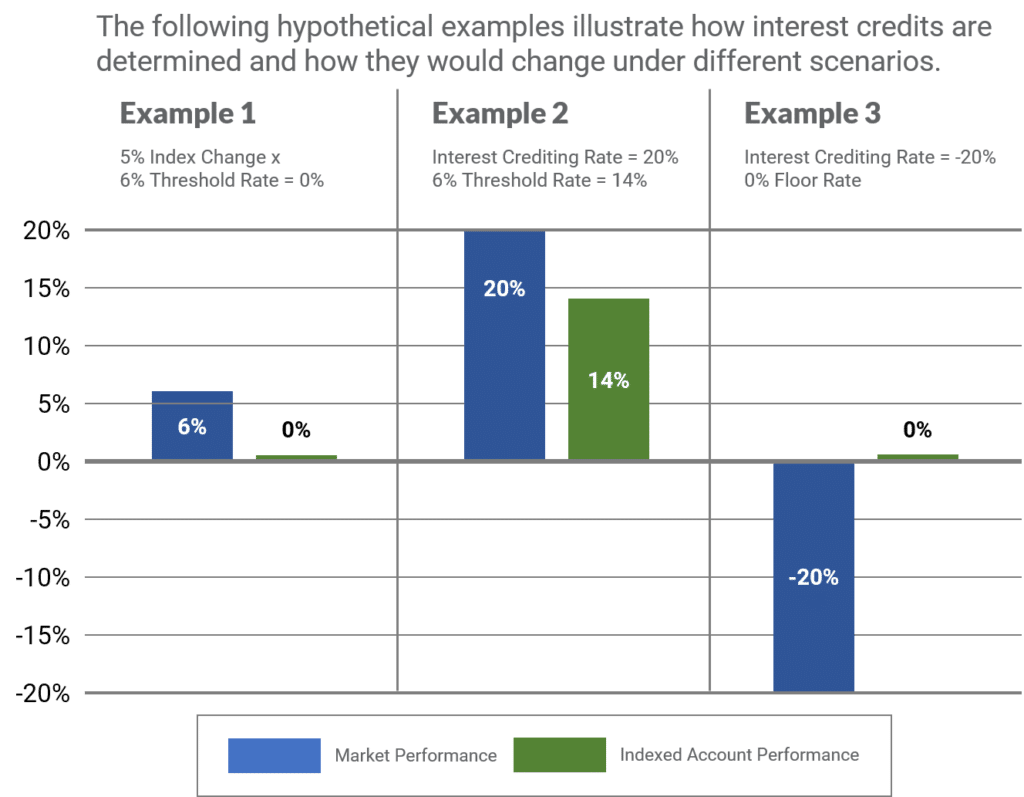
- Participation Rate: This represents the percentage of the index's growth that the insurance company will attribute to your account. If an index rises by 10% and your participation rate is 80%, your crediting rate is calculated based on an 8% gain before applying caps.
- Cap Rate: The maximum interest rate the insurer will credit to your account during a single index segment, regardless of how much higher the index actually climbed. For example, if your cap is 9% and the market rises by 15%, you receive only 9%.
- Floor Rate: The minimum interest rate the insurer will credit, protecting you from negative market performance. In most modern IUL products, the floor is typically set at 0%. If the market drops by 10%, the policyholder’s cash value remains unchanged for that period, excluding policy costs.
Comparison of Crediting Strategies
Policyholders often have the flexibility to allocate their cash value among different "segments" or "buckets." Understanding the risk-reward profile of these options is essential for policy management.
| Strategy | Upside Potential | Downside Protection | Predictability |
|---|---|---|---|
| Fixed Account | Low (Set by Insurer) | Guaranteed | High |
| Capped Index | Moderate | 0% Floor | Moderate |
| High-Participation | Moderate/High | 0% Floor | Variable |
| Uncapped/Multiplier | Highest | 0% Floor | Low |
The Impact of Policy Costs
It is a common misconception that the interest credited to the policy is the "net" gain. In reality, IUL policies are subject to ongoing costs of insurance (COI), which increase as the policyholder ages. If the index performs poorly for an extended period, the interest credited may be insufficient to cover these rising costs. When this happens, the policyholder must either pay additional out-of-pocket premiums to keep the policy in force or face a reduction in the death benefit and potential policy lapse. This makes the "floor" a vital feature, as it ensures that at least the cash value is not eroded by market crashes, though it does not offset the internal fees required to maintain the coverage.
Why "Interest Rates" Are Not Guaranteed Returns
Insurance carriers calculate the "current" interest rate annually, but they reserve the right to change participation rates and caps based on their own internal investment performance and market conditions. This is known as "non-guaranteed" behavior. While the 0% floor is a contractual guarantee, the cap and participation rates are often subject to periodic adjustment (typically annually or upon the start of a new segment). Consequently, a policy that performed well in its first five years may face different constraints in its tenth year if the insurance company decides to lower its caps due to a low-interest-rate environment.
Managing Expectations and Policy Longevity
For those holding IUL policies, regular reviews are necessary. Because interest rates are volatile and subject to insurer discretion, policyholders should treat their IUL as a long-term risk-management tool rather than a short-term yield generator. You should request an "in-force illustration" from your insurance agent. This document provides a projection of how the policy will perform based on current crediting rates versus more conservative estimates. If you rely on optimistic interest rate assumptions, you risk having the policy underperform, which may necessitate an increase in premium payments later in life.
Frequently Asked Questions
Does the 0% floor mean my cash value never decreases? While the index-linked interest credited to the account cannot be negative, the policy’s cash value can still decrease. This occurs because the insurance company deducts cost-of-insurance charges and administrative fees from the cash value balance every month, regardless of whether the index credited any interest.
Can I switch between index strategies? Yes, most IUL policies allow you to reallocate your cash value among different index segments or the fixed-interest account at the start of a new index period (usually on the policy anniversary). This allows you to adjust your risk tolerance as you get closer to retirement.
Are there taxes on the interest credited to my IUL? The interest credited to an IUL policy is tax-deferred. As long as the policy remains in force and does not become a Modified Endowment Contract (MEC), you do not pay income tax on the interest credited. You can access the cash value through policy loans or withdrawals, which are generally income-tax-free, provided the policy is not surrendered.
How often do insurance companies change the caps? Insurance carriers have the contractual right to change cap rates and participation rates annually. While some carriers maintain stable rates for long periods, market volatility or shifts in the economic climate often lead to downward adjustments to these caps to ensure the long-term solvency of the insurance product.
What happens if the index performs at 0% for several years? If the index performs at or below 0%, your policy receives no index interest. Your cash value will only decrease by the amount of the internal costs and insurance premiums. If these costs are not offset by your premium payments, the cash value will be depleted, and the policy may lapse unless additional premiums are paid.
Practical Next Steps
If you currently hold an IUL policy, contact your insurance agent or the company's customer service department to request an updated in-force illustration. Ensure this illustration shows both the "current" interest rate assumptions and a more conservative "guaranteed" scenario. Review the "cumulative premium" and "surrender value" columns to understand the relationship between the interest credited and the actual growth of your account. If the projections show the policy may lapse before your planned age of coverage, consider increasing your premium payments or reallocating your segments to a more stable index option to lock in modest, consistent gains.
Image Gallery