The US Navy SEAL Helicopter in Operations: Capabilities, Aircraft, and Tactical Deployment
The US Navy SEAL helicopter in operations represents the absolute pinnacle of naval aviation and special operations integration, utilizing heavily modified rotary-wing aircraft like the MH-60S and MH-60M Black Hawk variants to execute...
The US Navy SEAL helicopter in operations represents the absolute pinnacle of naval aviation and special operations integration, utilizing heavily modified rotary-wing aircraft like the MH-60S and MH-60M Black Hawk variants to execute high-stakes infiltration, exfiltration, fire support, and maritime interdiction missions across the globe.
Contents
Evolution of Rotary-Wing Aviation in Naval Special Warfare
The relationship between United States Navy SEALs and rotary-wing aviation dates back to the Vietnam War, where units like the Helicopter Attack Light Squadron 3 (HAL-3), known as the "Seawolves," provided vital close air support and insert/extract capabilities for early naval commandos. Over subsequent decades, the nature of maritime and littoral warfare evolved, demanding increasingly specialized aviation assets capable of operating seamlessly with Naval Special Warfare (NSW) groups.
Before the establishment of dedicated joint aviation task forces, SEAL teams relied on conventional fleet helicopter squadrons or Air Force special operations assets. However, the unique requirements of maritime insertion—such as fast-roping onto storm-tossed ship decks, conducting over-the-horizon navigation in zero-illumination environments, and sustaining operations from amphibious assault ships—necessitated the creation of dedicated aviation units. Today, specialized Army, Navy, and joint aviation components work in lockstep with SEAL operators, ensuring that every squadron possesses the exact technological adaptations and tactical proficiency required for clandestine missions.
Primary Aircraft Platforms Utilized in SEAL Operations
Naval Special Warfare operators do not rely on a single helicopter model; rather, they deploy a fleet of specialized aircraft tailored to specific mission profiles, ranging from light assault and direct action penetration to heavy logistical support and tactical resupply.
| Aircraft Designation | Primary Operator / Branch | Core Special Operations Role |
|---|---|---|
| MH-60S Knighthawk | US Navy (HSC Squadrons) | Maritime combat search and rescue, armed reconnaissance, and naval insertion. |
| MH-60M Direct Action Penetrator (DAP) | US Army (160th SOAR) | Heavy direct-action assault, precision fire support, and high-threat transport. |
| MH-6M "Little Bird" | US Army (160th SOAR) | Ultra-light urban insertion, close-in fire support, and narrow-space landings. |
| CH-47G Chinook | US Army (160th SOAR) | Long-range heavy transport, vehicle deployment, and massive troop movement. |
The MH-60S Knighthawk and Naval Integration
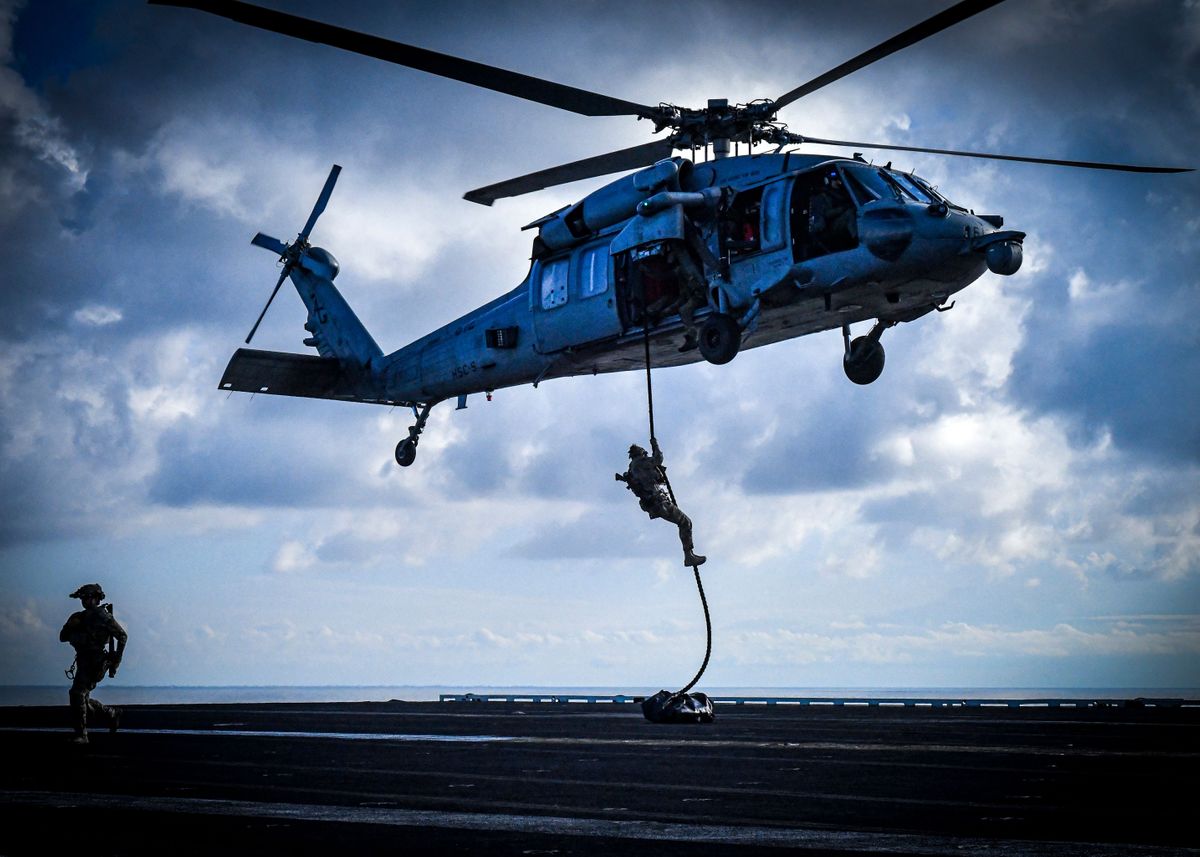
The MH-60S Knighthawk, operated by the United States Navy’s Helicopter Sea Combat (HSC) squadrons, serves as a primary rotary-wing workhorse for maritime operations. Merging the utility features of the UH-60 Black Hawk airframe with the navalized dynamic components of the SH-60 Seahawk, the Knighthawk is engineered for salt-water corrosion resistance and shipboard compatibility. Equipped with folding rotor blades and tail sections, it fits neatly into the compact hangars of guided-missile destroyers, cruisers, and amphibious transport docks.
In standard operational configurations, the MH-60S can be armed with M130 general-purpose machine guns, GAU-17/A miniguns, and Hellfire missiles. This armament allows the aircraft to transition smoothly from an unarmed transport vehicle into a devastating gunship capable of suppressing hostile shorelines or neutralizing fast-attack craft during Visit, Board, Search, and Seizure (VBSS) operations.
The 160th Special Operations Aviation Regiment (Airborne)
While Navy HSC squadrons handle organic maritime support, joint special operations frequently pair SEAL teams with the elite aviators of the US Army’s 160th Special Operations Aviation Regiment (SOAR), famously known as the "Night Stalkers." Operating heavily modified platforms such as the MH-60M Black Hawk, the MH-6M Little Bird, and the CH-47G Chinook, the 160th SOAR brings unmatched night-vision navigation, defensive electronic countermeasures, and precision gunship fire to any SEAL deployment.
The MH-6M Little Bird, in particular, remains a staple for ultra-tight insertion profiles. Its compact footprint allows pilots to land on confined rooftops, narrow ship decks, or rugged mountain ledges where standard utility helicopters cannot physically fit, directly depositing small reconnaissance or direct-action SEAL squads into contested zones.
Core Tactical Missions and Operational Profiles
The deployment of a US Navy SEAL helicopter in operations spans a wide spectrum of tactical environments, each demanding rigorous planning, precise execution, and advanced piloting skills.
Maritime Interdiction and VBSS Operations
Interdicting rogue vessels, embargoed cargo ships, or pirate-controlled watercraft requires absolute synchronization between the boarding team and the helicopter crew. An MH-60 variant typically acts as an overwatch platform, hovering above the target vessel to provide real-time thermal intelligence and suppressive sniper or minigun fire if the crew encounters hostile resistance.
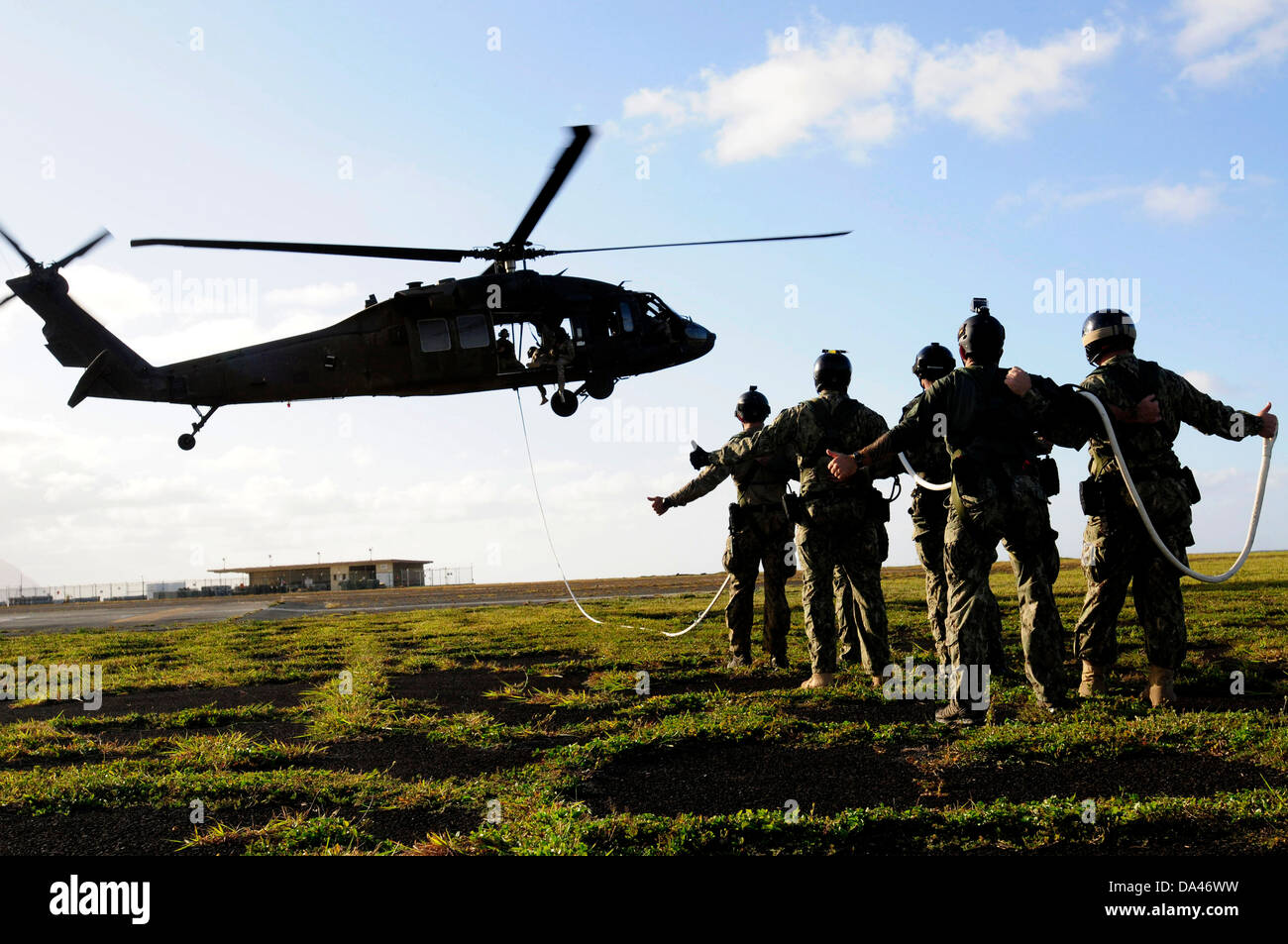
Simultaneously, the helicopter inserts SEAL operators via fast-rope techniques directly onto the weather deck or flight deck of the moving ship. The pilot must maintain a steady hover relative to the vessel's roll, pitch, and yaw—often in high sea states and gale-force winds—relying on advanced stabilization systems and clear verbal communication from the crew chief.
Over-the-Horizon Infiltration and Exfiltration
SEAL teams frequently operate deep behind hostile coastlines or across vast ocean expanses where surface vessels are too slow or too vulnerable to detection. Long-range helicopter insertions utilize mid-air refueling capabilities, advanced terrain-following radar, and low-level flight profiles to bypass enemy early-warning radar networks.
During these missions, aviators wear sophisticated night-vision goggles (NVGs) or fusion-based panoramic night vision goggles (PNVGs), flying unlit aircraft at tree-top level or just feet above white-capping ocean swells. Upon reaching the objective area, the helicopter executes a tactical landing or water insertion (such as casting Zodiac combat rubber raiding craft into the surf), dropping the operators before swiftly exfiltrating to a pre-designated staging area or offshore mother ship.
Direct Action and Hostage Rescue
In high-risk hostage rescue or direct-action raids against high-value targets, helicopters deliver the assault force directly onto the objective. The speed of the helicopter minimizes the enemy's reaction time, turning acoustic surprise into a decisive tactical advantage.
Armed variants lay down heavy suppressing fire around the perimeter of the target compound to pin down opposing forces while SEAL operators disembark via fast-rope or ramp operations. Once the objective is secured, the extraction phase begins immediately, with the aircraft returning to load the team and any detained individuals or recovered intelligence under the cover of airborne fire support.
Advanced Technological Systems and Survivability Gear
To survive in modern contested airspace bristling with radar-guided and heat-seeking surface-to-air missiles, US Navy SEAL helicopters and their supporting aviation assets are equipped with a suite of advanced defensive and navigational technologies.
- Integrated Threat Warning Systems: Modern special operations helicopters feature radar warning receivers, missile approach warning systems, and laser warning sensors that automatically detect incoming threats.
- Countermeasure Dispensing Systems: Advanced flare and chaff dispensers confuse incoming infrared-guided (heat-seeking) and radar-guided projectiles, protecting the aircraft during egress from hostile zones.
- Terrain-Following and Avoidance Radar: Allows pilots to navigate through mountainous terrain or blinding sandstorms and snow squalls at extremely low altitudes without relying on external lights or visual references.
- Secure Satellite Communications: Encrypted data links enable real-time video streaming, secure voice transmission, and tactical chat between the helicopter crew, the ground force commander, and airborne command-and-control assets.
Operational Limitations and Risk Mitigation
Despite their immense tactical utility, operating helicopters in support of naval special operations involves severe inherent risks and operational boundaries that planners must carefully navigate.
Environmental Vulnerabilities
Rotary-wing aircraft are highly susceptible to degraded visual environments (DVE), such as brownouts caused by blowing sand in desert environments or whiteouts caused by rotor wash over snow-covered terrain. Salt spray corrosion in maritime environments also places immense strain on engine components, requiring rigorous maintenance schedules and fresh-water wash-downs immediately following coastal or shipboard missions.
Acoustic and Visual Signatures
Unlike surface watercraft operating under the cover of night, helicopters generate a distinct acoustic signature that can alert adversaries miles before visual contact is established. To mitigate this risk, aviators practice specialized flight profiles, utilizing terrain masking (flying behind ridges, hills, or urban structures) to deaden the sound profile and delay enemy detection until the moment of insertion.
Frequently Asked Questions
What specific helicopters do Navy SEALs use in combat?
SEALs do not own organic rotary-wing aircraft; instead, they rely on specialized aviation units. These include the US Navy’s MH-60S Knighthawk squadrons for maritime and amphibious tasks, and the US Army’s 160th Special Operations Aviation Regiment (Night Stalkers), which flies platforms like the MH-60M Black Hawk, MH-6M Little Bird, and CH-47G Chinook.
How do helicopters insert SEALs onto moving ships at sea?
Aviators utilize specialized fast-roping techniques, hovering steadily above the deck of a moving vessel while operators slide down heavy-duty ropes. Pilots must compensate for wind gusts, ocean swells, and the vessel's movement to maintain a stable hovering platform throughout the insertion.
Are Navy SEAL helicopters armed for offensive combat?
Yes. Special operations helicopters are heavily armed depending on the mission profile. They frequently carry weapon systems such as M130 general-purpose machine guns, GAU-17/A miniguns, M240 machine guns, and AGM-114 Hellfire missiles to provide suppressive fire and close air support.
What is the biggest challenge when flying helicopter missions for SEAL operations?
The primary challenges involve operating in degraded visual environments (such as over-water night flights with zero horizon or brownout conditions) and avoiding sophisticated modern air defense systems while maintaining strict acoustic and electronic silence.
Can standard Navy fleet helicopters support SEAL missions?
While standard fleet helicopters can perform basic utility tasks, high-threat or clandestine special operations require aircraft equipped with specialized navigation suites, defensive countermeasures, air-refueling probes, and pilots trained extensively in night-vision tactical flying.
Conclusion and Strategic Outlook
The employment of rotary-wing aviation remains a cornerstone of successful Naval Special Warfare strategy. By blending the precision engineering of platforms like the MH-60S and the unmatched tactical expertise of joint aviation units, US Navy SEALs maintain the global reach and rapid-response capability necessary to counter emerging maritime threats. Continued investments in advanced avionics, electronic countermeasures, and autonomous flight systems will further enhance the survivability and lethality of these vital airborne assets in future operational landscapes.
Image Gallery